

Artificial intelligence is no longer only a technical experiment or a future-facing idea. For many organizations, it has become a practical way to improve decision-making, automate repetitive work, personalize customer experiences, and create more scalable operating models. This guide explains how to approach AI in business with a growth mindset, so leaders can move from curiosity to focused, measurable action.
Used well, AI supports digital transformation by helping teams work faster, see patterns sooner, and serve customers with greater relevance. Used poorly, it becomes another expensive tool with unclear ownership and weak adoption. The difference is strategy.
What does AI mean for business growth?
AI for business growth means using artificial intelligence in business to increase efficiency, revenue potential, customer value, or strategic agility. It is not simply about adding software; it is about identifying where intelligence, automation, prediction, or personalization can improve how the business operates and competes.
In practical terms, AI can support growth in three major ways. First, it can reduce friction inside the company by automating manual processes and improving workflows. Second, it can help teams make better decisions by analyzing data faster than people can do manually. Third, it can create better customer experiences through personalization, faster support, smarter recommendations, and more responsive service.
The most successful use of AI in business usually begins with a specific business problem, not with the technology itself. A company might want to shorten sales cycles, reduce service backlogs, improve demand forecasting, speed up reporting, or identify higher-value customer segments. Once the problem is clear, leaders can evaluate which ai applications are appropriate and whether the organization has the data, systems, people, and processes needed to support them.
The role of AI in digital transformation
Digital transformation is the broader shift from disconnected, manual, or legacy ways of working toward more connected, data-driven, and adaptable business models. AI accelerates that shift because it can turn data into recommendations, automate decisions within defined rules, and improve processes continuously as more information becomes available.
However, AI should not be treated as a shortcut around foundational transformation work. If a company has fragmented data, unclear processes, or inconsistent ownership, AI solutions may amplify confusion rather than solve it. Before investing heavily, businesses should understand where data lives, how work moves across teams, and which outcomes matter most.
AI can strengthen digital transformation by helping companies:
- Modernize operations: Business automation can reduce manual handoffs, duplicate data entry, and repetitive administrative tasks.
- Improve visibility: AI-powered analytics can help leaders detect trends, risks, and opportunities earlier.
- Personalize experiences: Customer interactions can become more relevant when systems use behavioral, transactional, or preference data responsibly.
- Support faster decision-making: Teams can move from static reports to dynamic insights and scenario planning.
- Scale knowledge: AI tools can help employees find information, summarize documents, draft content, and follow standardized workflows.
The key is to connect AI initiatives to the larger operating model. A chatbot, forecasting tool, or recommendation engine may be valuable, but only if it improves the way the company creates, delivers, or captures value.
Core AI applications that support growth
AI applications vary widely, but most business use cases fall into a few practical categories. Understanding these categories helps leaders choose tools based on business impact rather than hype.
Process automation and workflow support
Business automation is one of the most accessible starting points for many organizations. AI can help classify requests, extract information from documents, route tasks, draft responses, flag exceptions, and reduce the time employees spend on repetitive work.
For example, an operations team might use AI to review incoming forms and send them to the right department. A finance team might use AI-assisted tools to categorize expenses or identify unusual transactions for review. A human resources team might use AI to summarize policy questions or support onboarding workflows.
The goal is not to remove human judgment from every process. In many cases, the strongest model is human-in-the-loop automation, where AI handles repetitive or low-risk work and people review exceptions, sensitive decisions, or complex cases.
Predictive analytics and forecasting
Predictive AI helps businesses estimate what may happen next based on historical patterns, current signals, and relevant variables. This can support sales forecasting, inventory planning, churn prediction, staffing models, risk scoring, and demand planning.
The business value comes from acting earlier. If a company can identify customers at risk of leaving, it can intervene before revenue is lost. If a retailer can anticipate demand more accurately, it can make better inventory decisions. If a sales team can prioritize high-intent leads, it can spend more time on the opportunities most likely to convert.
Prediction is never perfect, so leaders should treat AI forecasts as decision support rather than guaranteed answers. The best systems show assumptions, confidence levels, and relevant context so teams understand how to use the output responsibly.
Customer experience personalization
AI can help companies tailor customer journeys based on behavior, preferences, purchase history, support interactions, or stage in the buying process. This can include product recommendations, personalized email timing, dynamic website content, targeted offers, and smarter support routing.
Personalization works best when it feels useful rather than intrusive. Customers should receive clearer choices, faster answers, and more relevant information, not confusing messages that suggest the business is overusing personal data. Responsible data practices and clear consent policies are essential.
Generative AI for content and knowledge work
Generative AI can draft, summarize, translate, brainstorm, classify, and reformat information. For many teams, this creates immediate productivity gains in marketing, sales enablement, customer support, product documentation, internal communications, and research.
The most reliable use cases involve clear prompts, approved source material, review processes, and brand or compliance guidelines. Generative AI can help employees move faster, but it should not publish sensitive, legal, financial, or technical content without appropriate human review.
Decision intelligence and management support
Some AI solutions help leaders compare options, model scenarios, and understand trade-offs. This can be useful in pricing, resource planning, supply chain decisions, market expansion, and budget allocation.
Decision intelligence is especially valuable when many variables interact. Instead of relying only on historical reports, teams can explore possible outcomes and adjust plans with more confidence. The value is not that AI replaces leadership judgment, but that it gives leaders a more informed view of the landscape.
How should a company choose the right AI strategy?
A company should choose its AI strategy by starting with business goals, then identifying the use cases where AI can create measurable value, reduce friction, or improve decisions. The right strategy balances ambition with readiness, so the organization can build momentum without taking on unnecessary complexity.
A useful AI strategy answers five questions:
- What business outcome are we trying to improve? Define the target clearly, such as faster response times, lower processing costs, better lead conversion, improved forecasting, or stronger customer retention.
- Where is the current bottleneck? Look for repetitive work, data overload, slow handoffs, inconsistent decisions, or missed customer signals.
- What data do we have, and can we use it responsibly? AI depends on accessible, relevant, and trustworthy data. If the data is incomplete or poorly governed, the first step may be cleanup rather than tool selection.
- Who will own the process? AI needs business owners, technical support, compliance input, and frontline feedback. Without ownership, adoption often stalls.
- How will we measure value? Measurement should connect to business results, not only tool usage. Track outcomes such as time saved, error reduction, revenue influence, customer satisfaction, or cycle-time improvement where appropriate.
This approach keeps artificial intelligence in business grounded in practical value. It also helps avoid scattered experimentation, where different teams adopt tools independently without shared standards or integration plans.
A practical roadmap for adopting AI
AI adoption becomes more manageable when companies move in phases. A phased roadmap lets teams learn, reduce risk, and build confidence before expanding to larger initiatives.
1. Identify high-value use cases
Begin by mapping areas where work is repetitive, data-heavy, slow, or inconsistent. Good early use cases often have visible pain, available data, clear ownership, and a realistic path to measurement.
Examples include customer support triage, internal knowledge search, sales lead prioritization, document review, content drafting, demand forecasting, or operational reporting. Avoid choosing a use case only because it sounds innovative. Choose it because solving it would matter.
2. Assess data and system readiness
Before selecting AI solutions, review the systems, data sources, integrations, and governance practices involved. AI tools often need access to accurate information, and that information may be spread across customer relationship management platforms, enterprise systems, spreadsheets, support tools, or document repositories.
This step may reveal gaps. Data may be inconsistent, duplicated, outdated, or restricted. Addressing those issues early improves the quality of AI output and reduces frustration later.
3. Start with a controlled pilot
A pilot should be narrow enough to manage but meaningful enough to teach the organization something useful. Define the audience, workflow, success metrics, review process, and timeline before launch.
A strong pilot includes human oversight. Employees should know when to trust AI output, when to question it, and how to report problems. The pilot should also test whether the tool fits real working conditions, not only whether it performs well in a demonstration.
4. Train teams and redesign workflows
AI adoption is not just a software rollout. People need to understand how the tool changes their work, what judgment is still required, and how success will be measured.
Training should be role-specific. A sales team may need guidance on using AI insights in outreach. A support team may need escalation rules. A marketing team may need standards for reviewing AI-assisted content. Workflow redesign ensures AI becomes part of daily operations rather than an optional add-on.
5. Measure, refine, and scale
After the pilot, compare results against the original goals. Look at both quantitative and qualitative feedback. Did the process become faster? Did quality improve? Did employees use the tool consistently? Did customers notice a better experience?
If the results are promising, refine the workflow before scaling. If the results are weak, determine whether the issue was the use case, the data, the tool, the training, or the measurement plan. Scaling too quickly can turn small problems into expensive ones.
Risks and responsibilities leaders should manage
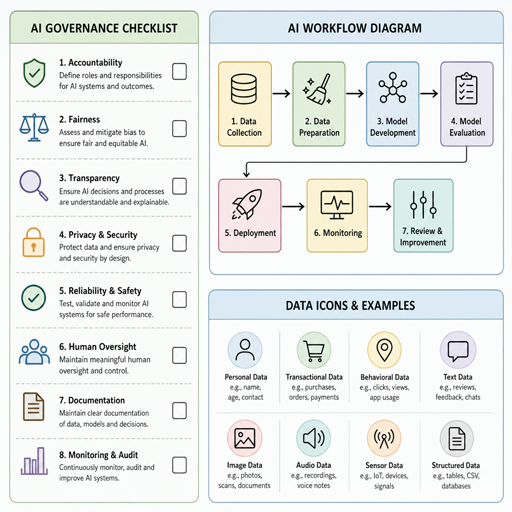
AI can create meaningful advantages, but it also introduces risks that leaders should address from the start. Responsible AI practices help protect customers, employees, brand trust, and business performance.
Key considerations include:
- Data privacy: Teams should understand what data AI tools can access, where that data is stored, and whether its use aligns with company policies and customer expectations.
- Security: AI systems should be evaluated for access controls, vendor risk, sensitive information handling, and integration safety.
- Accuracy: AI can produce incomplete, outdated, or incorrect outputs. Review processes are especially important for customer-facing, regulated, or high-stakes decisions.
- Bias and fairness: Models can reflect patterns in the data used to train or operate them. Businesses should monitor outcomes and avoid unfair treatment of individuals or groups.
- Transparency: Employees and customers should understand when AI is being used in meaningful interactions, especially where decisions or recommendations affect them.
- Change management: AI can create anxiety if teams believe it is being introduced without context. Clear communication helps employees see how the technology supports better work.
Responsible adoption does not mean avoiding AI. It means creating guardrails so the business can innovate with confidence.
Building the business case for AI solutions
A business case turns AI interest into a decision leaders can evaluate. It should explain the problem, the proposed solution, the expected benefit, the required investment, and the risks of doing nothing.
The strongest business cases are specific. Instead of saying, “We need AI to improve productivity,” describe the workflow, the teams involved, the current burden, and the desired improvement. If precise numbers are not available, use ranges, pilot findings, or qualitative evidence without overstating certainty.
A practical business case may include:
- The process or customer journey being improved
- The current pain point and who experiences it
- The AI capability being considered
- The data and systems required
- The people responsible for implementation and governance
- The success metrics for the pilot and later scale-up
- The risks, limitations, and review points
This structure helps executives compare AI initiatives against other priorities. It also gives implementation teams a clearer mandate.
Signs your organization is ready to expand AI
Not every company should scale AI at the same pace. Readiness depends on more than budget or executive enthusiasm. It depends on whether the organization can use AI consistently, responsibly, and productively.
Signs of readiness include clear business priorities, usable data, leadership alignment, engaged process owners, basic governance practices, and a willingness to redesign workflows. Teams should also have a realistic understanding of AI’s limits. If people expect flawless automation immediately, disappointment is likely.
A company may be ready to expand when early pilots show meaningful value, employees are using the tools properly, and the organization has learned how to manage risk. Expansion can then move from one workflow to adjacent processes, from one department to cross-functional use cases, or from internal productivity to customer-facing experiences.
Best practices for long-term AI growth
Long-term success with ai in business depends on discipline as much as experimentation. Companies that treat AI as an ongoing capability tend to build stronger results than those that treat it as a one-time project.
Use these best practices to keep momentum productive:
- Tie every initiative to a business outcome. AI should serve growth, efficiency, quality, or customer value.
- Prioritize adoption, not novelty. A simple tool used well can outperform an advanced tool that employees ignore.
- Keep humans accountable. AI can recommend, draft, classify, and predict, but people should own important decisions.
- Document standards. Create guidance for data use, review requirements, prompt practices, vendor selection, and escalation.
- Invest in employee capability. Training helps teams move from fear or experimentation to confident, responsible use.
- Review performance regularly. Models, workflows, customer needs, and business priorities change over time.
- Encourage cross-functional collaboration. AI initiatives often touch technology, operations, legal, marketing, sales, finance, and customer experience.
These practices help a business in artificial intelligence mature beyond scattered tools. Over time, AI becomes part of how the company learns, adapts, and competes.
Turning AI from initiative into advantage
AI creates the most value when it is connected to real strategy, supported by clean data, adopted by teams, and governed with care. The opportunity is not simply to automate tasks, but to build a smarter, more responsive business that can recognize patterns, act faster, and deliver better experiences.
For leaders, the next step is to choose one meaningful problem and evaluate where AI could make the work faster, clearer, or more valuable. Start focused, measure honestly, and scale what proves useful. That is how AI moves from a promising technology to a practical engine for business growth.