
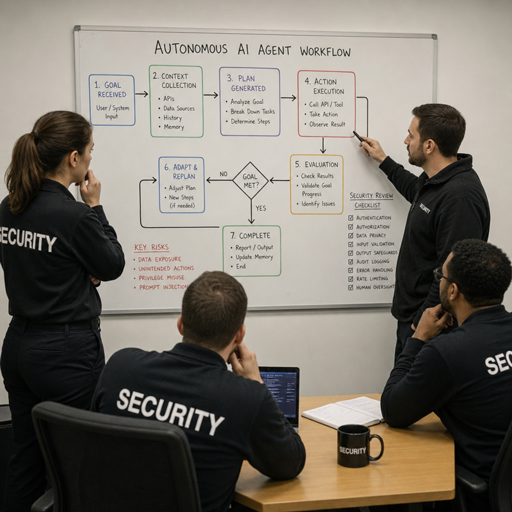
Autonomous AI agents are moving from clever demos into workflows that can retrieve data, use tools, trigger actions, and adapt without constant human prompting. That shift creates a security reckoning: organizations can no longer treat AI as only a content generator or chatbot. They need ai security solutions, practical ai safety measures, and governance that matches the level of autonomy they are giving these systems.
What makes autonomous AI agents a security reckoning?
Autonomous AI agents create new risk because they combine reasoning, memory, tool access, identity, and action. A traditional application usually follows predictable paths, while an agent can choose steps dynamically, call external systems, and interpret ambiguous instructions. That makes the “Autonomous AI Agents & Security Reckoning” less about fear of AI and more about a familiar security principle: the more power a system has, the more carefully its permissions, inputs, outputs, and recovery paths must be designed.
The difference is speed and context. An agent connected to email, ticketing, cloud consoles, code repositories, payment systems, or customer data can make useful decisions quickly. It can also amplify a bad prompt, a poisoned document, an overbroad credential, or a compromised plugin just as quickly. The goal is not to block agentic AI. The goal is to make autonomy conditional, observable, and reversible.
The threat model changes when AI can act
Generative AI security often focuses on data leakage, prompt injection, model behavior, and policy compliance. Those still matter. Agentic systems add another layer: the model is no longer just producing an answer; it may be deciding which tool to use, what data to fetch, and what action to take next.
AWS describes its Agentic AI Security Scoping Matrix as a framework for understanding autonomous AI systems across different levels of connectivity and autonomy, mapping security controls to the level of agency involved. In plain language, the AWS agentic AI security scoping matrix framework for autonomous systems is useful because it pushes teams to ask, “How much can this agent do, and what could go wrong at that level?” rather than applying one generic control set to every use case. (aws.amazon.com)
That scoping mindset matters because not every agent carries the same risk. A read-only research assistant that summarizes public documentation is different from an operations agent that can restart infrastructure, modify IAM policies, or message customers. The second system needs stronger identity controls, approval gates, logging, simulation, rollback, and incident response planning.
Common risk patterns to watch
Security teams should look beyond dramatic “rogue AI” scenarios and focus on practical failure modes:
- Prompt injection through untrusted content: The agent reads a webpage, email, document, or ticket that contains instructions designed to override its task.
- Excessive tool permissions: The agent receives broad API or account access when it only needs a narrow set of actions.
- Credential exposure: Secrets, tokens, or tool credentials are placed in prompts, memory, logs, or context windows where they can be leaked or manipulated.
- Unverified outputs becoming actions: A generated recommendation is automatically executed without validation, testing, or human approval.
- Weak auditability: Teams cannot reconstruct what the agent saw, decided, called, changed, or returned.
- Multi-agent confusion: Multiple agents hand off tasks without clear ownership, policy boundaries, or shared state controls.
These are not exotic problems. They are extensions of application security, cloud security, data governance, and machine learning security under a faster, more autonomous operating model.
Security starts with scoping, not tooling
Buying tools before defining autonomy is one of the easiest ways to create false confidence. A useful agent security program begins with scoping: what the agent can see, what it can do, when it must ask for approval, and how the organization can stop or reverse its actions.
A practical scoping exercise should define:
- Purpose: The business task the agent is allowed to perform, written narrowly enough to test.
- Data access: The exact systems, documents, records, and classifications the agent can retrieve.
- Tool access: The APIs, plugins, functions, scripts, or platforms it can call.
- Action authority: Whether actions are read-only, draft-only, approval-based, or fully autonomous.
- Human checkpoints: The moments where a person must review, approve, or reject the next step.
- Failure handling: What happens if the agent is uncertain, receives conflicting instructions, or detects unsafe content.
- Evidence: The logs and records required to explain decisions after the fact.
This is where agentic ai cybersecurity autonomous security agents 2025 2026 planning should become more disciplined. The next wave of agent adoption will reward teams that classify use cases before launch, not after the first incident. If the agent’s authority cannot be described clearly, it probably is not ready for production.
Which AI safety measures actually reduce risk?
The most effective ai safety measures are layered controls that limit unsafe behavior before, during, and after agent execution. No single guardrail can solve the problem because agent risk comes from the interaction among prompts, models, tools, permissions, data, and users. The strongest approach combines least privilege, policy enforcement, testing, monitoring, and recovery.
Start with least privilege. Each agent should have its own identity, scoped permissions, and environment boundaries. Avoid shared human credentials, wildcard cloud permissions, and long-lived secrets. If an agent only needs to create a draft response or open a ticket, it should not have permission to send customer communications or change production systems.
Next, separate reasoning from execution. Let the agent propose a plan, but require validation before high-impact steps. For sensitive actions, use approval workflows that show the user what the agent intends to do, what systems it will touch, and what evidence supports the action. Human approval should not be a rubber stamp; it should provide enough context for a real decision.
Finally, design for containment. Sandboxed execution, rate limits, allowlisted tools, output filtering, retrieval controls, and rollback procedures make mistakes less expensive. AWS Prescriptive Guidance for agentic AI emphasizes attention to input validation, access controls, and system recovery capabilities, which aligns with the broader principle that autonomous systems must be built to fail safely. (docs.aws.amazon.com)
Automated threat detection becomes a core capability
Autonomous agents can operate too quickly and too continuously for manual review to be the only defense. Automated threat detection is essential because teams need to identify abnormal agent behavior while it is happening, not days later during a log review.
Detection should cover both security events and agent-specific signals. Traditional indicators include unusual authentication attempts, unexpected API calls, privilege changes, data exfiltration patterns, and anomalous network activity. Agent-specific indicators include repeated tool failures, prompt injection markers, attempts to access disallowed resources, unexpected goal changes, excessive retries, and actions that diverge from the approved plan.
A useful monitoring program should answer these questions quickly:
- What task was the agent trying to complete?
- Which user, service, or workflow initiated it?
- What data sources did it retrieve from?
- Which tools did it call, and with what parameters?
- Did it encounter untrusted instructions or policy conflicts?
- What action did it take, and can that action be reversed?
- Did the activity match normal behavior for that agent and use case?
This is where ai security solutions should integrate with existing SIEM, SOAR, IAM, endpoint, cloud, and data security platforms. Agent security should not become a separate island. It should feed the same detection, response, ticketing, and governance systems the organization already uses.
Machine learning security still matters
Agentic security is not a replacement for machine learning security; it depends on it. Model selection, training data quality, evaluation, adversarial testing, data privacy, and model lifecycle management remain important. If the underlying model is poorly evaluated or the retrieval pipeline is contaminated, the agent’s decisions become less trustworthy.
Machine learning security also includes protecting embeddings, vector databases, fine-tuning datasets, model endpoints, evaluation data, and feedback loops. A compromised retrieval source can influence outputs without changing the model itself. A weak feedback process can reinforce bad behavior. A poorly protected model endpoint can become a path for abuse, data leakage, or denial of service.
For agentic systems, ML security and application security must work together. The model may decide, but the surrounding system grants access, executes calls, stores memory, and records evidence. Treating those layers separately creates gaps attackers can exploit.
A practical readiness checklist for agentic AI
Before deploying an autonomous agent into a real workflow, organizations should run a readiness review. The goal is not bureaucracy. It is to make sure the system’s autonomy is matched by controls that are easy to understand and operate.
Use this checklist as a starting point:
- Use case clarity: The agent has a defined purpose, owner, and success criteria.
- Autonomy level: The team has documented whether the agent is read-only, draft-only, approval-based, or autonomous.
- Identity design: The agent has a dedicated identity with least-privilege permissions.
- Tool governance: Every tool call is allowlisted, logged, and tied to a legitimate task.
- Data boundaries: Sensitive data access is restricted by role, policy, and business need.
- Prompt injection defense: The system treats external content as untrusted and separates instructions from reference material.
- Human approval: High-impact actions require meaningful review before execution.
- Testing: The agent is evaluated against misuse cases, edge cases, and adversarial inputs.
- Observability: Logs capture prompts, retrieved context, tool calls, decisions, and outcomes where appropriate.
- Response plan: Teams know how to pause the agent, revoke access, investigate activity, and reverse changes.
This checklist should be revisited whenever the agent gains a new tool, connects to a new data source, changes models, or moves into a more sensitive workflow.
The path forward is governed autonomy
The security reckoning around autonomous AI agents is not a warning to avoid them. It is a reminder that autonomy must be earned. Agents can help security teams triage alerts, enrich investigations, summarize incidents, draft detections, and support response workflows. Autonomous security agents may become valuable assistants, especially when their scope is narrow, their evidence is visible, and their actions are controlled.
The healthiest pattern is governed autonomy: give agents enough freedom to be useful, but not so much authority that a single bad instruction can create business damage. Start with low-risk tasks, measure performance, expand permissions gradually, and keep humans in the loop for decisions that affect money, safety, customer trust, regulated data, or production stability.
The Autonomous AI Agents & Security Reckoning is ultimately a design challenge. Organizations that combine ai security solutions, machine learning security, automated threat detection, and clear ai safety measures will be better positioned to use agents confidently. The winners will not be the teams that move fastest with the fewest controls. They will be the teams that make autonomous systems understandable, accountable, and safe enough to trust.