
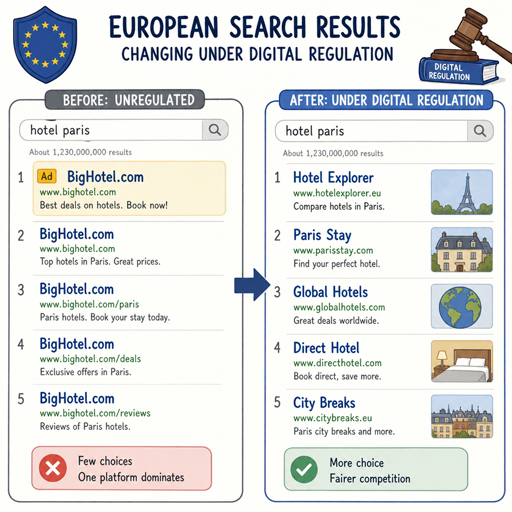
Google’s EU Search Overhaul (Digital Markets Act) is reshaping how search results appear for European users, especially in areas such as travel, shopping, local discovery, and comparison-style queries. For marketers, publishers, and businesses watching search engine news, the shift is not just another google search update; it is a regulatory-driven change that affects visibility, clicks, and the way users move from results pages to websites.
The bigger story is that eu tech regulations are pushing dominant digital platforms to change how they rank, display, and share access to information. That means SEO teams should watch not only algorithm updates, but also eu digital policies that can change the structure of the search results page itself.
What is Google’s EU Search Overhaul under the Digital Markets Act?
Google’s EU Search Overhaul under the Digital Markets Act refers to changes Google is making in European search results to comply with the EU’s rules for large “gatekeeper” platforms. The Digital Markets Act aims to make digital markets fairer and more contestable, and the European Commission has focused closely on whether Google gives its own services more favorable treatment inside Search. (digital-markets-act.ec.europa.eu)
In practice, this can affect how hotel results, flight results, product comparisons, local listings, rich snippets, and other vertical search features appear. Google has said its EEA search changes include new experiences such as rich results, aggregator units, and refinement chips, while the Commission has continued reviewing whether those changes go far enough. (developers.google.com)
The DMA turns search design into a competition issue
For years, SEO teams treated Google Search changes mainly as product or ranking updates. The Digital Markets Act adds another layer: search design is now also a competition policy issue in the EU. When a search results page promotes a map pack, a booking box, a shopping module, or a direct answer, regulators may ask whether that placement helps users fairly or privileges Google’s own services.
That distinction matters because modern search is no longer a list of blue links. It is a mixed interface of organic results, ads, comparison modules, AI-style summaries, images, maps, filters, and direct booking paths. If regulation changes which modules appear, which providers are shown, or how users refine results, then organic traffic patterns can shift even when rankings appear stable.
For businesses, the practical lesson is simple: traffic changes in Europe may not always come from content quality, technical SEO, or backlinks. They may come from the layout of the page, the presence of comparison units, or new rules about how competing services are displayed.
Why does this matter for SEO, publishers, and brands?
It matters because Google’s EU Search Overhaul (Digital Markets Act) can change the path between search intent and website visits. A user looking for a hotel, product, restaurant, or service may now see different intermediaries, comparison options, or result modules than users in other regions, creating a more fragmented search experience across markets.
For SEO teams, that means European performance needs its own analysis. A ranking report may show little movement, while click-through rate, impressions, or conversions change because the search result page has been redesigned. This is especially important for brands in travel, retail, local services, publishing, and any category where Google has historically displayed specialized search features.
Publishers should also pay attention. The European Commission opened proceedings in November 2025 to assess whether Google applies fair, reasonable, and non-discriminatory access conditions to publishers’ websites in Search, showing that content visibility remains part of the broader DMA debate. (digital-strategy.ec.europa.eu)
Signals to monitor in European search performance
Instead of reacting to every headline, teams should build a practical monitoring routine. The goal is to separate normal google search trends from regulation-driven interface changes.
Useful checks include:
- Segment by country: Compare EU and non-EU markets rather than blending all search traffic into one dashboard.
- Watch device differences: Mobile results often show layout changes more sharply because screen space is limited.
- Track query categories: Separate brand, non-brand, local, shopping, travel, and informational queries.
- Review SERP features manually: Look at the actual results page, not only position data.
- Monitor CTR and impressions together: A stable ranking with falling CTR can point to layout or feature changes.
- Check comparison and aggregator visibility: Some categories may send users through intermediaries more often.
- Document timing: Match traffic shifts against known regulatory announcements, Google communications, and confirmed search updates.
This approach avoids panic. It also helps teams explain performance changes with more confidence when clients or executives ask why European search traffic moved.
Google, the Commission, and the tension behind the overhaul
The overhaul is not happening in a vacuum. Google has argued that some DMA-driven changes may reduce the usefulness of Search for European users, particularly where direct features are removed or reduced. In its own updates, Google has described changes to European search results and has said it proposed additional adjustments to accommodate regulatory requests while trying to preserve helpful search experiences. (blog.google)
The European Commission, meanwhile, has taken a firmer view. In March 2025, it sent preliminary findings saying certain Google Search features and functionalities appeared to favor Alphabet’s own services over rivals. In July 2026, the Commission announced decisions finding non-compliance by Google under the DMA, including self-preferencing in Google Search. (digital-markets-act.ec.europa.eu)
There is also a data-sharing dimension. In 2026, the Commission outlined proposed measures for Google to share search data with third-party search engines on fair, reasonable, and non-discriminatory terms, covering data such as ranking, query, click, and view information. (digital-strategy.ec.europa.eu)
Practical steps for adapting your search strategy
The best response is not to abandon SEO fundamentals. Strong content, crawlable pages, useful structured data, fast performance, and clear commercial information still matter. What changes is the need to understand the search environment around your result.
Start with these actions:
- Create an EU-specific SEO view. Build separate reporting for European Economic Area traffic, especially if Europe is a meaningful market for your business.
- Audit your structured data. Google has stated that structured data can affect eligibility for certain EEA search experiences, while pages without markup may show as standard text results. (developers.google.com)
- Strengthen direct brand demand. If users encounter more intermediaries, recognizable brands have a better chance of earning direct clicks.
- Diversify acquisition channels. Email, direct traffic, paid search, social, marketplaces, and referral partnerships can reduce dependence on one results-page design.
- Compare visibility, not just rankings. Screenshots, SERP feature tracking, and Search Console analysis can reveal changes that rank trackers miss.
- Follow regulatory news as SEO news. In Europe, eu digital policies can now affect search visibility as much as a conventional product update.
The bigger takeaway for search engine news watchers
Google’s EU Search Overhaul (Digital Markets Act) signals a new era where search is shaped by both technology and regulation. The search results page is becoming more regional, more policy-sensitive, and more contested by platforms, competitors, publishers, and regulators.
For marketers, the winning habit is disciplined observation. Track what changes, where it changes, and how users respond. The brands that adapt fastest will be the ones that treat eu tech regulations, google search trends, and product updates as connected parts of the same search ecosystem.