
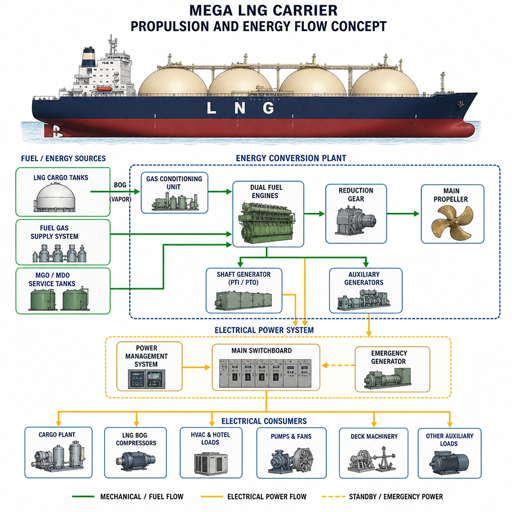
Hybrid-electric propulsion systems combine fuel-burning machinery, electrical generation, energy storage, power electronics, electric motors, and digital controls to move large LNG carriers more flexibly than a single mechanical drivetrain can. In mega LNG carriers, the goal is not simply to add batteries or replace an engine; it is to create an integrated hybrid powertrain that can match propulsion demand, onboard electrical loads, boil-off gas management, port requirements, and operating conditions with greater precision. This guide explains how hybrid systems work, where they fit in LNG carrier design, and what shipowners, naval architects, operators, and technical stakeholders should consider before adopting them.
What are hybrid-electric propulsion systems in mega LNG carriers?
Hybrid-electric propulsion systems in mega LNG carriers are propulsion architectures that blend conventional marine power sources with electric propulsion and, in many cases, energy storage. Instead of relying on one direct mechanical path from engine to propeller, a hybrid arrangement can route power through generators, switchboards, batteries, converters, propulsion drives, and electric motors. The result is a more flexible system that can support efficient sailing, maneuvering, redundancy, hotel loads, cargo systems, and emissions management across different operating modes.
A mega LNG carrier is an unusually demanding platform for any propulsion technology. It must move a very large hull over long distances, maintain the cargo containment environment, power auxiliary systems, meet safety requirements for gas handling, and operate reliably through long voyages. The propulsion plant is therefore not an isolated machine room decision. It is connected to the vessel’s commercial schedule, cargo temperature control, port restrictions, crew workload, fuel strategy, maintenance philosophy, and lifecycle cost.
Hybrid-electric propulsion systems address those demands by separating power production from propulsion delivery. Engines, turbines, fuel cells, or other prime movers can generate electricity; electric motors can turn the propeller shaft or podded propulsors; batteries or other storage systems can absorb and release energy; and power management software can decide how each asset should be used. In simple terms, hybrid systems give the vessel more ways to produce, store, and use energy.
That flexibility is especially relevant for LNG carriers because they already operate within an energy-rich environment. Natural boil-off gas from the cargo, dual-fuel engines, reliquefaction systems, cargo pumps, and high hotel loads create a complex onboard energy balance. A hybrid powertrain can help coordinate these loads and sources rather than treating propulsion and ship service power as separate problems.
The operating reality of mega LNG carriers
Mega LNG carriers operate under conditions that make propulsion decisions more complex than they appear from the outside. A ship may spend long periods at steady sea speed, then transition into low-speed maneuvering, port approach, cargo loading, cargo discharge, waiting at anchorage, canal transit, or cold-ironing where shore power is available. Each phase creates a different power profile.
Traditional propulsion systems can be optimized for one major operating point, often efficient deep-sea sailing. The challenge is that ships rarely live at one point forever. They move through a profile of changing loads, and engines can become less efficient or less responsive when operated far from their preferred range. Hybrid engines, generator sets, batteries, and electric motors can be coordinated to keep machinery closer to efficient operating bands while supplying the propulsion and auxiliary loads the ship actually needs at that moment.
Large LNG carriers also face growing pressure to reduce greenhouse gas emissions, limit local pollutants, cut fuel waste, and improve port compatibility. Electric propulsion is not automatically zero-emission when electricity is produced onboard from fuel. However, it can enable cleaner operation when paired with cleaner fuels, shore power, optimized engine loading, waste heat recovery, or energy storage. The value lies in the system-level design.
The scale of a mega LNG carrier also changes the stakes. A small inefficiency repeated over long voyages can become commercially meaningful. A failure in the propulsion chain can affect cargo delivery, charter performance, safety margins, and port operations. Hybrid-electric propulsion systems must therefore be judged not only by efficiency promises but also by reliability, maintainability, redundancy, crew familiarity, class approval, and integration with cargo systems.
Core components of a hybrid LNG carrier powertrain
A hybrid powertrain is best understood as a network of energy producers, energy users, storage devices, and control systems. The exact arrangement differs by vessel design, yard capability, regulatory requirements, and owner preference, but most hybrid-electric propulsion systems share several core building blocks.
Prime movers and hybrid engines
The prime movers are the machines that convert fuel into mechanical energy. In LNG carriers, these may include dual-fuel engines capable of using natural gas and liquid fuel, diesel generator sets, gas turbines in some concepts, or future-ready systems designed to accommodate lower-carbon fuels. When people refer to hybrid engines in this context, they usually mean engines operating as part of a hybridized power architecture rather than engines that are themselves electrically driven.
The benefit of using engines inside a hybrid system is load flexibility. Instead of one large engine struggling through a wide range of demand, multiple generator sets can be started, stopped, or loaded according to the vessel’s needs. This can help reduce inefficient low-load operation, improve redundancy, and simplify maintenance scheduling. It can also allow different engine types or ratings to serve different operating profiles.
Generators and electrical distribution
Generators convert the mechanical output of prime movers into electrical power. That power enters the ship’s electrical distribution system, where it can serve propulsion motors, cargo systems, hotel loads, pumps, compressors, navigation equipment, and other consumers. The electrical architecture may include medium-voltage switchboards, transformers, converters, protection systems, and control interfaces.
In a hybrid-electric LNG carrier, the distribution system is not a passive set of cables. It is the backbone of the vessel’s energy strategy. It must manage high power levels, fault isolation, harmonics, redundancy, safety zoning, and fast changes in demand. A well-designed electrical system allows propulsion technology and auxiliary systems to work together without compromising safety or availability.
Energy storage systems
Batteries are the most familiar form of marine energy storage, although other storage technologies may appear in future designs. On a mega LNG carrier, batteries are not usually expected to power an entire ocean crossing by themselves. Their value is more targeted: peak shaving, spinning reserve, blackout prevention support, low-speed maneuvering assistance, transient load response, and temporary zero-emission operation in specific areas.
Energy storage can smooth the load seen by engines. For example, if propulsion demand rises quickly during maneuvering, the battery can help meet the short-term peak while engines ramp up more gradually. When demand falls, the system may recharge from available generation. This reduces stress on machinery and can improve operational stability.
Battery systems also require careful treatment. They need thermal management, fire detection, ventilation, physical protection, battery management systems, class-approved safety design, and clear operating procedures. For LNG carriers, where cargo safety is already central to vessel design, energy storage must be integrated with a conservative safety philosophy.
Electric motors and propulsion drives
Electric motors convert electrical energy into rotational force for propulsion. They may drive a shaft connected to a conventional propeller or be part of a podded or azimuthing propulsion concept, depending on the design. Large marine electric motors are paired with variable frequency drives or similar power electronics that control motor speed and torque.
This is where electric propulsion changes the character of the ship. Motors can provide responsive torque at low speeds, which supports maneuvering and station-keeping. They can be controlled precisely and integrated with automation systems. They also make it possible to decouple engine speed from propeller speed, giving designers more freedom than a purely mechanical propulsion line.
Power electronics and control systems
Power electronics convert, condition, and control electrical power between generators, batteries, motors, and ship loads. They are essential to any modern hybrid powertrain. Converters, inverters, drives, and protection equipment determine how smoothly power can move through the vessel.
The control layer is equally important. A power management system decides which generators run, when batteries charge or discharge, how much power is allocated to propulsion, and how reserves are maintained. On an LNG carrier, the system may also interact with cargo handling requirements, boil-off gas availability, emissions targets, shore power, and operational modes.
Good control logic is what turns hardware into a useful hybrid system. Poor control logic can leave expensive equipment underused, overworked, or confusing for crew. The best designs make the operating mode clear, predictable, and safe while still taking advantage of automation.
How does hybrid electric propulsion actually work on board?
Hybrid electric propulsion works by allowing the vessel to choose the most suitable mix of power sources for each operating condition. The ship may run generator sets to feed propulsion motors during open-sea transit, use batteries to handle short load peaks, operate with fewer engines at better load, draw shore power in port, or combine stored energy with onboard generation during maneuvering. The practical advantage is that the vessel’s energy system can respond to changing demand without forcing every component to operate in the same way all the time.
In a conventional direct-drive arrangement, the main engine is mechanically linked to the propeller shaft. Engine speed, shaft speed, and propeller behavior are closely connected. This can be efficient for steady operation, but it limits flexibility when speed changes, auxiliary loads vary, or the vessel needs fine control.
In a hybrid-electric architecture, the energy path becomes more adaptable. An engine may drive a generator rather than the propeller directly. The generator supplies a common electrical bus. From there, power can feed propulsion motors, charge batteries, serve hotel loads, or support cargo equipment. Batteries can then discharge back into the electrical system when needed.
This creates several operating modes:
- Generator-fed electric propulsion Engines run generator sets, electricity flows through the distribution system, and electric motors drive the propeller. This mode is common for vessels that rely heavily on integrated electric propulsion.
- Battery-assisted propulsion Batteries provide additional power during short peaks, engine load transitions, or maneuvering. This can reduce the need to start another generator for a brief demand spike.
- Engine-optimized hybrid operation The control system selects the number of running engines and their load points to avoid inefficient operation. Energy storage may absorb excess power or supply deficits.
- Port and low-emission mode The vessel may use shore power, batteries, or a limited set of onboard generators to reduce noise, vibration, and local emissions during port stays or restricted operations.
- Redundancy and reserve mode Batteries and multiple generation paths can provide extra resilience if one component trips or demand changes suddenly. This does not eliminate the need for robust protection design, but it adds options.
The effectiveness of these modes depends on sizing. A battery that is too small may offer limited value. A motor or converter that is oversized may add cost and complexity without proportional benefit. Engines that are poorly matched to the vessel’s actual operating profile may still run inefficiently. Hybrid design is therefore an optimization exercise, not a simple equipment checklist.
Why LNG carriers are strong candidates for hybrid systems
LNG carriers are well suited to hybrid systems because they already involve complex onboard energy flows. The cargo is energy-dense, temperature-sensitive, and connected to fuel strategy through boil-off gas. The vessel also carries substantial auxiliary loads, especially during cargo operations. A hybrid architecture can coordinate these factors with propulsion demand.
Another reason is operational variety. A mega LNG carrier may cross oceans at relatively stable speed, but it also spends important time in terminals, traffic separation schemes, canals, coastal approaches, and waiting zones. Those non-steady phases are where electric motors, batteries, and flexible generation can be especially useful. Fine control and fast response matter during low-speed operation, while load optimization matters during long transits.
Hybrid-electric propulsion systems may also support future readiness. The marine fuel landscape is changing, and shipowners are cautious about locking themselves into one pathway. An electric backbone can make it easier to integrate new power sources later, provided the original design includes space, weight, safety margins, cooling capacity, and electrical capacity. This does not make retrofits effortless, but it can reduce some barriers.
From a commercial perspective, flexibility has value. Charterers, ports, and regulators may place different expectations on emissions, reporting, and operational behavior. A vessel that can adapt its power mode to the voyage profile may be better positioned than one that can operate efficiently only under narrow conditions.
Benefits and trade-offs of hybrid-electric propulsion
Hybrid-electric propulsion systems are not a universal upgrade that automatically improves every LNG carrier. They bring real advantages, but they also introduce cost, engineering complexity, new maintenance requirements, and integration risk. A balanced view is essential.
Potential benefits
The strongest benefits usually come from system optimization rather than from any single component. A battery, motor, or generator is useful when it helps the whole vessel operate better.
Key benefits may include:
- Improved load management: Multiple generators and storage devices can be coordinated so engines avoid inefficient low-load operation.
- Peak shaving: Batteries can supply short bursts of power, reducing the need to start additional engines for temporary peaks.
- Responsive maneuvering: Electric motors can provide precise torque control at low speeds, supporting safer port and terminal operations.
- Redundancy: Distributed generation and stored energy can add alternative paths for power delivery, depending on the architecture.
- Reduced noise and vibration in selected modes: Electric propulsion can be smoother than some mechanical arrangements, particularly at low speed.
- Operational flexibility: The vessel can shift among transit, port, cargo, standby, and restricted-area modes with more control.
- Future integration potential: A strong electrical architecture may make it easier to connect emerging fuels, fuel cells, shore power, or upgraded storage.
These benefits are most persuasive when they are connected to a vessel’s actual duty cycle. If a ship spends nearly all its time at one efficient operating point, the hybrid advantage may be smaller. If the ship has frequent load changes, port restrictions, or variable auxiliary demand, the business case can become stronger.
Practical trade-offs
The trade-offs should be considered early, not after the concept has already been sold internally. Hybrid powertrain equipment requires space, weight allowance, cooling, electrical protection, software integration, crew training, spare parts, and class review. It may also change the vessel’s maintenance strategy.
Important trade-offs include:
- Higher system complexity: More components mean more interfaces, more control logic, and more failure modes to analyze.
- Capital cost: Motors, converters, switchboards, batteries, and integration engineering add cost before fuel or operational savings are realized.
- Space and weight: Batteries and electrical rooms compete with other ship design priorities.
- Thermal management: Power electronics and batteries need dependable cooling and environmental control.
- Safety requirements: Energy storage and high-voltage equipment require rigorous fire, ventilation, isolation, and emergency procedures.
- Crew capability: Operators must understand modes, alarms, limitations, and maintenance routines.
- Lifecycle uncertainty: Battery replacement planning, software support, and component obsolescence must be considered.
A strong hybrid project does not deny these challenges. It addresses them directly through modeling, risk assessment, supplier coordination, and operational planning.
Propulsion architecture options for large LNG carriers
There is no single hybrid-electric layout for every mega LNG carrier. The right architecture depends on the vessel’s size, operating route, cargo system, owner priorities, yard capability, and regulatory context. Still, several broad arrangements are useful for understanding the design space.
Integrated electric propulsion
In an integrated electric propulsion system, prime movers generate electricity for both propulsion and ship service loads. Propulsion motors drive the propeller, while the same electrical plant supports auxiliary systems. This approach allows the power management system to allocate generation across the vessel.
The appeal is flexibility. Instead of having separate engines dedicated to propulsion and separate generators for hotel loads, the ship can use a shared power pool. When cargo or hotel loads are high, the system allocates power accordingly. When propulsion demand dominates, more power goes to the motors.
The challenge is dependence on the electrical architecture. Switchboards, converters, protection systems, and automation become mission-critical. Their design must prevent a single fault from causing unacceptable loss of propulsion or power.
Mechanical propulsion with electric assist
Some vessels may retain a mechanical shaftline while adding electric assist through a shaft generator, power take-in motor, or hybrid module. In this arrangement, the main engine can still drive the propeller mechanically, but electrical equipment can add power, recover power, or support selected operating modes.
This can be attractive when owners want some benefits of hybrid systems without fully moving to electric propulsion. It may support peak shaving, low-speed assist, or improved auxiliary generation. It can also be relevant for retrofits if the existing vessel has enough space and structural suitability.
The trade-off is that flexibility may be lower than in a fully integrated electric propulsion system. The mechanical line still shapes much of the operating behavior, and integration around the shaft can be technically demanding.
Battery-hybrid electric propulsion
A battery-hybrid LNG carrier uses energy storage as an active part of the propulsion and power system. Batteries may support spinning reserve, peak shaving, load leveling, emergency response, or zero-emission operation over short periods. The system may be designed around battery support from the beginning or added as part of a broader upgrade.
The key question is not whether a battery is present, but what job it performs. A small battery sized for transient support has a different design purpose than a larger installation intended for extended low-emission operation. Clear use cases prevent disappointment.
Future-ready electric backbone
Some newbuild designs may prioritize an electric backbone that can accept future power sources. This does not necessarily mean the vessel starts with every possible technology. Instead, the design may reserve space, electrical capacity, cooling, and safety pathways for later integration.
For mega LNG carriers, future readiness can be valuable because ship lifecycles are long and fuel policy is evolving. However, reserved capability must be specific enough to be useful. Vague statements about being “future-proof” are less valuable than defined margins, documented interfaces, and realistic retrofit pathways.
Design priorities for a safe and effective hybrid powertrain
Hybrid-electric propulsion systems require disciplined design. The vessel is not merely adding equipment; it is changing how energy is produced, distributed, stored, and controlled. The following priorities help keep the design practical.
Start with the operating profile
The operating profile should drive the technical concept. Designers need to understand expected voyage lengths, service speed, maneuvering time, port stays, cargo handling loads, boil-off gas availability, weather margins, redundancy requirements, and likely future operating restrictions. Without this profile, equipment sizing becomes guesswork.
A useful operating profile should include:
- Typical sea passages and expected speed ranges.
- Time spent at low speed, waiting, or maneuvering.
- Cargo loading and discharge electrical demand.
- Hotel load variation across climates and routes.
- Port power availability and terminal requirements.
- Reserve power philosophy and emergency scenarios.
- Maintenance access windows and crew capability.
This analysis often reveals where hybridization has the strongest value. For example, if the vessel has frequent short power peaks, batteries may be attractive. If auxiliary loads vary widely, integrated electric propulsion may offer benefits. If port emissions are the main concern, shore power readiness and battery-supported hotel loads may matter most.
Match component sizing to real use cases
Oversizing can be as harmful as undersizing. Large batteries, motors, or converters that rarely operate near their intended purpose add cost and complexity. Undersized equipment may fail to deliver promised benefits.
Sizing should be linked to named use cases. If the battery is intended for peak shaving, the designer must define peak duration and recharge strategy. If electric motors are intended for maneuvering performance, torque and response requirements must be clear. If the hybrid powertrain is expected to support redundancy, fault scenarios must be modeled.
Treat software as part of the propulsion system
In a hybrid-electric vessel, software is not an accessory. Power management, drive controls, battery management, alarm handling, and mode selection directly affect propulsion performance. Control logic should be validated through simulation, hardware-in-the-loop testing where appropriate, commissioning trials, and crew training.
Mode transitions deserve particular attention. A vessel may move from sea passage to coastal approach, then to maneuvering, then to cargo operation. Each transition should be predictable. The crew should know what the system is doing, what reserves are available, and what actions are required if a component trips.
Build in maintainability
Mega LNG carriers operate on demanding commercial schedules. A technically impressive system that is difficult to maintain can become a burden. Designers should consider access routes, modular replacement, spare parts strategy, diagnostic tools, supplier support, and crew workload.
Maintainability also includes documentation. Crew should not need to interpret an overly complex control philosophy during a stressful event. Clear manuals, alarm priorities, training simulators, and practical maintenance routines support safe operation.
How should shipowners evaluate a hybrid-electric propulsion concept?
Shipowners should evaluate a hybrid-electric propulsion concept by testing it against the vessel’s real operating profile, commercial goals, safety requirements, and lifecycle plan. The right question is not “Is hybrid technology better?” but “Which hybrid functions create measurable value for this ship, on this route, under these constraints?” A concept that looks advanced on paper may be weak if it does not match the way the vessel will actually operate.
A practical evaluation should move through several stages.
Step 1: Define the business and operational drivers
The project team should identify why hybridization is being considered. Possible drivers include fuel efficiency, emissions reduction, port compliance, redundancy, future fuel flexibility, reduced noise, improved maneuvering, or corporate decarbonization strategy. Ranking these goals matters because the best design for one goal may not be the best design for another.
For example, a vessel focused on low-emission port operation may prioritize shore power integration and battery-supported hotel loads. A vessel focused on long-voyage efficiency may prioritize generator optimization, waste heat integration, and propulsion motor efficiency. A vessel focused on resilience may prioritize redundancy and fault isolation.
Step 2: Model energy flows across the voyage
Energy modeling should cover more than average propulsion demand. It should include transient loads, seasonal variation, cargo system loads, hotel loads, ballast and laden conditions, weather margins, and operating restrictions. Averages can hide the peaks and transitions where hybrid systems provide much of their value.
The model should also consider fuel use and boil-off gas strategy. LNG carriers have unique relationships between cargo condition, fuel availability, reliquefaction, and propulsion demand. A hybrid powertrain should support that relationship rather than complicate it.
Step 3: Compare architecture options
Instead of choosing one vendor solution too early, owners should compare several architectures. A fully integrated electric system, a mechanical system with electric assist, and a battery-supported arrangement may all meet the same broad goal in different ways. The comparison should include space, weight, redundancy, emissions, maintenance, crew training, lifecycle cost, and retrofit potential.
The best option is rarely the one with the most technology. It is the one that provides the strongest fit between mission, risk, and return.
Step 4: Evaluate safety and class requirements early
High-voltage systems, battery rooms, gas handling, hazardous zones, fire protection, and emergency shutdown philosophy must be coordinated early. Waiting until late design stages can create expensive redesign. LNG carrier safety culture is already rigorous, and hybrid-electric propulsion systems must fit within that culture.
Class society engagement should begin before major equipment choices are locked. Suppliers should provide evidence for safety functions, protection settings, battery management, fault handling, and failure mode analysis.
Step 5: Plan the human side of operation
Crew acceptance is critical. A hybrid system that operators do not trust may be run conservatively, reducing its value. Training should explain not only which buttons to press but why the system chooses certain modes and how operators should respond to abnormal conditions.
Human-machine interfaces should be clear and consistent. The crew should be able to see power flow, battery state, available reserve, active operating mode, alarms, and limitations without navigating confusing screens.
Evaluation checklist
Before committing to a hybrid concept, decision-makers should be able to answer these questions:
- What operating problem does the hybrid system solve?
- Which loads and voyage phases create the strongest value case?
- How are batteries, engines, generators, and electric motors sized?
- What happens if a generator, converter, battery string, switchboard section, or propulsion motor fails?
- How are gas systems, cargo systems, and electrical systems coordinated?
- What crew training is required before delivery?
- How will battery health, software updates, and spare parts be managed over the vessel’s life?
- What parts of the design support future fuels or future electrical upgrades?
- How will performance be measured after the vessel enters service?
Integration with LNG cargo and boil-off gas systems
LNG carriers differ from many other ship types because the cargo itself influences the energy system. Boil-off gas can be used as fuel in suitable engines, managed through reliquefaction, or balanced through other operational strategies. Hybrid-electric propulsion systems must be designed with this reality in mind.
A power management system that ignores cargo energy flows may optimize one part of the vessel while creating inefficiency elsewhere. For example, propulsion demand, generator loading, reliquefaction power, and boil-off gas availability can interact. The most useful system-level design considers how these elements affect each other over a voyage.
Cargo operations also create high and variable electrical loads. Pumps, compressors, control systems, and safety equipment may place different demands on the electrical plant than open-sea sailing does. Integrated electric propulsion can help allocate generation, but it must maintain adequate reserves and separation so cargo operations do not compromise propulsion safety.
The operational philosophy should be documented clearly. During cargo loading, discharge, cooldown, gas freeing, or other specialized operations, the hybrid system may need defined modes and limitations. Crew should understand when propulsion reserves are prioritized, when cargo loads take precedence, and how emergency conditions are handled.
Reliability, redundancy, and failure management
Reliability is central to the acceptance of hybrid-electric propulsion systems in mega LNG carriers. Owners and charterers need confidence that new propulsion technology will not introduce unacceptable downtime. Redundancy is not just a matter of having extra components; it is a matter of designing the system so faults are detected, isolated, and managed without cascading failure.
A robust design may include separated switchboard sections, multiple generator sets, redundant propulsion drives, independent cooling loops, duplicated control networks, emergency power arrangements, and carefully defined protection zones. Batteries may support reserve power, but they should not be treated as a substitute for proper electrical protection and fault analysis.
Failure mode and effects analysis is especially important. The design team should examine credible faults such as converter trip, battery isolation, generator failure, cooling loss, sensor failure, blackout, fire detection, loss of communication, or erroneous mode selection. For each scenario, the system should have a defined response that supports vessel safety.
Reliability also depends on component quality and supplier coordination. Hybrid powertrains often involve engines, drives, batteries, switchboards, automation, and propulsion equipment from multiple suppliers. Interface responsibility must be clear. If every supplier optimizes only its own equipment, the integrated system may underperform.
Energy storage safety and lifecycle management
Battery systems can strengthen a hybrid powertrain, but they must be treated with respect. Marine batteries operate in a demanding environment and must comply with safety expectations for fire protection, ventilation, monitoring, electrical isolation, and emergency response. On LNG carriers, where hazardous materials and cargo safety are already carefully managed, battery safety cannot be an afterthought.
A battery installation should include appropriate detection and monitoring, physical separation, thermal control, battery management, emergency shutdown logic, and crew procedures. The design should consider not only normal operation but also abuse conditions, cell failure, cooling failure, smoke detection, and firefighting strategy.
Lifecycle planning is just as important as installation safety. Batteries age with time, cycling, temperature, and operating patterns. Owners should plan how battery health will be monitored, when capacity degradation becomes operationally relevant, and how replacement or augmentation will be handled. Disposal and recycling pathways should also be considered according to applicable rules and supplier programs.
Battery software deserves attention. State-of-charge estimates, health monitoring, alarms, and protective actions influence how the system behaves. Crew should not be forced to guess whether the battery can support a requested mode. The interface should communicate capability and limitations in practical terms.
The role of digitalization and automation
Hybrid systems depend heavily on digital coordination. Sensors measure loads, temperatures, voltages, currents, engine status, battery condition, and propulsion demand. Control software uses that information to allocate power, maintain reserves, and protect equipment. This digital layer can improve performance, but it also creates new responsibilities.
Data quality matters. If sensors are poorly calibrated, if equipment status is delayed, or if alarms are not prioritized properly, the power management system may make poor decisions or overwhelm the crew. Digital design should focus on trustworthy information, not simply more information.
Automation should also be transparent. Operators need to understand why the system starts another generator, limits battery discharge, changes motor output, or rejects a requested mode. A black-box system may be efficient in normal conditions but difficult to trust during abnormal events.
Cybersecurity is another consideration. As vessels become more connected, propulsion and energy systems must be protected from unauthorized access, corrupted updates, and insecure remote connections. Cybersecurity should be included in procurement, commissioning, crew training, and maintenance procedures.
Retrofit considerations for existing LNG carriers
Retrofitting hybrid-electric propulsion systems into existing mega LNG carriers can be attractive, but it is often more constrained than a newbuild design. Existing vessels have fixed machinery spaces, shaftlines, electrical ratings, structural arrangements, ventilation systems, and class documentation. Hybrid retrofits must work within those boundaries.
The most realistic retrofit options may involve targeted improvements rather than full propulsion transformation. Examples include battery systems for peak shaving, shore power integration, upgraded power management, shaft generator enhancements, or auxiliary system optimization. Full conversion to electric propulsion may be possible in some cases, but it is typically a major engineering project.
Retrofit feasibility should examine:
- Available space for batteries, converters, transformers, and switchgear.
- Structural support and fire zone implications.
- Cooling and ventilation capacity.
- Integration with existing engines, generators, and shaftline equipment.
- Class approval path and downtime requirements.
- Cable routing and electromagnetic compatibility.
- Crew retraining and updated operating procedures.
- Payback period relative to remaining vessel life.
A retrofit should not be judged only by installation cost. Off-hire time, engineering risk, commissioning complexity, and future support are part of the real cost. A smaller upgrade that works reliably may be more valuable than an ambitious conversion that creates operational uncertainty.
Environmental performance and emissions strategy
Hybrid-electric propulsion can support environmental goals, but it should be described accurately. Electric motors do not eliminate emissions if their electricity comes from onboard fuel-burning generators. The emissions outcome depends on fuel type, engine efficiency, operating mode, shore power use, battery charging source, and voyage profile.
Where hybrid systems can help is through better energy management. Engines can run closer to efficient load ranges. Batteries can reduce inefficient transient operation. Shore power can reduce local emissions in port when available and when the shore electricity mix supports the goal. Future power sources may connect more easily to an electric backbone.
For LNG carriers, methane management is also relevant. Fuel choice, engine technology, combustion behavior, and gas handling strategy all influence the environmental profile. A hybrid powertrain should be part of a broader emissions strategy rather than a label applied to the propulsion plant.
Owners should define which environmental outcomes they want to measure. These may include fuel consumption, carbon intensity, local air pollutants, port emissions, noise, vibration, or compliance with specific reporting frameworks. Without defined metrics, it is difficult to prove that hybridization is delivering value.
Commercial and operational implications
The commercial case for hybrid-electric propulsion systems depends on more than fuel savings. A vessel may gain value through improved port access, reduced waiting emissions, operational flexibility, charter appeal, redundancy, or readiness for future requirements. However, these benefits are not guaranteed. They depend on how the ship is contracted, operated, maintained, and measured.
Capital expenditure is visible at the start of the project, while operational benefits unfold over time. That makes assumptions critical. Fuel price, utilization rate, route profile, battery replacement cost, shore power availability, maintenance intervals, and regulatory expectations can all influence the business case.
Operators should also consider how hybrid capability will be used in daily decision-making. If voyage planning, engine room procedures, and bridge operations remain unchanged, the system may not achieve its potential. Hybrid propulsion is not just machinery; it is an operating model.
A practical commercial review should include:
- Newbuild or retrofit cost compared with conventional alternatives.
- Expected fuel and maintenance effects under realistic operating profiles.
- Port and terminal requirements that may reward low-emission operation.
- Charterer expectations and reporting needs.
- Supplier support over the vessel’s life.
- Battery replacement or augmentation assumptions.
- Training and documentation costs.
- Residual value and future compliance flexibility.
The strongest business cases are usually built around specific use cases, not broad claims. “Battery-supported peak shaving during maneuvering and cargo operations” is more actionable than “green hybrid technology.”
Best practices for project teams
A successful hybrid-electric LNG carrier project requires coordination across naval architecture, marine engineering, electrical engineering, cargo systems, safety, operations, procurement, and class approval. The following practices help reduce risk.
Build a cross-functional concept team early
Hybrid propulsion touches many disciplines. If the electrical team, machinery team, cargo team, yard, class society, and operator work in isolation, integration problems are likely. Early coordination helps reveal conflicts between space, power, safety, and operational goals.
The concept team should include people who understand real ship operation, not only design assumptions. Crew feedback can identify practical issues around alarms, access, maintenance, and mode selection before they become expensive to fix.
Specify functions before equipment
Procurement should begin with required functions rather than preferred hardware. The owner should define what the system must do in each mode, what reserves it must maintain, what failures it must tolerate, and what performance should be measured. Suppliers can then propose equipment that meets those functions.
This prevents technology-led design, where a battery or motor is added because it is fashionable rather than because it solves a defined problem.
Demand clear interface responsibility
Hybrid systems depend on interfaces: engine to generator, generator to switchboard, switchboard to drive, drive to motor, battery to converter, automation to crew, and control software to safety systems. Someone must own each interface.
Contracts and specifications should define data exchange, protection coordination, control authority, testing responsibilities, cybersecurity expectations, and support obligations. Clear responsibility reduces disputes during commissioning and operation.
Test operating modes before delivery
Factory testing, simulation, harbor trials, and sea trials should verify more than individual equipment performance. They should test mode transitions, fault responses, load changes, blackout recovery philosophy, battery behavior, and crew interface clarity.
A trial program should include realistic scenarios. The question is not whether each device turns on, but whether the vessel behaves safely and predictably when demand changes or equipment fails.
Keep the system understandable
Complexity can be justified, but confusion cannot. A hybrid-electric propulsion system should be understandable to the people who operate and maintain it. This means clear displays, sensible alarms, practical manuals, and training that connects system behavior to operating decisions.
The best systems make advanced control feel natural. They support the crew rather than forcing the crew to manage hidden complexity.
Common mistakes to avoid
Hybrid-electric propulsion projects can underperform when expectations are vague or design choices are made too early. Avoiding common mistakes improves the chance that the system delivers real value.
Mistakes include:
- Adding batteries without a defined duty: Energy storage needs a clear role, such as peak shaving, reserve support, or port operation.
- Using average load data only: Averages hide transient peaks, mode changes, and cargo-related loads.
- Treating electric propulsion as automatically green: Emissions depend on how electricity is generated and used.
- Ignoring crew workload: Operators need training, clear displays, and confidence in automation.
- Underestimating cooling and ventilation: Power electronics and batteries require reliable thermal management.
- Leaving class engagement too late: Safety and approval issues should shape the design from the beginning.
- Overpromising future readiness: Future capability must be backed by space, interfaces, margins, and documentation.
- Failing to plan lifecycle support: Software updates, spare parts, battery health, and supplier continuity matter.
These mistakes are avoidable when the project is driven by operating needs and verified through modeling and testing.
Future outlook for hybrid propulsion technology
The future of propulsion technology in mega LNG carriers is likely to be more integrated, more electrical, and more digitally managed. That does not mean every vessel will look the same. Some may adopt integrated electric propulsion, others may use mechanical systems with electric assist, and some may focus on energy storage and shore power integration.
Electric propulsion may become more attractive as power electronics improve, energy storage matures, and alternative power sources become more practical. Fuel cells, advanced batteries, cleaner fuels, and smarter energy management may all influence future designs. The electric backbone is important because it can provide a common platform for different sources and loads.
At the same time, the marine industry will remain cautious for good reason. LNG carriers are high-value, safety-critical assets. New systems must prove reliability, maintainability, and regulatory acceptance. The winning technologies will be those that combine performance with operational trust.
For shipowners, the best strategy is to avoid both extremes: do not dismiss hybrid-electric propulsion as a passing trend, but do not adopt it as a slogan. Evaluate it as an engineering and commercial tool. When hybrid systems are matched to the right operating profile, integrated with LNG cargo realities, and supported by trained crews, they can become a meaningful part of next-generation LNG carrier design.
Key takeaways
Hybrid-electric propulsion systems give mega LNG carriers more flexible ways to produce, store, and use energy. Their value comes from coordinated operation of hybrid engines, generators, electric motors, batteries, power electronics, and control software, not from a single component.
The strongest applications are tied to real operating needs: load optimization, maneuvering control, peak shaving, redundancy, port operation, and future integration. LNG carriers are strong candidates because cargo energy management, boil-off gas strategy, auxiliary loads, and propulsion demand are already deeply connected.
A successful hybrid powertrain starts with the vessel’s duty cycle, not with equipment selection. Owners should define use cases, model energy flows, compare architectures, engage class early, and train crews thoroughly. Safety, maintainability, and lifecycle support are as important as efficiency.
Hybrid-electric propulsion is not automatically cleaner, cheaper, or simpler. It becomes valuable when designed as a complete system and operated with discipline. For mega LNG carriers, that system-level approach is the difference between adding complexity and creating a more adaptable, resilient, and future-ready vessel.