
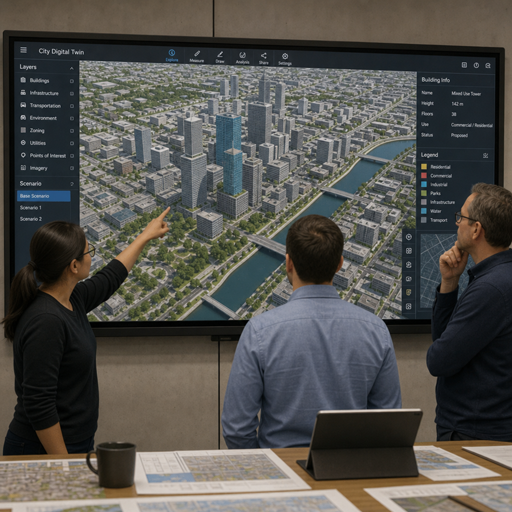
Cities are becoming more connected, more data-rich, and more complex to manage. Smart City Digital Twins bring these moving parts into a dynamic digital model, helping planners, engineers, and public agencies understand how urban systems behave before decisions are made in the real world. From mobility and energy to emergency planning and smart infrastructure, this approach is reshaping how cities test ideas, reduce risk, and improve daily life.
What are Smart City Digital Twins?
Smart City Digital Twins are virtual representations of physical urban environments, systems, or assets that are continuously informed by data. Unlike a static 3D model, a digital twin can reflect changing conditions, such as traffic flow, air quality, utility demand, weather, building performance, or infrastructure status. This makes it useful not only for visualization, but also for analysis, simulation, and long-term decision-making.
At its simplest, a city digital twin connects three things: the physical city, the data generated by that city, and a digital environment where scenarios can be explored. That digital environment may represent an entire district, a transportation network, a water system, a port, a campus, or a single high-value asset. The goal is not to create a perfect copy of everything. The goal is to create a useful model that helps people ask better questions and make more informed choices.
Digital twin technology is changing urban planning
Traditional urban planning often relies on historical reports, surveys, forecasts, and specialist studies. Those tools still matter, but digital twin technology adds a more interactive layer. Instead of reviewing a proposal in isolation, planners can examine how a decision might affect mobility, emissions, public space, utilities, maintenance, and community access across connected systems.
For example, a proposed transit corridor can be modeled against pedestrian movement, road congestion, development patterns, and energy demand. A flood mitigation project can be tested against rainfall scenarios, drainage capacity, land use, and emergency response routes. A new public building can be evaluated for accessibility, energy performance, and its relationship to the surrounding street network.
This matters because cities rarely face single-variable problems. A traffic change may affect local businesses. A new housing development may shift school demand, utility loads, and transit needs. A climate adaptation project may also influence public health, land value, and maintenance budgets. Urban digital twins help decision-makers see these relationships earlier, when changes are easier and less expensive to make.
Why do urban digital twins matter now?
Urban digital twins matter now because cities are under pressure to make faster, better decisions with limited resources. Population growth, aging infrastructure, climate risk, housing needs, and public expectations are all increasing the demand for smarter planning. Digital twins give city teams a way to connect information that is often scattered across departments and turn it into practical insight.
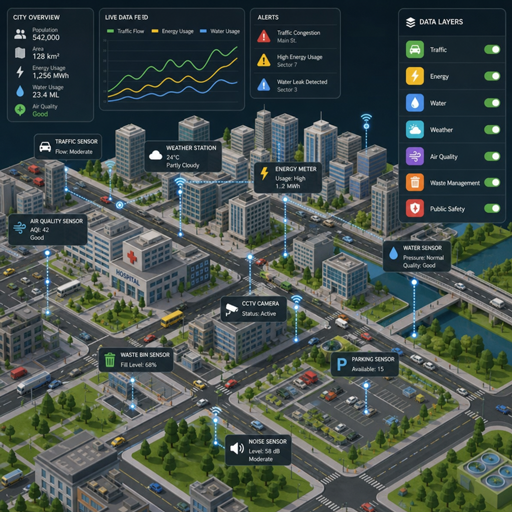
Many local governments already collect data from traffic sensors, utility systems, permitting platforms, public works teams, emergency services, environmental monitoring tools, and community engagement channels. The challenge is that this information often lives in separate systems. Smart City Digital Twins can help integrate those data streams so that decision-makers see a more complete picture.
The value is not just technical. A well-designed digital twin can support clearer communication between engineers, elected officials, residents, developers, and service providers. Instead of asking stakeholders to interpret dense reports, a city can show possible outcomes visually and explain trade-offs more transparently.
The role of urban data analytics
Urban data analytics is the engine that makes a digital twin useful. Data on its own can be overwhelming, inconsistent, or disconnected from action. Analytics turns raw information into patterns, forecasts, alerts, and evidence that support better decisions.
In a smart city context, analytics may be used to understand how people move through a neighborhood, where energy demand peaks, which roads require maintenance, or how environmental conditions vary from one area to another. When this intelligence is connected to a digital twin, users can move from asking “What is happening?” to “What might happen next?” and “What should we do about it?”
A strong analytics layer can support:
- Operational awareness: helping city teams monitor systems such as roads, utilities, lighting, transit, and public facilities.
- Scenario testing: comparing different planning, construction, or policy options before committing resources.
- Predictive maintenance: identifying assets that may need inspection or repair before failure disrupts service.
- Resource allocation: directing staff, funding, and equipment toward areas of greatest need.
- Performance tracking: measuring whether smart city solutions are producing the intended results over time.
The practical benefit is confidence. Leaders can still use judgment, public input, and professional expertise, but those decisions are supported by clearer evidence.
Smart infrastructure becomes more responsive
Smart infrastructure includes physical assets that use sensors, connectivity, automation, or analytics to operate more efficiently. This can include intelligent traffic signals, connected streetlights, monitored bridges, smart water networks, energy systems, public buildings, waste systems, and communications infrastructure.
A digital twin can make these assets easier to understand and manage. Rather than treating each asset as a separate item on a maintenance list, a city can view infrastructure as part of a living system. If a water main issue affects a road closure, which then changes traffic flow near a hospital, the digital twin can help reveal those dependencies.
This is especially important for resilience. Cities need to prepare for extreme weather, service disruptions, energy constraints, and emergency events. Smart infrastructure connected to digital twin technology can help teams model vulnerabilities, plan response routes, prioritize repairs, and communicate risks before a disruption becomes a crisis.
Practical digital twin applications in cities
Digital twin applications are broad because city systems are deeply connected. Some use cases focus on operations, while others support planning, sustainability, asset management, or public engagement. The best applications usually begin with a clear problem rather than a desire to build a model for its own sake.
Transportation and mobility
Transportation is one of the most visible areas for Smart City Digital Twins. A city can model traffic flow, public transit performance, pedestrian safety, parking behavior, freight movement, and curbside demand. This helps transportation teams test signal timing, bus priority measures, bike lane designs, road closures, and event management plans.
The benefit is not simply smoother traffic. Better mobility planning can improve safety, reduce delays, support local commerce, and make streets more accessible for people who walk, cycle, use transit, drive, or rely on mobility aids.
Energy and utilities
Energy, water, and utility networks are ideal candidates for digital twin technology because they involve complex assets spread across large areas. A digital twin can help monitor demand, model capacity, identify weak points, and plan upgrades. It can also support coordination between new development and existing infrastructure.
For example, if a neighborhood is expected to grow, a digital twin can help teams explore whether current utility systems can support that growth. It can also help assess the impact of electrification, renewable energy integration, building efficiency improvements, or changes in water demand.
Climate resilience and environmental planning
Cities are increasingly planning for heat, flooding, air quality, stormwater, and changing weather patterns. Urban digital twins can combine environmental data with land use, buildings, infrastructure, and demographic information to identify vulnerable areas. This makes it easier to prioritize interventions such as tree planting, green infrastructure, drainage improvements, cooling centers, or emergency response planning.
These models can also help explain climate risks to the public. When residents can see how heat or flooding may affect specific streets, parks, routes, and services, planning becomes more tangible.
Public safety and emergency response
Emergency teams need accurate, timely information. A digital twin can support response planning by showing road access, building layouts, utility locations, population patterns, evacuation routes, and hazard zones. During planning exercises, agencies can simulate different emergency scenarios and identify gaps in coordination.
The value here is preparation. A city that understands its operational constraints before an event is better positioned to respond quickly and communicate clearly.
Development review and community engagement
Planning proposals can be difficult for residents to interpret when presented as flat drawings or technical documents. Digital twins can make proposed changes easier to understand by placing them in a realistic urban context. Residents can see how a new building, street redesign, or public space improvement might look and how it may affect the surrounding area.
This does not remove the need for dialogue. It improves the quality of that dialogue by giving everyone a shared reference point.
What makes a smart city solution successful?
A smart city solution is successful when it solves a real problem, earns trust, and can be maintained over time. Technology alone is not enough. Cities also need governance, data quality, staff capability, privacy safeguards, funding plans, and a clear understanding of who benefits from the system.
Before investing in a digital twin initiative, city leaders should define the practical outcome they want. Is the goal to reduce congestion, improve infrastructure maintenance, strengthen resilience, streamline permitting, or support sustainability planning? Clear goals help determine what data is needed, which departments should be involved, and how success will be evaluated.
A useful readiness checklist includes:
- Problem definition: The city has identified a specific challenge or decision the digital twin should support.
- Data inventory: Relevant datasets are known, accessible, and assessed for quality and gaps.
- Interdepartmental ownership: Planning, engineering, IT, operations, and leadership understand their roles.
- Privacy and security review: Sensitive data is protected, and public trust is treated as essential.
- Scalable architecture: The system can grow without becoming locked into a narrow use case.
- User training: Staff know how to interpret and apply insights, not just view dashboards.
- Public communication: The city can explain why the technology is being used and how it supports better outcomes.
The most effective smart city solutions are not the flashiest. They are the ones that become part of everyday decision-making.
Data governance and trust are central
The future of Smart City Digital Twins depends heavily on trust. Cities handle information about public assets, movement patterns, services, land use, and sometimes individuals or communities. If residents believe data is being collected or used without clear purpose, even a technically impressive system can face resistance.
Good governance starts with transparency. Cities should be clear about what data is collected, why it is used, who can access it, and how it supports public value. Privacy protections should be built into the system from the beginning, not added after concerns arise.
Equity also matters. If a digital twin is built mainly from data generated by connected devices, it may underrepresent communities with fewer sensors, lower digital access, or less visible infrastructure investment. City teams should actively look for gaps and include community knowledge alongside technical data. A model that overlooks parts of the city can reinforce the very problems it is meant to solve.
The future points toward connected urban ecosystems
The next phase of digital twin applications will likely move beyond isolated pilots toward connected urban ecosystems. Instead of separate models for transport, utilities, buildings, and climate, cities will increasingly look for ways to connect these systems. That shift could make planning more holistic and operations more responsive.
Artificial intelligence may also play a larger role in identifying patterns, recommending actions, and improving simulations. However, AI should support human decision-making rather than replace it. Cities involve values, trade-offs, and lived experience that cannot be reduced to an algorithm.
The strongest future use cases will combine real-time data, historical context, professional expertise, and community input. A digital twin can show what might happen, but people still decide what should happen.
Getting started without overcomplicating the process
Cities and organizations do not need to model everything at once. In fact, starting too broadly can make a digital twin initiative difficult to manage. A focused project with a clear use case often creates more value than a large platform with unclear priorities.
A practical starting path looks like this:
- Choose a priority problem. Select a challenge that is important, measurable, and connected to real decisions.
- Map the stakeholders. Identify the departments, partners, and community groups affected by the issue.
- Review available data. Determine what exists, what is missing, and what quality improvements are needed.
- Build a limited model. Start with the geography, assets, and variables required for the first use case.
- Test scenarios. Compare options and document how the model changes the decision process.
- Evaluate usefulness. Ask whether the twin improved clarity, coordination, cost awareness, risk management, or public communication.
- Scale carefully. Expand only when the first use case proves valuable and maintainable.
This approach keeps digital twin technology grounded. It prevents the project from becoming an expensive visualization exercise and helps teams build confidence step by step.
A more intelligent way to shape urban life
Smart City Digital Twins are not just a technology trend. They represent a more connected way to understand, plan, and manage the urban systems people rely on every day. When paired with strong urban data analytics, clear governance, and practical goals, they can help cities make decisions that are more transparent, resilient, and responsive.
The future of smart infrastructure will depend on how well cities connect physical assets, digital insight, and public purpose. Urban digital twins can support that connection, but their real value comes from the choices they improve. Cities that start with real problems, protect public trust, and build useful models over time will be best positioned to turn data into better urban outcomes.
