
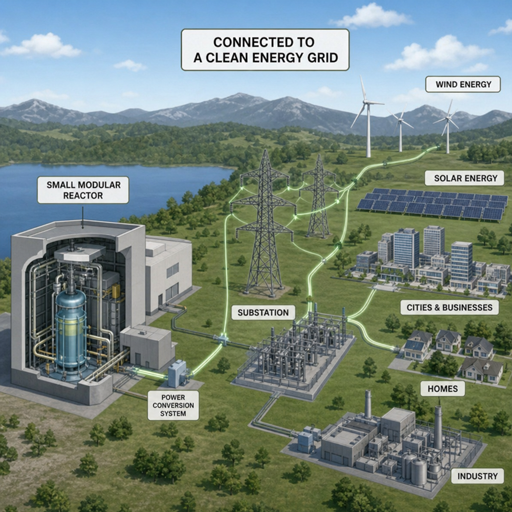
Small Modular Reactors SMRs are compact nuclear power systems designed to deliver reliable, low-carbon energy in smaller, more flexible increments than traditional large nuclear plants. They are attracting attention because modern grids need firm power that can work alongside renewables, support industrial heat demand, and strengthen energy resilience without relying only on large, centralized generation. This guide explains what they are, how modular reactor technology works, where it may fit, and what challenges still need to be solved before SMRs become a widely deployed nuclear energy solution.
What are small modular reactors SMRs?
Small modular reactors are nuclear reactors generally designed to produce up to about 300 megawatts of electric power per unit, with major systems intended for factory fabrication and transport to a site for installation. “Small” refers to unit size compared with conventional large reactors, “modular” refers to repeatable factory-built components or modules, and “reactor” refers to the controlled nuclear fission process that produces heat for electricity, steam, or other energy uses. Organizations including the IAEA, OECD Nuclear Energy Agency, World Nuclear Association, and U.S. Department of Energy describe SMRs as a family of designs rather than one single product or technology.
The concept matters because electricity systems are changing. Wind and solar are expanding, coal plants are retiring in many regions, industrial facilities are searching for cleaner heat, and communities want dependable power during extreme weather or fuel disruptions. SMRs are being explored as one possible answer: a source of firm, low-carbon energy that can be added in smaller steps and, in some designs, located closer to the demand it serves.
That does not mean SMRs are a universal replacement for every power plant. They still face the same broad issues that shape nuclear energy: licensing, cost, public trust, fuel supply, waste management, security, and construction discipline. Their promise depends on whether developers, regulators, utilities, and supply chains can turn advanced reactor designs into repeatable, financeable projects.
The energy problem SMRs are trying to solve
Modern power systems need more than clean electricity on an annual basis. They need electricity at the exact moment homes, factories, hospitals, data centers, and transportation systems require it. Solar output falls at night, wind output changes with weather, hydropower can vary with seasonal water conditions, and batteries are powerful but still limited by duration, cost, materials, and charging availability.
This is why firm low-carbon power is so important. Firm resources can operate through long periods of low renewable output, provide capacity during peak demand, and help stabilize the grid. The IEA has emphasized that electricity systems with high shares of variable renewables need flexibility, adequacy, stability, storage, demand response, interconnections, and dispatchable generation working together rather than relying on one resource alone.
SMRs fit into this conversation because they are designed to produce steady heat and electricity with very low operational greenhouse gas emissions. In a clean grid, they could serve as around-the-clock generation, flexible support for renewables, or dedicated energy for industrial customers that cannot easily run on variable power alone. The main value is not simply that the reactors are smaller; it is that their size and modular approach may open deployment models that large nuclear stations cannot easily serve.
Centralized generation is not the only model anymore
For decades, electricity systems were built around large power stations sending energy across long transmission networks. That model still matters, especially for major cities and heavy industry, but it is no longer the only architecture. Decentralized power generation is gaining attention because resilience, transmission constraints, local load growth, and industrial electrification are changing where energy is needed.
Small nuclear reactors could support this shift by serving regional grids, remote industrial sites, retiring fossil-fuel plant locations, military or research facilities, and energy-intensive campuses. A smaller unit may be easier to match with local demand than a gigawatt-scale plant, and multiple modules can potentially be added over time as demand grows. The benefit is planning flexibility: communities and utilities can consider nuclear capacity in increments rather than committing only to very large projects.
How modular reactor technology works
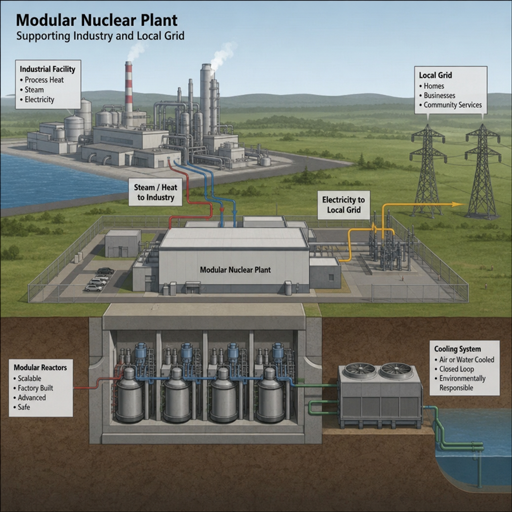
Modular reactor technology changes the delivery model as much as the reactor size. A conventional large nuclear project is usually a major site-specific construction effort. SMRs aim to shift more work into factories, standardize designs, reduce on-site complexity, and repeat the same configuration across multiple projects. If successful, that approach could help developers learn from each unit, shorten schedules, and improve quality control.
The core physics remains familiar: nuclear fission releases heat, heat is transferred to a working fluid, and that energy is used to produce electricity or useful thermal output. What varies is the coolant, fuel form, operating temperature, safety architecture, containment approach, and intended market. Some SMRs are based on light-water reactor technology, while other advanced reactor designs use high-temperature gas, molten salt, liquid metal, or other concepts.
The three ideas behind the name
- Small: Unit sizes are usually much lower than large nuclear reactors, which can exceed 1,000 megawatts electric. Smaller units may fit into weaker grids, industrial sites, island systems, or staged capacity additions.
- Modular: Key components are intended to be manufactured in controlled factory settings, transported to the site, and assembled with less custom field construction.
- Reactor: Like all nuclear reactors, the system must control fission, remove heat, contain radioactive materials, protect workers and the public, and follow strict regulatory requirements.
This combination is what makes SMRs different from simply building a smaller version of yesterday’s nuclear plant. The business case depends on repetition. A one-off small reactor may not be cheaper than a large plant on a per-megawatt basis, but a series of standardized modules could improve procurement, manufacturing, construction learning, training, operations, and maintenance.
Passive and simplified safety concepts
Many SMR designs emphasize passive safety features. Passive systems rely on natural physical forces such as gravity, convection, pressure differences, or natural circulation rather than depending only on powered pumps and active operator intervention. The U.S. Department of Energy notes that many SMRs use passive cooling concepts, and resilience-focused designs may also place portions of a plant below grade for added protection.
Passive safety is not magic, and it does not remove the need for rigorous licensing or emergency planning. It does, however, influence design philosophy. A reactor that can safely shut down and remove heat with fewer active systems may reduce complexity, simplify some safety cases, and improve public confidence if the design is demonstrated and independently reviewed.
Factory construction and repeatable deployment
The modular approach borrows from industries where repeat manufacturing improves quality and cost control. Instead of treating every plant as a custom megaproject, SMR developers want major components to be produced repeatedly under controlled conditions. This could reduce weather delays, improve inspection consistency, and support a specialized supply chain.
The challenge is that nuclear-grade manufacturing has exceptionally high quality standards. Factories, suppliers, welders, inspectors, digital controls, fuel producers, and transport logistics all need qualification. The first units are likely to carry higher costs because the supply chain is still learning; the strongest economic case appears only if enough reactors are ordered to create true series production.
The main types of advanced reactor designs
Small Modular Reactors SMRs are often discussed as if they were one technology, but they include several design families. Some are evolutionary designs based on today’s commercial nuclear experience. Others are more innovative systems intended to serve new markets such as industrial heat, hydrogen, desalination, or remote power.
Light-water SMRs
Light-water reactors use ordinary water as coolant and moderator. This is the most familiar nuclear technology because most operating commercial reactors use some form of light-water design. Many near-term SMRs build on this foundation because regulators, utilities, operators, fuel suppliers, and safety analysts already understand much of the underlying technology.
A light-water SMR may use an integrated design, placing major components such as the reactor core, steam generators, and pressurizer inside a single pressure vessel. This can reduce large piping and simplify certain accident scenarios. In the United States, NuScale’s SMR design review illustrates how regulators are evaluating smaller modular configurations within existing nuclear licensing frameworks.
High-temperature gas reactors
High-temperature gas reactors use helium or another gas coolant and can operate at higher temperatures than conventional light-water reactors. That makes them interesting for industrial heat applications, not just electricity. High-temperature output could support processes such as steam production, certain chemical operations, or hydrogen pathways where heat is valuable.
These designs often use robust fuel forms intended to retain fission products at high temperatures. Their potential advantage is energy versatility. Instead of being only a power plant, the reactor can become part of a broader industrial energy system.
Molten salt reactors
Molten salt reactors use liquid salt as coolant, and in some concepts the fuel is dissolved in the salt itself. These designs are attractive to researchers because salts can operate at high temperatures and low pressures compared with water-cooled systems. High temperature can improve thermal efficiency and expand non-electric uses.
However, molten salt technology also introduces engineering questions around materials corrosion, chemistry control, fuel processing, licensing methods, and maintenance. The promise is significant, but commercialization requires proving that the systems can operate reliably, safely, and economically over long periods.
Fast reactors and liquid-metal systems
Fast reactors use high-energy neutrons and may be cooled by liquid metal such as sodium or lead. They can be designed for efficient fuel use, waste-management strategies, or specialized industrial applications. Some concepts aim to use different fuel cycles than conventional reactors.
The technical opportunity is balanced by complexity. Liquid-metal coolants require careful materials selection, chemical control, and specialized operating practices. These designs may play a future role, but their success depends on demonstration projects and regulatory confidence.
Why are SMRs important for decentralized power generation?
SMRs are important for decentralized power generation because they may allow reliable, low-carbon energy to be placed closer to where it is needed, in smaller increments than traditional nuclear stations. That could help communities, industrial sites, utilities, and large energy users reduce dependence on distant generation and long fuel supply chains. The practical value is resilience: a well-sited SMR could support local demand, stabilize a regional grid, and provide heat or power even when weather-dependent resources are limited.
This does not mean every town would have its own nuclear plant. Nuclear sites require security, skilled operators, emergency planning, regulatory oversight, and public acceptance. Decentralization in this context means a more distributed portfolio of firm energy assets, not casual deployment. A realistic SMR network would likely begin with carefully selected sites: existing nuclear locations, retiring coal plants, large industrial campuses, remote mines, defense facilities, or regions with constrained transmission.
Where SMRs could fit best
- Retiring coal plant sites: Existing grid connections, cooling infrastructure, industrial zoning, and skilled energy workforces may make some fossil-plant locations attractive for nuclear repowering.
- Industrial heat users: Refineries, chemical plants, paper mills, district heating systems, and future hydrogen facilities need reliable thermal energy that electricity alone may not efficiently provide.
- Remote regions: Mining operations, isolated communities, islands, and Arctic or desert sites often rely on expensive fuel deliveries and may value long-duration energy security.
- Data centers and large campuses: Energy-intensive facilities increasingly need clean, reliable power with high uptime expectations.
- Growing regional grids: Smaller units may be easier to integrate into grids that cannot absorb a very large reactor all at once.
The strongest cases share a few traits: high energy demand, a clear need for firm power, supportive regulation, suitable siting, long-term customers, and enough project volume to justify manufacturing investment. Without those conditions, SMRs may struggle to compete against renewables, storage, transmission upgrades, demand response, geothermal, hydro, or gas with carbon management.
SMRs as nuclear energy solutions beyond electricity
One of the most important SMR advantages is that reactors produce heat first and electricity second. Conventional energy discussions often focus on power generation, but a large share of energy demand comes from heat used in buildings, industry, water treatment, and fuel production. Electrification can meet many needs, but not every thermal process is easy or economical to electrify.
The U.S. Department of Energy notes that advanced SMRs are being considered for power generation, process heat, desalination, and other industrial uses. Some advanced designs may provide higher-temperature heat than traditional light-water reactors, expanding the range of possible applications.
Industrial heat and steam
Many factories need constant steam or high-temperature heat. Today, that heat often comes from natural gas, coal, or oil. If an SMR can deliver dependable heat without direct fossil combustion, it may help decarbonize industrial processes that are difficult to serve with wind and solar alone.
The commercial structure would matter. An industrial customer may not want to own or operate a nuclear plant. Future models could involve energy service providers, utility partnerships, heat purchase agreements, or colocated nuclear-industrial parks where trained operators manage the reactor while customers buy steam, electricity, or both.
Desalination and water security
Desalination requires energy to remove salt from seawater or brackish water. In regions facing water scarcity, nuclear-powered desalination has long been studied because reactors can supply both electricity and heat. SMRs could make the concept more flexible if smaller units align with regional water demand.
This application would need careful coastal siting, environmental review, brine management, and integration with water infrastructure. It is not simply an energy project; it is also a water, permitting, ecological, and community planning project.
Hydrogen and synthetic fuels
Clean hydrogen production may grow if industries need low-carbon feedstocks, fuels, or energy storage. Nuclear energy can support hydrogen through electricity for electrolysis, heat-assisted processes, or high-temperature designs that improve efficiency. SMRs could be paired with hydrogen facilities where constant operation improves equipment utilization.
The value depends on hydrogen markets, infrastructure, policy, and competing production methods. An SMR does not automatically make hydrogen economical, but it can provide the steady low-carbon energy that many hydrogen pathways need.
Comparing SMRs with large nuclear plants and renewables
SMRs are not “better” or “worse” than other energy technologies in a universal sense. They serve different needs. The right comparison depends on grid size, demand profile, financing, climate goals, land availability, fuel logistics, public acceptance, and regulatory readiness.
|
Energy option |
Main strength |
Main limitation |
Where it may fit |
|---|---|---|---|
|
Large nuclear plant |
Very high output, long operating life, firm low-carbon power |
Large upfront project size, complex construction, long development timelines |
Major grids with strong financing and high demand |
|
SMR |
Smaller increments, modular deployment, potential industrial siting |
First-of-a-kind cost, licensing, manufacturing scale-up |
Regional grids, industrial sites, coal repowering, remote power |
|
Solar and wind |
Fast deployment, low operating emissions, scalable |
Variable output, location-dependent, needs balancing resources |
Broad clean-energy expansion where resources are strong |
|
Batteries |
Fast response, grid services, short-duration shifting |
Duration and cost limits for long energy gaps |
Daily balancing, peak shaving, frequency support |
|
Gas with carbon management |
Dispatchable generation using familiar plant models |
Fuel supply, methane, capture rates, CO₂ transport and storage |
Backup or firm capacity where carbon infrastructure exists |
The most realistic clean-energy systems will likely use portfolios. Wind and solar can provide large volumes of low-cost energy when conditions are favorable. Batteries and demand response can shift demand and stabilize short-term operations. Transmission can move power across regions. Firm low-carbon technologies such as nuclear, geothermal, hydro, long-duration storage, or carbon-managed thermal plants can help cover longer gaps and maintain reliability.
The economics of SMRs depend on repetition
The economic argument for SMRs is often misunderstood. A smaller reactor does not automatically produce cheaper electricity. In fact, large reactors benefit from economies of scale: one containment, one control room, one site, and one large output. SMRs attempt to replace economies of scale with economies of series production.
That means the first unit is not the true test of the business model. First-of-a-kind projects carry design finalization, licensing, supply chain, workforce, and construction learning costs. The larger question is whether the tenth, twentieth, or fiftieth module can be produced more predictably and installed with less risk. The OECD Nuclear Energy Agency describes SMRs as relying on modularisation, standardisation, and factory-based construction to enable more predictable delivery models.
What could improve cost performance
- Standardized designs: Fewer custom changes reduce engineering rework, licensing uncertainty, and supply-chain confusion.
- Factory learning: Repeated manufacturing can improve quality, speed, and labor productivity.
- Staged capacity additions: Utilities can add modules as demand grows instead of financing a very large plant upfront.
- Simplified systems: Integrated designs and passive safety may reduce some components, construction tasks, or maintenance needs.
- Repurposed sites: Retiring coal or industrial sites may already have transmission, roads, water access, and trained energy workers.
What could weaken the business case
- Low order volume: Without many units, factories cannot spread costs or improve through repetition.
- Regulatory delay: Long review timelines can raise financing costs and slow deployment.
- Custom site demands: If every project becomes bespoke, modular savings shrink.
- Supply-chain bottlenecks: Nuclear-grade components, qualified labor, and specialized fuel can constrain growth.
- Competing technologies: Renewables, storage, geothermal, transmission, and efficiency may be cheaper in some markets.
The economic future of SMRs will therefore be shaped less by marketing claims and more by project execution. Cost discipline, repeat orders, regulatory clarity, and operational performance will determine whether small nuclear reactors become mainstream energy infrastructure.
Safety, regulation, waste, and public trust
Nuclear energy solutions cannot succeed on engineering alone. They require public legitimacy. Communities need clear information about safety systems, emergency planning, waste handling, security, water use, land impacts, decommissioning, and long-term oversight. For SMRs, public trust may be even more important because the technology is often discussed for new locations outside traditional nuclear sites.
Regulation remains central. In the United States, commercial nuclear plants and related activities are licensed by the Nuclear Regulatory Commission, and applicants must go through formal review before construction and operation. SMR developers must demonstrate that their designs meet safety requirements, protect workers and the public, and can be operated securely.
Waste does not disappear because the reactor is smaller
SMRs still produce radioactive waste and used nuclear fuel. The quantity, form, and management approach vary by design, fuel type, and operating strategy, but the responsibility remains. Any serious SMR plan must include storage, transportation, safeguards, decommissioning, and national policy alignment.
This point matters because “small” can sound simple. Nuclear materials management is never casual. Smaller units may change logistics, but they do not remove the need for strong institutions and long-term stewardship.
Security and safeguards are part of the design conversation
Nuclear facilities require physical protection, cybersecurity, material accounting, and safeguards against misuse. If SMRs are deployed at more locations, the security model must scale with them. This could influence which sites are appropriate, how remote operation is handled, how transport is secured, and what staffing levels regulators require.
Designers often argue that underground siting, robust containment, passive safety, and smaller source terms can improve resilience. Those features must be evaluated through independent review, not assumed. The path to public acceptance runs through transparent evidence, not slogans.
How should utilities and communities evaluate SMRs?
Utilities and communities should evaluate SMRs by matching the technology to a real energy need, not by starting with the reactor and searching for a purpose. A good SMR project begins with demand: how much electricity or heat is needed, when it is needed, what alternatives exist, and what reliability or emissions goals must be met. Only then can planners decide whether an SMR is better than renewables, storage, transmission, efficiency, geothermal, conventional nuclear, or other options.
A disciplined planning process also prevents overpromising. SMRs may be valuable, but they are not plug-and-play devices. They require strong local institutions, skilled workforces, emergency services coordination, grid integration, financing, fuel planning, waste pathways, and long-term operations capability.
SMR readiness checklist
Use this checklist as an early screening tool before deeper feasibility work:
- Demand fit: Is there a steady need for power, steam, heat, water production, or hydrogen that justifies firm generation?
- Site suitability: Does the location have land, cooling options, transmission access, security boundaries, and environmental compatibility?
- Regulatory pathway: Is there a clear licensing process, experienced regulator, and realistic project timeline?
- Customer structure: Are there creditworthy buyers for electricity, heat, or both over a long enough period?
- Community engagement: Have local residents, workers, emergency responders, and public officials been involved early?
- Supply chain: Can the developer source fuel, components, qualified labor, and maintenance support?
- Waste and decommissioning: Is there a credible plan for used fuel, radioactive waste, and end-of-life obligations?
- Alternative comparison: Has the project been compared fairly against efficiency, renewables, storage, transmission, and other firm resources?
- Financing: Can the project manage first-of-a-kind risk, construction risk, and interest during development?
- Scalability: If the first module succeeds, is there a realistic pathway to add more units and capture modular benefits?
This kind of evaluation is especially important for public communication. People are more likely to trust a project when the problem is clear, the alternatives have been considered, and the tradeoffs are acknowledged honestly.
The biggest barriers to SMR deployment
SMRs are promising because they respond to real energy challenges, but the barriers are substantial. The technology is advancing, yet broad deployment depends on solving practical problems that are financial, institutional, and social as much as technical.
Licensing and first-of-a-kind uncertainty
Regulators must review new designs carefully, especially when they differ from existing reactor types. That process protects public safety, but it can take time and money. Developers need enough certainty to attract investment, while regulators need enough evidence to make defensible decisions.
This tension is normal for advanced energy technologies. The best path is not weaker oversight; it is clearer expectations, better test data, standardized applications, and early communication between developers and regulators.
Fuel availability
Some advanced reactor designs may require fuels or enrichment levels that are not yet widely available at commercial scale. Fuel supply affects national security, project timing, operating costs, and international partnerships. A reactor design cannot be commercially successful if its fuel supply chain is fragile.
Workforce and manufacturing capacity
A mature SMR industry would need nuclear engineers, operators, welders, inspectors, construction managers, cybersecurity specialists, emergency planners, and manufacturing technicians. Many countries already face energy workforce constraints. Scaling SMRs would require training pipelines, apprenticeships, university programs, supplier qualification, and long-term career pathways.
Public acceptance
Public opinion on nuclear energy varies widely by region and political culture. Some communities see nuclear as a necessary low-carbon tool; others focus on accident risk, waste, cost, or distrust of institutions. SMR projects will need early engagement that listens before it persuades.
Public acceptance is not a communications afterthought. It is a project condition. Communities should be able to ask hard questions and receive clear answers about safety, emergency planning, local benefits, jobs, water use, environmental impacts, and long-term responsibilities.
The future of SMRs in the energy mix
The future of SMRs will likely be uneven rather than sudden. Early projects may appear in countries with strong nuclear regulators, government support, suitable industrial customers, and urgent reliability or decarbonization needs. Some designs will fail to commercialize. Others may find niche markets first, then expand if operating experience, cost data, and public confidence improve.
In the near term, light-water SMRs may have an advantage because they build on known technology. Over the longer term, advanced reactor designs could become important if they prove they can deliver high-temperature heat, flexible operation, improved fuel use, or strong performance in industrial settings. The most successful designs will be the ones that solve a customer’s real problem at an acceptable cost and with a credible safety case.
SMRs should be understood as part of a broader clean-energy toolkit. They can complement renewables, strengthen decentralized power generation, support industrial decarbonization, and provide reliable heat and electricity where other solutions are incomplete. But they are not exempt from economics, regulation, or public accountability.
The future of energy will not be built by one technology alone. It will be built by portfolios that match local resources, demand, reliability needs, and climate goals. If modular reactor technology delivers on standardization, safety, repeatability, and cost control, Small Modular Reactors SMRs could become one of the most important nuclear energy solutions for a cleaner and more resilient power system.
