
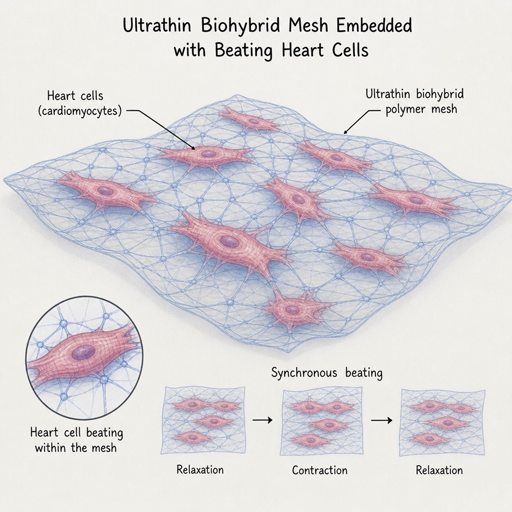
A research team led by the University of Massachusetts Amherst has reported an ultrathin, flexible biohybrid mesh that can harvest energy from human cardiac cells and turn their motion into electricity. The device, described in Science Advances on October 7, 2026, points toward battery-free wearable and implantable electronics, though the work remains at the laboratory stage. The advance matters because many medical electronics still depend on batteries that add bulk, limit flexibility, and eventually need replacement.
How does the ultrathin mesh generate electricity?
The mesh uses a distributed energy harvesting design: instead of drawing power from one centralized battery, it places many tiny harvesting units throughout a soft platform that can integrate with living tissue. Researchers built the system with thin ribbons of lead zirconate titanate, or PZT, a piezoelectric material that converts mechanical movement into electrical energy. When human cardiac cells grew into and around the PZT-loaded polymer mesh, their contractions supplied the motion needed for energy capture.
That design is the central shift. Conventional electronics usually depend on a single power source, while living tissue distributes energy production across cells. By borrowing that biological model, the researchers say the mesh technology can sit closer to the cellular scale and behave more like the tissue it is designed to support.
The reported breakthrough in brief
The study, titled “A Biohybrid Mesh Harvester for Distributed Energy Harvesting in Living Tissues,” was authored by Siqi Wang, Xiaoyu Wang, Shuai Fu, Claire Senger, Jacob Pfund, Menka Jain, Reika Katsumata, and Jun Yao. It appears in Science Advances, volume 12, issue 41, with the DOI 10.1126/sciadv.aei5963. The research demonstrates the concept in an in vitro cardiac tissue system, meaning the electricity-generating tissue platform was tested in the lab rather than implanted in a living person.
Key details from the announcement and paper abstract include:
- Material approach: arrays of thin PZT ribbons placed on an ultrathin, ultraflexible polymer platform.
- Biological interface: human cardiac cells seeded onto the platform, where they grew into the mesh structure.
- Energy source: biomechanical motion from contracting heart cells, not an external charger or conventional battery.
- Performance claim: effective energy density more than an order of magnitude higher than existing centralized approaches, according to the study abstract.
- Current status: a laboratory demonstration, not a clinical product.
- Long-term direction: possible use as a framework for in vivo biohybrid harvesting solutions and other energy capture methods.
Why battery-free implantable electronics are difficult
The appeal of flexible energy systems is easy to understand in medicine. Pacemakers, implantable defibrillators, deep brain stimulators, cochlear implants, and health monitors all need dependable power. Batteries have made those devices possible, but they also create practical constraints: they occupy space, they can be mechanically mismatched with soft tissue, and their stored charge is finite.
Making batteries smaller is not a simple solution. Smaller batteries generally store less energy, while making devices softer and more tissue-like can be difficult when a rigid power component remains part of the system. That tension has pushed researchers toward sustainable energy concepts inside the body, including piezoelectric, biochemical, thermal, and wireless approaches for low-power bioelectronics.
The UMass-led mesh addresses the problem by making energy capture part of the tissue interface rather than a separate bulky module. In plain terms, the system is meant to move with the cells that power it. If future versions can operate safely and reliably in living tissue, the approach could reduce dependence on replacement batteries for certain classes of low-power implants.
A distributed design modeled on living tissue
The phrase “distributed energy harvesting” is important because it separates this work from earlier power-harvesting concepts that attach a generator to a tissue surface. The study abstract says existing approaches based on continuous substrates follow a centralized paradigm, while living tissues naturally distribute energy conversion across many small biological units. The new mesh tries to imitate that pattern by embedding individual harvesting units within a network that resembles the structural and mechanical properties of biological tissue.
That could help with both scalability and biocompatibility. A rigid or bulky device may irritate surrounding tissue or lose contact as organs move. A soft mesh that can be engulfed by growing cells may form a more intimate interface, giving the harvester access to small-scale motion that surface-mounted devices can miss.
Still, “more tissue-like” does not automatically mean ready for medicine. Any implantable version would need to address long-term stability, immune response, electrical safety, material durability, manufacturability, and regulatory review. The present finding is best understood as a platform advance: it shows a way to rethink energy harvesting at the cellular level, not a finished replacement for today’s medical-device batteries.
Flexible energy beyond the heart-cell experiment
Although the demonstration focused on human cardiac cells, the researchers describe the concept as a generalizable framework. In other words, the heart-cell system is a proof of principle because cardiac tissue contracts rhythmically and provides a clear mechanical input. Future versions might adapt the architecture to other energy capture modes or tissue environments, depending on the device’s power needs and safety requirements.
That broader possibility gives the work relevance beyond one material stack. Flexible energy harvesting has become a major research direction as electronics move from hard boxes and flat circuit boards toward soft patches, wearable sensors, and organ-conformal implants. Mesh technology is especially attractive because it can combine open space for cells with pathways for electronic function.
For sustainable energy discussions, this is not the same as grid-scale renewable power. It is sustainable in a biomedical sense: the device seeks to draw small amounts of usable electricity from biological activity that is already happening. That distinction matters. The goal is not to power homes or vehicles; it is to make tiny electronics less dependent on disposable or surgically replaceable power sources.
What happens next
The next phase is likely to focus on proving whether ultrathin mesh energy harvesting can remain stable and useful under more realistic biological conditions. Lab-grown cardiac tissue is a controlled environment; living bodies are not. Fluids, immune reactions, scar formation, movement, and long operating times can all change how an implant performs.
Researchers will also need to match power output to real electronic workloads. A harvester that generates promising density in the lab still has to support sensing, stimulation, data processing, communication, or energy storage in a complete system. Stacking ultrathin films could increase available power, according to the UMass announcement, but each added layer must preserve softness, safety, and reliable tissue integration.
For now, the finding adds momentum to a clear trend in bioelectronics: power systems are becoming softer, smaller, and more biologically integrated. If the approach advances beyond the bench, it could help reshape harvesting solutions for implants that need long-term power without the burden of conventional batteries. The promise is significant, but the timeline remains open, and clinical use will require far more testing than this early demonstration provides.
