
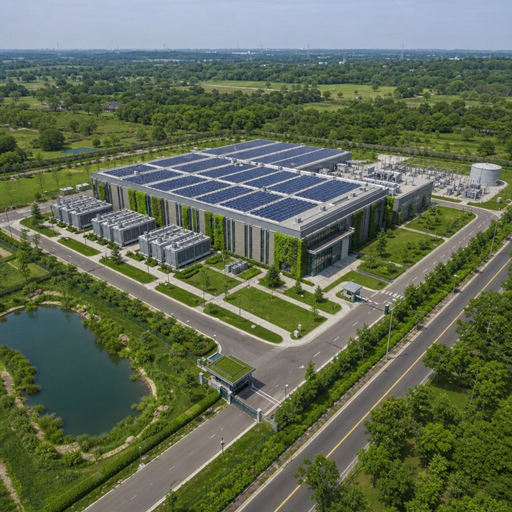
Hyperscale green data centers are large-scale computing facilities designed to deliver massive digital capacity while reducing environmental impact. They combine hyperscale computing architecture with renewable energy data strategies, efficient cooling, responsible water use, circular hardware practices, and smarter operational controls. For cloud providers, enterprises, AI platforms, and digital infrastructure teams, the goal is clear: build and run data capacity that can grow without treating energy, land, water, and equipment as afterthoughts.
What makes a data center “green” at hyperscale?
A hyperscale data center becomes “green” when sustainability is built into how the facility is powered, cooled, designed, operated, expanded, and eventually upgraded. At hyperscale, small inefficiencies multiply quickly, so green performance depends on both the building and the computing model inside it. A truly sustainable approach considers energy sourcing, server utilization, cooling efficiency, grid impact, hardware lifecycle, emissions reporting, and resilience together rather than as separate projects.
Traditional data centers often focused first on uptime and capacity, then optimized energy use later. Hyperscale green data centers reverse that habit by treating efficiency as a design requirement from the beginning. This does not mean sacrificing reliability. It means choosing systems, locations, and operating practices that support high availability while reducing wasted power, heat, water, and materials.
The “green” label can be vague if it is not tied to measurable actions. A facility may purchase renewable power, but still run inefficient cooling. Another may use advanced green technology inside the building, but lack a credible plan for equipment reuse or transparent reporting. The strongest sustainable data centers combine several layers of improvement instead of relying on a single claim.
The core building blocks of hyperscale green data centers
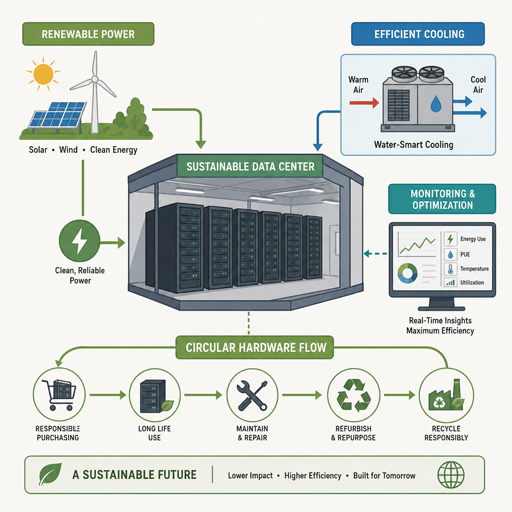
Sustainable design at hyperscale is not one technology. It is a coordinated system in which facility engineering, IT architecture, procurement, and operations all influence the footprint. The most effective strategies usually start with reducing demand before replacing supply, because the cleanest energy is the energy that never has to be used.
Key building blocks include:
- Renewable energy procurement: Using power purchase agreements, onsite generation where practical, renewable tariffs, or other clean energy mechanisms to match electricity demand with lower-carbon supply.
- Efficient power distribution: Reducing conversion losses between the grid, backup systems, racks, and servers.
- High-utilization computing: Designing workloads so servers do more useful work instead of sitting idle.
- Low-impact cooling: Matching cooling methods to climate, workload density, water availability, and heat reuse opportunities.
- Automation and monitoring: Using sensors, software, and operational analytics to detect inefficiency before it becomes normal.
- Circular hardware management: Extending equipment life, refurbishing components, recycling materials responsibly, and avoiding unnecessary replacement cycles.
- Transparent data center sustainability reporting: Tracking energy, water, emissions, and waste in ways that decision-makers can actually use.
These elements work best when they are planned together. For example, a high-density AI cluster may improve compute efficiency per task, but it can also increase rack-level heat. That changes the cooling strategy, power distribution design, and renewable energy data model. Hyperscale green data centers must therefore be evaluated as ecosystems, not as isolated rooms filled with servers.
Renewable energy data turns intention into strategy
Renewable energy data is essential because clean power claims depend on timing, location, source, and verification. It is not enough to say a facility uses renewable energy; operators need to understand when the data center consumes power, where that power is generated, how it is matched, and whether the procurement model supports additional clean energy capacity.
For hyperscale operators, electricity demand can be enormous and continuous. Matching that demand with clean energy requires planning across contracts, grid regions, workload scheduling, and backup systems. Some organizations use annual matching, while more advanced strategies may consider hourly or regional matching to better align consumption with renewable generation. The practical implication is that sustainability teams need reliable energy data, not just certificates or marketing language.
Renewable energy data also supports better workload decisions. If a non-urgent computing task can run when cleaner power is available, software scheduling can become part of the sustainability toolkit. This is especially relevant for batch processing, analytics, rendering, model training, and other flexible workloads. It does not replace efficient infrastructure, but it helps hyperscale computing operate more intelligently.
A useful renewable energy data program should clarify:
- Source: What type of renewable energy is being used or matched?
- Location: Is the generation connected to the same grid region as the demand?
- Timing: Is clean energy matched annually, monthly, hourly, or through another method?
- Additionality: Does the procurement help bring new renewable capacity online?
- Reliability: How is the facility powered when renewable supply is unavailable?
- Reporting: Can the claims be audited, compared, and improved over time?
Without this level of detail, green data centers can appear sustainable on paper while still placing stress on local energy systems. With it, operators can make better investments and communicate progress more credibly.
Cooling, heat, and water define real-world efficiency
Cooling is one of the most important sustainability challenges in hyperscale environments because servers convert electricity into heat. The more computing density increases, the more carefully operators must manage that heat. Efficient cooling is not just a facility cost issue; it affects energy demand, water consumption, hardware performance, and location strategy.
Air cooling remains common, but higher-density workloads may require more advanced designs. Liquid cooling, rear-door heat exchangers, immersion systems, and hybrid approaches can move heat more efficiently in the right context. The best choice depends on climate, rack density, maintenance capacity, water availability, and the type of computing being supported. A cooling technology that works well in one region may be a poor fit in another.
Water use deserves special attention. Some cooling systems reduce electricity consumption but rely on significant water resources. In water-stressed regions, that tradeoff may undermine broader data center sustainability goals. Sustainable data centers should consider water source, local scarcity, treatment needs, discharge impact, and opportunities for closed-loop or low-water designs.
Heat reuse is another promising area. Instead of treating waste heat as a problem to remove, some facilities can direct usable heat to nearby buildings, industrial processes, greenhouses, or district heating systems. This depends heavily on local infrastructure and heat quality, so it is not universally available. Still, it reflects the right mindset: in green technology, waste streams should be examined for potential value before being discarded.
How do hyperscale facilities reduce emissions without reducing performance?
Hyperscale facilities reduce emissions by improving efficiency, sourcing cleaner power, increasing utilization, and designing systems that deliver more computing output per unit of environmental impact. Performance and sustainability do not have to compete when infrastructure is engineered around both outcomes. In many cases, the same practices that reduce waste also improve reliability, capacity planning, and long-term cost control.
The first step is usually measurement. Operators need visibility into energy use at the facility, rack, cluster, and workload levels. Broad facility metrics can reveal trends, but they may hide inefficient applications or underused equipment. More granular data allows teams to identify which workloads consume the most power, when demand peaks, and where optimization will matter most.
The second step is workload efficiency. Software design, virtualization, container orchestration, storage architecture, and scheduling all influence infrastructure demand. A poorly optimized workload can waste energy even inside a highly efficient building. For organizations using cloud or colocation environments, this means sustainability is not only the provider’s responsibility; application teams also shape the footprint.
Practical emission-reduction measures include:
- Rightsizing infrastructure so applications are not overprovisioned for normal demand.
- Improving server utilization through workload consolidation and better scheduling.
- Retiring inefficient hardware when replacement creates a credible lifecycle benefit.
- Selecting lower-carbon regions for workloads that do not need a specific location.
- Using renewable power contracts aligned with actual facility demand.
- Optimizing storage tiers so rarely accessed data does not sit on unnecessarily energy-intensive systems.
- Designing for resilience efficiently rather than duplicating capacity without a clear risk model.
The most mature programs connect these decisions to governance. Sustainability targets should influence procurement, architecture reviews, capacity planning, and vendor selection. Otherwise, green goals remain separate from the decisions that actually create energy demand.
Location strategy shapes sustainability outcomes
Where a hyperscale data center is built can influence its environmental performance for decades. Climate affects cooling demand. Grid composition affects emissions. Water availability affects cooling choices. Land use, permitting, community impact, fiber connectivity, and latency requirements all matter as well.
Cooler climates can support efficient cooling strategies, but location decisions are rarely that simple. A facility also needs access to power, network routes, skilled labor, and customers or workload regions. If a data center is located far from users, latency-sensitive services may suffer. If it is located in a constrained energy market, it may increase pressure on the grid even if the building itself is efficient.
A strong site selection process considers both operational and community impact. Hyperscale green data centers should be planned with awareness of local infrastructure, not just corporate sustainability goals. This includes evaluating whether renewable energy projects can be developed responsibly, whether water use is appropriate for the region, and whether the facility creates avoidable stress during peak demand periods.
Sustainable siting questions include:
- Is the regional grid becoming cleaner or more constrained?
- Can the facility access renewable energy in a credible way?
- Does the climate support efficient cooling for the intended workloads?
- Are water resources sufficient and responsibly managed?
- Can waste heat be reused by nearby systems?
- Does the community benefit from infrastructure investment without bearing disproportionate environmental costs?
- Are future expansions likely to remain sustainable, or will growth outpace local resources?
Location is not a one-time real estate decision. It becomes part of the facility’s sustainability profile for its entire operating life.
Green technology inside the facility
Green technology in data centers includes the systems that reduce energy waste, improve operational control, and support cleaner resource use. Some of these technologies are physical, such as efficient transformers, liquid cooling loops, high-efficiency UPS systems, and advanced building materials. Others are digital, including monitoring platforms, predictive maintenance tools, workload schedulers, and energy management software.
Automation is especially valuable at hyperscale because manual optimization cannot keep pace with constant workload changes. Sensors can detect temperature variation, airflow problems, equipment degradation, and abnormal power consumption. Control systems can then adjust cooling, balance loads, or alert teams before a small inefficiency becomes a larger issue.
Artificial intelligence and machine learning may also support operational tuning, but they should be used carefully. The sustainability benefit depends on whether the optimization saves more resources than the system consumes. In practical terms, green technology should be judged by outcomes: lower waste, better reliability, reduced emissions, improved visibility, or longer equipment life.
A useful way to evaluate any green technology is to ask:
- What problem does it reduce? Energy loss, water use, heat, downtime risk, material waste, or reporting gaps?
- Where does it fit? Facility systems, IT hardware, software operations, procurement, or governance?
- What tradeoffs does it create? Cost, complexity, maintenance needs, water demand, or vendor lock-in?
- How will success be measured? Through consumption data, emissions reporting, utilization rates, or lifecycle outcomes?
This prevents technology from becoming a badge rather than a tool. Sustainable data centers need practical systems that improve performance in measurable ways.
Circular hardware practices reduce hidden impact
The environmental footprint of hyperscale computing is not limited to electricity. Servers, storage equipment, networking gear, batteries, cooling systems, and construction materials all carry embedded impact from manufacturing, transport, installation, and disposal. Circular hardware practices help reduce this hidden burden.
A circular approach starts with procurement. Equipment should be selected for durability, efficiency, serviceability, and compatibility with future upgrades. Modular designs can make it easier to replace components without discarding entire systems. Standardized parts can simplify repair and reuse across large fleets.
During operation, asset management becomes critical. Operators need to know what equipment they own, how it performs, when it should be upgraded, and whether it can be redeployed before recycling. A server that is no longer suitable for a demanding workload may still be useful for a less intensive one. Extending useful life can reduce waste, as long as older equipment does not consume so much extra energy that replacement is clearly better.
At end of life, responsible recycling and data security must work together. Drives and components need secure handling, but secure disposal should not automatically mean destruction of everything. Sustainable programs look for safe reuse, parts recovery, certified recycling, and clear documentation.
Data center sustainability metrics that matter
Metrics help teams move from good intentions to accountable progress. However, a single number rarely tells the whole story. Hyperscale green data centers should track a balanced set of indicators across energy, emissions, water, hardware, and operational efficiency.
Commonly useful categories include:
- Energy efficiency: How much total facility energy is required relative to IT energy.
- Carbon intensity: How emissions vary by power source, region, and time.
- Renewable energy matching: How clean energy procurement aligns with actual consumption.
- Water efficiency: How much water is used for cooling and operations, especially in sensitive regions.
- Server utilization: How much installed computing capacity performs useful work.
- Hardware lifecycle: How equipment is reused, refurbished, recycled, or retired.
- Waste management: How construction, packaging, batteries, and electronic waste are handled.
- Resilience impact: How backup power and redundancy choices affect emissions and resource use.
Good reporting also explains boundaries. Does the data include only the facility, or also embodied carbon from construction and equipment? Does it cover owned sites, leased space, and cloud services? Are renewable energy claims based on annual matching, hourly matching, or another approach? Clear boundaries make sustainability claims more credible and easier to improve.
Best practices for planning a hyperscale green data center
Planning a green hyperscale facility requires early coordination between executives, engineers, sustainability teams, finance, procurement, software architects, and community stakeholders. Decisions made during design can lock in energy use and operating constraints for years. Retrofitting is possible, but prevention is usually more effective than correction.
A practical planning checklist includes:
- Define sustainability goals before design begins. Decide what success means for energy, emissions, water, waste, and community impact.
- Model demand realistically. Include expected workload growth, density changes, AI or analytics requirements, and redundancy needs.
- Choose sites with resource constraints in mind. Evaluate grid conditions, water availability, climate, land use, and expansion risk.
- Design power and cooling together. Avoid treating thermal management as a late-stage engineering fix.
- Build a renewable energy strategy. Use reliable renewable energy data to match procurement with operational needs.
- Plan for flexible workloads. Shift non-urgent computing when cleaner or lower-impact energy is available.
- Select equipment for lifecycle value. Consider efficiency, repairability, reuse, and recycling from the start.
- Create transparent governance. Assign responsibility for sustainability decisions across teams, not just to one reporting function.
- Monitor continuously. Use operational data to identify drift, waste, and improvement opportunities.
The best practices are not only technical. They also require decision discipline. If capacity growth is approved without sustainability review, or if procurement rewards lowest upfront cost without lifecycle analysis, green goals can quickly erode.
The future of hyperscale computing is sustainability-led
Hyperscale computing will continue to support cloud services, artificial intelligence, streaming, enterprise platforms, digital finance, research, and connected devices. As demand grows, the industry’s ability to scale responsibly will depend on cleaner power, efficient infrastructure, smarter software, and more transparent accountability. Green data centers are not a niche concept; they are becoming a practical requirement for resilient digital growth.
The next stage of data center sustainability will likely be more integrated. Energy-aware software, grid-interactive operations, advanced cooling, circular supply chains, and better renewable matching will increasingly work together. Organizations that understand this shift can make better decisions about where their workloads run, which providers they choose, and how their own applications consume resources.
For any team evaluating hyperscale green data centers, the most important lesson is to look beyond labels. Ask how energy is sourced, how efficiently computing is delivered, how water and heat are managed, how equipment is handled, and how progress is measured. Sustainable digital infrastructure is built through evidence, design discipline, and continuous improvement—not slogans.
Key takeaways for sustainable data center decisions
Hyperscale green data centers combine large-scale computing capacity with sustainability practices that reduce environmental impact across energy, cooling, water, hardware, and operations. The strongest facilities use renewable energy data, efficient design, green technology, transparent metrics, and circular asset management to support growth responsibly.
When comparing options or planning a new project, focus on the full system. Clean electricity matters, but so do workload efficiency, site selection, cooling design, equipment lifecycle, and governance. A data center is only as sustainable as the decisions that shape it every day.
In practical terms, the path forward is straightforward: measure carefully, reduce waste first, source cleaner energy, design for local conditions, and keep improving as technology and grid conditions change. That is how sustainable data centers can support the future of hyperscale computing without ignoring the physical resources behind the digital world.
