
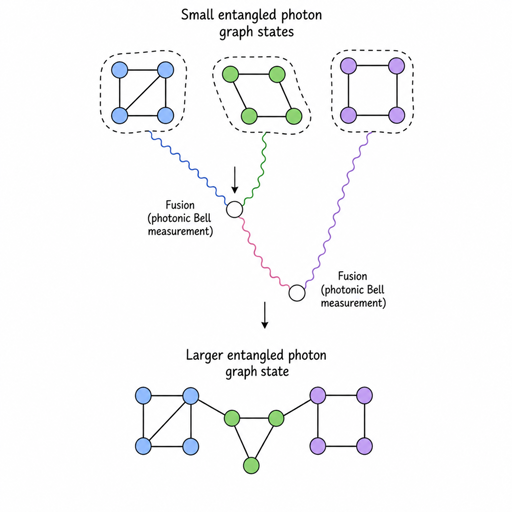
A new superconducting-circuit experiment shows a practical way to assemble larger entangled photon states from smaller building blocks. Researchers at Tsinghua University and Hefei National Laboratory used microwave photons, programmable fusion, and a superconducting device to demonstrate genuine multipartite entanglement across 13 photonic qubits, pointing toward more flexible resources for quantum computing and quantum networks.
Why does linking smaller photon groups matter?
Linking smaller photon groups matters because large, controllable entangled states are difficult to create in one shot. Instead of trying to build a huge quantum state all at once, the new approach treats smaller entangled photon groups as modular pieces that can be fused into a larger graph state. That is important because graph states are useful resources for measurement-based quantum computing, quantum communication, and future quantum networks.
In ordinary computing, scaling often means adding more transistors, memory, or servers. In quantum computing, scaling is more subtle: the system must preserve delicate quantum states while connecting many qubits in useful patterns. Quantum entanglement is the link that makes these patterns meaningful, allowing the state of one part of a system to be inseparable from the state of the whole.
The recent Nature Physics work, titled “Deterministic and programmable fusion for the scalable generation of photonic graph states,” focuses on exactly that scaling challenge. Rather than relying on a probabilistic process that may fail and destroy resources, the team demonstrated a deterministic and programmable fusion operation for microwave photonic qubits.
The experiment in plain language
The core idea is simple to state, even if the physics is highly sophisticated: make small entangled groups of microwave photons, choose which photons should be connected, and use a superconducting circuit to fuse those groups without destroying the photons being linked. The result is a larger entangled graph state whose connection pattern can be adjusted.
The researchers used superconducting circuits to generate microwave photons in small entangled states. A quantum non-demolition detector then performed a parity measurement on selected photon pairs, entangling them while preserving them. Frequency tuning allowed the team to choose which photons were fused, giving the method a programmable quality.
That combination is what makes the result notable. “Superconducting circuits entangled states” can sound like a niche phrase, but it captures a major theme in modern quantum research: using engineered circuits to create, guide, and measure entanglement in ways that are harder to achieve with passive optical components alone.
How graph states turn entanglement into a usable structure
Graph states are quantum states whose entanglement pattern can be represented as a network. In that network, the nodes represent qubits and the edges represent entanglement links. This makes graph states easier to reason about than a vague cloud of correlations, because researchers can describe the target state by its connection pattern.
That structure is especially relevant for measurement-based quantum computing. In that model, a large entangled state is prepared first, and computation proceeds through carefully chosen measurements. The quality, size, and connectivity of the graph state all matter because they shape what operations can be performed.
For communication, graph states are also attractive because photons are natural carriers of quantum information. Photons can move, making them useful for links between devices or network nodes. In this experiment, the photons were microwave photons, which fit naturally with superconducting qubits and superconducting quantum circuits operated at very low temperatures.
What makes deterministic fusion different?
Deterministic fusion means the operation is designed to work reliably rather than only some of the time. Conventional optical fusion methods often rely on components such as beam splitters and detectors, and those approaches can be probabilistic, so failed attempts create overhead and slow progress toward larger states. The superconducting-circuit method aims to remove that bottleneck by making fusion nondestructive, programmable, and deterministic.
This matters because scaling a probabilistic process can become expensive very quickly. If a larger graph state requires many successful connections, and each connection can fail, researchers must add backup resources, repeat attempts, or build complicated routing schemes. A deterministic operation changes the engineering picture: each fusion step can become part of a planned assembly process rather than a gamble.
The team’s approach used quantum non-demolition measurement, often shortened to QND measurement. In broad terms, QND measurement extracts information about a quantum system without absorbing or destroying the measured particle. Here, that allowed selected photon pairs to be projected into an entangled relationship while remaining available as part of the larger photonic graph state.
Key pieces of the superconducting-circuit approach
Several ingredients work together in this experiment. None is enough by itself; the advance comes from combining generation, selection, fusion, and verification in one platform.
- Microwave photonic qubits: The qubits are carried by microwave photons, which interact well with superconducting circuits and superconducting qubits.
- Small on-demand resource states: Instead of attempting one large state immediately, the system creates smaller entangled photon groups that can act as building blocks.
- Programmable fusion: Frequency tuning helps select which photons are fused, so the connection pattern is not fixed in advance.
- Nondestructive parity measurement: The detector links photon pairs through a measurement that does not simply consume them.
- Graph-state verification: The researchers tested whether the resulting quantum states showed genuine multipartite entanglement rather than merely separate smaller entangled clusters.
These elements make the work relevant beyond a single demonstration. Quantum circuits are not just wires and components in the classical sense; they are engineered quantum systems that can control energy levels, interactions, and measurements. In superconducting platforms, that control is one reason researchers continue to explore microwave photons and artificial atoms as building blocks for quantum information processing.
The 13-photonic-qubit milestone
Using the fusion strategy, the team demonstrated genuine multipartite entanglement across 13 photonic qubits. “Genuine multipartite” is the important phrase: it means the entanglement was not merely confined to separate smaller groups, but spanned the full group being tested.
This does not mean the experiment produced a general-purpose 13-qubit quantum computer. It also does not mean large-scale fault-tolerant quantum computing is solved. The result is better understood as a resource-state generation milestone: the researchers showed a way to assemble a larger entangled photonic state from smaller pieces using a programmable superconducting circuit.
That distinction matters for clear science communication. Quantum computing progress often arrives through narrow but important technical improvements: better gates, longer coherence, improved readout, stronger links between modules, or more flexible state preparation. This work belongs in that category. It improves the toolkit for creating useful quantum states, especially photonic graph states.
Why superconducting circuits are useful for photonic entanglement
Superconducting circuits operate in regimes where electrical current can flow with effectively zero resistance below critical temperatures. In quantum devices, these circuits can be engineered to behave like artificial atoms, resonators, couplers, and detectors. That makes them powerful tools for controlling microwave quantum states.
Superconducting qubits have become one of the leading platforms in quantum computing research because they can be fabricated with chip-based methods and controlled using microwave signals. When paired with microwave photons, they offer a natural way to generate and manipulate quantum states inside a cryogenic environment. That is why superconducting circuits are often central to experiments involving state transfer, entanglement generation, and quantum networks at microwave frequencies.
In this case, the superconducting circuit does more than host qubits. It acts as a fusion engine for photonic graph states. That is a slightly different emphasis from many quantum-computing headlines, which focus on processor size or benchmark performance. Here, the story is about building entangled resources that future quantum systems may consume.
A useful way to think about the method
A simple analogy is modular construction. Instead of pouring an entire complex structure in one fragile step, you manufacture smaller reliable parts and connect them according to a design. The quantum version is much harder because the “parts” are delicate quantum states, and the “connections” must preserve coherence and entanglement.
The experiment suggests a workflow like this:
- Prepare small entangled photon groups. These are the starting resource states.
- Choose the connection pattern. The desired graph determines which photons should be fused.
- Apply deterministic fusion. The superconducting circuit performs a nondestructive parity measurement on selected photon pairs.
- Build a larger graph state. The smaller states become one larger entangled state.
- Verify the result. Measurements confirm whether the target multipartite entanglement has been achieved.
This workflow is appealing because it separates a difficult scaling problem into repeatable operations. If each operation can be improved, automated, and combined with better error handling, larger graph states become more realistic.
The practical implications for quantum computing
For quantum computing, the most immediate implication is not a new consumer device or a faster cloud processor. The implication is architectural: large entangled resource states may be easier to assemble if researchers can fuse smaller states deterministically. That is relevant to measurement-based quantum computing, where graph states form the substrate for computation.
The work may also inform fusion-based models of quantum computing, where small entangled resources are joined into larger structures. Probabilistic fusion has long been a challenge in photonic approaches because failures increase overhead. A programmable deterministic operation could reduce that burden if it can be made high-fidelity, repeatable, and scalable.
There is also a connection to quantum error correction. Error correction requires carefully structured correlations among many qubits, and those correlations must be created and maintained despite noise. Graph states with programmable connectivity could become useful resources for such schemes, although significant engineering improvements would still be needed.
The practical implications for quantum networks
Photons are natural messengers for quantum networks, while superconducting qubits are strong candidates for processing quantum information locally. Bridging these strengths is a major research theme. The demonstrated fusion operation sits in that broader landscape because it shows how photonic entanglement can be assembled with superconducting hardware.
Large photonic graph states may support quantum communication protocols and networked quantum systems. A graph state can encode more than a pairwise link; it can represent a multi-node entanglement structure. That matters for future networks where quantum information may need to be distributed, routed, corrected, or measured across multiple devices.
Still, there is a practical caveat. Microwave photons are well suited to superconducting circuits inside cryogenic systems, but long-distance communication usually favors optical photons in telecom bands. Future systems may need efficient microwave-to-optical conversion or hybrid architectures that connect superconducting processors to optical communication channels.
What still needs to improve
The researchers themselves pointed to several next steps: improving device fidelity, photon-generation efficiency, and detector performance, as well as developing multidetector architectures for more fusion operations and larger, higher-dimensional graph states.
Those goals are not minor details. Fidelity determines how close the generated state is to the ideal target. Photon-generation efficiency affects how reliably the system can create the building blocks it needs. Detector performance influences whether fusion and verification can scale without introducing too much noise.
The multidetector point is especially important. One fusion operation is valuable, but a large graph state may require many fusion operations arranged in a coordinated architecture. Scaling will likely depend on whether the method can be parallelized, integrated, and protected against accumulated errors.
A balanced view of the breakthrough
This is a meaningful advance in superconducting circuits entangled states, but it is also an early-stage research result. The strongest interpretation is that the experiment demonstrates a promising method for assembling photonic graph states in a more controlled way. The weakest interpretation would be to treat it as a finished quantum-computing platform, which it is not.
The real value is in the mechanism. Deterministic, programmable, nondestructive fusion gives researchers a new lever for building complex quantum states from smaller quantum states. If that lever can be made more accurate and scalable, it could help future quantum circuits, network nodes, and measurement-based systems handle larger entangled resources.
For now, the achievement is best read as a carefully engineered step toward modular quantum-state construction. It shows how superconducting circuits, microwave photons, and quantum entanglement can work together to move from isolated small resource states toward larger, reconfigurable structures. In a field where scaling is often the central obstacle, that is exactly the kind of progress worth watching.
