
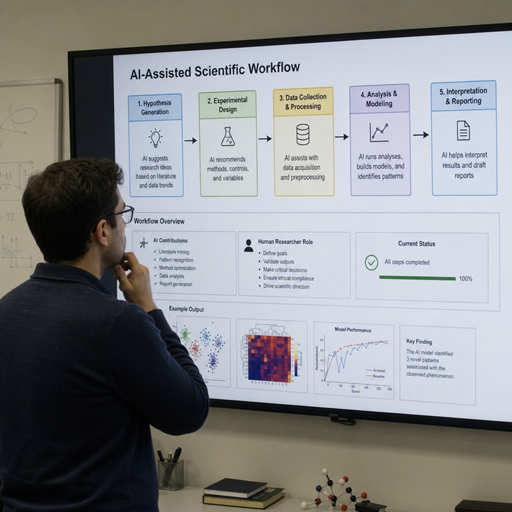
Interactive scientific AI research agents are software systems that help researchers explore questions, organize evidence, generate hypotheses, run repeatable workflows, and interpret results with a human in the loop. They combine interactive science tools, language-based reasoning, data access, and research automation AI so scientists can move from idea to investigation more efficiently. Used well, they do not replace scientific judgment; they make research work more traceable, testable, and easier to refine.
What are interactive scientific AI research agents?
Interactive scientific AI research agents are AI-powered systems designed to collaborate with researchers across parts of the scientific process. Unlike a static chatbot that simply answers a prompt, an agent can break a research goal into steps, ask clarifying questions, call tools, inspect outputs, adjust its plan, and present findings for review. The “interactive” part matters because research rarely moves in a straight line; scientists need to challenge assumptions, change variables, compare methods, and decide what evidence is strong enough to trust.
In practical terms, an AI research agent may help search literature, summarize papers, extract structured information, generate code, design experiments, analyze datasets, or produce a draft protocol. More advanced systems can coordinate multiple tools in sequence, such as retrieving papers, ranking relevance, creating a comparison of methods, and proposing a reproducible analysis workflow.
The best interactive ai tools in research are not magic answer engines. They are collaborative workspaces where the researcher remains responsible for the question, the evidence standard, the interpretation, and the final decision.
The shift from passive tools to collaborative research systems
Traditional research software is usually task-specific. A statistics package analyzes data. A reference manager stores sources. A search database returns papers. These tools are powerful, but they generally wait for precise instructions and do not connect the full reasoning process.
AI-driven research changes that pattern. A research agent can act as a connective layer between tools, documents, datasets, code, and researcher intent. Instead of asking separate systems separate questions, a scientist can work through a broader objective: “Find recent approaches to this method, identify common limitations, and suggest a validation plan.”
That shift is important because much of research time is spent on coordination rather than discovery. Researchers must translate between formats, keep track of assumptions, compare versions, and repeat routine steps. Interactive scientific AI research agents can reduce some of that friction by keeping the investigation organized and making intermediate reasoning easier to inspect.
A useful agent should support scientific habits rather than bypass them. It should make it easier to ask better questions, trace claims to sources, document uncertainty, and rerun work when new information appears.
Core capabilities that make AI agents useful in science
Different platforms use different architectures, but most effective ai research agents share several capabilities. These capabilities determine whether the system is merely convenient or genuinely useful for scientific work.
Goal decomposition
A strong agent can break a broad research objective into smaller tasks. For example, a question about a biological mechanism might become a literature search, a concept map, a list of competing hypotheses, a dataset inventory, and a proposed analysis plan. This decomposition helps researchers see the path from question to evidence.
The value is not just speed. It is visibility. When the agent shows its plan, the researcher can correct the direction before time is spent on the wrong problem.
Tool use and workflow orchestration
Research agents become more powerful when they can interact with external tools. These may include document databases, lab notebooks, code environments, statistical packages, visualization tools, or internal knowledge bases. The agent’s role is to coordinate the workflow and explain what it is doing.
For example, an agent might retrieve a dataset, check metadata, generate exploratory plots, run a preliminary model, and ask whether the researcher wants to test additional variables. This kind of research automation AI is most useful when each step can be reviewed, modified, and repeated.
Context retention
Scientific work depends on context. The same term can mean different things across fields, and the relevance of a paper depends on the question being asked. Interactive agents can maintain a working memory of the research goal, chosen constraints, preferred methods, rejected assumptions, and prior decisions within a project.
Good context retention helps reduce repeated setup and makes collaboration easier. It also helps the agent avoid treating every prompt as an isolated request.
Evidence handling
For research, an answer without evidence is not enough. A reliable agent should distinguish between source-backed claims, model-generated suggestions, and speculative ideas. It should help surface relevant evidence, but it should not hide uncertainty behind confident language.
Researchers should expect to verify important claims directly. The agent can assist with evidence discovery and organization, but validation remains a scientific responsibility.
How do AI research agents support the scientific workflow?
AI research agents support the scientific workflow by helping researchers move through discovery, planning, analysis, interpretation, and documentation with less manual friction. They can accelerate routine work, but their deeper value is in making complex research processes more interactive and easier to revise. When designed carefully, they become a thinking partner that helps organize the path from question to conclusion.
One useful way to understand ai in research is to map agents to common stages of scientific work.
Literature exploration
Agents can help researchers scan a field, identify recurring themes, compare methods, and extract key details from papers. Instead of reading every source in the same depth at the start, a researcher can use an agent to build a first-pass map of the topic.
A careful workflow might include:
- Define the research question and inclusion criteria.
- Ask the agent to identify major concepts and likely search terms.
- Retrieve and cluster relevant papers.
- Summarize methods, datasets, limitations, and conclusions.
- Flag claims that require direct human review.
- Export a traceable reading list for deeper analysis.
This does not eliminate expert reading. It helps focus expert reading where it matters most.
Hypothesis generation
AI-driven research tools can suggest relationships, mechanisms, or explanations that a researcher may not have considered. This is especially useful in interdisciplinary work, where insights from one area may inspire questions in another.
However, hypothesis generation should be treated as creative support, not proof. A suggested hypothesis is a starting point for testing. The researcher still needs to assess plausibility, design controls, and determine whether the idea is worth pursuing.
Experimental and study design
Interactive science tools can help draft protocols, identify variables, list controls, and expose possible confounders. They may also help compare design options in plain language, which is useful for teams with mixed expertise.
For example, an agent can ask clarifying questions such as what outcome is being measured, what constraints apply, what equipment is available, and what level of uncertainty is acceptable. Those prompts can improve planning by forcing assumptions into the open.
Data analysis and interpretation
Research agents can assist with data cleaning, code generation, exploratory analysis, visualization, and model selection. The strongest use case is not “press a button and get a conclusion.” It is an iterative workflow where the agent proposes an analysis, explains the reasoning, runs or drafts code, and helps interpret the output.
A researcher might ask the agent to compare several statistical approaches, explain assumptions, identify missing values, or generate plots that reveal outliers. The human researcher then decides whether the analysis is appropriate.
Documentation and reproducibility
Research loses value when the process cannot be reconstructed. Agents can help document steps, record decisions, summarize version changes, and produce structured notes from messy exploratory work.
This is one of the most practical benefits of interactive scientific AI research agents. By turning conversations, code, outputs, and decisions into a clearer project record, they can support reproducibility and team communication.
Practical use cases across research environments
Interactive AI tools can be useful in many research settings, but the best application depends on the environment, risk level, and type of evidence involved.
In academic research, agents can support literature reviews, grant preparation, data analysis planning, and teaching. A graduate student might use an agent to organize a reading list or understand competing methodologies, while a principal investigator might use one to explore how a project connects to adjacent fields.
In industrial research and development, agents can help teams manage technical knowledge, review prior experiments, compare candidate materials, or automate parts of reporting. The benefit is often less about replacing expertise and more about reducing duplicated effort across teams.
In clinical or biomedical research, agents may help organize protocols, summarize literature, and support data review. These settings require especially careful governance because errors, privacy issues, and unsupported claims can carry serious consequences.
In environmental and field research, agents can assist with sensor data interpretation, geospatial analysis planning, and synthesis of observations from multiple sources. Their ability to combine structured and unstructured information can be valuable when evidence comes from diverse formats.
Benefits of interactive scientific AI research agents
The promise of ai research agents is not simply doing things faster. Speed matters, but science also depends on quality, transparency, and careful reasoning. The most meaningful benefits appear when agents improve the research process itself.
Key benefits include:
- Faster orientation in complex topics: Agents can help researchers build an initial map of a field, including terminology, methods, debates, and gaps.
- More structured thinking: By turning broad goals into steps, agents make assumptions and decisions easier to inspect.
- Reduced repetitive work: Tasks such as summarizing, formatting, tagging, cleaning, and drafting can often be partially automated.
- Improved collaboration: Shared agent workflows can help teams understand why decisions were made and what evidence informed them.
- Better documentation: Agents can convert exploratory work into clearer notes, checklists, and reproducible workflows.
- Support for interdisciplinary research: Researchers can ask an agent to translate concepts across domains and identify connections that may otherwise be missed.
These benefits depend heavily on implementation. A poorly designed agent can create confusion, overconfidence, or hidden errors. A well-designed one keeps the researcher in control.
Risks, limitations, and responsible use
AI in research introduces real risks. Agents can generate incorrect summaries, misread sources, produce flawed code, overlook context, or present speculation as fact. Because scientific work often builds on prior steps, a small mistake early in a workflow can affect later conclusions.
The most important limitation is that AI systems do not understand evidence the way scientists do. They can model patterns in language and data, but they do not independently guarantee truth. This means their outputs must be reviewed, tested, and documented.
Responsible use requires clear boundaries:
- Treat agent output as a draft, not an authority.
- Verify important claims against primary sources or validated datasets.
- Review generated code before running it in consequential workflows.
- Keep records of prompts, tool calls, assumptions, and changes.
- Avoid entering sensitive or restricted data into systems that are not approved for that data.
- Require human approval before using AI-generated conclusions in publications, clinical decisions, policy recommendations, or product claims.
The goal is not to distrust every output. The goal is to apply the same skepticism researchers already apply to instruments, methods, and collaborators.
How should researchers choose interactive AI tools?
Researchers should choose interactive AI tools by evaluating the quality of evidence handling, workflow transparency, data governance, integration options, and human control. A tool that produces polished answers but hides sources, assumptions, or intermediate steps may be less useful than a simpler tool that makes its process inspectable. The right choice depends on the research context and the cost of being wrong.
A practical evaluation checklist includes:
- Traceability: Can the tool show where claims, data, and outputs came from?
- Interactivity: Can researchers correct the plan, refine constraints, and ask follow-up questions?
- Tool integration: Does it connect to the databases, notebooks, code environments, or repositories the team already uses?
- Reproducibility: Can workflows be saved, exported, rerun, or audited?
- Data controls: Does the system support the privacy and compliance needs of the project?
- Uncertainty handling: Does it flag limitations, conflicts, and low-confidence outputs?
- Customization: Can it adapt to domain-specific terminology, protocols, and preferred methods?
- Human oversight: Does the workflow require review at important decision points?
Researchers should test tools on known problems before using them on new ones. If an agent cannot handle a benchmark task where the answer is already understood, it should not be trusted for exploratory work without strong safeguards.
Best practices for working with AI-driven research systems
The way researchers interact with agents has a large effect on output quality. Vague prompts often produce vague results. Clear constraints, examples, and review steps create better outcomes.
A strong workflow usually starts with a well-framed request. Instead of asking, “Summarize this topic,” a researcher might specify the field, date range if relevant, inclusion criteria, desired output format, and known controversies. The more clearly the research goal is defined, the easier it is for the agent to produce useful work.
Best practices include:
- Start with the research objective. State the question, audience, and intended use of the output.
- Define boundaries. Include what sources, methods, datasets, or assumptions are allowed or excluded.
- Ask for a plan before execution. Review the agent’s proposed steps before it performs a long workflow.
- Require evidence labels. Separate confirmed findings, inferred patterns, and speculative ideas.
- Use checkpoints. Pause after major steps to inspect outputs and correct direction.
- Keep humans accountable. Assign responsibility for review, validation, and final decisions.
- Document the process. Save prompts, outputs, code, parameters, and revisions when they affect conclusions.
This style of interaction turns the agent from a black box into a visible collaborator. It also helps teams build consistent research habits around AI.
The future of research automation AI
Research automation AI is likely to become more integrated into everyday scientific work. Agents may become better at coordinating specialized models, operating lab instruments through approved systems, maintaining project memory, and generating reproducible workflows across documents, code, and data.
The most valuable future systems will probably not be the ones that claim to automate science end to end. They will be the systems that make researchers more effective while preserving scientific accountability. That means better provenance, clearer uncertainty, stronger validation loops, and smoother collaboration between humans and machines.
As these tools mature, scientific teams may design projects with agent support in mind from the beginning. Literature review, data management, protocol drafting, analysis, and reporting could become parts of a connected workflow rather than separate manual tasks.
A practical way to begin
Teams do not need to transform their entire research process at once. A safer approach is to begin with low-risk, high-friction tasks such as organizing literature, drafting internal summaries, cleaning non-sensitive datasets, or documenting analysis steps. These tasks allow researchers to learn the strengths and weaknesses of interactive ai tools without handing over critical decisions.
A simple starting plan could look like this:
- Choose one recurring research task that consumes time but has clear review criteria.
- Define what the agent may and may not do.
- Run the task on a past project where the team can compare results.
- Record errors, useful outputs, and workflow improvements.
- Decide whether to expand, revise, or reject the use case.
This measured approach builds trust through evidence rather than enthusiasm.
Human judgment remains the center of AI-assisted science
Interactive scientific AI research agents can make research faster, more organized, and more exploratory, but they are most valuable when they strengthen human judgment rather than replace it. They help researchers ask clearer questions, connect information, automate routine steps, and document how conclusions were reached.
The core principle is simple: let AI assist with navigation, synthesis, and workflow, while humans remain responsible for meaning, validation, ethics, and decisions. When interactive science tools are used with that balance, they can become a practical part of modern research rather than a distraction from it.