
ASEAN’s digital economy agenda is no longer just about faster internet, online shopping, or startup growth. It is becoming a regional rules project: a set of multilateral frameworks designed to make digital trade, data, payments, cybersecurity, consumer trust, and digital skills work across borders. For businesses, policymakers, and investors, understanding ASEAN digital economy frameworks helps explain how Southeast Asia is trying to turn national digital transformation into regional economic integration.
What are ASEAN digital economy frameworks?
ASEAN digital economy frameworks are regional agreements, masterplans, and cooperation mechanisms that help the ten ASEAN Member States align their digital policies while respecting different levels of development. They do not replace national laws. Instead, they create shared direction on issues such as e-commerce, digital connectivity, data governance, cybersecurity, online consumer protection, and interoperable digital services.
This matters because the digital economy ASEAN is building depends on cross-border confidence. A small business in Viet Nam, a fintech in Singapore, a logistics provider in Thailand, and a consumer in the Philippines all benefit when rules are clearer and systems can connect. ASEAN’s approach is gradual and consensus-driven, but the direction is clear: digital policy is now part of ASEAN economic integration, not a separate technology conversation.
The shift from connectivity to integration
Early regional digital cooperation focused heavily on connectivity: expanding access, reducing divides, and helping more people and firms participate online. That foundation still matters. Without affordable broadband, secure networks, and basic digital skills, higher-level digital trade rules have limited impact.
The newer phase is more ambitious. ASEAN is moving from enabling digital access to shaping a more integrated digital market. The ASEAN Digital Masterplan 2025 set out a vision of ASEAN as a leading digital community and economic bloc supported by secure, transformative services, technologies, and ecosystems. (asean.org)
This shift changes the practical meaning of digital transformation ASEAN-wide. It is not only about governments digitizing services or companies adopting cloud tools. It is also about whether invoices, contracts, payments, product information, and data can move across borders with fewer frictions and higher trust.
Core building blocks of ASEAN’s digital multilateralism
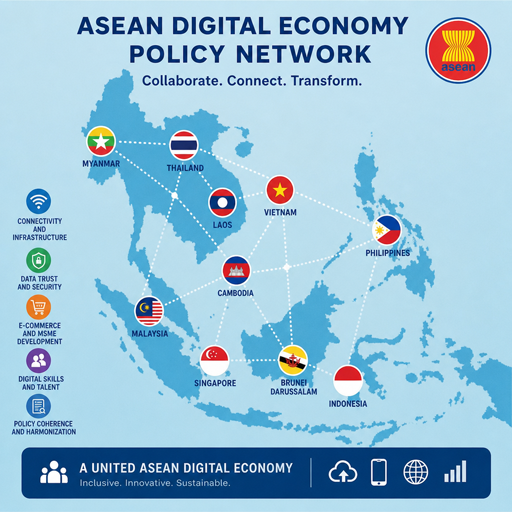
ASEAN’s digital economy agenda is not built on one document alone. It is a layered system of commitments, sector plans, and implementation work. The most important building blocks include:
- Digital connectivity: improving infrastructure, affordability, and access so more citizens and firms can join the online economy.
- E-commerce cooperation: supporting cross-border online trade, electronic transactions, consumer confidence, and paperless processes.
- Data governance: encouraging trusted data flows while recognizing privacy, security, and domestic regulatory concerns.
- Cybersecurity and trust: reducing risks that can undermine digital adoption, especially for businesses and public services.
- Digital skills and inclusion: helping workers, MSMEs, and underserved communities participate in digital growth.
- Interoperability: making systems, standards, and procedures easier to connect across markets.
The ASEAN Agreement on Electronic Commerce, signed in 2019 and in force from December 2021, is one example of this framework-building approach. It recognizes e-commerce as a driver of growth and highlights the need for coordination among Member States. (agreement.asean.org)
Why does DEFA matter for ASEAN economic integration?
The ASEAN Digital Economy Framework Agreement, widely known as DEFA, matters because it aims to become ASEAN’s first region-wide agreement focused specifically on the digital economy. In June 2026, ASEAN announced that senior economic officials had resolved all outstanding issues in DEFA negotiations, marking the successful conclusion of negotiations for the agreement. (asean.org)
DEFA is important because it brings digital policy closer to the logic of a regional market. Traditional ASEAN economic integration has often focused on goods, services, investment, and supply chains. DEFA extends that integration into the digital layer where modern trade increasingly happens: online platforms, digital payments, electronic documentation, data-enabled services, and technology-supported logistics.
For companies, the promise is not abstract. A stronger regional framework can make it easier to scale digital services across Southeast Asia, reduce duplicated compliance burdens, and improve confidence in cross-border transactions. For governments, DEFA offers a way to coordinate rules without requiring every country to move at the same speed or adopt identical domestic systems.
Opportunities for businesses and MSMEs
The most visible opportunity is market access. If digital trade procedures become more interoperable, smaller firms may find it easier to sell beyond their home market. This is especially relevant for MSMEs that cannot afford complex legal, payments, or logistics arrangements in every country.
ASEAN digital economy frameworks can also support new business models. Regional trust in e-payments, electronic contracts, digital identities, and data practices can help firms provide services across borders more efficiently. In practical terms, this could support sectors such as e-commerce, fintech, education technology, creative services, health-related digital services, and digital logistics.
Businesses can prepare by focusing on several practical steps:
- Map digital compliance early. Track privacy, cybersecurity, consumer protection, and e-commerce rules in priority ASEAN markets.
- Build interoperable operations. Use systems that can handle multiple currencies, tax rules, languages, and documentation requirements.
- Strengthen trust signals. Clear refund policies, secure payment options, and transparent data practices matter in cross-border commerce.
- Invest in digital skills. Teams need more than tools; they need the ability to manage online sales, analytics, compliance, and customer support.
- Watch DEFA implementation. The agreement’s practical value will depend on how commitments are translated into domestic rules and regional programs.
The hard part is implementation
ASEAN’s diversity is both its strength and its challenge. Member States have different legal systems, digital readiness levels, infrastructure gaps, and policy priorities. A framework that works for a highly digitized economy may be difficult for a less connected market to implement quickly.
That is why ASEAN’s multilateralism often moves through cooperation, capacity building, and staged commitments. The approach can feel slow, but it helps keep all members inside the process. In digital policy, that inclusiveness is essential because a fragmented region would limit the benefits of cross-border platforms and services.
Implementation will require attention to practical details: how data rules interact, how electronic documents are recognized, how cybersecurity cooperation works, how disputes are handled, and how smaller firms are supported. The success of ASEAN digital economy frameworks will depend less on broad ambition and more on whether companies and citizens experience simpler, safer, and more affordable digital transactions.
A regional digital economy built on trust
The future of the digital economy ASEAN is pursuing will not be defined by technology alone. It will be defined by trust: trust that payments will clear, data will be handled responsibly, consumers will be protected, and businesses can operate across borders without unnecessary friction.
ASEAN’s frameworks are creating the policy architecture for that trust. The opportunity now is to turn negotiated principles into usable systems that support growth, inclusion, and resilience. For anyone following Southeast Asia’s next stage of development, digital transformation ASEAN-wide is one of the clearest signs that regional integration is entering a new era.