
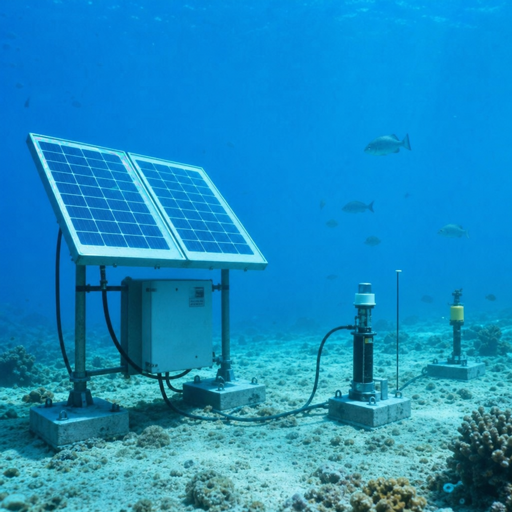
Deep-sea solar energy sounds like a contradiction: sunlight fades fast underwater, and the true deep ocean is dark. Still, a practical version of ocean solar power is emerging for the upper, sunlit ocean, floating platforms, and shallow seafloor equipment that needs local, low-maintenance power. The opportunity is not to light whole cities from the abyss, but to expand ocean renewable energy options for sensors, robots, communications gear, and remote marine operations.
Can solar power really work beneath the ocean surface?
Yes, but only within clear limits. Solar energy ocean systems can capture light underwater when enough usable wavelengths remain, especially in shallow, clear water where blue-green light penetrates better than red and infrared light. Recent research has shown underwater photovoltaic cells operating at 10 meters below the sea surface, while earlier modeling suggests useful harvesting may be possible down to around 50 meters in clear conditions with the right cell design.
That distinction matters. “Deep-sea solar energy” is often used loosely, but the deep sea is not a sunlit environment in the way rooftops, deserts, or even shallow reefs are. At true ocean-floor depths, solar panels cannot simply sit on the seabed and produce meaningful electricity. The realistic future is more nuanced: marine solar technology can support shallow submerged systems, floating solar arrays, buoy-linked charging stations, and hybrid ocean renewable energy networks.
The ocean is an energy landscape, not one technology
Ocean renewable energy usually refers to multiple resources working in and around seawater. The U.S. Department of Energy describes marine energy as power from moving water, including waves, tides, river and ocean currents, and thermal gradients between warm surface water and cold deep water. Ocean solar power sits beside these options rather than replacing them.
That makes the ocean more like an energy ecosystem than a single power plant. A coastal site might use floating photovoltaic panels at the surface, wave energy for nighttime or storm-season generation, and batteries or subsea cables for steady delivery. A remote monitoring station might combine a surface buoy with solar panels, a battery pack, and underwater communication links. In deeper locations, solar may still be part of the system, but it is usually positioned where sunlight exists, not on the dark ocean floor.
How underwater solar harvesting works
Underwater solar cells face a different light environment than land-based panels. Water filters sunlight, absorbs many infrared wavelengths, scatters light, and changes the spectrum that reaches a photovoltaic surface. Traditional silicon solar cells are optimized for sunlight in air, so researchers are exploring materials that better match the blue-green light that remains underwater.
A major research direction is wide-bandgap photovoltaic materials. In September 2026, a Joule study reported wide-bandgap perovskite solar cells tested at 10 meters in the South China Sea, with the cells designed to match the underwater solar spectrum. The researchers reported battery charging in real submerged conditions and projected multi-year operation under simulated 10-meter conditions, which points to practical low-power uses rather than utility-scale generation.
A simplified underwater solar system may include:
- A tuned photovoltaic module that performs better under filtered underwater light.
- Protective encapsulation to resist seawater, pressure, corrosion, and biofouling.
- A charge controller and battery to store intermittent energy.
- A sensor, camera, robot, or communication device that uses low, steady power.
- A maintenance plan for cleaning surfaces and checking seals.
This is why underwater energy sources are often judged differently from grid power. A few watt-hours can be valuable if they prevent a costly ship visit, extend an autonomous mission, or keep a seafloor instrument running longer.
Where could ocean-floor solar harvesting make sense?
Ocean-floor solar harvesting makes the most sense in shallow, sunlit seafloor zones or in systems connected to floating solar collectors above. It is not a practical match for abyssal plains, trenches, or other dark deep ocean environments. The most promising applications are places where power demand is modest, access is difficult, and replacing batteries is expensive.
Potential use cases include:
- Marine science stations: Long-term sensors can monitor temperature, salinity, oxygen, acidity, currents, biodiversity, or coastal habitat conditions.
- Aquaculture and blue economy operations: Underwater cameras, feeders, and environmental monitors can benefit from local power near farms.
- Autonomous underwater vehicles: Docking stations may use solar-supported charging in shallow water to extend robot missions.
- Coastal security and navigation: Low-power acoustic beacons, cameras, or communication nodes can operate with less dependence on cables.
- Offshore energy inspection: Sensors near wind, tidal, or offshore solar infrastructure can support condition monitoring.
The practical value is resilience. If a device can harvest even limited local power, it may need fewer battery swaps, smaller cables, or less vessel time. That reduces operational complexity and can make ocean data collection more continuous.
Floating solar is the nearer-term ocean solar opportunity
While submerged solar is exciting, floating solar is the more mature path for large-scale ocean solar power. Floating photovoltaic systems place panels on buoyant structures, often in reservoirs, lakes, sheltered coastal waters, or potentially offshore zones. Reviews of floating PV note benefits such as dual use of water surfaces and reduced land-use conflict, while offshore expansion introduces harsher reliability and maintenance demands.
For the ocean, that means engineering becomes just as important as cell efficiency. Panels must survive waves, salt spray, storms, mooring loads, marine growth, and electrical insulation challenges. Nearshore systems may be easier to inspect and connect to the grid, while offshore systems need stronger platforms and more robust logistics.
Floating solar can also serve underwater systems. A surface array can power a buoy, charge batteries, and send electricity down a cable to instruments below. In many cases, this is more efficient than placing the photovoltaic material underwater, because the panels receive stronger sunlight at the surface.
Deep ocean energy is likely to be hybrid
Deep ocean energy will rarely come from one source alone. In the real deep sea, where sunlight is absent, other ocean renewable energy options may be more suitable, including current energy, ocean thermal energy, and wave-linked surface generation. Solar can still support the network from the surface, but it will not be the primary generator on a dark seabed.
A hybrid deep ocean system might look like this:
- Surface generation: Floating solar panels and wave devices generate power where conditions allow.
- Storage: Batteries smooth day-night cycles, cloudy weather, and variable sea states.
- Subsea distribution: Cables deliver power to underwater instruments or docking stations.
- Local backup: Small marine energy devices or high-capacity batteries support critical loads.
- Data return: Acoustic, optical, or cabled communication sends information back to operators.
This hybrid model is more realistic than imagining the ocean floor covered in solar panels. It also fits how marine operations work: power, data, access, and maintenance are interconnected problems.
What stands in the way of deep-sea solar energy?
The biggest barriers are physics, durability, ecology, and economics. Sunlight weakens quickly with depth, seawater is harsh, and marine systems are expensive to install and service. Even when a prototype works, it must prove that it can survive fouling, corrosion, pressure changes, storms, sediment, wildlife interactions, and long maintenance intervals.
Key challenges include:
- Light attenuation: Less sunlight reaches deeper water, and the available spectrum changes.
- Biofouling: Algae, microorganisms, and marine growth can block light and reduce output.
- Material stability: Seals, coatings, cables, and photovoltaic layers must tolerate seawater for long periods.
- Environmental safeguards: Any deployment should consider habitat disturbance, shading, entanglement risk, and chemical leakage.
- Cost and access: Offshore installation, inspection, and repair can dominate project economics.
These barriers do not make marine solar technology irrelevant. They simply narrow the best applications. The stronger case is for targeted systems that solve a specific ocean power problem, not broad claims that underwater solar will replace land-based solar.
A practical outlook for marine solar technology
The future of deep-sea solar energy is likely to be precise, distributed, and application-specific. Shallow underwater photovoltaics may power instruments directly. Floating solar may expand clean generation in coastal and offshore settings. Hybrid systems may connect surface solar to deeper devices through storage and cables.
For developers, researchers, and ocean operators, the smartest approach is to start with the load. How much energy does the device need each day? How deep is it? How clear is the water? How often can it be serviced? The answers determine whether submerged solar, floating solar, wave power, batteries, or a cabled connection makes sense.
A quick feasibility checklist:
- Is the equipment in the photic zone or connected to a surface platform?
- Is the water clear enough for useful solar harvesting?
- Is the power demand low and predictable?
- Can the system tolerate marine growth between maintenance visits?
- Are materials safely sealed against seawater exposure?
- Would local generation reduce vessel trips, cable length, or battery replacement?
If the answer is mostly yes, ocean solar power may be worth exploring. If the system sits in darkness at great depth and needs substantial energy, another deep ocean energy source is probably a better fit.
The takeaway
Deep-sea and ocean floor solar energy harvesting is not science fiction, but it is often misunderstood. Solar power belongs in the sunlit ocean, on floating platforms, in shallow submerged systems, or as part of hybrid networks that serve deeper equipment. Used that way, deep-sea solar energy can become a practical member of the broader ocean renewable energy family: not a universal power source, but a valuable tool for cleaner, longer-lasting marine operations.