
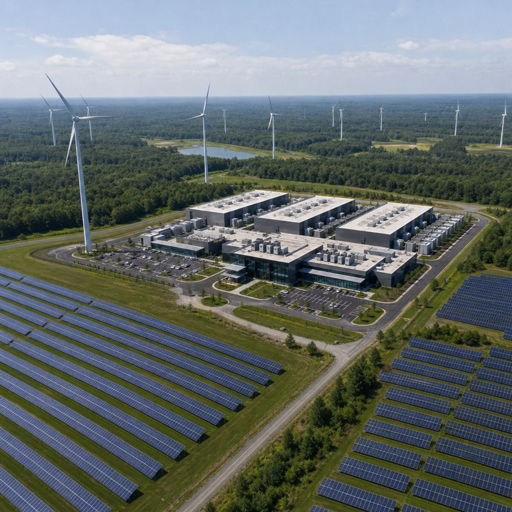
Cloud providers are increasingly treating clean power access as a core requirement for where new data centers get built. As AI demand grows, the next wave of cloud infrastructure is likely to cluster around clean energy corridors: regions where renewable generation, grid capacity, land, fiber connectivity, and supportive policy can come together. For businesses, this shift changes how they should evaluate cloud regions, sustainability claims, and long-term digital infrastructure risk.
Why are cloud providers moving toward clean energy corridors?
Cloud providers are moving toward clean energy corridors because data centers now compete not only on latency, cost, and resilience, but also on access to large volumes of reliable low-carbon electricity. The International Energy Agency has reported that data center electricity demand is rising sharply with AI, and that renewables are expected to be the fastest-growing source of electricity for data centers through 2030. That combination makes clean energy data centers a business priority, not just an environmental preference.
A corridor is not simply a single solar farm beside a server hall. It is a regional stack of assets: transmission lines, substations, wind or solar resources, battery storage, water-smart cooling options, skilled labor, permitting pathways, and high-capacity network routes. When those pieces align, cloud providers can scale faster and make stronger sustainability commitments without relying only on broad annual energy matching.
The rise of AI makes the issue more urgent. Training and inference workloads can be energy-intensive, and demand can arrive in large blocks rather than gradual increments. That is why ai data centers powered by clean energy are becoming part of infrastructure planning discussions in North America, Europe, the Middle East, and Asia.
The clean energy data center is becoming a platform decision
For enterprise buyers, the location of cloud workloads used to feel like a technical detail. Today, region selection can influence emissions reporting, customer trust, operating resilience, and future compliance exposure. A cloud region with stronger clean power access may help a company reduce the carbon intensity associated with digital services, especially if the provider offers credible reporting tools.
The largest providers are already framing sustainability as part of their infrastructure strategy. Google says it aims to operate on 24/7 carbon-free energy across every grid where it operates by 2030, and it reports data center efficiency metrics as part of that effort. Microsoft has stated goals to become carbon negative, water positive, and zero waste by 2030, while also expanding renewable energy procurement. AWS says it matched 100% of electricity consumed by its global operations with renewable energy sources in 2025 and is investing in renewable, battery storage, and nuclear-related energy projects.
These commitments do not make every facility automatically carbon neutral every hour of the year. They do, however, show where the market is going: toward more detailed accounting, cleaner grids, and infrastructure decisions shaped by energy availability.
What makes sustainable data centers different from conventional facilities?
Sustainable data centers are designed, sourced, and operated to reduce environmental impact across power, cooling, equipment use, land, and waste. The difference is not one feature; it is the combination of lower-carbon electricity, efficient cooling, smarter workload management, transparent measurement, and responsible end-of-life practices.
A facility can be marketed as green, but serious buyers should look for the operating model behind the claim. Strong sustainable data centers typically focus on:
- Clean electricity procurement: renewable power purchase agreements, carbon-free energy matching, green tariffs, or direct clean power access where available.
- Grid alignment: siting near regions where clean electricity can be delivered reliably, not just purchased on paper.
- Efficient cooling: air-side economization, liquid cooling for dense AI racks, water-conscious design, or heat reuse where climate and infrastructure allow.
- Hardware utilization: higher server utilization, longer equipment life, and better capacity planning to avoid waste.
- Transparent reporting: clear metrics on energy use, emissions, water withdrawal, and renewable coverage.
- Resilience planning: backup systems that reduce reliance on diesel where technically and legally feasible.
Equinix, for example, reported 96% renewable energy coverage in recent sustainability materials, reflecting how colocation providers are also competing on renewable procurement and efficiency.
Middle East cloud growth puts clean energy planning in focus
The Middle East has become a strategic region for AI and cloud infrastructure because of capital investment, geographic connectivity, sovereign AI ambitions, and large-scale energy development. Microsoft’s investment in UAE-based G42 and the announced Stargate UAE partnership involving OpenAI, Oracle, Nvidia, Cisco, SoftBank, and G42 illustrate how the region is positioning itself as a major AI infrastructure hub.
That makes clean energy applications in Middle East data centers especially important. Hot climates can increase cooling challenges, while AI workloads can demand high-density power. At the same time, Gulf markets have substantial solar potential, growing renewable project pipelines, and government-led digital transformation programs. The opportunity is to connect green energy facilities with data center campuses in ways that support both uptime and credible decarbonization.
Practical applications may include solar-backed power procurement, battery storage to manage intermittency, advanced cooling systems, AI-based energy optimization, and workload scheduling that favors lower-carbon hours when possible. The most credible projects will avoid vague “green” claims and instead show how electricity is sourced, how cooling is managed, and how emissions are measured over time.
Carbon-neutral data centers need better proof than annual claims
The phrase carbon-neutral data centers can be useful, but it can also hide important details. A provider may match annual electricity use with renewable energy certificates while still drawing from a fossil-heavy grid during certain hours. That approach is different from 24/7 carbon-free energy, where the goal is to match consumption with clean supply in the same region and time period.
For buyers comparing providers, the key is to ask what “neutral” means. Is the claim based on offsets, annual renewable matching, hourly carbon-free energy, direct procurement, on-site generation, or a mix of methods? Each approach has a different impact on the grid and a different level of credibility.
A useful evaluation checklist includes:
- Check the boundary. Does the claim apply to one facility, a cloud region, global operations, or only corporate offices?
- Look at timing. Is clean power matched annually, monthly, or hourly?
- Review location. Is the clean power generated on the same grid as the data center?
- Separate offsets from electricity. Offsets may address residual emissions, but they are not the same as clean power supply.
- Ask about water. In water-stressed regions, low-carbon power is only part of sustainability.
- Request workload-level data. Better reporting helps teams choose lower-carbon regions and optimize architecture.
This level of scrutiny matters because clean tech data strategies are becoming part of procurement, investor reporting, and brand reputation. Businesses that understand the difference between renewable matching and round-the-clock carbon-free power will make stronger infrastructure decisions.
Green energy facilities are reshaping cloud geography
Data centers have historically clustered near network exchanges, enterprise demand, tax incentives, and available land. Those factors still matter, but power is now a primary constraint. In some markets, the fastest path to capacity is not the cheapest land; it is the place where grid interconnection, clean generation, and permitting can move together.
This is why green energy facilities and data center campuses are increasingly discussed as connected assets. A solar project, wind farm, battery installation, or advanced nuclear agreement may influence where cloud capacity expands. The result could be more regional specialization: some corridors optimized for AI training, others for low-latency enterprise workloads, and others for disaster recovery or sovereign cloud needs.
There is also a customer-side benefit. When cloud providers compete on clean energy access, businesses gain more options for reducing the footprint of applications without owning physical infrastructure. That does not remove the need for efficient software design, but it makes sustainability easier to operationalize.
Practical steps for businesses choosing cloud regions
Organizations do not need to wait for perfect carbon-free infrastructure before making better decisions. They can start by integrating sustainability into architecture, procurement, and governance.
Useful steps include:
- Choose cloud regions with stronger renewable or carbon-free energy data when latency and compliance requirements allow.
- Right-size compute resources so unused capacity does not create unnecessary energy demand.
- Use autoscaling, efficient storage tiers, and lifecycle policies to reduce waste.
- Ask vendors for region-specific emissions, water, and renewable energy information.
- Consider whether AI workloads can be scheduled, compressed, distilled, or optimized to reduce compute intensity.
- Include sustainability requirements in RFPs, not as a branding question but as a measurable operating criterion.
Clean energy data centers are not a single technology trend. They are part of a broader shift in how digital infrastructure is planned, financed, and judged.
The takeaway
Cloud providers are targeting clean energy corridors because the next generation of cloud and AI infrastructure depends on abundant, reliable, lower-carbon power. Sustainable data centers will be defined by real grid impact, not just polished sustainability language.
For businesses, the smartest move is to treat cloud sustainability as a practical selection factor alongside price, performance, security, and availability. As clean energy applications in Middle East data centers and other fast-growing regions mature, the winners will be the providers and customers that connect digital growth with transparent, resilient, low-carbon infrastructure.