
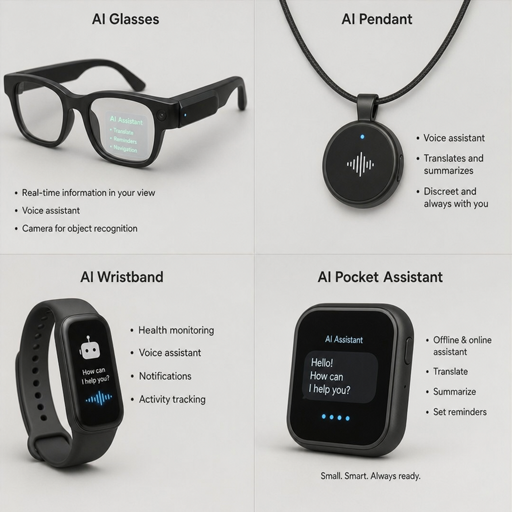
Portable AI workmate hardware is moving from a single “AI gadget” idea into a crowded set of form factors: glasses, pins, pendants, wrist wearables, pocket companions, and tethered XR systems. The shift is being driven by a practical question for workers and creators: where should an AI assistant live when the job involves meetings, movement, screens, conversations, and real-world context? As of September 23, 2026, the market is less about replacing the smartphone outright and more about finding the right portable AI interface for each task.
Why are portable AI workmates splitting into so many shapes?
Portable AI hardware is fragmenting because work itself is fragmented. A sales call, a factory walkthrough, a conference panel, a coding session, and a commute all ask different things from an ai productivity tool. That has pushed hardware makers toward specialized designs rather than one universal portable ai device.
Recent announcements point in the same direction. Snap is positioning SPECS as AR glasses with an AI-native operating system, hand and voice interaction, and computing hardware built into the frames rather than a separate puck or tether. Samsung and Google, meanwhile, showed intelligent eyewear with Gentle Monster and Warby Parker designs that can handle navigation, everyday tasks, photo capture, and real-time translation while working as a companion to a phone. Google also said reservations opened for XREAL AURA, wired XR glasses powered by Android XR and Qualcomm’s Snapdragon Reality Elite platform, with availability targeted for fall 2026.
The result is a category that looks more like a toolbox than a single device race. Smart glasses aim to put information in the user’s line of sight. Pendants and pins focus on conversation capture and recall. Pocket devices try to provide a dedicated ai assistant without taking over the phone. XR glasses and headsets target immersive workspaces where digital content can sit around the user.
Glasses are becoming the most visible work companion
The biggest momentum is gathering around eyewear because glasses can combine camera, microphones, speakers, display, and hands-free control in a form people already understand. For an ai work companion, that matters. A user can ask for help while walking, looking at a sign, reviewing a product, navigating a venue, or staying present in a conversation.
Snap’s September 2026 SPECS update made the glasses pitch especially explicit. The company introduced SPECS Intelligence, an anticipatory AI service designed to work across iPhone, Mac, and SPECS AR glasses, with the goal of surfacing relevant information and actions rather than waiting for every prompt. Snap also described privacy controls, including no facial recognition, no continuous recording or saving of audio, video, or photos, and an external LED when recording is active.
Samsung and Google’s intelligent eyewear announcement shows the same idea from a phone ecosystem angle. The companies described glasses that rely on voice interaction and Gemini, connect to a phone, and support tasks such as navigation, notification summaries, calendar events, translation, and photo capture. The first collections are scheduled to launch this fall in select markets, making fashion and everyday comfort part of the competitive strategy rather than an afterthought.
Meta’s Ray-Ban Meta line remains another major signal for the eyewear path. Meta highlighted Ray-Ban Meta glasses at Cannes 2026 for hands-free point-of-view capture, Live Translation, real-time sharing, and access to Meta AI features. The company also teased Meta Ray-Ban Display as its next-generation smart glasses in a dedicated wearable showcase.
For workplace adoption, glasses have a clear promise: they reduce the need to pull out a phone or laptop for small interventions. The challenge is equally clear. Recording indicators, camera placement, battery life, display brightness, comfort, prescription support, and social acceptance all affect whether eyewear becomes a daily portable AI workmate or a niche device for demos and creators.
Pins, pendants, and wrist devices are settling into note-taking
The second major form factor is quieter: small wearable recorders that sit on a shirt, lanyard, wristband, or clip. These devices are less ambitious than full AR glasses, but that restraint may be their strength. They are built around capturing conversations, generating transcripts, summarizing meetings, and helping users remember commitments.
Plaud’s NotePin is a useful example of this narrower strategy. Plaud describes it as a wearable AI note taker that can be worn as a necklace, wristband, clip, or magnetic pin, with transcription and summary features aimed at professionals who have many in-person conversations. Its product materials emphasize use cases for executives, sales teams, clinicians, lawyers, educators, and content creators, while also warning pacemaker users not to wear the device on the chest because of magnetic components.
Amazon’s Bee is also pushing the wearable memory angle. In an Amazon update, Bee co-founder Maria de Lourdes Zollo said the device learns from conversations, emails, and information users choose to share, and can turn conversations into suggested actions. Amazon said Bee processes conversations in real time without storing audio, uses a button and green LED to indicate recording, and has added features such as Voice Notes since Bee joined Amazon.
The appeal of this form factor is practical. Many workers do not need a screen on their face, but they do need reliable recall after back-to-back meetings. A wearable recorder can become an ai productivity tool for people who spend their day in interviews, classrooms, client visits, design reviews, or clinical documentation workflows. The main constraints are consent, data governance, organizational recording policies, and whether summaries are accurate enough to trust without manual review.
Pocket companions are becoming software bridges
Pocket AI devices have had a more uneven path. The original idea was simple: build a small object that gives users a dedicated ai assistant without the distractions of a smartphone. In practice, the category has had to prove why people should carry another device when phones already run powerful AI apps.
Rabbit’s r1 remains the best-known example of this form factor, and the company has shifted much of the story toward operating-system-level agent work. Rabbit released rabbitOS 2 in 2025 with a redesigned card-based interface, multimodal conversations, local meeting recordings, and “creations,” which lets users build small tools and experiences by speaking to the device. On September 22, 2026, Rabbit announced OS3, an agentic operating system that runs in the cloud, connects to user devices through a local agent, and can operate across PCs, cloud VMs, r1, and other device types.
That evolution is important because it reframes the pocket device. Instead of asking the orange box to replace a phone, Rabbit is positioning the broader system as a cross-device agent that can use the r1 as one input point among several. The hardware becomes a portable handle for a larger software layer.
Humane’s AI Pin shows the risk on the other side of the pocket-and-pin category. HP announced in February 2025 that it would acquire key AI capabilities from Humane, including the Cosmos platform, talent, and intellectual property, and would form HP IQ as an AI innovation lab focused on future work experiences. That deal made Humane’s most important legacy less about the standalone pin and more about AI software, patents, and device-orchestration ideas moving into a larger computing company.
Limitless tells a similar consolidation story. The company said it was acquired by Meta, would stop selling the Pendant to new customers as of December 5, 2025, and would support existing Pendant customers throughout 2026. That move reinforces a pattern: conversation-memory hardware is valuable, but long-term distribution may depend on bigger platforms with existing device ecosystems.
XR systems are targeting heavier knowledge work
A separate branch of portable AI hardware is forming around XR glasses and headsets that can create large virtual workspaces. These devices are less discreet than pendants and less everyday than audio-first smart glasses, but they can offer more screen space and spatial context for design, training, collaboration, simulation, and software development.
Qualcomm’s June 2026 Snapdragon Reality Elite announcement is a key infrastructure moment for this track. The company said the platform is designed for immersive mixed reality, can run large vision and language models on-device, and supports both all-in-one video-see-through headsets and lightweight tethered optical-see-through devices. Qualcomm also said the platform powers Android XR devices, first with XREAL Project Aura, and is built for sleeker, cooler, longer-lasting hardware.
Google’s AWE 2026 update adds the ecosystem layer. XREAL AURA is positioned as wired XR glasses powered by Android XR and Snapdragon Reality Elite, with developer workshops and live demonstrations of Samsung Galaxy XR, XREAL AURA, and intelligent eyewear. That puts XR into a familiar platform pattern: hardware vendors, chip suppliers, OS providers, and developers are all trying to create enough momentum for useful work applications to emerge.
For a portable AI workmate, XR’s value is not just “more screen.” It is the possibility of an assistant that understands digital files, physical surroundings, 3D objects, gestures, and spatial workflows at the same time. The trade-off is bulk, cost, attention, and workplace fit. A designer may accept glasses plus a compute pack for a focused session; a field technician may not.
The form-factor map emerging in 2026
The current market is sorting into use-case lanes rather than converging on one winner. For buyers, teams, and developers, the useful way to evaluate a portable ai device is to start with the work pattern, then pick the hardware shape that creates the least friction.
Key form factors now include:
- AI glasses: Best suited for hands-free prompts, translation, navigation, capture, live context, and heads-up notifications.
- AR and XR glasses: Better for spatial workspaces, visual overlays, training, design review, and immersive productivity sessions.
- Pendants and pins: Strongest for meeting memory, interviews, lecture capture, personal recall, and post-conversation summaries.
- Wrist wearables: Useful when microphones, quick controls, and glanceable interaction matter more than cameras or displays.
- Pocket companions: Most relevant when users want a dedicated AI interface, push-to-talk access, camera input, or a portable controller for broader agent workflows.
- AI PCs and connected workstations: Not always “wearable,” but increasingly part of the same workmate system when agents need local files, desktop apps, and longer tasks.
This map also explains why the smartphone has not disappeared. Phones remain the account hub, network connection, app bridge, payment device, and fallback screen for many AI wearables. The more realistic near-term future is a cluster of connected devices, with the ai assistant moving between them depending on whether the user is walking, meeting, coding, presenting, or reviewing information.
Privacy and workplace policy are becoming product features
The hardware race is not only about microphones, displays, and chips. It is also about trust. Devices that listen, see, summarize, and act on behalf of a user create obvious concerns for colleagues, clients, patients, students, and bystanders.
That is why recording lights, local processing claims, consent flows, data export, and enterprise controls are becoming part of the product story. Snap’s SPECS materials emphasize visible recording indicators, user control over connected data, and limits on continuous recording. Bee’s Amazon update similarly highlights real-time processing without stored audio and a green LED when capture is active. Limitless’ acquisition notice points customers to export and deletion options as the service changes ownership and availability.
For employers, the buying question is shifting from “Does this AI tool work?” to “Can this AI tool work here?” A portable AI workmate used in legal, healthcare, finance, education, or enterprise sales may need policy controls before it needs another feature. If hardware makers cannot answer those concerns clearly, even strong devices may stay outside formal workflows.
What happens next
The next phase of portable AI hardware will likely be defined by orchestration: how well an assistant moves between glasses, phones, PCs, recorders, and cloud services without losing context. Rabbit’s OS3 announcement points directly at that future by emphasizing a single identity, multi-device orchestration, and local agents. Qualcomm’s Reality Elite and Google’s Android XR work point at another side of the same future, where on-device AI and spatial interfaces make assistants more context-aware.
For users, the near-term takeaway is practical rather than futuristic. The best ai work companion is not necessarily the most ambitious device. It is the form factor that fits the moment: glasses when eyes-up context matters, a pin when memory matters, a pocket device when focused AI input matters, and XR when the work benefits from space around the screen.