
Synthetic data is artificially created information designed to reflect the patterns, structure, and usefulness of real-world data without directly copying it. For teams building analytics, AI, and machine learning systems, it can help expand limited datasets, protect sensitive information, test edge cases, and accelerate experimentation. This guide explains how synthetic data works, where it adds value, and how to use it responsibly without treating it as a shortcut for sound data strategy.
What is synthetic data?
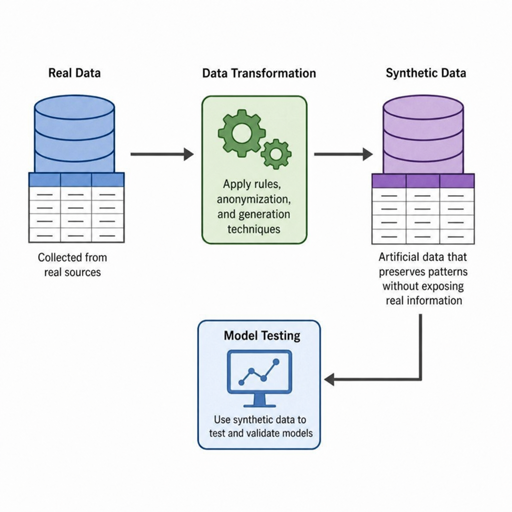
Synthetic data is data generated through rules, simulations, statistical models, or AI systems rather than collected directly from real events, people, devices, or transactions. It may look and behave like real data, but it is created through data synthesis so teams can train, test, or validate systems under controlled conditions.
In practice, synthetic data can take many forms. A retail team might generate artificial customer transactions to test a recommendation engine. A healthcare technology team might create non-identifiable patient-like records to evaluate software workflows. A computer vision team might generate labeled images of objects in different lighting, backgrounds, and angles to support model training.
The point is not to create random noise. Useful synthetic data preserves the relationships, distributions, constraints, and scenarios that matter for the task. If income, age, purchase frequency, or sensor readings relate to each other in the real world, strong synthetic data generation should represent those patterns well enough for the intended use.
Why synthetic data matters for modern AI and analytics
Synthetic data matters because many organizations need more usable data than they can safely, affordably, or ethically collect. Machine learning data is often incomplete, biased toward common cases, restricted by privacy obligations, or too expensive to label at scale. Synthetic Data Generation gives teams another way to create fit-for-purpose datasets while reducing some of those constraints.
This is especially important when real data is scarce or sensitive. Fraud events, equipment failures, unusual medical cases, and rare driving conditions may be too infrequent to provide enough examples for model training. Meanwhile, personally identifiable or confidential data may require strict controls that slow down development. Synthetic data can help teams explore ideas, test systems, and improve coverage before using production data.
It also supports faster iteration. Instead of waiting for months of new data collection, teams can generate controlled examples for specific hypotheses. That does not remove the need for real-world validation, but it can make early development more efficient and more deliberate.
How synthetic data generation works
Synthetic data generation tools use different methods depending on the type of data, the target use case, and the fidelity required. Some approaches are simple and rule-based, while others use advanced machine learning models to learn patterns from existing datasets.
Rule-based generation
Rule-based generation creates artificial data using defined logic. For example, a team might specify that every test customer needs a name format, region, account type, purchase history, and realistic date sequence. This method is useful when the rules are well understood and the goal is testing workflows, forms, databases, or software behavior.
The advantage is control. Teams can intentionally create valid records, invalid records, boundary cases, and rare combinations. The limitation is that hand-written rules may miss subtle relationships unless subject-matter experts define them carefully.
Statistical and simulation-based methods
Statistical methods generate data from known distributions, correlations, and constraints. Simulation-based methods model a process, environment, or system, then produce data from that model. These approaches are common when teams understand the underlying mechanics, such as traffic flow, supply chains, manufacturing systems, or financial stress scenarios.
This type of data synthesis is valuable because it can expose systems to events that are possible but uncommon. For example, a logistics platform may need to test how it behaves when demand spikes, weather delays increase, or inventory drops suddenly across regions.
AI-generated synthetic data
AI-based methods learn from real examples and generate new records, images, text, audio, or sequences with similar properties. These systems can be powerful when the source data contains complex patterns that are hard to write as rules.
However, AI-generated data must be checked carefully. If the model memorizes sensitive examples, exaggerates bias, or produces unrealistic combinations, the synthetic dataset may create more risk than value. Quality evaluation is therefore a core part of any synthetic data strategy.
Key benefits of synthetic data
Synthetic data is useful because it can solve several practical problems at once. Its benefits are strongest when the team knows exactly what the generated data is supposed to support.
More data for training and experimentation
Machine learning models often need many diverse examples to learn reliable patterns. When real datasets are too small, data augmentation and synthetic data can help expand the training set. This is common in image recognition, natural language processing, forecasting, anomaly detection, and classification problems.
Synthetic examples can fill gaps by adding variation. A vision model might need images from different angles. A chatbot evaluation set might need alternate phrasings of the same request. A predictive maintenance model might need more examples of unusual sensor behavior. In each case, synthetic data helps the model encounter more situations before deployment.
Better coverage of rare and edge cases
Real-world datasets often overrepresent routine events and underrepresent unusual ones. Unfortunately, rare cases are often the ones that matter most. A payment system must detect uncommon fraud patterns. A safety system must respond to unusual environmental conditions. A support automation tool must handle unexpected user inputs.
Synthetic data lets teams deliberately generate those examples. This can improve testing, reveal weaknesses, and reduce blind spots. The goal is not to pretend synthetic edge cases are identical to reality, but to make systems more prepared for variation.
Stronger privacy protection
Synthetic data can reduce reliance on sensitive real records. When generated properly, it can preserve analytical value without exposing direct personal details. This is helpful for development, vendor testing, demos, internal training, and research environments where access to production data should be limited.
Privacy is not automatic, though. Poorly generated synthetic data may still leak information if it closely reproduces real individuals or rare records. Teams should use privacy reviews, similarity checks, access controls, and governance standards before sharing or operationalizing synthetic datasets.
Faster software testing
Software teams need data to test forms, workflows, APIs, dashboards, integrations, and system behavior. Real production data is often messy, restricted, or unsafe to use in lower environments. Artificial data gives teams realistic test material without copying sensitive records into places where they do not belong.
Synthetic data can also be generated on demand. A quality assurance team can create records for new users, expired accounts, failed payments, missing values, unusual file sizes, or regional formatting differences. This makes testing more repeatable and easier to automate.
Lower labeling and collection burdens
Collecting and labeling real data can be expensive and slow. Synthetic data can reduce that burden when labels are generated as part of the process. For example, simulated images can include object boundaries, positions, or classifications automatically.
This is especially useful when manual annotation is difficult. Still, synthetic labels should be validated against the real task. A perfectly labeled artificial dataset is only valuable if it reflects the conditions the model will face later.
Synthetic data compared with traditional data augmentation
Synthetic data and data augmentation are closely related, but they are not always the same. Data augmentation usually starts with existing data and modifies it, while synthetic data may be generated from rules, simulations, or models without directly transforming a specific original record.
|
Approach |
How it works |
Best used for |
Main caution |
|---|---|---|---|
|
Data augmentation |
Alters existing examples through transformations or variations |
Expanding training data while preserving known labels |
May not add truly new scenarios |
|
Rule-based artificial data |
Creates records from predefined logic |
Software testing, workflow validation, known constraints |
Can feel unrealistic if rules are too simple |
|
Simulation-based data synthesis |
Models a system or environment and generates outputs |
Rare events, operational scenarios, safety testing |
Depends on the quality of the simulation |
|
AI-generated synthetic data |
Learns patterns from source data and creates new examples |
Complex data types and high-volume generation |
Requires checks for bias, leakage, and realism |
The right choice depends on the problem. If a model needs slight variations of known examples, data augmentation may be enough. If a team needs entirely new scenarios, synthetic data generation may be more appropriate. Many mature workflows use both.
Where synthetic data creates the most value
Synthetic data is not limited to one industry or one type of model. It is most valuable wherever real data is limited, sensitive, uneven, or hard to obtain.
Machine learning model development
For machine learning teams, synthetic data can support prototyping, training, validation, and stress testing. It can help balance classes, expand examples, and expose models to conditions that are not well represented in historical datasets.
The practical benefit is better preparation. A team can ask, “What happens if the model sees more low-frequency cases?” or “How does performance change when the input data contains missing values?” Synthetic datasets make those questions easier to test.
Privacy-aware analytics
Organizations often want to share data for analysis without exposing confidential records. Synthetic data can provide a safer working dataset for analysts, partners, or development teams. It may allow people to explore patterns, build dashboards, or test logic before requesting access to sensitive production data.
This is particularly useful in regulated or high-trust environments. Even then, synthetic data should be handled as part of a broader privacy program rather than a free pass to share without review.
Product development and demos
Product teams need believable data to design interfaces, populate dashboards, and demonstrate features. Empty screens and unrealistic placeholders make it harder to evaluate user experience. Synthetic data can make prototypes feel closer to the real product environment.
A sales or training demo, for example, may need customer-like accounts, transactions, alerts, and reports. Synthetic data allows the team to show how the product works without exposing actual customer information.
System resilience and scenario testing
Synthetic data is useful for testing how systems behave under stress. Teams can create high-volume traffic, unusual input combinations, delayed events, duplicate records, or failure scenarios. This helps reveal weaknesses before real users encounter them.
The best scenario tests are specific. Instead of generating “more data” in general, teams define the condition they want to test: peak load, corrupted inputs, regional formats, extreme values, or rare business events.
What should teams watch out for?
Teams should watch out for unrealistic patterns, hidden bias, privacy leakage, overconfidence, and poor alignment between the synthetic dataset and the real-world task. Synthetic data is a tool, not a replacement for domain expertise or real-world validation.
The biggest mistake is assuming that more data automatically means better results. If generated examples are low quality, they can teach a model the wrong patterns or give testers a false sense of coverage. Synthetic data must be evaluated with the same seriousness as collected data.
Common risks include:
- Low realism: The data looks valid on the surface but fails to capture important relationships.
- Bias amplification: The generation process repeats or magnifies imbalances from the source data.
- Privacy leakage: Generated records resemble real individuals, accounts, or rare events too closely.
- Misaligned use: Data built for testing software is reused for model training without enough validation.
- Weak documentation: Teams cannot explain how the data was created, what assumptions it carries, or where it should not be used.
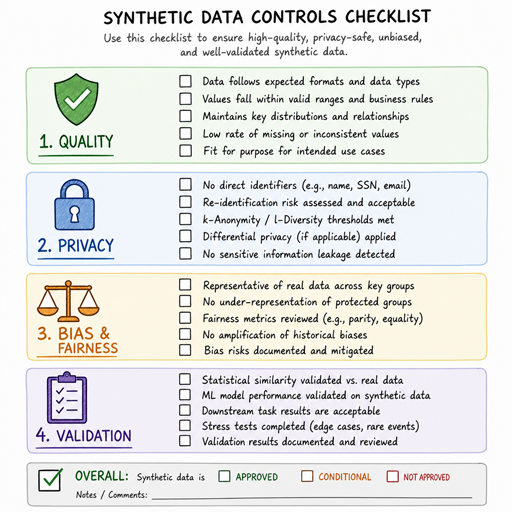
A responsible approach starts with purpose. A dataset for UI testing does not need the same fidelity as one used to train a risk model. A dataset for a public demo needs stronger privacy controls than one used inside a restricted sandbox.
Best practices for effective synthetic data generation
Strong synthetic data programs combine technical generation with governance, evaluation, and clear business goals. The following practices help teams create data that is useful, safe, and defensible.
- Define the use case first. Decide whether the data is for model training, software testing, analytics, demos, or scenario simulation. Each purpose requires different quality standards.
- Identify the patterns that matter. Document important distributions, relationships, constraints, and edge cases. Do not focus only on field names and formats.
- Choose the right generation method. Use rules for controlled test data, simulations for process behavior, augmentation for variations, and AI-based tools for complex patterns.
- Validate against real-world expectations. Compare synthetic outputs with domain knowledge and, where appropriate, real data summaries. Look for impossible values and missing relationships.
- Measure task performance. If the data supports machine learning, evaluate whether it improves the model on realistic validation data rather than only on synthetic examples.
- Check privacy and security. Test for memorization, excessive similarity, and accidental exposure. Apply access controls and review policies.
- Document assumptions and limits. Record how the data was generated, what sources informed it, and where it should or should not be used.
- Refresh when conditions change. Business processes, customer behavior, threats, and systems evolve. Synthetic datasets should evolve with them.
These steps keep synthetic data grounded. They also make it easier for technical teams, legal teams, product leaders, and stakeholders to understand what the data can safely support.
Choosing synthetic data generation tools
Synthetic data generation tools vary widely, so the best choice depends on the data type, workflow, privacy needs, and technical skill of the team. Some tools focus on tabular data, while others specialize in images, text, time series, simulations, or test data management.
A useful evaluation checklist includes:
- Data type support: Does the tool handle tabular, text, image, audio, time-series, or multimodal data?
- Control and customization: Can teams define constraints, business rules, rare cases, and invalid examples?
- Privacy features: Does it support similarity checks, privacy-preserving methods, or governance workflows?
- Quality evaluation: Does it help compare synthetic and real distributions, relationships, and downstream performance?
- Integration: Can it connect with existing data pipelines, testing environments, notebooks, or model development workflows?
- Documentation: Does it make generation steps traceable and repeatable?
- Usability: Can the intended users operate it without creating bottlenecks or relying on one specialist?
Teams should avoid choosing a tool only because it can generate large volumes of data. Volume is useful only when the data is relevant, realistic, and aligned with the objective. A smaller, carefully designed synthetic dataset can be more valuable than a massive dataset filled with weak examples.
Building a responsible synthetic data workflow
A practical workflow begins with a clear problem and ends with monitored use. The process does not need to be overly complicated, but it should be intentional.
First, define the data need. For example, the team may need more examples of rare customer support requests, more balanced machine learning data, or safer records for application testing. Next, decide what real information can guide the generation process without exposing unnecessary sensitive data.
Then generate a pilot dataset and evaluate it. Review field-level validity, relationship accuracy, edge-case coverage, and privacy risk. If the data will train a model, compare performance against a trusted validation set. If it will test software, confirm that it triggers the intended workflows and failure modes.
Finally, create documentation and ownership. Someone should know how the synthetic data was produced, when it was last reviewed, and what assumptions it carries. This makes future updates easier and prevents misuse.
Synthetic data is most powerful when paired with real judgment
Synthetic data generation can help organizations work faster, protect sensitive information, improve testing, and build more resilient AI systems. It is especially useful when real data is scarce, restricted, expensive to label, or missing important edge cases.
Its value depends on quality, context, and responsible use. Artificial data should be designed for a clear purpose, validated against realistic expectations, and documented well enough that others understand its limits. When used thoughtfully, synthetic data becomes more than a convenience; it becomes a practical foundation for safer experimentation, better machine learning data, and smarter product development.
