
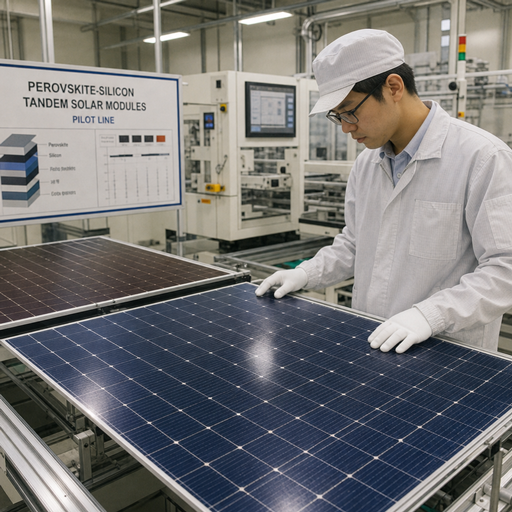
Perovskite solar cells are one of the most closely watched next-generation photovoltaic cells because they can absorb light efficiently in very thin layers and can be paired with silicon to push solar cell efficiency beyond the practical limits of conventional single-junction panels. The technology is no longer only a laboratory topic: early commercial deployments, pilot lines, and demonstration factories now exist, while full-scale bankable manufacturing is still being proven. This guide explains how Perovskite Solar Cells work, why tandem designs matter, and what the perovskite solar cells commercialization status 2026 means for renewable energy planning.
What makes perovskite solar cells different?
Perovskite solar cells use metal-halide perovskite materials as the light-absorbing layer, allowing a very thin film to convert sunlight into electricity. Compared with crystalline silicon, which dominates today’s solar market, perovskite layers can be deposited using lower-temperature processes and can be tuned to absorb different parts of the solar spectrum. That tunability is the core reason they are considered a promising platform for high-efficiency clean energy solutions.
The word “perovskite” describes a crystal structure rather than one single material. In solar applications, researchers usually work with metal-halide perovskites made from organic ions, metals, and halogens. When sunlight hits the perovskite absorber, electrons are excited and then collected through adjacent transport layers, creating electrical current.
The practical attraction is simple: a small amount of active material can do a lot of optical work. That could eventually support lightweight modules, flexible form factors, integrated solar surfaces, and tandem devices layered on top of silicon. The challenge is that high performance must be maintained under heat, moisture, ultraviolet exposure, electrical stress, and years of outdoor operation.
The technology has advanced from single cells to tandem systems
Early perovskite research focused on proving that the material could convert sunlight effectively. The field moved unusually fast: the U.S. Department of Energy notes that perovskite solar cell efficiency rose from about 3% in 2009 to more than 26% on small-area devices, while perovskite-silicon tandem cells have reached nearly 34% in DOE’s cited benchmark context.
That progress shifted attention from “Can this material work?” to “Can it work reliably at commercial scale?” In modern devices, the perovskite layer is not alone. It sits within a stack of charge-selective layers, electrodes, encapsulation materials, and sometimes a silicon bottom cell. Each layer must be optimized so light enters efficiently, charges move with minimal losses, and the device resists degradation.
Tandem cells solve a spectrum problem
A single-junction solar cell wastes some solar energy because one absorber cannot perfectly use every wavelength. High-energy photons lose excess energy as heat, while low-energy photons may pass through without generating current. Tandem cells reduce those losses by stacking two absorbers with complementary bandgaps.
In perovskite-silicon tandems, the perovskite top cell is tuned to capture higher-energy visible light, while the silicon bottom cell captures lower-energy red and infrared light. This architecture can produce more electricity from the same panel area, which is especially valuable where land, roof space, racking, wiring, and labor are major cost drivers.
Efficiency records are moving quickly
In July 2026, LONGi announced a certified 35.5% conversion efficiency for a crystalline silicon-perovskite tandem solar cell, verified by the European Solar Test Installation. The same announcement reported progress at larger industrially relevant areas and independently certified tandem module efficiencies above 29%, showing that the field is moving from tiny record cells toward more scalable formats.
These records do not mean every commercial panel will immediately reach those numbers. Laboratory cells, demonstration modules, and mass-produced panels operate under different constraints. Still, the direction is important: perovskite tandems are showing a credible route to higher power density than conventional silicon alone.
Key advancements driving solar cell efficiency
The recent rise in performance is not the result of one breakthrough. It comes from many incremental advances in materials chemistry, interface control, deposition methods, and encapsulation. Together, these improvements reduce electrical losses and help the perovskite layer survive real-world stress.
Better composition and bandgap tuning
Researchers can adjust perovskite composition to change which wavelengths the material absorbs. This matters for tandem devices because the top cell must be matched to the silicon bottom cell. If the bandgap is too high or too low, the tandem stack loses current balance and overall efficiency suffers.
Composition tuning also affects stability. Some perovskite formulations perform well initially but degrade faster under heat or light. Newer mixed-cation and mixed-halide designs aim to preserve strong absorption while reducing phase instability, ion migration, and other degradation pathways.
Interface engineering and passivation
A solar cell can lose energy when charge carriers recombine before they are collected. Many recent advances focus on passivation, which means reducing defects at grain boundaries, interfaces, and surfaces. Better passivation allows electrons and holes to travel more cleanly through the device.
For readers outside materials science, the practical implication is straightforward: cleaner interfaces can raise efficiency without requiring a completely new panel design. In manufacturing, however, those treatments must be repeatable over large areas and compatible with high-throughput production.
Scalable deposition and module integration
A high-efficiency postage-stamp cell is not the same as a durable module. Commercial perovskite technology needs uniform coating across large substrates, precise layer thickness, laser scribing, reliable electrical interconnection, and robust edge sealing. The DOE describes a typical perovskite manufacturing flow as material creation, cell production, module completion, and testing, with laser scribing and encapsulation playing key roles in module construction.
Scalability is where many photovoltaic cells succeed or fail. A process that works slowly in a glovebox may not work on a factory line. The most important manufacturing advances are therefore not always the most dramatic scientific headlines; they are the repeatable steps that convert delicate films into modules installers can handle.
Are Perovskite Solar Cells commercially available in 2026?
Yes, but availability remains early-stage and limited rather than mainstream. The clearest perovskite solar cells commercialization status 2026 is that perovskite-silicon tandem products have entered initial commercial use and customer validation, while broad, high-volume, bankable deployment is still developing.
Oxford PV announced in September 2024 that it had made the first commercial deployment of a perovskite tandem solar panel, shipping 72-cell perovskite-on-silicon panels to a U.S.-based customer for utility-scale use. The company stated that its first market panels had 24.5% module efficiency and were produced from its megawatt-scale pilot line in Germany.
In the United States, Tandem PV announced in April 2026 that it had opened a commercial demonstration factory in Fremont, California, with approximately 40 MW of annual nameplate capacity. The company said it had begun producing initial modules, planned customer validation shipments later in 2026, and was targeting high-volume manufacturing in 2028.
The broader market is still cautious. The IEA PVPS 2025 trends report stated that perovskite module pilot lines and demonstration shipments were active, but full-scale commercial production had not yet begun by the end of 2024; it also emphasized the need to close the gap between small-area cells and large modules, verify lifetime and reliability, establish manufacturing processes, and address environmental safety and recycling.
Benefits for renewable energy and sustainable energy deployment
Perovskite solar cells matter because they could improve the economics and flexibility of solar generation, not simply because they set records. Higher efficiency can reduce the amount of area required for a given power output. If durability and manufacturing scale are proven, that can help solar compete in more locations and applications.
Key potential benefits include:
- More power from the same footprint: Tandem modules can target rooftops, constrained utility sites, transportation surfaces, and other locations where area is valuable.
- Lower balance-of-system pressure: Higher module efficiency can reduce some non-module costs, including land, racking, wiring, and installation labor per watt.
- Manufacturing flexibility: Thin-film deposition may support new production approaches, although commercial cost advantages must still be proven at scale.
- Application diversity: Lightweight or semi-flexible formats could support specialty markets before commodity rooftop or utility adoption becomes widespread.
- Stronger clean energy solutions: If paired with storage, grid upgrades, and recycling systems, higher-efficiency solar can contribute to more sustainable energy infrastructure.
These benefits are conditional. Perovskites must meet the same practical expectations as other solar technologies: safe operation, predictable output, financeable warranties, certified reliability, and supply chains that can expand without creating new sustainability problems.
The barriers still limiting widespread adoption
The main barriers are durability, scaling, environmental management, and bankability. DOE identifies stability and durability, power conversion efficiency at scale, manufacturability, and technology validation as primary challenges for commercial success.
Stability under real conditions
Perovskite materials can be sensitive to moisture, heat, oxygen, ultraviolet light, and internal ion movement. Encapsulation can protect the active layers, but the module must remain sealed through thermal cycling, humidity, mechanical stress, and years of outdoor exposure. Passing accelerated tests is important, yet investors and project owners also want long-term field data.
Scaling without performance loss
Large modules introduce defects and non-uniformities that small cells avoid. Coating must be even, interfaces must remain clean, and cell interconnections must avoid excess resistance. This is why the industry watches large-area efficiency and certified module results, not just record cell numbers.
Lead and recycling concerns
Many high-performing metal-halide perovskites contain lead. The total quantity can be small compared with other industrial material flows, but environmental containment still matters. Responsible commercialization needs encapsulation, breakage management, end-of-life recycling, and transparent safety standards.
Bankability and warranties
Solar projects depend on predictable performance over decades. Developers, insurers, lenders, and asset owners need confidence that new modules will maintain output and that manufacturers can honor warranties. Until perovskite products build operating history, adoption will likely begin in selected markets rather than instantly replacing silicon everywhere.
How should buyers and energy planners evaluate the technology?
Buyers should treat perovskite solar cells as a promising emerging option, not a drop-in commodity replacement for mature silicon panels in every project. The right evaluation combines certified performance data, durability evidence, manufacturer capacity, warranty terms, and project-specific economics.
Use this checklist when reviewing a perovskite or tandem product:
- Confirm independent certification. Look for recognized third-party efficiency and safety testing, not only internal performance claims.
- Separate cell efficiency from module efficiency. A record cell may be much smaller and less complex than a field-ready module.
- Ask for durability evidence. Review accelerated testing, outdoor field results, degradation assumptions, and encapsulation design.
- Understand the production stage. Pilot-line output, demonstration factories, and gigawatt-scale manufacturing represent very different risk profiles.
- Evaluate total system value. Higher efficiency matters most when it reduces land use, structural requirements, interconnection costs, or installation labor.
- Review environmental controls. Ask how the product handles lead containment, damaged modules, recycling, and end-of-life recovery.
- Match the application to the risk. Specialty, space-constrained, or demonstration projects may justify earlier adoption than conservative utility portfolios.
For policymakers, the priority is to support testing standards, domestic manufacturing learning, recycling pathways, and field demonstrations. For developers, the priority is to quantify whether higher output per area offsets technology risk. For consumers, the priority is to wait for clear warranties, installer support, and proven product availability.
The outlook is promising but incremental
Perovskite solar technology is advancing quickly because it addresses a real problem: silicon solar is excellent, but single-junction devices are approaching practical efficiency ceilings. Tandem perovskite-silicon modules offer a credible path to more electricity from the same sunlight and surface area, making them relevant to the next phase of renewable energy growth.
The most realistic outlook is not an overnight replacement of silicon. Instead, expect staged adoption: specialty uses, pilot utility projects, validation deployments, premium high-efficiency modules, and then broader commercialization if reliability and manufacturing costs meet market expectations. In that sense, the biggest advancement is not only higher solar cell efficiency; it is the gradual movement from scientific promise toward manufacturable, financeable, sustainable energy products.
For now, Perovskite Solar Cells should be viewed as one of the most important emerging technologies in photovoltaics. Their future will depend on whether manufacturers can turn record-setting materials into durable modules that deliver clean energy solutions for decades, not just impressive numbers in the lab.
