
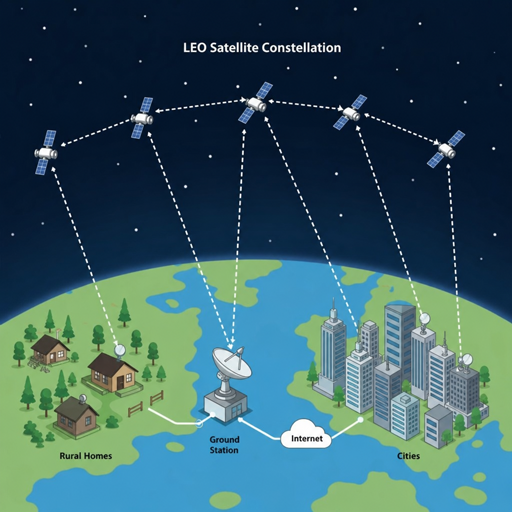
Low-Earth Orbit Satellite Internet is changing how people think about broadband access beyond cities, fiber routes, and cellular towers. Instead of relying only on ground networks or distant geostationary satellites, LEO systems use constellations of satellites closer to Earth to deliver satellite broadband with lower delay and wider reach. The future is not about replacing every terrestrial network; it is about making high-speed internet more available where traditional infrastructure is slow, expensive, fragile, or impossible to build.
What makes low earth orbit satellite internet different?
Low earth orbit satellite internet uses satellites that operate much closer to the planet than traditional geostationary systems, which reduces the distance signals must travel. That shorter path can support lower latency, making web browsing, video calls, cloud tools, and connected devices feel more responsive than older satellite internet services. ITU reporting describes LEO constellations as part of a broader satellite shift that has improved capacity, reduced latency, and made satellite solutions more viable for connectivity gaps.
The key difference is movement. A geostationary satellite appears fixed above one point on Earth, while leo satellites move quickly across the sky and hand connections from one satellite to another. To the user, the service should feel continuous; behind the scenes, antennas, gateways, software, and network routing are constantly coordinating traffic.
That architecture makes LEO internet especially useful for areas where fiber trenching, tower construction, or microwave links are difficult. Remote homes, farms, ships, aircraft, emergency sites, research stations, and underserved communities can all benefit from a network that arrives from above rather than from the nearest road.
The technology behind LEO satellite broadband
A LEO internet system is not just a satellite dish and a spacecraft. It is a layered network that combines orbiting satellites, user terminals, ground gateways, spectrum rights, network operations, and often partnerships with telecom providers. Each layer affects performance, reliability, cost, and the user experience.
Satellites, user terminals, and gateways
The satellite acts as the relay between the customer and the broader internet. The user terminal, often installed on a roof, vehicle, vessel, or portable mount, tracks satellites overhead and sends or receives data. Gateways connect the satellite network to terrestrial internet backbones unless the constellation uses satellite-to-satellite links to route traffic in space before reaching a ground connection.
Because the satellites are closer to Earth, each one covers a smaller area than a geostationary satellite. That is why LEO systems rely on constellations: many satellites working together provide continuous coverage as individual spacecraft pass in and out of view.
Latency, speed, and real-world performance
Latency is one of the biggest reasons LEO is treated as a major step forward for satellite internet. The FCC has noted that LEO satellites avoid some propagation-delay limitations of higher-orbit satellites, while also emphasizing that total latency depends on more than altitude, including network processing and other technical factors.
That distinction matters. A low orbit helps, but performance also depends on network congestion, gateway placement, weather resilience, hardware quality, routing, and how many users share capacity in a region. The future of satellite broadband will be shaped as much by software optimization and network management as by rockets and antennas.
Why LEO internet matters for global connectivity
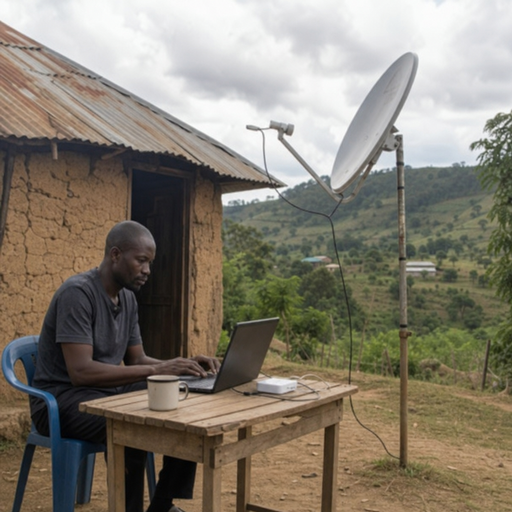
LEO internet matters because broadband access is still uneven, and geography remains one of the hardest barriers to solve. The World Bank has reported that global internet use has grown sharply over two decades, but low-income countries and remote areas still lag, showing that coverage and affordability remain major challenges.
For many communities, the economics of broadband are unforgiving. Fiber is fast and durable, but it can be costly across mountains, forests, deserts, islands, and sparsely populated regions. Cellular networks are powerful, but towers need backhaul, power, permits, and enough customers nearby to justify investment. Satellite broadband can fill gaps where the business case for ground infrastructure is weak.
This does not mean LEO is a universal solution. It means it is becoming an important part of the connectivity mix. The most successful future networks will likely combine fiber, mobile, fixed wireless, Wi-Fi, and satellites, using each technology where it works best.
Practical use cases are expanding
The first wave of LEO adoption focused heavily on rural households and hard-to-reach businesses. The next wave is broader. As terminals improve and networks mature, low earth orbit satellite internet can support more flexible, mobile, and resilient connectivity models.
Common use cases include:
- Rural home broadband: A household outside cable or fiber coverage can use satellite broadband for school, work, entertainment, and essential services.
- Agriculture and land management: Farms can connect sensors, autonomous equipment, irrigation systems, cameras, and field offices across wide areas.
- Disaster response: Emergency teams can deploy connectivity when storms, fires, earthquakes, or floods damage local infrastructure.
- Maritime and aviation: Ships and aircraft can maintain internet access far from land-based towers.
- Construction, mining, and energy: Temporary or remote worksites can connect staff, machinery, safety systems, and cloud platforms.
- Community access points: Schools, clinics, libraries, and local hubs can use satellite links where terrestrial backhaul is limited.
The practical value is not just speed. It is availability. A connection that can be installed quickly, moved when needed, and operated far from dense infrastructure can support economic activity, education, healthcare access, and public safety.
LEO will complement, not replace, terrestrial broadband
The strongest future for LEO internet is hybrid. Fiber will remain essential for core networks, dense cities, data centers, and high-capacity backbones. Mobile networks will continue to dominate everyday connectivity for smartphones and urban mobility. LEO satellites will be most valuable where terrestrial networks are unavailable, vulnerable, or too slow to deploy.
|
Connectivity option |
Best suited for |
Main limitation |
|---|---|---|
|
Fiber broadband |
Dense areas, backbones, high-capacity fixed service |
Expensive or slow to extend across difficult terrain |
|
Mobile networks |
Everyday consumer access, cities, highways, towns |
Requires towers, power, spectrum, and backhaul |
|
Fixed wireless |
Regional broadband and last-mile alternatives |
Performance depends on line of sight and tower density |
|
LEO satellite internet |
Remote, mobile, emergency, and underserved locations |
Capacity, affordability, equipment, and regulatory constraints |
This blended model is already reflected in global policy discussions. The ITU describes satellite systems as complementary to terrestrial networks, especially for broadband expansion, disaster response, remote communities, maritime operations, and aviation.
What challenges must be solved next?
The future of LEO internet depends on solving practical challenges in cost, capacity, regulation, sustainability, and customer experience. The technology is promising, but scale brings complexity. A network that works well for early adopters must perform reliably for millions of users across different climates, markets, and regulatory environments.
Affordability and digital inclusion
A satellite link only helps if people can afford the service, the equipment, power, installation, and the devices needed to use it. Digital inclusion also depends on skills, local language content, trust, and relevant services. ITU’s Global Connectivity Report highlights persistent divides by income, age, gender, and location, which means infrastructure alone cannot close the gap.
For LEO to advance global connectivity, providers and policymakers may need community access models, public-private partnerships, universal service support, shared terminals, or subsidized programs. The goal should not simply be coverage on a map; it should be usable access for real people.
Capacity, congestion, and fair use
Every satellite has finite capacity. As more users join a network in the same region, providers must manage demand through additional satellites, better spectrum use, improved antennas, traffic shaping, and ground infrastructure. In low-density regions, capacity may feel abundant; in popular service areas, congestion can become noticeable.
This is why future LEO networks will rely heavily on intelligent network management. They will need to route traffic efficiently, prioritize critical services when appropriate, and balance consumer, enterprise, government, and mobility demand.
Regulation, spectrum, and orbital sustainability
Satellite internet depends on access to radio spectrum and permission to operate in each market. Regulators must balance innovation, competition, interference protection, national security, consumer rights, and long-term space sustainability.
The growth of large constellations also raises concerns about orbital debris, collision avoidance, astronomy impacts, and responsible end-of-life disposal. The future of high-speed internet from space will require coordination between operators, governments, standards bodies, and scientific communities.
How should buyers evaluate LEO satellite internet?
Buyers should evaluate LEO satellite internet by matching the service to the location, workload, reliability needs, and total cost of ownership. The best choice is not always the fastest advertised plan; it is the service that performs consistently for the applications that matter most.
Use this checklist before choosing a provider or deployment model:
- Confirm coverage at the exact location. Service availability can vary by country, region, terrain, and network capacity.
- Check latency and speed expectations. Look for realistic performance ranges rather than assuming peak speeds apply all day.
- Review equipment needs. Consider antenna placement, power supply, mounting, weather exposure, portability, and installation skill.
- Understand data policies. Some plans may include prioritization, fair-use thresholds, or different service classes.
- Plan for backup connectivity. Businesses and critical sites should consider failover through mobile, fiber, fixed wireless, or a second satellite path.
- Assess support and maintenance. Remote sites need clear troubleshooting procedures and replacement options.
- Consider security. Use strong Wi-Fi settings, updated devices, VPNs where appropriate, and clear access controls.
For households, the decision often comes down to whether LEO is better than the available local options. For enterprises, the decision is broader: LEO can become part of a resilience, mobility, or remote operations strategy.
The next phase of LEO internet
The next phase of Low-Earth Orbit Satellite Internet will be defined by integration. Satellite providers will increasingly connect with mobile operators, cloud platforms, enterprise networks, emergency systems, and government connectivity programs. Instead of being treated as a niche fallback, LEO can become a standard layer in broadband planning.
Several developments are likely to shape that future. User terminals should become easier to install and more adaptable for vehicles, vessels, and temporary sites. Multi-orbit strategies may combine LEO, medium Earth orbit, and geostationary capacity to balance latency, coverage, and resilience. Direct-to-device services may also expand basic messaging or connectivity in places where phones cannot reach a terrestrial tower, although performance will vary by device, spectrum, and network design.
The biggest shift may be in expectations. People increasingly expect internet access wherever they live, work, travel, or respond to emergencies. LEO internet pushes the industry closer to that expectation, but it also reminds us that connectivity is an ecosystem, not a single product.
A more connected future depends on smart deployment
LEO satellites can make satellite internet faster, more responsive, and more practical for places that have waited too long for reliable broadband. They can support rural households, mobile industries, emergency response, and communities beyond the edge of terrestrial infrastructure. They can also strengthen network resilience when fiber cuts, tower outages, or natural disasters disrupt local service.
The future of low earth orbit satellite internet will depend on responsible scaling: fair pricing, smart regulation, sustainable orbital practices, realistic performance claims, and integration with the networks already on the ground. If those pieces come together, LEO will not just expand satellite broadband; it will help make global connectivity more flexible, resilient, and inclusive.
