
Web3 smart contract royalties are a way to record, calculate, and route creator or rights-holder payments when digital assets are sold. They are most commonly discussed in relation to NFT royalties, but the same ideas can support broader web3 payments, licensing, revenue sharing, and automated royalty distribution. This guide explains how smart contract royalties work, what they can and cannot enforce, and how to design them responsibly.
What are web3 smart contract royalties?
Web3 smart contract royalties are royalty terms expressed in blockchain-based logic, usually through a smart contract that identifies who should receive a payment and how much should be paid from a sale. In NFT markets, the best-known approach is ERC-2981, a standard that lets contracts expose royalty payment information so marketplaces and other ecosystem participants can retrieve it consistently. The standard focuses on returning a royalty recipient and amount for a given sale price; it does not, by itself, guarantee that the payment will be made.
That distinction matters. A smart contract can make royalty information visible and easier to integrate, but many secondary sales still depend on marketplaces, escrow systems, or custom payment flows to actually transfer funds. In practice, smart contract royalties sit at the intersection of code, marketplace policy, user behavior, and legal agreements.
For creators, teams, and brands, this means blockchain royalties should be treated as payment infrastructure rather than magic enforcement. They can make royalty terms more transparent, portable, and programmable, but they still need a thoughtful commercial and technical design.
The basic royalty flow
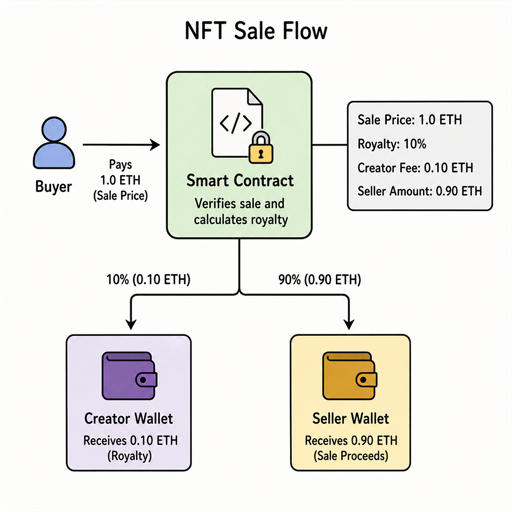
Most smart contract royalty systems follow a simple pattern: a sale occurs, the sale price is used to calculate a royalty amount, and the royalty recipient receives a payment while the seller receives the remaining proceeds. When implemented well, this turns an otherwise manual payment process into a repeatable rule that software can read.
A typical NFT royalty flow looks like this:
- A creator or rights holder sets royalty terms. This may happen when the NFT collection is deployed, when a specific token is minted, or through an admin-controlled contract function.
- A buyer purchases the asset. The marketplace or sales contract knows the sale price and payment currency.
- The royalty data is queried. Under ERC-2981, the royaltyInfo() function returns the recipient address and royalty amount for the token and sale price.
- The payment is routed. A compliant sales system sends the royalty to the receiver and the remaining amount to the seller.
- Records remain inspectable. The royalty configuration and transaction history can often be reviewed on-chain, depending on how the system is designed.
This is why smart contract payments are attractive: the logic can be consistent, transparent, and composable. A marketplace, game, metaverse platform, or licensing application can all read the same royalty rules instead of negotiating and storing them separately.
Why royalties matter in web3 commerce
Royalties are important because digital assets can move across wallets, platforms, and markets long after the original sale. In traditional digital commerce, a creator’s revenue often ends at the first transaction unless contracts, distributors, or collecting societies manage ongoing payments. Web3 introduces a different possibility: payment instructions can travel with the asset or be discoverable from the asset’s smart contract.
For artists and creative teams, this can support ongoing participation in secondary-market value. For brands, it can create a structured way to share revenue with collaborators, licensors, game studios, musicians, or community treasuries. For developers, royalty-aware contracts can become building blocks for marketplaces, token-gated products, and digital licensing systems.
The practical benefit is not just “automatic income.” It is cleaner coordination. When royalty data is standardized, external platforms need less custom integration work, and buyers can better understand the economic terms attached to an asset.
NFT royalties and ERC-2981
NFT royalties became one of the earliest mainstream examples of blockchain royalties because NFTs are designed to represent unique digital assets. ERC-721 and ERC-1155 collections can use royalty standards to tell external systems how royalties should be calculated. ERC-2981 was created as a minimal standard for retrieving NFT royalty payment information across marketplaces and participants.
OpenZeppelin’s contracts documentation describes ERC-2981 as a way to retrieve royalty payment information and notes that royalty information can be set globally for all token IDs or individually for specific token IDs. Its implementation also uses a fee denominator that defaults to 10,000, meaning royalty rates are commonly represented in basis points.
Collection-wide royalties
A collection-wide royalty applies the same royalty recipient and percentage to every token in a collection. This is simpler to manage and often works well for single-creator drops, brand collections, or projects where one treasury receives all royalties.
The drawback is reduced flexibility. If different tokens involve different collaborators, licenses, or revenue shares, a single global royalty may be too blunt. Teams may then need token-level rules or a payment splitter.
Token-level royalties
Token-level royalties allow different tokens to point to different recipients or rates. This is useful when each asset has a different artist, rights holder, or commercial arrangement. OpenZeppelin’s ERC-2981 implementation allows token-specific royalty information to override the default royalty setting.
The tradeoff is operational complexity. More granular royalty data requires better minting workflows, stronger permissions, and clearer records. A project should know who can update royalty terms, when updates are allowed, and how errors will be corrected.
Split royalties
Many real-world projects involve multiple payees: an artist, producer, platform, DAO treasury, charity, or licensing partner. Since ERC-2981 returns one receiver address, projects often use a receiving contract or off-chain process to handle additional splitting. The ERC-2981 rationale notes that added complexity such as fee splitting and accounting belongs in the receiver’s contract or related processes rather than the minimal royalty standard itself.
This design keeps the standard flexible. The NFT contract can point to a splitter contract, and that splitter can distribute incoming funds according to the project’s agreement.
Can smart contracts enforce royalty payments?
Smart contracts can enforce royalties only in payment flows they control. If a sale happens inside a marketplace contract or custom sales contract that is designed to honor royalties, payment can be routed automatically. However, ERC-2981 itself only signals royalty information and does not force payment; OpenZeppelin also notes that on-chain royalty tracking does not automatically mean payouts occur.
This is one of the most misunderstood parts of smart contract royalties. A basic NFT transfer between wallets is not always a sale. It might be a gift, a migration to a hardware wallet, a transfer between accounts owned by the same person, or collateral movement. The ERC-2981 specification explains that transfer functions cannot simply require royalty payment because not every transfer represents a sale.
There are ways to increase enforcement, but each has tradeoffs. A project might restrict transfers to approved marketplaces, build its own marketplace, use escrow-based sales, or design assets with platform-specific utility. These choices may improve royalty capture, but they can also reduce composability, increase user friction, or create governance concerns.
Smart contract royalty models
Different royalty models fit different business goals. The right model depends on who should be paid, how often the asset might trade, and how much flexibility the project needs.
|
Model |
Best for |
Main advantage |
Main risk |
|---|---|---|---|
|
Fixed percentage |
Art drops, collectibles, simple licensing |
Easy to understand and implement |
May not fit every sale context |
|
Token-specific percentage |
Multi-artist collections or licensed assets |
Matches unique rights per asset |
Requires careful data management |
|
Split receiver contract |
Collaborations and revenue sharing |
Sends funds to multiple parties |
Splitter logic must be secure and auditable |
|
Platform-controlled payout |
Games, apps, closed marketplaces |
Stronger enforcement inside one ecosystem |
Less portable across open markets |
|
Off-chain reconciliation |
Enterprise licensing and complex rights |
Supports invoices, taxes, and legal workflows |
Less automatic and less transparent |
A fixed royalty is usually the simplest starting point. More advanced royalty distribution becomes valuable when the project has multiple stakeholders or when royalties must support accounting, reporting, or compliance workflows.
Designing royalty distribution that works
Good royalty distribution starts before the contract is deployed. The technical setup should reflect the commercial agreement, not the other way around. If the business terms are unclear, the contract will only automate confusion.
Use this checklist before launching smart contract royalties:
- Define the royalty recipient. Decide whether payments go to an individual wallet, company wallet, treasury, or splitter contract.
- Document the percentage. Record the rate, when it applies, and whether it can change.
- Map every stakeholder. Include creators, licensors, collaborators, platforms, and any community allocation.
- Choose the payment flow. Decide whether royalties depend on third-party marketplaces, a native marketplace, or direct sales contracts.
- Plan for wallet changes. People lose keys, companies restructure, and treasuries migrate. Know whether updates are possible.
- Separate royalty data from legal rights. A blockchain royalty setting does not automatically define copyright ownership, licenses, or tax obligations.
- Test edge cases. Burns, transfers, upgrades, refunds, chargebacks in fiat workflows, and cross-chain movement can all affect payment expectations.
The most resilient systems combine clear rights documentation with clean smart contract payments. The contract should make the agreed payment path easier to execute, while legal and operational documents explain what the code cannot fully express.
Web3 payments beyond NFTs
Although NFT royalties receive most of the attention, the same infrastructure can support broader blockchain royalties. Music rights, game assets, digital fashion, AI model licensing, software components, media archives, and membership-based intellectual property can all use programmable payment logic in different ways.
In these cases, royalties may not be tied only to resale. They may apply to access, usage, subscriptions, licensing renewals, revenue share, or in-app transactions. A smart contract payment system can route funds when a license is purchased, when a digital item is rented, or when a token-gated product generates revenue.
The challenge is modeling the real business event. A resale royalty is relatively simple because it uses a sale price. A usage-based royalty may require trusted data from an application, oracle, reporting system, or enterprise database. The more the payment depends on off-chain activity, the more important governance and reconciliation become.
Implementation best practices
Smart contract royalties should be simple where possible and explicit where complexity is unavoidable. Over-engineering royalty logic can increase gas costs, create security risk, and make the project harder for marketplaces to support.
Use recognized standards when they fit
For NFT royalties on EVM-compatible networks, ERC-2981 is the widely recognized baseline for exposing royalty information. It is compatible with ERC-721 and ERC-1155, and it can also be used by other contracts that need to return royalty payment information.
Using a recognized standard helps other tools understand the contract. Custom royalty logic may still be necessary, but it should not block basic interoperability unless there is a strong reason.
Keep payment logic auditable
Royalty contracts handle money, so readability and review matter. Use proven libraries when appropriate, limit privileged functions, and make admin controls clear. If royalty recipients or rates can be changed, the contract should define who has that power and whether changes are immediate, delayed, or governed.
For higher-value projects, independent review is prudent. Even a small mistake in a splitter, upgrade mechanism, or access-control function can misroute funds or lock revenue.
Communicate limitations honestly
A project should not promise guaranteed lifetime royalties unless its system actually controls every relevant sale path. A clearer message is that the project supports royalty-aware payment infrastructure and that royalties are paid when sales occur through compatible systems.
This honesty protects trust. Creators understand what is automated, collectors understand what they are buying, and partners know where additional agreements may be needed.
Common mistakes to avoid
The most common royalty mistakes are not purely technical. They usually come from unclear assumptions about enforcement, ownership, and marketplace behavior.
Avoid these issues:
- Assuming every transfer is a sale. Wallet movement, gifts, and custody changes may not generate royalty obligations.
- Treating royalty settings as a full legal contract. Smart contract royalties can support rights agreements, but they rarely replace them.
- Hardcoding the wrong recipient. A permanent wallet error can be difficult or impossible to fix.
- Ignoring marketplace support. If the sales venue does not honor royalty information, payments may not happen.
- Making upgrades too powerful. Admin flexibility can solve mistakes, but it can also reduce buyer confidence if terms can change without limits.
- Forgetting tax and accounting needs. On-chain payments still need real-world reporting, categorization, and recordkeeping.
The best approach is to design for clarity. Every participant should know what is automatic, what is voluntary, what is legally documented, and what depends on a specific platform.
The future of blockchain royalties
Blockchain royalties are likely to keep evolving from simple NFT resale fees into broader payment infrastructure for digital ownership and licensing. The strongest use cases will combine transparent royalty data, reliable payment execution, and business terms that users can understand.
For creators, web3 smart contract royalties offer a path toward more direct participation in the value of digital assets. For platforms and brands, they provide a programmable foundation for partner payouts, licensing networks, and automated revenue sharing. For buyers, they create more visible economics around the assets they collect, trade, or use.
The key is realism. Smart contract royalties are powerful because they make payment rules legible to software, not because they remove every legal, commercial, or social dependency. When designed with that balance in mind, smart contract royalties can become a practical layer for fairer and more transparent web3 payments.
