
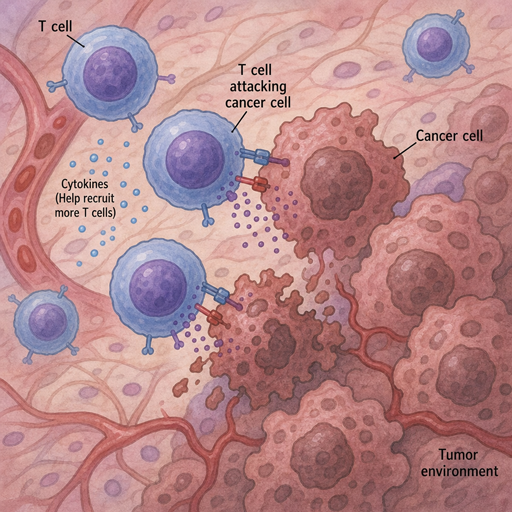
Cancer-fighting T cells are central to some of the most promising advances in modern cancer treatment, but they can lose power when tumors keep them activated for too long. New research suggests that part of this burnout may be tied to how T cells spend and conserve energy, opening a possible path to longer-lasting cancer immunotherapy. The finding is not a ready-made cure, but it gives scientists a sharper target for improving the immune response against cancer cells.
Why do cancer-fighting T cells burn out?
Cancer-fighting T cells burn out because they can be pushed into a state of long-term stress after repeatedly recognizing and attacking tumor signals. In that exhausted state, the cells may remain present in the tumor environment but become less able to sustain a strong attack, which can weaken the overall immune response. This is one reason some cancer immunotherapy results can look promising at first and then fade over time.
T cells are not simple on/off switches. They are living cells with limited energy, internal repair systems, and molecular programs that decide whether to keep fighting, slow down, or shut off. When the tumor burden is high or stimulation continues for a long time, the immune system may face a difficult trade-off: push T cells harder for a rapid attack, or preserve them for a longer campaign.
The new clue: MEK and the T cell energy problem
Researchers at Memorial Sloan Kettering Cancer Center reported that a signaling molecule called MEK appears to play an important role in driving terminal exhaustion in CD8+ T cells, a major class of tumor-killing immune cells. Their study, published in Immunity, suggests that MEK can push exhausted T cells toward high energy demand as they produce cancer-killing proteins; in animal and laboratory studies, blocking MEK helped the cells conserve energy and persist longer.
That matters because a T cell’s ability to fight is tied to its internal “budget.” If a cell spends too much energy too quickly, it may not have enough left to survive and keep working in a hostile tumor microenvironment. MEK inhibition, in this model, does not simply make T cells stronger in the obvious sense. Instead, it may help them shift from a short, intense burst toward a slower, more durable response.
The practical insight is subtle but important. In cancer treatment, the best immune response is not always the fastest one. For some patients, especially those with large tumors or fewer tumor-reactive immune cells, a sustained response may be more useful than a brief surge that burns out before the cancer is controlled.
What did scientists actually find?
Scientists found that changing the energy demands of exhausted T cells may help them last longer, but the work so far is mainly preclinical and should not be read as proof of a new standard treatment. The research points to MEK as a possible lever for tuning T cell behavior, especially in forms of immunotherapy where persistence is a major challenge.
Here is the takeaway in plain English:
- T cells can become exhausted when they are continuously exposed to tumor antigens, the abnormal signals that help the immune system recognize cancer.
- MEK appears to influence the pace of the fight by affecting how aggressively T cells spend energy while producing cancer-killing proteins.
- Blocking MEK may encourage conservation, helping T cells survive longer instead of burning through their resources too quickly.
- The approach may be most relevant when the immune response needs endurance, such as cases involving large tumors or too few active tumor-fighting cells.
- More research is needed before this can be applied broadly in people, because slowing a T cell down could help in one setting but weaken the attack in another.
This is why the discovery is exciting without being definitive. It gives researchers a more precise question to test: when should doctors encourage T cells to sprint, and when should they help them pace themselves?
Why exhaustion is a major barrier in cancer immunotherapy
Cancer immunotherapy is built on a powerful idea: help the immune system recognize and attack cancer cells more effectively. Checkpoint inhibitors, for example, can block signals that restrain T cells, allowing them to attack tumors. T-cell transfer therapy aims to boost or engineer a patient’s own immune cells so they are better able to fight cancer.
But removing the brakes is not always enough. If the T cells inside a tumor are already metabolically strained, poorly repaired, or deeply exhausted, they may not respond strongly even after checkpoint pathways are blocked. Recent Johns Hopkins research in head and neck cancer also supports the idea that exhausted immune cells can share metabolic weaknesses, and that targeting those weaknesses in lab experiments may reactivate some cells.
This broader pattern is changing how scientists think about cancer immunotherapy. The field is moving beyond the question, “Can we activate T cells?” toward a more layered question: “Can we activate the right T cells, keep them alive, preserve their function, and help them work inside a difficult tumor environment?”
The endurance model of T cell therapy
The MEK finding fits into a growing view of T cell therapy as an endurance problem, not just a targeting problem. In CAR T-cell therapy, for example, T cells are engineered to recognize cancer cells more effectively. This form of treatment has had major impact in some blood cancers, while use in many solid tumors remains more challenging and often experimental.
Persistence is one of the central issues. A T cell that recognizes the right target still has to expand, survive, enter or remain in the tumor environment, and keep functioning after repeated stimulation. If it burns out too early, the therapy may lose momentum.
That is why a “slow burn” strategy could be valuable in selected situations. Instead of forcing cancer-fighting T cells into maximum activity immediately, doctors might one day use carefully timed combinations to help them stay functional longer. The MSK researchers specifically noted potential applications across checkpoint inhibitors, CAR T cell therapy, tumor-infiltrating lymphocyte therapy, and bispecific antibodies, though each use would need careful testing.
Other researchers are finding different burnout switches
MEK is not the only possible explanation for T cell exhaustion. UC San Diego researchers recently reported that exhausted T cells can have problems with proteostasis, the cell’s protein quality-control and recycling system. In their mouse studies, restoring certain E3 ligases helped clear damaged protein buildup and improved T cell function against tumors.
That may sound like a separate issue, but it points in the same direction: exhausted T cells are not merely “tired” in a casual sense. They may be dealing with tangled energy use, repair failure, protein stress, and suppressive signals from the tumor environment. Cancer cells can also create conditions that make immune attack harder, including signals that restrain T cells or environments that starve them of resources.
For readers following cancer research, this is the bigger story. Scientists are mapping the internal failure points that keep immune cells from finishing the job. Each map may reveal a different way to improve cancer treatment: adjust metabolism, repair protein recycling, engineer stronger cells, combine therapies, or select patients more precisely.
What this could mean for patients and clinicians
The most responsible interpretation is cautious optimism. Existing MEK inhibitors are already used in some cancer contexts, which could make clinical testing of this strategy more feasible than starting from an entirely new drug class. However, using a known type of drug in a new immunotherapy strategy still requires careful trials to understand dose, timing, patient selection, benefits, and risks.
A useful way to think about future applications is by matching the immune strategy to the tumor situation:
|
Treatment situation |
Possible T cell need |
Why pacing may matter |
|---|---|---|
|
Small tumor with many active immune cells |
Fast, forceful attack |
T cells may be close enough to the “finish line” to push hard |
|
Large tumor or low T cell numbers |
Longer persistence |
A slower immune response may help cells avoid early collapse |
|
CAR T or other t cell therapy |
Survival after infusion |
Engineered cells need to remain active long enough to matter |
|
Combination immunotherapy |
Balanced activation |
Too much stimulation can sometimes contribute to exhaustion |
This does not mean patients should seek MEK inhibition on their own or assume it will improve every immunotherapy plan. The biology is context-dependent. A strategy that preserves T cells in one setting could blunt their killing power in another, so the key will be learning when conservation helps more than intensity.
The bigger lesson for the future of cancer treatment
The emerging lesson is that the immune system needs both power and stamina. Cancer-fighting T cells must recognize cancer cells, attack them, survive repeated encounters, and adapt to a tumor environment designed to resist immune pressure. Better cancer treatment may depend on managing all of those steps, not just amplifying one of them.
The new MEK research adds an important piece to that puzzle. It suggests that T cell exhaustion may be partly managed by changing how immune cells use energy, potentially making cancer immunotherapy more durable for patients whose current options fall short. That is not a final fix yet, but it is a promising direction: helping the body’s own defenders fight smarter, last longer, and stay in the battle when cancer tries to wear them down.
