
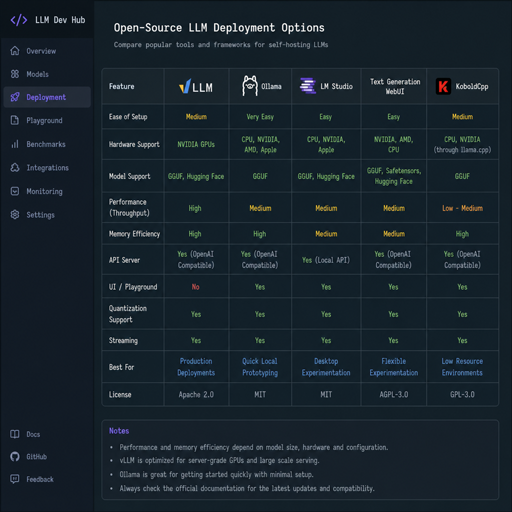
Open-Source LLMs are moving from experimental downloads to practical infrastructure for developers, startups, researchers, and enterprise AI teams. The future is not simply “bigger models”; it is more local deployment, better coding support, stronger reasoning, multimodal workflows, clearer governance, and faster iteration across the open-source AI ecosystem. This list breaks down the biggest shifts to watch and how to choose models without getting lost in hype.
What will define the next generation of open-source LLMs?
The next generation of open-source LLMs will be defined by control, specialization, and deployability. Instead of choosing a model only because it tops a leaderboard, teams will compare licensing, hardware needs, context length, reasoning behavior, safety options, coding quality, multilingual support, and integration with their existing stack. Public leaderboards such as Hugging Face’s Open LLM Leaderboard remain useful for discovery, but real-world selection increasingly depends on private evaluations that reflect a team’s own data, risk tolerance, and product goals.
A useful way to think about the future is this: closed frontier models will continue to set expectations, while Open-Source LLMs will make those capabilities adaptable, inspectable, and easier to run in controlled environments. That does not mean every organization should self-host everything. It means more teams will mix local models, open-weight APIs, retrieval systems, and proprietary models depending on the task.
1. Smaller, efficient models will become the practical default
The most important trend in open-source AI is not only the release of giant models. It is the rapid improvement of small and mid-sized models that can run on a workstation, a single GPU, or a modest private server. Google positions Gemma 3 as a family of lightweight open models, with variants designed for more accessible deployment, and notes that Gemma 3 can run on a single GPU or TPU.
That matters because most production use cases do not need a massive model for every request. A support classifier, internal search assistant, code explainer, meeting summarizer, or document router may perform well with a smaller model when paired with retrieval, good prompts, and clear evaluation. Smaller models reduce latency, simplify privacy reviews, and make local experimentation less expensive.
For teams searching for the best open source llms for local running 2025 and beyond, the practical answer is not one universal winner. The best option is usually the smallest model that meets the quality bar for the job. That might mean a compact model for chat, a specialized model for code, and a larger reasoning model only when the task truly requires it.
2. Reasoning models will change how teams evaluate quality
Open models are increasingly competing on reasoning, not just fluent text generation. DeepSeek-R1 drew attention because its release included open-sourced distilled models in multiple sizes, making reasoning-style capabilities more accessible to developers who could not run the largest model.
Reasoning changes evaluation because the output is not only about tone or grammar. Teams need to test whether a model can follow multi-step instructions, catch contradictions, explain assumptions, and avoid confident mistakes. For legal, financial, medical, engineering, or compliance-adjacent workflows, a model that sounds polished but skips reasoning steps can be more dangerous than a smaller model that knows when to ask for clarification.
The future of llm development will include more task-specific reasoning tests. Teams will create prompt suites that include edge cases, ambiguous requests, bad inputs, and adversarial instructions. They will also compare latency and cost at different reasoning settings, because deeper reasoning often requires more compute.
3. Local running will become a mainstream deployment pattern
Local LLM deployment used to feel like a hobbyist niche. That is changing as model formats, inference engines, quantization tools, and desktop applications improve. Qwen’s Qwen3 release notes highlight local development paths including Ollama, LM Studio, llama.cpp, and related tools, reflecting how normal local experimentation has become for open-weight models.
Local running is attractive for three reasons. First, it can keep sensitive prompts and documents inside a controlled environment. Second, it gives developers fast iteration without waiting on external API limits. Third, it supports offline or edge use cases where network access is unreliable.
Local does not automatically mean cheaper or better. Hardware, maintenance, updates, monitoring, and security still matter. OpenAI’s guidance for its open-weight models notes that self-hosting can be cheaper in some cases, while API use may be more efficient when hosting and maintenance are included.
Local deployment checklist:
- Confirm the model license allows your intended use.
- Test the model on your real prompts, not only public benchmarks.
- Measure latency at the context length you actually need.
- Decide whether quantization changes quality enough to matter.
- Add logging, access controls, and prompt-injection defenses.
- Plan for model updates, rollbacks, and reproducible environments.
4. Coding models will split into specialized roles
The phrase best open source llms for coding 2026 is too broad unless you define the coding task. Code completion, repository search, bug explanation, test generation, pull-request review, architecture planning, and agentic software engineering are different workloads. A model that is excellent for short autocomplete suggestions may not be the best choice for editing a large codebase.
Mistral’s model catalog illustrates this specialization trend, listing open coding-focused models such as Devstral Small alongside broader language and multimodal models. OpenAI’s gpt-oss series is also positioned for reasoning, agentic tasks, and developer use cases, with 120B and 20B open-weight options.
For software teams, the future is a stack rather than a single coding model. One model may handle inline suggestions, another may summarize files, another may reason through failing tests, and a retrieval layer may provide repository-specific context. The winning setup will be the one that improves developer flow without flooding teams with noisy diffs.
Coding model fit by task:
|
Task |
What to prioritize |
|---|---|
|
Autocomplete |
Low latency, code syntax accuracy, IDE integration |
|
Debugging |
Reasoning quality, stack trace understanding, concise explanations |
|
Repo Q&A |
Long context, retrieval quality, citation of files or functions |
|
Test generation |
Framework awareness, edge-case thinking, deterministic formatting |
|
Agentic coding |
Tool use, planning, rollback behavior, safety limits |
5. Multimodal open models will expand real-world use cases
Text-only chatbots are no longer the full story. Open models are moving into multimodal work that combines text with images, documents, screenshots, charts, and interface states. Meta describes Llama 4 Scout and Llama 4 Maverick as natively multimodal open-weight models and notes that Llama 4 uses a mixture-of-experts architecture.
Multimodal capability matters because many business workflows are visual. A model may need to read a PDF table, interpret a chart, compare product screenshots, inspect a form, or explain an error in a user interface. When those capabilities become easier to run in controlled environments, open-source AI becomes more useful for operations, education, analytics, design, and support.
The key challenge is reliability. A multimodal model can describe what appears in an image, but teams still need validation when outputs affect customers or decisions. Future llm development will combine vision-language models with OCR, structured extraction, human review, and domain rules.
6. Licenses and model openness will matter more than labels
“Open source” is often used loosely in AI. Some models provide weights but not training data. Some use permissive licenses; others restrict commercial use, scale, or certain applications. That means buyers and developers should look beyond the phrase open source llms and read the actual license, acceptable use policy, model card, and release notes.
Mistral states that most of its open-source models are released under Apache 2.0, while also directing users to model cards for explicit licensing terms. Qwen3 includes multiple open-weight dense models under Apache 2.0, according to the Qwen team’s release notes. These details matter because licensing can affect commercial deployment, redistribution, fine-tuning, and customer commitments.
In the future, model selection will involve legal, security, and procurement teams earlier. A model that performs well but carries unclear usage restrictions may create more risk than a slightly weaker model with a clean, permissive license. For serious deployments, “Can we use it?” is just as important as “How smart is it?”
7. Fine-tuning will become more selective and evaluation-driven
Early open-source LLM adoption often jumped straight to fine-tuning. The newer pattern is more disciplined: start with prompting, add retrieval, evaluate, then fine-tune only when the use case clearly demands it. This shift is practical because fine-tuning can introduce maintenance work, regressions, and safety concerns if teams do not measure it carefully.
Retrieval-augmented generation remains especially valuable for company-specific knowledge. Instead of retraining a model every time a policy, product document, or API reference changes, teams can retrieve the latest source material and ask the model to answer from that context. Fine-tuning is better reserved for stable patterns: tone, structured outputs, domain-specific reasoning habits, or repeated task formats.
The future of llm development will look more like software engineering than prompt tinkering. Teams will version datasets, test prompts, track model behavior, document evaluation results, and create rollback plans. Open models make that process more controllable because teams can inspect, host, adapt, and compare them on their own terms.
8. Open tooling will become as important as open weights
A strong model is only one layer of the stack. The open-source AI ecosystem also depends on inference servers, quantization methods, evaluation harnesses, vector databases, orchestration frameworks, guardrails, monitoring, and deployment templates. Without that surrounding tooling, even the best open source llms can be difficult to operate reliably.
Qwen’s release notes mention deployment with vLLM or SGLang for OpenAI-compatible API endpoints, which reflects a broader trend: developers want open models to fit into familiar application patterns. The easier it is to swap models behind a stable interface, the easier it becomes to test several options before committing.
This is where open models may gain durable advantage. A team can benchmark a model locally, run it through an internal evaluation suite, serve it through a compatible API, and replace it later without redesigning the entire application. The model is important, but the operating system around the model is what makes it production-ready.
9. Safety practices will shift earlier in the development cycle
As Open-Source LLMs become easier to download and modify, safety cannot be an afterthought. Teams need to evaluate misuse risk, prompt injection, data leakage, hallucination, unsafe tool use, and harmful outputs before a model reaches users. Meta’s Llama resources emphasize safe deployment guidance and trust-and-safety resources for developers.
Open-weight models create both opportunity and responsibility. They allow independent auditing, red-teaming, and adaptation, but they also reduce the ability of the original publisher to intervene after release. OpenAI’s safety discussion for gpt-oss notes that open-weight models have limited post-release intervention options compared with hosted systems.
Future-ready teams will build safety into product requirements. That includes input filtering, output review, model-specific policy tests, restricted tool permissions, and clear escalation paths. For high-risk workflows, the question is not whether the model is open or closed; the question is whether the full system is controlled, evaluated, and monitored.
10. Benchmarks will become more practical and more private
Public benchmarks are useful, but they cannot answer every deployment question. A model may perform well on math or coding leaderboards and still fail at a company’s support tickets, compliance language, internal acronyms, or messy spreadsheets. That is why the future of model evaluation will combine public results with private test sets.
DeepSeek-V3’s technical report, for example, presents benchmark results showing strong performance relative to other open-source models and some closed-source models, but teams still need to test whether that strength translates to their actual workflows. The same is true for any model family. Benchmarks are signals, not guarantees.
A practical evaluation set should include normal cases, hard cases, and failure cases. It should measure not only final answer quality but also formatting, refusal behavior, citation accuracy, latency, cost, and consistency across repeated runs. As open models mature, the best teams will compete on evaluation discipline as much as model choice.
11. Hybrid AI stacks will beat one-model strategies
The future of open-source LLMs is not a simple replacement of proprietary models. It is a more flexible architecture where teams use the right model for the right job. A product might use a small local model for private classification, a larger open reasoning model for complex internal analysis, and a hosted frontier model for rare tasks that require maximum capability.
This hybrid approach reduces dependency on any single vendor or model family. It also supports better cost control: routine tasks can move to efficient open models, while expensive models are reserved for work that justifies them. Teams can also keep sensitive data in local workflows while using external APIs for lower-risk tasks.
For many organizations, the best open source llms will be the ones that fit into this mixed environment. A model that is easy to deploy, monitor, and replace may create more business value than a model that is impressive in isolation but difficult to operate.
12. Model choice will become a product strategy decision
Choosing among open source llms is no longer only a developer preference. It affects product speed, privacy posture, support quality, infrastructure cost, user trust, and long-term flexibility. That is why model decisions increasingly belong in product strategy discussions.
A customer-facing AI feature has different requirements from an internal research assistant. A regulated workflow has different constraints from a creative drafting tool. A startup may prioritize iteration speed, while an enterprise may prioritize governance, auditability, and vendor risk reduction.
The future will favor teams that connect model selection to outcomes. Instead of asking, “Which model is best?” they will ask, “Which model best supports this user, this task, this risk level, and this deployment environment?” That question leads to better decisions than chasing every new release.
How should you choose the best open source LLMs now?
Start with the use case, not the model name. Define the task, quality bar, latency target, privacy requirement, license constraints, and maintenance budget before comparing models. Then shortlist models from credible families, run them against your own evaluation set, and choose the smallest reliable option that leaves room to scale.
Use this decision path when comparing options:
- Define the workload. Separate chat, coding, summarization, extraction, reasoning, multimodal, and agentic tasks.
- Set constraints. Identify hardware, data sensitivity, license needs, and acceptable response time.
- Create an evaluation suite. Include real examples, edge cases, and expected output formats.
- Test multiple sizes. Compare small, medium, and large models before assuming bigger is necessary.
- Measure operations. Track latency, memory use, failure modes, monitoring needs, and update complexity.
- Plan governance. Document model source, version, license, risk review, and rollback process.
The best open source llms for local running 2025 searches were often about “Can I run this at all?” The better 2026 question is “Can I run this reliably, safely, and usefully for my exact workflow?” That shift captures where the market is going.
Key takeaways for the future of Open-Source LLMs
Open-Source LLMs are becoming more capable, but the real story is control. Developers can run more models locally, enterprises can evaluate models against private data, and product teams can design hybrid systems that balance performance, privacy, and cost. Model families such as Llama, Qwen, DeepSeek, Gemma, Mistral, Phi, and gpt-oss show how varied the ecosystem has become, from compact local models to reasoning-focused and multimodal systems.
The winners will not simply download the newest model and hope for the best. They will build repeatable evaluation, select models by task, read licenses carefully, invest in safety, and design systems that can evolve. In that future, open-source AI is not just an alternative to closed AI—it is a foundation for more adaptable, transparent, and purpose-built AI products.
