
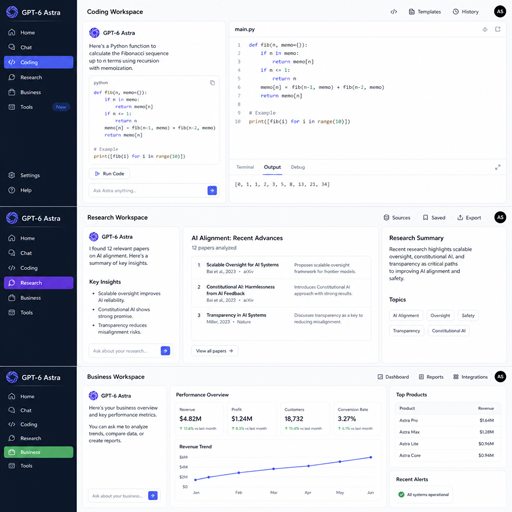
OpenAI has introduced GPT‑6 Astra, a new flagship AI language model aimed at complex professional work, software engineering, computer use, research, and document creation. The company says the model is rolling out first to a limited set of organizations, with availability expanding to ChatGPT Plus, Pro, Business, and Enterprise users, as well as the OpenAI API, Microsoft Azure, and Amazon Bedrock.
The release places Astra at the center of the latest OpenAI updates, with the company positioning it as its most capable broadly deployed model to date. For businesses, developers, and teams already using AI text generation or agentic workflows, the announcement signals a shift from chat-only assistance toward models that can reason, browse, write code, operate software, and produce finished work artifacts in longer, more demanding tasks.
What is GPT‑6 Astra and who gets access first?
GPT‑6 Astra is OpenAI’s new top-tier model for difficult end-to-end work, including complex reasoning, coding, computer use, research, and document creation. OpenAI says access is rolling out to selected organizations first, followed by ChatGPT Plus, Pro, Business, and Enterprise users; developers can use the model in the OpenAI API as gpt-6-astra, with availability also planned through Microsoft Azure and Amazon Bedrock.
OpenAI’s API documentation lists Astra with a 1,050,000-token context window and up to 128,000 output tokens, giving developers more room to work with long documents, codebases, research material, and multi-step project histories in a single workflow. The model supports reasoning controls, including low, medium, high, xhigh, and max, allowing teams to tune effort for speed, cost, or harder reasoning tasks.
The company’s stated pricing for standard text tokens is $10 per million input tokens and $50 per million output tokens, with cached input priced lower and higher rates applied to very large prompts above the listed threshold. That pricing makes implementation planning important: teams evaluating OpenAI GPT 6 Astra will need to match model use to workflows where deeper reasoning, longer context, and more reliable completion justify the cost.
The main GPT‑6 features focus on computer use, coding, and workplace output
OpenAI describes GPT‑6 Astra as a step forward in computer and browser use, saying it can complete tasks such as filling out forms, updating CRM records, organizing calendars, conducting online research, drafting summaries, analyzing data, generating plots, creating websites, and running frontend quality checks. The company also says Astra can install and test software and troubleshoot problems visible on screen, pointing to a broader push into agentic systems that act across tools rather than only responding in a chat window.
For software teams, OpenAI says Astra is its best model to date for software engineering and has introduced new context-handling behavior in Codex. Instead of relying only on repeated compaction when a context window fills, Astra in Codex can preserve notes across context windows and search earlier context, which could help during long debugging sessions, large refactors, and codebase investigations where lost details often slow progress.
The company is also emphasizing professional document creation. Astra is described as better at following templates, matching a team’s writing and visual style, and producing more usable documents, spreadsheets, presentations, and analyses. For business users, that means the model is being marketed less as a general chatbot and more as a work system that can translate instructions and source material into formatted, organization-ready outputs.
Key capabilities highlighted in OpenAI’s launch materials include:
- Computer use: operating browsers and workplace applications to carry out multi-step tasks.
- Coding support: assisting with software engineering, testing, debugging, refactoring, and codebase understanding.
- Long-context work: handling large prompts, files, research collections, and extended project history through a larger context window.
- Document generation: producing reports, spreadsheets, slide decks, and other polished artifacts that follow supplied templates.
- Research and analysis: browsing, summarizing, analyzing data, and helping users inspect evidence across complex tasks.
- Adjustable reasoning effort: giving developers control over how much reasoning the model applies to a request.
OpenAI frames Astra as a model for high-stakes professional work
A major theme in the GPT‑6 release is reliability in complex, professional environments. OpenAI says Astra combines advances in pre-training, reinforcement learning, and alignment, and describes the model as state-of-the-art across computer use, browsing, software engineering, cybersecurity, science, and professional work. The company also reports strong benchmark results, including a 98% score on FrontierMath Tier 4, a 99.9% score on ARC-AGI-3, and a 100% score on ExploitBench, though real-world performance will depend on the task, tools, safeguards, and deployment configuration.
The practical implication is that organizations may use Astra for longer workflows where a model needs to remember constraints, work across applications, revise its output, and produce something close to final form. That could include preparing a client-facing presentation from source documents, reviewing a codebase and proposing fixes, analyzing operational data, or coordinating research across web sources and internal files. OpenAI’s documentation specifically recommends Astra for complex reasoning, coding, computer use, research, and document creation.
At the same time, Astra’s higher capability raises deployment questions. Teams adopting the model will need to decide which workflows require human review, which tool permissions are appropriate, and how to monitor outputs when the model can act across browsers, code environments, and business systems. That governance work is especially important because the model is being promoted for tasks that may affect customer records, software releases, financial analysis, security reviews, and other sensitive operations.
Safety and cybersecurity are central to the launch
OpenAI’s separate safety overview says GPT‑6 Astra is the company’s first model to reach the “Critical” level of cybersecurity capability under its Preparedness Framework. The company says that, with the right tools and access, Astra can find previously unknown security flaws and develop new ways to exploit them across well-protected systems, which led OpenAI to strengthen protections against harmful cyber actions, misuse, and misalignment.
In its launch materials, OpenAI says Astra can help defenders with secure code review and patching, while refusing more advanced cybersecurity tasks such as creating proof-of-concept exploits for vulnerabilities. OpenAI also says it plans to expand access through Daybreak for additional defensive workflows, including vulnerability validation, malware analysis, and detection engineering, as safeguards evolve.
For enterprises, the safety message is two-sided. Astra may help security teams move faster, but organizations should not treat powerful AI access as a simple productivity toggle. Admins will likely need clear permissioning, audit practices, acceptable-use policies, and escalation paths before connecting a model like Astra to sensitive systems or production infrastructure.
Developers get a new flagship model in the API
For developers, the model name gpt-6-astra is the key API entry point. OpenAI’s model page lists support for tools such as file search, image generation, code interpreter, hosted shell, apply patch, skills, computer use, MCP, and tool search, making Astra relevant for applications that require more than basic AI text generation.
The large context window is likely to be one of the most important gpt-6 features for builders. Applications that previously needed to split long documents, summarize aggressively, or use retrieval to compensate for limited context may be able to give Astra more complete source material. That does not remove the need for good application design, but it changes the ceiling for workflows involving large contracts, repositories, research packets, transcripts, or knowledge bases.
Cost management will remain part of the migration story. Astra’s per-token pricing is higher than many models used for routine tasks, so developers may reserve it for complex reasoning, final synthesis, agentic coding, or workflows where failure is expensive. Simpler routing strategies may send lightweight requests to smaller models and escalate only difficult work to Astra.
The release expands the GPT‑6 family roadmap
OpenAI has already updated the Astra launch page to note the September 22, 2026 expansion of the GPT‑6 family with GPT‑6 Sol and GPT‑6 Luna. That update suggests Astra is the flagship tier in a broader model lineup, with other GPT‑6 models likely positioned for faster or more economical use cases.
For users following OpenAI GPT 6 developments, the most important near-term question is not simply whether Astra is more powerful, but where it fits in day-to-day work. The model appears designed for tasks where context, reasoning, tool use, and final output quality matter together. In that sense, the gpt-6 release is less about a single chatbot upgrade and more about expanding the kinds of work AI systems can attempt inside existing business and developer environments.
What happens next
OpenAI says Astra will become available over the coming days to eligible ChatGPT plans and through major developer channels, while Enterprise administrators can enable access for their workspaces. Eligible API customers also get support for Zero Data Retention, and OpenAI says it is testing Private Safety Processing to strengthen safety monitoring while preserving customer privacy.
The rollout will now be judged by real-world adoption: whether teams find Astra reliable enough for complex work, whether developers can manage costs, and whether OpenAI’s safeguards keep pace with the model’s stronger cyber and computer-use capabilities. For now, OpenAI GPT‑6 Astra stands as the company’s clearest move yet toward AI systems that do not just generate text, but help carry work from instruction to completed output.
