
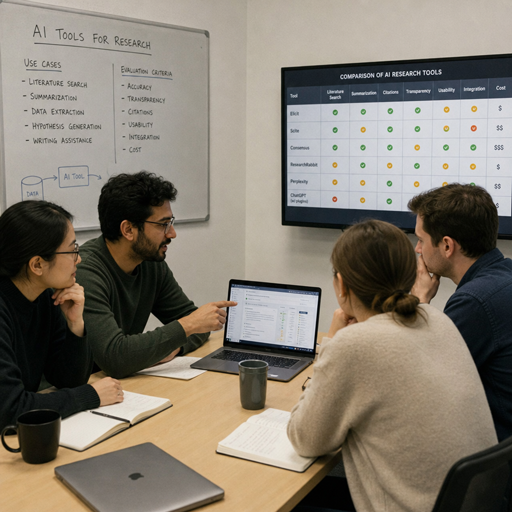
Scientific research is becoming more interactive, more computational, and more demanding. Interactive AI research agents are emerging as a practical way to help researchers search literature, test ideas, organize evidence, and turn complex scientific materials into systems people can query, reuse, and extend. Instead of treating AI as a simple chatbot or static summarizer, this approach frames AI as a research companion that can work with papers, datasets, workflows, and human feedback in a more reliable loop.
The promise is not that AI replaces careful scholarship. The real opportunity is that well-designed ai research solutions can reduce repetitive work, surface useful connections, and make scientific knowledge easier to explore.
What are interactive AI research agents?
Interactive AI research agents are AI systems designed to participate in research tasks through dialogue, tool use, reasoning steps, and user-guided refinement. They can help read papers, extract methods, compare findings, generate hypotheses, plan experiments, or connect a researcher with relevant prior work. The “interactive” part matters because the researcher remains in control: asking follow-up questions, correcting assumptions, narrowing scope, and deciding what evidence is strong enough to use.
A basic AI tool may answer a question once. An interactive agent can often continue a task across several steps, consult structured sources, call external tools, and update its response based on new instructions. In scientific settings, that difference is significant. Research rarely moves in a straight line, and good systems need to support uncertainty, revision, and explanation.
These agents are most useful when they are designed around research behavior rather than generic conversation. Scientists, analysts, and technical teams need traceable outputs, transparent limitations, and workflows that respect the difference between a plausible answer and a verified finding.
The shift from static papers to active research systems
Scientific papers are dense by design. They compress background, methods, experiments, results, limitations, and citations into a format that rewards careful reading but can be slow to navigate. Even when a paper is open and searchable, many readers still struggle to quickly understand what was done, how reliable it is, and whether the methods apply to their own work.
This is where the idea behind paper2agent reimagining research papers as interactive and reliable ai agents becomes especially compelling. Instead of viewing a paper only as a document, researchers can imagine it as an interface: a system that can answer questions about its methods, explain assumptions, retrieve supporting details, and help users reproduce or adapt parts of the work. The paper becomes less like a static PDF and more like a guided research environment.
That shift could make scientific knowledge more usable. A graduate student might ask an agent to explain the experimental design. A reviewer might ask where the evidence supports a specific claim. A lab team might ask how to adapt a method to a different dataset. In every case, the value comes from interaction, not just automation.
Of course, this requires care. A paper-based agent must not invent missing details, overstate conclusions, or hide uncertainty. It should distinguish between what the paper explicitly says, what can be inferred, and what remains unknown. Reliability is not an optional feature in scientific work; it is the foundation.
Why researchers are paying attention now
Several trends are making ai-driven research more practical. Scientific literature is growing quickly, research teams are often distributed, and many fields depend on complex computational workflows. At the same time, AI models are becoming better at language understanding, code assistance, retrieval, and multi-step task support.
The result is a new category of ai research tools that can do more than summarize abstracts. They can help map a topic, identify methods, draft analysis plans, or organize a knowledge base around a research question. When connected to trusted sources and clear workflows, these tools can make research faster without making it careless.
Researchers are also under pressure to move efficiently. Reading every relevant paper in full may be impossible in a fast-moving area. Repeating manual extraction tasks can consume hours that would be better spent on experimental design, interpretation, or collaboration. Research automation AI can help with these bottlenecks when it is applied to well-defined tasks and reviewed by humans.
The most successful use cases are not usually “let the AI do the research.” They are more specific: let the AI collect candidate sources, compare methods, extract variables, check consistency, or prepare a first-pass synthesis that a human expert can inspect.
Practical ways interactive agents support scientific work
Interactive agents can support research at several stages, from early exploration to publication planning. Their usefulness depends on the quality of the source material, the design of the workflow, and the researcher’s ability to evaluate outputs critically.
Common applications include:
- Literature exploration Agents can help researchers move through large bodies of work by clustering themes, identifying recurring methods, and suggesting papers that may deserve closer reading. This does not replace a formal review process, but it can make the first phase more manageable.
- Paper comprehension A well-designed agent can explain a paper’s purpose, methods, assumptions, and limitations in plain language. It can also answer targeted questions such as what dataset was used, which baseline was compared, or what the authors claimed as their main contribution.
- Method extraction Scientific methods are often scattered across sections, appendices, code repositories, and supplementary materials. Interactive agents can help gather procedural details into a more usable format, while flagging gaps that require human checking.
- Hypothesis development By comparing findings across sources, agents can suggest possible research questions or tensions in the literature. These suggestions should be treated as prompts for expert thinking, not as validated scientific claims.
- Workflow assistance Agents can help draft code outlines, analysis steps, documentation, or experiment checklists. When connected to approved tools and reviewed carefully, this can reduce administrative friction.
- Collaboration support Research teams can use agents to maintain shared context, summarize meeting decisions, track open questions, and make complex project materials easier for new team members to understand.
The common thread is augmentation. Interactive agents help researchers spend less time searching and reformatting information, and more time judging, designing, testing, and communicating.
What makes an AI research agent reliable?
A reliable AI research agent is not simply one that sounds confident. It is one that shows its sources, separates evidence from interpretation, admits uncertainty, and fits into a workflow where humans can verify important outputs. In scientific environments, the design goal should be disciplined assistance rather than frictionless persuasion.
Reliability starts with grounding. If an agent is answering questions about a paper, dataset, or knowledge base, it should draw from that material rather than relying only on general model memory. It should make clear when an answer is directly supported, when it is inferred, and when the requested information is not available.
Strong agents also make their process visible. They may point to relevant sections, quote only what is necessary, summarize assumptions, or explain why one method appears related to another. This transparency helps users decide whether the output is trustworthy enough to act on.
A practical reliability checklist includes:
- Source grounding: The agent connects claims to specific documents, data, or approved repositories.
- Uncertainty signaling: It states when evidence is incomplete, ambiguous, or outside the available material.
- Human review points: It encourages review before conclusions, citations, clinical decisions, policy recommendations, or publication use.
- Scope control: It avoids answering beyond the material or presents such answers as general background.
- Version awareness: It makes clear which document, dataset, or model output a response is based on.
- Reproducibility support: It helps preserve steps, prompts, parameters, and references when workflows need to be repeated.
Reliability is also cultural. Teams need norms for how AI outputs are used, checked, and documented. Without those norms, even a technically strong tool can introduce confusion.
Human expertise stays at the center
The best interactive ai agents for science are designed around human judgment. They can accelerate reading, prompt new angles, and organize evidence, but they cannot understand the full stakes of a research question the way a domain expert can. They may miss context, misread nuance, or present a weak association as more meaningful than it is.
That is why scientific teams should define boundaries before adopting agentic tools. Which tasks are safe for automation? Which outputs require expert review? Which sources are approved? Which information should never be uploaded or processed by a third-party system? These questions are not obstacles to innovation; they are what make responsible use possible.
Interactive AI works best when it becomes part of a disciplined research routine. A researcher might use an agent to generate a literature map, then manually inspect the most important papers. A lab might use an agent to draft a protocol checklist, then have senior staff validate each step. A product team might use an agent to summarize technical findings, then ask subject-matter experts to confirm interpretation before decisions are made.
Where research automation AI can go wrong
Automation can make weak processes faster. If a team uses AI to summarize unreliable sources, skip verification, or produce polished claims without evidence, the result may look efficient while becoming less rigorous. The risk is not only factual error; it is misplaced confidence.
Common failure modes include hallucinated citations, oversimplified methods, hidden assumptions, outdated context, and answers that blur the line between what a paper states and what the model infers. In scientific settings, those mistakes can waste time or distort decisions.
To reduce risk, teams should build guardrails into the workflow:
- Use AI for first-pass exploration, not final authority.
- Keep source documents linked to outputs whenever possible.
- Ask agents to identify missing information instead of forcing complete answers.
- Require expert review for conclusions, experimental plans, and external communications.
- Preserve prompts, settings, and source versions for important work.
- Test agents on known papers or datasets before relying on them for new projects.
Good implementation is less about chasing novelty and more about designing dependable habits. The safest systems make verification easier, not optional.
How should teams choose AI research solutions?
Teams should choose AI research solutions by matching the tool to the research task, the sensitivity of the data, and the level of verification required. A tool that is excellent for brainstorming may be inappropriate for evidence synthesis, while a secure internal agent may be better suited for proprietary research than a general-purpose assistant.
Before selecting a platform or building an internal system, teams should clarify what problem they are solving. Are they trying to reduce literature review time, improve access to internal knowledge, support reproducibility, or help non-specialists understand technical material? Different goals require different agent capabilities.
Useful evaluation criteria include:
- Grounding and retrieval Can the system answer from selected documents, papers, databases, or internal repositories? Can users inspect the source of a claim?
- Transparency Does the agent show where information comes from and when it is uncertain? Can it explain how it reached a response?
- Workflow fit Does it support the way researchers already work, including notes, citations, code, datasets, and collaboration tools?
- Data governance Can the team control what is uploaded, stored, shared, or used for improvement? This is especially important for sensitive, unpublished, or proprietary work.
- Review and auditability Can important outputs be reviewed, repeated, and documented? Are there logs or version histories when they matter?
- Ease of correction Can users correct the agent, refine context, and improve results without starting over?
The strongest solution is not always the most complex one. For many teams, a focused agent that performs a few research tasks reliably is more valuable than a broad system that tries to do everything.
The future of interactive scientific research
The next phase of interactive ai research agents will likely be defined by deeper integration. Agents may become better at moving between papers, datasets, code notebooks, lab records, and collaboration spaces. Instead of only answering questions, they may help maintain living research maps that update as teams add new evidence.
This future also depends on standards and expectations. Researchers will need clearer ways to cite AI-assisted work, disclose methods, audit outputs, and preserve reproducibility. Institutions and teams may develop internal policies that define acceptable use, especially for sensitive data and high-stakes domains.
The most exciting possibility is not faster content generation. It is better access to scientific reasoning. When research materials become interactive, more people can ask precise questions, inspect assumptions, and learn from complex work without needing to decode every detail alone. That could support education, collaboration, peer review, and innovation.
Still, the best outcomes will come from a balanced view. AI can make research more navigable, but science remains a human process of skepticism, testing, debate, and revision. Interactive agents should strengthen that process, not shortcut it.
Key takeaways for research teams
Interactive scientific agents are worth exploring, but they should be introduced with clear expectations. Start small, measure usefulness, and keep expert judgment visible throughout the workflow.
A practical path forward looks like this:
- Begin with a narrow use case, such as paper Q&A, method extraction, or literature mapping.
- Choose sources carefully and keep outputs connected to the evidence they came from.
- Define which AI-generated outputs require human review.
- Encourage agents to report uncertainty and missing information.
- Document important workflows so results can be checked and repeated.
- Treat AI as a research partner for organization and exploration, not as an independent authority.
Interactive agents can make scientific work more accessible and efficient when they are built around reliability. The goal is not to remove the researcher from research. The goal is to give researchers better ways to interact with knowledge, ask sharper questions, and move from information overload toward clearer understanding.