
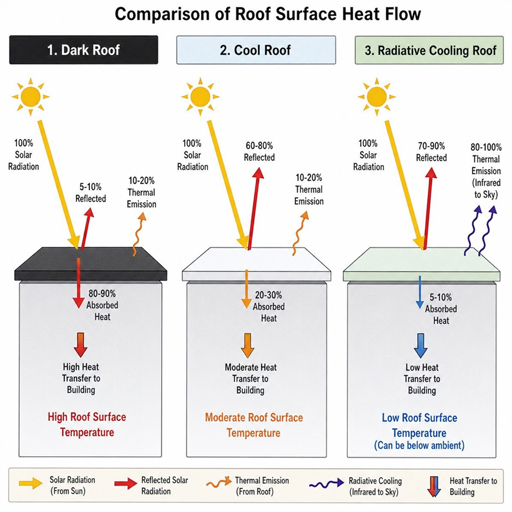
Passive radiative cooling materials help buildings reject heat without compressors, fans, or electricity by reflecting sunlight and emitting thermal radiation toward the cold sky. In urban real estate, they are best understood as a new layer in the passive cooling toolkit: not a replacement for HVAC, insulation, shading, or ventilation, but a way to reduce solar heat gain, surface temperatures, and cooling demand when specified correctly. This guide explains how radiative cooling materials work, where they fit in commercial and residential assets, and how owners, developers, and property teams can evaluate them without overbuying the hype.
What are passive radiative cooling materials?
Passive radiative cooling materials are surfaces engineered to do two things at once: reflect a large share of incoming solar radiation and emit heat strongly in infrared wavelengths that can pass through the atmosphere. The principle is often called passive daytime radiative cooling when it works under direct sun, because the material must overcome solar heating while still shedding thermal energy to the sky. Early research demonstrated below-ambient cooling under direct sunlight using photonic structures, including a reported 5 °C below ambient temperature and 40 W/m² cooling power in a 2014 Nature study.
For real estate, the simplest way to picture the technology is as a smarter exterior surface. A dark conventional roof absorbs sunlight and warms the roof assembly; a basic white cool roof reflects more sunlight; a high-performance radiative cooling surface aims to combine high solar reflectance with high thermal emittance, especially in the 8–13 μm atmospheric window discussed widely in materials research.
That makes these materials relevant to rooftops, façades, canopies, equipment enclosures, podium decks, parking structures, and other urban surfaces exposed to sun and sky. Their value is not only indoor comfort. In dense districts, cooler exterior surfaces can also contribute to broader heat island mitigation, especially when paired with trees, green roofs, cool pavements, shade, and efficient mechanical systems. The EPA identifies cool roofs and related reflective surfaces as one strategy communities use to reduce heat islands and cooling energy demand.
Why do they matter for urban real estate?
They matter because urban buildings are being asked to do more under hotter conditions: maintain comfort, reduce peak load, control operating costs, support resilience goals, and meet sustainability expectations. Passive radiative cooling materials address the exterior heat problem before it becomes an interior cooling load. In practical terms, they can help reduce the amount of heat a building envelope absorbs during sunny periods, which may lower stress on HVAC systems and improve occupant comfort in vulnerable spaces.
The real estate case is strongest where solar exposure, roof area, cooling demand, and heat-risk concerns overlap. Large low-slope roofs, distribution centers, multifamily buildings, schools, healthcare facilities, retail centers, and older properties with limited envelope upgrades may all have surfaces that can be improved. Dense urban assets may also face localized outdoor heat around roofs, terraces, walls, and service zones. Lowering surface temperatures in those areas can support usability and reduce thermal stress on waterproofing layers, roof-mounted equipment, and adjacent materials.
These materials also fit the direction of building performance strategy. Owners are no longer looking only at energy use inside the meter; they are also considering peak demand, thermal resilience, urban microclimates, tenant expectations, and climate adaptation. Passive cooling solutions are attractive because they work quietly in the background. They do not require occupant behavior changes, do not need daily operation, and can be integrated into planned capital work such as reroofing, façade upgrades, repainting, shade structures, or equipment screening.
The science behind passive heat dissipation
Passive heat dissipation through radiative cooling depends on the balance of energy coming into and leaving a surface. A surface receives heat from sunlight, warm surrounding air, nearby buildings, and sometimes mechanical equipment. It loses heat through radiation, convection, and conduction. Radiative cooling materials are designed so the radiation balance becomes favorable: less solar energy is absorbed, and more thermal energy is emitted outward.
Solar reflectance reduces the heat coming in
Solar reflectance is the fraction of sunlight a surface sends back rather than absorbing. In real estate terms, it is the difference between a roof membrane that becomes a heat reservoir and one that resists heating in the first place. High reflectance is especially important during the day, because even a highly emissive material can warm up if it absorbs too much solar energy.
This is why many radiative cooling materials look white or very light. Some use particles, pores, or multilayer structures to scatter sunlight across visible and near-infrared wavelengths. Research on barium sulfate paint, for example, reported 98.1% solar reflectance and high sky-window emissivity, showing why particle-based coatings have drawn attention for scalable exterior applications.
Thermal emittance helps the surface release heat
Thermal emittance describes how effectively a surface emits infrared radiation. For passive radiative cooling materials, the target is not simply “emit heat” in a general sense. The most discussed design goal is strong emission in the atmospheric window, commonly described as 8–13 μm, where infrared radiation can pass through the atmosphere more effectively and escape toward cold outer space.
For building teams, the takeaway is straightforward: a product’s visible color alone is not enough. A coating can be bright but not optimized for infrared emission; another can perform well in a lab but lose effectiveness if soiled, shaded, or applied to the wrong substrate. The most useful specifications look at both solar reflectance and thermal emittance, ideally through recognized rating or testing methods.
Sky exposure determines how much cooling is available
Radiative cooling needs a view of the sky. A roof with open exposure can reject heat more effectively than a narrow urban canyon façade facing another warm building. Nearby parapets, taller buildings, mechanical screens, tree canopies, and rooftop equipment can reduce sky view. That does not make radiative cooling useless in cities, but it does mean that geometry matters.
A good feasibility review should map the surfaces with the best sun and sky exposure. Low-slope roofs are often the first candidate because they combine large area, direct solar gain, and relatively open sky view. Upper façades, canopy tops, courtyard shade structures, and roof-mounted equipment housings may also be suitable. Lower façades in dense streets may require a more cautious performance expectation.
Passive radiative cooling is not the same as a standard cool roof
Cool roofs and radiative cooling materials overlap, but they are not identical. A cool roof typically refers to a roofing surface with high solar reflectance and useful thermal emittance. Passive radiative cooling materials push the concept further by engineering the surface’s optical and infrared behavior to increase net heat rejection, including under daytime sun.
That distinction matters when a property team compares products. A conventional white roof membrane may already deliver meaningful benefits and may be the most practical option for many buildings. A radiative cooling coating or film may offer additional surface-temperature reduction, but the result depends on climate, humidity, installation quality, durability, maintenance, and building use. The DOE has long advised that cool-roof savings depend on factors such as climate, insulation, building operation, energy prices, and HVAC efficiency.
The decision should not become a simple “new technology versus old technology” debate. Instead, owners should ask what the asset needs. If the building is due for a roof replacement, a rated cool roof may be the baseline. If the asset has high cooling loads, limited shade, heat complaints, or ESG targets, a higher-performance radiative cooling material may deserve pilot testing. If the roof is frequently shaded, heavily trafficked, or exposed to staining, a standard robust membrane may outperform an advanced material in real-world conditions.
Main categories of radiative cooling materials
The market and research landscape includes several material families. Some are close to familiar building products, while others are still emerging or better suited to specialty applications. Understanding the categories helps real estate teams avoid treating all heat-reducing materials as interchangeable.
Reflective paints and coatings
Coatings are attractive because they can potentially be applied to existing surfaces during maintenance or retrofit work. They may use ceramic particles, polymer binders, barium sulfate, calcium carbonate, silica, or other scatterers to reflect sunlight and emit infrared radiation. For property owners, coatings can be appealing when roof replacement is not yet due or when non-roof surfaces need treatment.
The key questions are adhesion, weathering, dirt pickup, cleanability, fire rating compatibility, warranty implications, and whether the coating is approved for the substrate. A coating applied over an aging membrane may not solve underlying moisture, ponding, or structural problems. It should be treated as part of an envelope system, not as a cosmetic layer.
Polymer films and membranes
Polymer-based films and membranes can incorporate microvoids, particles, or multilayer structures that scatter solar radiation and emit infrared heat. Research has explored porous polymers and phase-inversion methods because pore size and distribution can be tuned for optical performance. Reviews of passive daytime radiative cooling materials frequently point to porous polymer designs as promising because they can be lightweight and potentially scalable.
In real estate, films and membranes may be relevant for roofing, tensile structures, awnings, temporary shading, equipment covers, and modular building components. The practical test is whether they can withstand UV exposure, wind uplift, hail, foot traffic, cleaning, and code requirements. A material that performs well on a sample panel still needs building-grade durability.
Tiles, panels, and prefabricated components
Rigid panels and tiles can integrate radiative cooling layers into a controlled factory-made assembly. This may be useful for façades, rainscreens, rooftop pavers, shading devices, balcony soffits, or mechanical screens. Prefabrication can improve quality control, but it can also add attachment, detailing, and replacement complexity.
Panels are especially interesting for assets where the exterior surface is part of the architectural identity. A developer may not want a uniformly white façade, yet still wants passive cooling benefits. Research is increasingly exploring colored, selective, and adaptive materials, but the visual-performance tradeoff remains important: darker colors usually absorb more solar energy unless engineered carefully.
Transparent and semi-transparent materials
Transparent radiative cooling is an emerging area focused on surfaces such as windows, skylights, canopies, and solar-control films. The challenge is harder because the material must manage heat while preserving daylight and visibility. Recent reviews describe transparent radiative cooling as a pathway for windows and other systems where opaque white coatings are not acceptable.
For urban real estate, this category should be evaluated carefully. Windows are already complex assemblies involving solar heat gain coefficient, visible transmittance, U-factor, glare, condensation risk, safety glazing, and façade aesthetics. A transparent radiative layer may become valuable in the future, but it should be compared against established high-performance glazing, exterior shading, dynamic glass, and solar-control films.
Dynamic and temperature-adaptive materials
One limitation of always-cool surfaces is that buildings in mixed or cold climates may benefit from solar heat gain during winter. Dynamic materials aim to change behavior with temperature, electricity, humidity, or other triggers. Some research explores thermochromic or switchable systems that cool during hot conditions and reduce cooling action when heat is desirable.
This matters for portfolio owners with assets across climates. A passive cooling material that performs well in Phoenix may not be ideal for a heating-dominated property without seasonal analysis. Dynamic materials could eventually reduce that tradeoff, but teams should verify maturity, availability, controls, and maintenance requirements before assuming they solve all-season thermal management.
Best real estate applications for passive cooling solutions
The best applications are surfaces with high solar exposure, meaningful thermal connection to occupied or operational areas, and manageable maintenance conditions. Radiative cooling materials can be used broadly, but their return is strongest when they address a real heat pathway.
Low-slope commercial roofs
Low-slope roofs are often the most practical starting point. They are large, exposed, and directly above conditioned space. Many commercial buildings already evaluate reflective membranes, so radiative cooling can be considered as an enhanced option during reroofing, restoration, or coating work.
For offices, retail boxes, warehouses, schools, and healthcare buildings, the roof can be a major heat-gain surface. A cooler roof may reduce heat transfer into the building and reduce rooftop air temperatures around mechanical units. The benefit will vary depending on insulation level, ceiling plenum conditions, HVAC design, and whether the roof is shaded by solar panels or equipment.
Multifamily roofs and amenity decks
In multifamily properties, passive cooling can support both energy and comfort goals. Top-floor units often experience more heat stress, and rooftop amenity areas can become uncomfortable during hot periods. A heat-reducing roof surface, combined with shade, vegetation, and high-albedo walking surfaces, can make upper levels more resilient.
Owners should distinguish between roof areas that are purely protective and areas used by residents. A high-performance coating may be appropriate on inaccessible roof fields, while occupied decks need slip resistance, glare control, durability, and comfort underfoot. Radiative cooling is useful, but it must be integrated with life-safety and user-experience requirements.
Façades and exterior walls
Façade use is more nuanced than roof use. Walls receive different sun exposure depending on orientation, surrounding buildings, and season. South and west façades in many U.S. climates can experience intense solar gain, while shaded canyon walls may see less benefit.
Heat-reducing materials on façades can help lower exterior surface temperatures and reduce heat flow into wall assemblies. They may also reduce radiant heat near pedestrian areas, balconies, and courtyards. However, visible appearance matters more on façades, so owners need to balance cooling performance with color, texture, reflectivity, glare, and design intent.
Parking structures, pavements, and shade canopies
Parking structures and open lots contribute to urban heat because they expose large hard surfaces to sunlight. While pavements require specialized materials for load, skid resistance, and wear, radiative cooling concepts can be applied to shade canopies, parking-deck coatings, pedestrian covers, and rooftop parking areas. These surfaces may not reduce indoor cooling loads directly, but they can improve outdoor thermal conditions and reduce heat absorbed by the site.
The strongest approach is usually layered: shade first, then reflective or radiative surfaces, then trees and stormwater strategies where feasible. In urban real estate, outdoor comfort is often created by combinations rather than a single product.
Mechanical equipment and solar-adjacent uses
Radiative cooling materials can also support thermal management around equipment. Rooftop units, electrical enclosures, telecom cabinets, battery storage housings, and other exterior equipment can suffer from solar heating. A cooler enclosure surface may reduce internal heat buildup, though equipment manufacturers’ requirements and warranties must be respected.
Solar photovoltaic systems create another interesting interaction. Panels shade roof surfaces, reducing roof heat gain, but PV efficiency can decline as panel temperature rises. Radiative cooling concepts are being studied for photovoltaic cooling, but building owners should rely on manufacturer-approved products rather than field-applying unverified coatings to solar modules.
How should owners evaluate a passive radiative cooling product?
Owners should evaluate passive radiative cooling materials as building-envelope products, not as novelty materials. The right product must perform thermally, survive the site, meet code and warranty requirements, and fit the asset’s financial plan. A disciplined review prevents the common mistake of comparing lab performance numbers without considering installation and operations.
Use this checklist before specifying a material:
- Surface performance: Ask for solar reflectance, thermal emittance, and any sky-window emissivity data. Confirm whether testing reflects the final product, not only a lab sample.
- Relevant ratings: Look for recognized roof or wall performance ratings where available. The Cool Roof Rating Council, for example, lists radiative performance data for roofing and exterior wall products.
- Durability evidence: Review UV exposure, weathering, abrasion, dirt pickup, biological growth, hail, freeze-thaw, ponding water, and cleaning data.
- Substrate compatibility: Confirm approved substrates, primers, moisture limits, adhesion requirements, and whether the product affects roof or façade warranties.
- Fire and code compliance: Verify fire classification, wind uplift, smoke development, combustibility, and local code requirements for the assembly.
- Maintenance expectations: Ask how performance changes with soiling and how the surface should be cleaned without damaging optical properties.
- Climate fit: Model or estimate cooling benefits and heating penalties for the specific location, building use, and utility structure.
- Glare and aesthetics: Evaluate reflectivity, color, neighborhood impacts, tenant acceptance, and design-review requirements.
- End-of-life plan: Understand recoating cycles, removability, recyclability, disposal requirements, and compatibility with future roof or façade work.
A pilot installation can be more useful than a long debate. Select two or three comparable roof or wall areas, install the material alongside a baseline surface, and measure surface temperature, indoor conditions near the assembly, HVAC behavior, and visual changes over time. Even a small pilot can reveal dirt pickup, installation complexity, glare, and stakeholder response.
Design and specification best practices
Radiative cooling materials perform best when they are part of a complete passive and active cooling strategy. The material can reduce heat gain at the surface, but the building still needs insulation, air sealing, moisture control, shading, ventilation, and efficient HVAC. In new development, these decisions should be coordinated early. In existing assets, they should be coordinated with capital planning.
Start with climate and load analysis
Climate determines the value of passive cooling. Hot, sunny, cooling-dominated climates are natural candidates. Humid climates can still benefit, but atmospheric moisture can reduce radiative heat loss because water vapor absorbs infrared radiation. Mixed climates require more careful seasonal analysis because a highly reflective roof may reduce helpful winter solar gain.
The building’s load profile matters as much as the weather. A warehouse with minimal conditioning, a multifamily building with top-floor heat complaints, and a hospital with 24/7 cooling needs will all respond differently. Energy-efficient cooling depends on matching the material to the actual problem, not simply choosing the highest reflectance value.
Coordinate with insulation and roof assemblies
A well-insulated roof reduces heat transfer into the building, which can lower the incremental energy benefit of a cool surface. That does not make the surface irrelevant; it may still reduce membrane temperature, improve rooftop conditions, and support heat island goals. But the energy savings should be estimated realistically.
For reroofing projects, review the full assembly. Wet insulation, poor drainage, thermal bridging, and air leakage may create bigger problems than surface color. Radiative cooling materials should not be used to mask envelope failures. They work best when installed over sound assemblies with proper drainage and detailing.
Manage glare and visual comfort
High reflectance can create glare if placed near taller buildings, terraces, roadways, or neighboring windows. This is especially important for white roofs viewed from above, west-facing walls, and sloped surfaces. Glare is not only a design concern; it can become a tenant relations, safety, or permitting issue.
Design teams can reduce glare risk by using parapets, surface texture, selective placement, lower-gloss finishes, mockups, and visual simulations. In some cases, a slightly lower-performing but better-integrated material may be the smarter real estate choice.
Plan for dirt, aging, and maintenance
Outdoor surfaces do not remain pristine. Dust, pollution, leaves, ponding water, foot traffic, grease, bird droppings, and biological growth can reduce reflectance. Urban sites with construction dust, airport pollution, industrial emissions, or heavy tree cover may see faster performance decline.
Maintenance planning should be part of the specification. If the material needs periodic cleaning, the owner should know the method, frequency, water requirements, access needs, and labor implications. A surface that can be cleaned safely and restored predictably is more valuable than one that only performs when new.
Benefits for owners, tenants, and cities
The benefits of radiative cooling materials sit at three levels: asset performance, occupant experience, and urban heat reduction. The exact outcome depends on the building, but the mechanisms are clear enough to guide decision-making.
For owners, the most direct benefit is reduced heat absorption by the building envelope. That can support lower cooling loads, reduced peak demand, and less thermal stress on roof and façade materials. It may also help extend the usefulness of rooftop spaces and reduce heat around service areas.
For tenants and occupants, the benefit is comfort. Top floors, perimeter zones, poorly insulated spaces, and buildings with older HVAC systems may feel the impact of exterior heat more strongly. Passive cooling solutions can reduce the intensity of heat entering the building, though they should not be promised as a substitute for adequate mechanical cooling during extreme heat.
For cities, heat-reducing materials can be part of a broader heat island strategy. The EPA notes that heat island reduction strategies such as trees and cool roofs can lower surface and air temperatures while reducing energy needed for cooling. When many surfaces across a district absorb less heat, the surrounding microclimate can improve, especially when reflective surfaces are combined with vegetation and shade.
Limitations and risks to understand
Passive radiative cooling materials are promising, but they are not magic. Their performance changes with weather, installation, building geometry, and maintenance. Owners who understand the limits are more likely to deploy them successfully.
The first limitation is humidity and cloud cover. Radiative cooling works best when the sky is clear and dry. Clouds and water vapor reduce the effective coldness of the sky, limiting heat rejection. Hot-humid cities can still use reflective and emissive materials, but expectations should be based on local conditions.
The second limitation is winter performance. In heating-dominated climates, highly reflective surfaces can reduce solar heat gain when the building might benefit from it. The tradeoff may still be worthwhile for buildings with high internal loads or summer peak-demand concerns, but it should be modeled rather than assumed.
The third limitation is real-world durability. Materials research often reports impressive surface temperatures, cooling power, or optical properties. Real estate assets need products that survive years of UV exposure, weather, cleaning, and maintenance traffic. A high-performing lab material is not automatically a building product.
The fourth limitation is integration. Roof warranties, façade warranties, fire ratings, historic review, design guidelines, and local codes can affect what can be installed. Teams should involve roofing consultants, façade engineers, architects, contractors, and insurers early enough to avoid expensive redesign.
A practical implementation roadmap
A portfolio-level approach helps owners move from interest to action without taking unnecessary risk. Passive radiative cooling materials can be tested and scaled in stages.
- Identify heat-priority assets. Start with buildings in hot climates, assets with high cooling costs, top-floor comfort complaints, large exposed roofs, or upcoming exterior capital projects.
- Screen surfaces. Map roof areas, façades, canopies, and equipment zones by solar exposure, sky view, condition, access, and maintenance traffic.
- Establish the baseline. Record current roof or wall surface temperatures, indoor complaints, utility patterns, equipment runtime if available, and existing assembly details.
- Shortlist products. Compare radiative cooling materials against standard cool roof membranes, coatings, shading, green roofs, and other passive cooling solutions.
- Run a small pilot. Install test areas where they can be monitored safely. Include a control surface so results are meaningful.
- Measure through a season. Track surface temperature, visual condition, cleaning needs, occupant feedback, and any operational changes during hot periods.
- Integrate with capital planning. Scale the solution when roofs, façades, decks, or equipment screens are already scheduled for work.
- Document lessons learned. Create internal standards for climate fit, approved substrates, details, maintenance, and procurement language.
This roadmap keeps the process practical. Instead of waiting for perfect certainty, owners can test where the downside is limited and the learning value is high.
Procurement questions to ask vendors and project teams
Good procurement language protects the owner from vague claims. It also helps vendors provide useful information. Before selecting a product, ask:
- What are the measured solar reflectance and thermal emittance values, and which test methods were used?
- Are aged performance values available, not just initial values?
- Is the product rated or listed by a recognized third party for roof or wall radiative performance?
- What substrates are approved, and what primers or preparation steps are required?
- How does the product perform under ponding water, dirt accumulation, UV exposure, hail, and foot traffic?
- What cleaning methods are allowed, and how often is cleaning expected in polluted urban environments?
- Does installation affect existing roof, wall, or waterproofing warranties?
- What fire, wind, and code documentation applies to the full assembly?
- Are there glare studies, reflectance samples, or mockups available for design review?
- What happens at the end of service life: recoat, remove, overlay, recycle, or dispose?
These questions do not require a property team to become materials scientists. They simply shift the conversation from “How cool is it?” to “Will it work on this asset, in this climate, for this ownership plan?”
How radiative cooling fits with other thermal management materials
Radiative cooling materials should be compared with other thermal management materials and strategies, not considered in isolation. Insulation slows heat transfer. Air sealing reduces unwanted air movement. Shading blocks direct sun before it reaches the envelope. Low-solar-gain glazing reduces heat through windows. Green roofs add evapotranspiration, stormwater value, and habitat. Efficient HVAC removes heat actively when passive methods are not enough.
The strongest building strategies combine these tools. A roof might use high-R insulation, a durable reflective membrane, shaded mechanical zones, solar panels, and selective radiative cooling coatings on exposed areas. A multifamily retrofit might pair a cool roof with attic air sealing, window shading, and heat-pump upgrades. A campus might combine cool roofs, trees, reflective pavements, and shaded walkways to reduce both indoor loads and outdoor heat.
This layered approach is important because urban heat is not a single-source problem. Solar radiation, waste heat, dark surfaces, limited vegetation, building density, and weather patterns all interact. Passive radiative cooling materials are valuable because they address one important pathway: the way exterior surfaces absorb and release heat.
The future of passive radiative cooling in real estate
The field is moving from scientific demonstration toward practical building integration. Reviews of passive cooling for the built environment describe radiative, evaporative, ventilation, and solar-control technologies at different stages of maturity, with radiative cooling among the emerging materials that could support lower-energy buildings.
The most important future developments for real estate will likely be durability, color flexibility, manufacturability, and verified field performance. Owners do not need the most exotic material; they need products that contractors can install, consultants can specify, insurers can understand, and maintenance teams can care for. If manufacturers can deliver that, passive radiative cooling could become a normal part of roof, façade, and site-material selection.
Expect the category to become more differentiated. Some products will look like premium cool roof coatings. Others will be integrated into membranes, façade panels, shade fabrics, or equipment housings. Transparent materials may eventually influence glazing and skylight design. Dynamic materials may help mixed-climate buildings avoid seasonal tradeoffs.
Key takeaways for real estate decision-makers
Passive radiative cooling materials are most useful when they are treated as performance surfaces within a complete building strategy. They can reduce solar heat gain and support passive heat dissipation, but they must be matched to climate, exposure, substrate, maintenance capacity, and ownership goals.
For most urban real estate teams, the practical starting point is not a portfolio-wide rollout. It is a targeted assessment of high-exposure assets and upcoming capital projects. Compare advanced radiative cooling materials with proven cool roof options, model the building-specific impact, and use pilots to validate performance under real operating conditions.
The opportunity is significant because exterior surfaces are everywhere in cities. Roofs, walls, canopies, decks, and equipment enclosures all influence how buildings absorb and release heat. When selected carefully, passive radiative cooling materials can become one more durable, low-energy tool for improving comfort, reducing cooling demand, and making urban properties better prepared for hotter conditions.