
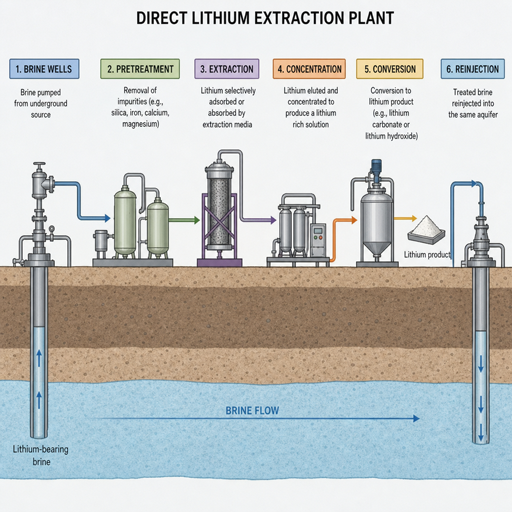
Direct lithium extraction is moving from an emerging lithium extraction technology into a serious commercial scaling challenge. Instead of relying mainly on large evaporation ponds or hard-rock mining, DLE systems are designed to selectively pull lithium from brines, then return much of the remaining brine to the source. For investors, operators, policymakers, and battery supply-chain teams, the key question is no longer whether direct lithium extraction DLE technology can work in controlled settings; it is whether projects can run reliably, economically, and responsibly at industrial scale.
What does commercial scaling mean for direct lithium extraction?
Commercial scaling means proving that a DLE process can operate continuously on real brine, produce saleable lithium chemicals, meet permitting and environmental requirements, and survive the cost pressures of the lithium market. It is not just a larger pilot skid. It is a full production system that must integrate wells, brine handling, pretreatment, extraction, lithium concentration, conversion, reagent management, waste handling, reinjection, quality control, maintenance, financing, and customer qualification.
That matters because every brine is different. The International Lithium Association notes that DLE includes multiple approaches, including sorption, ion exchange, solvent extraction, membranes, electrochemical methods, and carbonation processes, and that each brine requires a tailored approach because chemistry varies by site.
A pilot plant can show promising recovery and selectivity, but commercial operation adds harder questions: Can the system handle changing brine chemistry through seasons and wellfields? How often must media be replaced? How much water, acid, base, power, and heat are consumed? Can operators keep uptime high while maintaining battery-grade product quality? These questions determine whether direct lithium extraction technology becomes a durable business rather than an impressive demonstration.
The basic DLE flow from brine to lithium product
Most DLE projects follow a similar logic even when the underlying technology differs. Brine is brought to the surface, conditioned so it can move through the process, contacted with a material or system that selectively captures lithium, then stripped or eluted into a more concentrated lithium solution. That intermediate solution is purified and converted into lithium carbonate or lithium hydroxide, depending on the project and customer need.
A simplified commercial pathway looks like this:
- Resource definition and wellfield design — Operators must understand lithium concentration, flow rates, impurities, temperature, pressure, reservoir behavior, and reinjection capacity.
- Pretreatment — Suspended solids, scale-forming ions, hydrocarbons, silica, iron, or other impurities may need to be managed before extraction.
- Lithium capture — Adsorbents, ion-exchange materials, solvents, membranes, or electrochemical systems separate lithium from the brine.
- Elution or stripping — The captured lithium is released into a smaller, cleaner stream.
- Concentration and purification — The lithium-bearing solution is upgraded and contaminants are reduced.
- Chemical conversion — The process produces lithium carbonate, lithium hydroxide, or another lithium intermediate.
- Brine return or disposal — Depleted brine is typically reinjected or otherwise managed according to project design and regulation.
This flow is why commercial scaling touches both mining and chemical manufacturing. A successful DLE project is not only a resource project; it is also a water-chemistry, materials-science, process-engineering, and logistics project.
How DLE compares with other lithium extraction methods
Traditional lithium extraction methods fall mainly into two broad categories: hard-rock mining and brine evaporation. Hard-rock operations mine lithium-bearing minerals such as spodumene, then process and refine them. Brine evaporation operations pump lithium-rich brine into ponds, where solar evaporation concentrates salts before further processing. DLE aims to shorten or replace the evaporation stage by selectively extracting lithium from brine more directly.
The potential advantages are clear: DLE may reduce land use compared with large pond systems, unlock brines that are unsuitable for conventional evaporation, and fit geothermal or oilfield brine operations where brine is already being circulated. But “potential” is the important word. DLE performance depends on the resource, chemistry, technology route, plant design, reagent use, energy source, and local water constraints.
|
Method |
Typical source |
Main strength |
Main scaling challenge |
|---|---|---|---|
|
Hard-rock mining |
Spodumene and other minerals |
Established global production route |
Mining, beneficiation, roasting, refining, and tailings management |
|
Evaporation brine |
Salar brines in arid climates |
Proven at large scale in suitable regions |
Long cycle times, land footprint, water and climate sensitivity |
|
Direct lithium extraction |
Brines, geothermal fluids, produced water, some unconventional resources |
Selective lithium recovery and smaller pond footprint potential |
Site-specific chemistry, media life, integration, cost, and uptime |
This comparison does not make DLE automatically better than every alternative. Instead, it shows where direct lithium extraction may be most useful: resources with attractive lithium chemistry, sufficient flow, viable reinjection, and a process design that can produce a qualified lithium product at competitive cost.
The main DLE technology families
Adsorption and ion exchange
Adsorption and ion-exchange systems use solid materials that preferentially bind lithium ions. After loading, the material is washed or eluted so lithium moves into a smaller solution stream. This family is often discussed because it can be selective and modular, but it depends heavily on media durability, regeneration efficiency, impurity tolerance, and cycle stability.
Commercial attention has increased around adsorption-based systems. Rio Tinto’s Fenix operation in Argentina, for example, is described by the company as using proprietary selective adsorption DLE technology and has produced lithium carbonate from brine at Salar del Hombre Muerto since 1997.
Solvent extraction
Solvent extraction uses chemical phases that preferentially transfer lithium away from the original brine. It can be powerful in the right chemistry window, but commercial designs must control solvent losses, reagent management, phase separation, safety, and downstream purification. The technology may be attractive where selectivity is difficult with simpler approaches, but it requires disciplined plant operations.
Membrane and electrochemical systems
Membrane and electrochemical approaches use separation barriers, electrical potential, or intercalation-style materials to move lithium selectively. These systems can be appealing because they may offer precise control, but they must prove membrane life, fouling resistance, energy efficiency, and maintainability in harsh brines. In commercial scaling, the challenge is rarely one cell or one membrane; it is operating many units continuously without performance drift.
Why DLE commercial scaling is difficult?
DLE commercial scaling is difficult because lithium is usually only one valuable ion in a complex, high-salinity fluid. The process must separate lithium from sodium, potassium, calcium, magnesium, boron, silica, iron, and other constituents while avoiding scale, corrosion, fouling, and excessive reagent use. Even if the extraction step works, the full plant must deliver consistent lithium chemical quality over years.
The hardest scale-up risks usually include:
- Brine variability: A lab sample may not represent the entire reservoir or long-term production profile.
- Impurity management: Small concentrations of troublesome elements can drive pretreatment cost and complexity.
- Media or membrane degradation: Performance can fall as materials foul, dissolve, fracture, or lose selectivity.
- Water balance: Washing, elution, cooling, and conversion steps can create water demands that must fit local conditions.
- Reagent consumption: Acid, base, solvents, salts, or cleaning chemicals can change project economics.
- Reinjection performance: Returning brine underground must be technically and legally workable.
- Product qualification: Battery supply chains require consistency, not occasional high-quality batches.
This is why direct lithium extraction companies often move through bench testing, pilot work, demonstration plants, and then staged commercial modules. Each stage should reduce a specific risk, not simply generate publicity.
Commercial signals from current DLE projects
Direct lithium extraction news increasingly centers on demonstration milestones, offtake discussions, government support, and commercial-scale equipment. Standard Lithium has reported extensive demonstration work in Arkansas, including a commercial-scale DLE unit and thousands of operating cycles at its demonstration plant. In April 2026, the company reported more than 15,000 cycles for the DLE technology intended for its South West Arkansas project, along with stated performance targets for lithium recovery and contaminant rejection.
In California’s Imperial Valley, TerraLithium and BHE Renewables have announced work around geothermal brines and direct conversion of lithium chloride into lithium hydroxide using a commercial-scale electrolyzer at a Brawley, California R&D facility. The U.S. Department of Energy also announced a conditional commitment in 2025 for Project ATLiS, a planned lithium hydroxide project using DLE to recover lithium from Salton Sea geothermal brine.
In Europe, Vulcan Energy describes a process that extracts lithium from geothermal brine using its VULSORB adsorbent and then converts lithium chloride solution into lithium hydroxide monohydrate. In South Korea’s supply-chain strategy, POSCO has said it plans to complete and operate a U.S. DLE demonstration plant by 2027 and use actual brine verification as a foundation for commercialization by 2028.
These examples show momentum, but they also show the industry’s transitional state. Some assets are producing, some are demonstrating, and others are still proving that technology, resource, capital, and permitting can align.
What direct lithium extraction companies must prove before full scale
The best DLE projects are disciplined about evidence. They do not rely on a single headline recovery number. They build a data package that connects resource behavior, plant performance, environmental management, and commercial output.
A credible scale-up case should include:
- Representative brine testing from multiple wells, depths, seasons, or operating conditions.
- Mass and water balance across the whole plant, not only the extraction unit.
- Long-duration cycling data showing recovery, selectivity, and media stability over time.
- Impurity tracking from raw brine through final lithium product.
- Reagent and energy intensity under realistic operating conditions.
- Scale and corrosion control plans for pipes, heat exchangers, vessels, and wells.
- Reinjection studies that support reservoir pressure management and environmental compliance.
- Product samples that customers can test against technical specifications.
- Cost estimates that reflect real consumables, labor, maintenance, downtime, and waste streams.
For buyers and investors, the most useful question is not “What is the recovery rate?” It is “What recovery, purity, uptime, cost, and environmental performance can this integrated system maintain for years?”
Environmental and permitting considerations
DLE is often presented as a cleaner alternative to conventional brine evaporation, and in some settings it may reduce pond area and shorten processing time. However, commercial environmental performance depends on the entire project design. A plant with high reagent consumption, difficult waste streams, or stressed water sourcing may face challenges even if the extraction step is selective.
The most important permitting and community issues typically include water use, brine reinjection, induced seismicity concerns, chemical storage, waste handling, land disturbance, power supply, and effects on local communities or Indigenous rights. Geothermal-linked projects may also need to coordinate power generation, heat use, mineral recovery, and reservoir management in one operating plan.
A responsible DLE project should explain what happens to the brine after lithium removal, how freshwater demand is controlled, how chemicals are stored and recycled, and how monitoring will detect changes in groundwater, surface conditions, or reservoir pressure.
A practical checklist for evaluating DLE scale-up claims
Use this checklist when reviewing announcements from direct lithium extraction companies, technology vendors, or project developers:
- Does the company identify the brine source and chemistry clearly? Generic “brine” language is not enough.
- Has testing used real brine at meaningful duration? Synthetic brine can be useful early, but it cannot replace field validation.
- Is the announced unit integrated with pretreatment and downstream conversion? Extraction alone does not make a saleable product.
- Are recovery figures paired with impurity rejection and product quality? High recovery can be less valuable if purification becomes expensive.
- Is there evidence of repeatable cycling? Long-term stability matters more than a short peak result.
- Does the project have a credible water and reagent plan? Consumables can make or break economics.
- Is reinjection or brine disposal addressed? This is central to permitting and long-term operation.
- Are timelines described as targets rather than guarantees? DLE plants face normal mining, chemical, and infrastructure delays.
The path from promising technology to bankable production
Commercial DLE will likely scale in stages rather than through one sudden breakthrough. The most credible projects will pair strong brine resources with technology that has been tested under realistic conditions and a development plan that treats lithium production as an integrated chemical process. Companies that can prove uptime, quality, cost control, and environmental management will stand apart from those with only laboratory success.
The future of direct lithium extraction is therefore practical, not magical. DLE can expand the lithium resource base and improve certain brine development models, but only when geology, chemistry, engineering, permitting, and market timing work together. For anyone tracking lithium extraction technology, the signal to watch is sustained operation: real brine, real cycles, real product, real customers, and transparent performance data.