
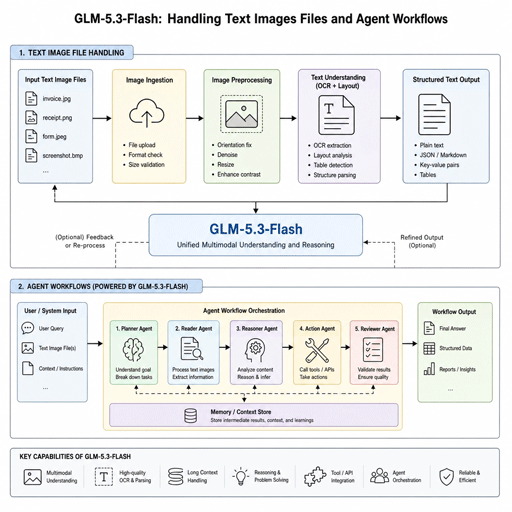
Z.ai’s new GLM-5.3-Flash is an efficiency-focused member of the GLM-5 family built for multimodal, long-context, agentic work. The release matters because it pairs a large mixture-of-experts design with a relatively small active footprint, aiming to make everyday coding, document, research, and workflow automation tasks faster and cheaper to run.
What is GLM-5.3-Flash?
GLM-5.3-Flash is Z.ai’s first natively multimodal model in the GLM-5 series, designed to handle text, images, video, files, coding workflows, and tool-using agent tasks. Z.ai describes it as a 320B-parameter model with 18B active parameters, trained on a 30T-token multimodal corpus and built around a hybrid sparse-and-linear attention architecture for more efficient inference.
In practical terms, GLM-5.3-Flash is not just a smaller “lite” model. It is positioned as a high-throughput workhorse for tasks where teams need strong reasoning and multimodal understanding without paying flagship-model prices on every request.
The release focuses on cost-efficient intelligence
The most important story around glm-5 right now is efficiency. Z.ai says GLM-5.3-Flash reduces active parameters compared with earlier GLM-4.5-series models of similar total size, and its attention system is designed to reduce long-context compute and memory pressure. The company also says the model achieves about a 3.0× reduction in attention compute and a 4.4× reduction in KV-cache size compared with GLM-5.3 in its own published comparison.
That matters for developers because latency and cost often decide which model gets used in production. A brilliant model that is too expensive for repeated tool calls can stay trapped in demos. A fast, capable, lower-cost model can become the default for code review, document parsing, internal agents, customer operations, and data-heavy workflows.
Why does the GLM 5 context window matter?
The glm 5 context window matters because long-context models can keep more instructions, source files, documents, tool output, and conversation history available at once. Z.ai describes GLM-5.3-Flash as supporting up to a one-million-token context window, which puts it in the category of models built for long-horizon tasks rather than short chat turns.
For teams building agents, that context length can change workflow design. Instead of constantly summarizing or dropping older information, an agent can reference more of the project state, prior decisions, logs, files, and visual feedback. It does not remove the need for retrieval or good prompting, but it gives builders more room to keep complex work coherent.
Useful long-context use cases include:
- Repository analysis: reviewing many files, dependency patterns, and previous agent steps in one workflow.
- Document automation: comparing PDFs, spreadsheets, presentations, and notes without losing supporting detail.
- Research synthesis: holding source material, assumptions, outlines, and draft outputs in the same working context.
- Visual QA: inspecting screenshots, charts, layouts, or rendered documents, then revising based on what the model sees.
- Agent memory: maintaining task plans, tool results, errors, and next actions during long-running automation.
Multimodal work is central, not optional
One notable shift is that GLM-5.3-Flash is described as natively multimodal rather than a text model with vision bolted on later. Z.ai says the model learns text and visual information together from pre-training and can work with documents, charts, interface states, layout relationships, screenshots, and files.
That gives it a natural role in professional workflows where information is rarely text-only. A finance team may need a model to read spreadsheet structure and chart output. A product team may want screenshot-based UI review. A content or operations team may need help turning messy source files into polished reports, presentations, or campaign materials.
GLM 5 pricing is part of the appeal
Search interest around “glm 5 pricing” and “glm 5 price” is understandable because model selection is often a budget decision as much as a capability decision. Current third-party pricing trackers that cite Z.ai’s official pricing page list GLM-5.3-Flash at about $0.15 per million input tokens and $0.50 per million output tokens, with cached input commonly shown at $0.03 per million tokens.
Pricing can change, and provider routing can vary, so teams should confirm rates before committing spend. Still, the listed glm 5 price makes GLM-5.3-Flash especially interesting for high-volume jobs where every extra model call adds up.
A practical evaluation checklist:
- Estimate token volume for both input and output, not just prompts.
- Measure cache-hit potential if your app reuses long system prompts, project files, or instructions.
- Benchmark real tasks rather than relying only on leaderboard scores.
- Track latency under load because agent workflows may call the model many times.
- Compare total task cost instead of only price per million tokens.
GLM 5 vs Opus 4.6 and Kimi comparisons need context
Many people will search for “glm 5 vs opus 4 6,” “kimi k2 5 vs glm 5,” “glm 5 vs kimi 2 5,” or similar model-matchup phrases. Those comparisons can be useful, but only if they focus on the job at hand. A coding agent, a research assistant, a document automation tool, and a visual QA workflow may each reward different strengths.
For example, Opus-class models are often evaluated for deep reasoning and writing quality, while Kimi-style comparisons often center on long context, agentic coding, and cost-effective throughput. GLM-5.3-Flash enters that discussion as a model trying to combine strong multimodal capability, long-context handling, and lower operating cost. The right question is not simply which model is “best,” but which model completes your actual workflow reliably at the best total cost.
Where GLM-5.3-Flash fits best
GLM-5.3-Flash looks most compelling as a frequent-use model for practical production work. Z.ai’s AutoClaw materials position it for image and visual-document understanding, chart and file processing, document and content workflows, frequent multi-step tasks, and work that benefits from fast feedback.
Strong fit scenarios include:
- internal agents that inspect files, browse tools, and produce reusable outputs;
- coding assistants that need broad repository context;
- office automation for reports, decks, spreadsheets, and meeting artifacts;
- multimodal review of screenshots, dashboards, charts, and layouts;
- high-volume API tasks where flagship pricing would be difficult to justify.
It may be less ideal when a team needs the absolute strongest reasoning model regardless of cost, or when deployment constraints require a specific provider ecosystem. As always, model choice should follow testing, not hype.
The takeaway
GLM-5.3-Flash makes the GLM-5 family more relevant for teams that care about both capability and operating economics. Its combination of native multimodality, long context, open-weight availability, and low listed API pricing gives developers a serious new option for agentic work. If you are comparing glm-5 with Opus, Kimi, or other frontier models, start with your real workload, measure quality and cost together, and let the model earn its place in your stack.