
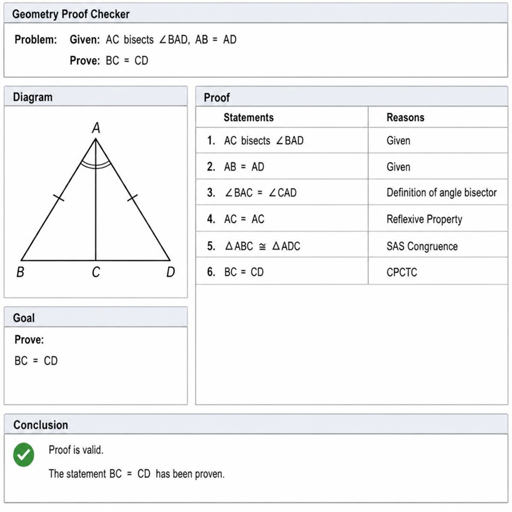
Artificial intelligence is moving from solving contest-style problems toward producing, checking, and accelerating real mathematical research. Recent announcements from Google DeepMind, OpenAI, Princeton researchers, and academic teams point to a fast-changing field in which ai theorem proving, formal verification, and human mathematical judgment are becoming tightly linked. The momentum is substantial, but so are the questions about trust, credit, and what counts as understanding in mathematics.
Why are mathematicians paying attention now?
Mathematicians are paying attention because recent systems have crossed visible thresholds: medal-level Olympiad performance, machine-checkable proof generation, and claimed progress on long-standing research problems. The biggest change is not simply that models can produce plausible proof text. It is that newer ai algorithms increasingly work with proof assistants such as Lean, giving researchers a way to test whether parts of an argument are logically valid rather than relying only on fluent language.
That distinction matters. A language model can still write a convincing but wrong proof; a formal proof assistant checks whether a proof term follows from the stated assumptions. The hard part is that a checked formal statement may still fail to capture the informal problem mathematicians intended to solve, so verification reduces one kind of uncertainty while leaving room for expert review.
A string of milestones has reset expectations
Google DeepMind’s 2024 AlphaProof and AlphaGeometry 2 result was one of the first widely noticed inflection points. The systems solved four of six International Mathematical Olympiad problems, scored 28 out of 42 points, and reached silver-medal standard, with AlphaProof using Lean-based formal reasoning and AlphaGeometry 2 handling geometry.
The follow-up was even more striking. In 2025, Google DeepMind reported that an advanced version of Gemini with Deep Think solved five of six IMO problems, earned 35 out of 42 points, and reached gold-medal level performance under official grading. Unlike the 2024 setup, which required translation into specialist formal languages and multi-day computation, Google said the newer model worked from natural-language problem statements within the 4.5-hour contest limit.
OpenAI then pushed the conversation from competitions toward research mathematics. In May 2026, the company said an internal model had disproved a long-standing conjecture in the Erdős unit distance problem, a central question in combinatorial geometry first posed in 1946. OpenAI said the proof was checked by external mathematicians and described the result as the first time a prominent open problem central to a subfield had been solved autonomously by AI.
In August 2026, OpenAI announced ten additional advances in mathematics and theoretical computer science, saying the results covered areas including sphere packing, coding theory, group theory, operator algebras, quantum complexity, lattice cryptography, and extremal combinatorics. The company said the arguments were prepared into manuscripts by humans with model assistance and then formalized into Lean certificates.
Academic work has been advancing in parallel. A 2025 ICML paper on Self-play Theorem Provers reported that training a system to generate conjectures and prove them improved performance across Lean-based theorem-proving benchmarks, including LeanWorkbook, miniF2F, ProofNet, and PutnamBench. Princeton researchers also reported a major update to Goedel-Prover-V2, describing it as a strong open-source theorem prover that uses Lean to verify outputs and a self-correction mode to revise failed proofs.
Key recent developments include:
- Competition-level reasoning: AI systems have moved from partial contest success to reported gold-medal-level IMO performance.
- Formal verification: Lean and similar tools are becoming central to credible ai mathematical proofs because they can check logical validity.
- Self-improving data loops: New theorem provers increasingly generate related problems, prove what they can, and add verified results back into training.
- Research-facing claims: AI labs are no longer limiting announcements to benchmark scores; they are presenting candidate results on open mathematical problems.
- Community scrutiny: Mathematicians are asking who verifies the meaning, originality, authorship, and importance of machine-produced work.
Proof assistants are becoming the credibility layer
The rise of ai in mathematics is closely tied to formal systems such as Lean, Isabelle, HOL Light, and Rocq. In these environments, a proof is encoded as a precise object that a small trusted kernel can check. This gives mathematical ai a feedback signal that ordinary prose does not provide: a proof attempt is either accepted by the checker or it is not.
For AI developers, that feedback is powerful. Reinforcement learning systems can search for proof steps and receive a reliable signal when a formal move works. Language models can propose tactics, translate natural-language statements into Lean, or help fill gaps in a proof. In DeepMind’s AlphaProof work, the system used auto-formalization to build a large curriculum from natural-language statements and Lean versions, then trained through proof search.
For mathematicians, proof assistants offer both reassurance and friction. They can prevent many hallucinated arguments from passing as valid, but they also require the informal theorem to be translated into formal language with extreme care. A Lean certificate confirms that the formalized statement follows from the formal assumptions. It does not, by itself, guarantee that the statement is the one the community cares about.
This is why the strongest near-term model may not be “AI replaces mathematicians.” It is more likely to be a layered workflow: AI proposes ideas, formal tools check local correctness, and human experts judge meaning, novelty, elegance, and connection to the broader literature. That workflow turns ai logic into a practical research instrument rather than a standalone authority.
The frontier is shifting from answers to research workflows
The most important breakthroughs are not just higher scores. They are changes in how proof work is organized. Earlier systems often looked like specialized solvers aimed at defined benchmarks. Newer systems look more like research assistants that can explore variations, generate lemmas, attempt formal proof search, and revise failed paths.
That change is visible in self-play and scaffolded-learning approaches. Instead of waiting for humans to supply every training example, these systems generate new conjectures or easier related questions, prove the ones they can verify, and use those successes as additional training data. The STP paper frames this as a way to address sparse rewards in formal theorem proving, while Princeton’s report describes a data flywheel in which verified self-generated problems can strengthen future performance.
The practical effect could be significant. Formalization is slow when done entirely by hand. Proof search can be repetitive. Literature exploration, lemma discovery, and routine verification consume time that mathematicians might prefer to spend on concepts and strategy. If AI tools reliably handle more of that work, they could change the economics of formal mathematics.
But the bottleneck does not vanish; it moves. A recent analysis of machine-checkable proof corpora argued that cheap proof checking creates “verification abundance” while leaving “adjudication” scarce. In plain terms, there may be more formally checked proofs than the mathematical community can quickly interpret, audit, and absorb.
Controversy is now part of the story
The same advances that excite AI researchers have unsettled parts of the mathematics community. In September 2026, OpenAI said an internal model had produced a proof related to the Navier–Stokes Millennium Prize problem, a claim that quickly became entangled with questions about unpublished outside research, user data, authorship, and competitive pressure among AI labs. Axios reported that OpenAI said it did not access the specific researchers’ user data, while also acknowledging it could not fully rule out an indirect connection through de-identified data used to improve models.
The dispute illustrates a broader trust problem. If frontier labs provide tools used by researchers, and those same labs also deploy large compute budgets to pursue similar discoveries, the community needs clearer norms for disclosure, credit, data handling, and independent review. Live Science reported sharp disagreement among prominent mathematicians over whether such announcements represent a golden age of AI-enabled discovery or a threat to the culture and incentives of human research.
There is also a philosophical divide. Some mathematicians value proof mainly as a route to new true statements. Others see proof as a form of explanation, taste, and shared understanding. A 200-page machine-generated argument may be correct and still fail to give the field the kind of conceptual compression that makes a theorem useful.
That tension will shape adoption. Researchers may welcome AI tools for checking, brainstorming, and formalizing, while resisting announcements that bypass normal peer review or blur human and machine contributions. The next stage of ai theorem proving will depend as much on governance and publishing standards as on model capability.
What happens next
The near-term direction is likely to be hybrid. AI systems will become better at moving between natural language and formal proof languages, while proof assistants will remain the anchor for checking difficult logical chains. Contest benchmarks will still matter, but research-facing evaluation will matter more: Can a system state the right theorem, use accepted definitions, cite relevant prior work, and produce insight that other mathematicians can build on?
Watch for several developments:
- More formal certificates attached to AI-generated claims, especially for results announced by major labs.
- Independent auditing practices, including expert review of whether a formal statement matches the intended informal theorem.
- Open-source theorem provers gaining influence, because academic teams can test methods without relying only on closed frontier models.
- New publication norms, covering AI contribution disclosure, data provenance, authorship, and credit.
- Better human-facing explanations, since a verified proof still needs to be understood, taught, generalized, and connected to existing mathematics.
For now, the breakthrough is real but unfinished. AI can already assist with proofs in ways that seemed remote only a few years ago, and in some settings it can generate results that demand serious mathematical attention. The unanswered question is not whether ai mathematical proofs will matter. It is how the mathematical community will decide which machine-aided results are correct, meaningful, responsibly produced, and worth carrying forward.