
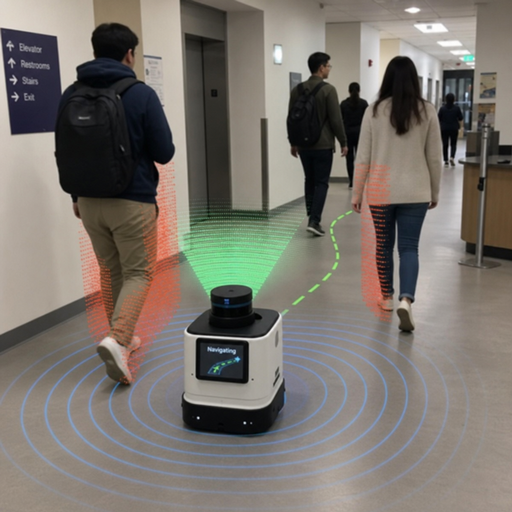
World models are changing how physical AI systems understand space, movement, and cause and effect. Instead of reacting only to the next camera frame or sensor reading, an embodied agent can use a learned internal model to predict what may happen next, test possible actions, and navigate with more context. For robots, autonomous vehicles, drones, and smart machines, this shift turns navigation from simple route-following into adaptive decision-making.
What are world models in AI?
World models in AI are learned representations of how an environment works: what objects are present, how they relate in space, how they change over time, and what is likely to happen after an action. In practical terms, an AI world model gives an agent a kind of internal simulator, allowing it to “imagine” future states before committing to a movement in the real world. Early influential work by David Ha and Jürgen Schmidhuber framed a world model as a compressed spatial and temporal representation that could be learned from experience and used by an agent for control.
That definition matters because physical AI cannot live only in text, images, or static datasets. A robot navigating a warehouse, for example, has to understand that a rolling cart may block an aisle, a person may step into its path, and a glossy floor may affect traction. It must connect perception with action.
When people search for “what are ai world models” or “what are world models in ai,” they are often looking for the same core idea: an AI system that learns enough about its surroundings to predict, plan, and act. The model does not need to copy the world perfectly. It needs to preserve the details that matter for decisions.
Physical AI needs more than perception
Traditional navigation systems often separate the world into pieces: perception identifies objects, mapping estimates where things are, planning chooses a path, and control executes motion. That modular structure is useful, but it can become brittle when the environment changes quickly or when the system faces a situation that was not anticipated by its rules.
World models AI research tries to close that gap by giving the agent a learned sense of dynamics. A navigation system can ask, “If I move left, will I pass safely?” or “If I wait one second, will the obstacle clear?” Those questions are not just about location. They are about time, motion, uncertainty, and consequence.
For physical AI, this is especially important because every action has cost. A chatbot can generate a bad sentence and correct it. A delivery robot, surgical assistant, or autonomous forklift has to deal with gravity, friction, human safety, limited battery life, and real-world delays. Better prediction can reduce unnecessary trial and error.
How world models improve navigation
Navigation is not only the ability to move from point A to point B. In the physical world, good navigation means moving safely, efficiently, and intelligently through environments that may be incomplete, noisy, crowded, or changing. AI world models help by connecting four capabilities that are often handled separately.
They create compact representations of complex scenes
A robot may receive video, lidar, depth, audio, proprioception, and other sensor inputs at the same time. Raw data is too dense to use directly for every decision. A world model compresses that data into a latent representation: a smaller internal state that preserves important information such as free space, object positions, motion patterns, and task-relevant context.
This is one reason machine learning models are so valuable in embodied AI. Rather than hand-coding every visual feature or physical rule, researchers can train models to learn patterns from interaction. The result is not a human-like mental picture, but a useful control-oriented representation.
They predict future states
The defining advantage of a world model is prediction. If an agent can simulate possible futures, it can compare actions before performing them. This can make navigation more proactive.
For example, a hallway robot may detect a person walking diagonally across its path. A reactive system might slow only when the person is directly in front of it. A world-model-based system can forecast the person’s likely position over the next few moments and adjust earlier.
This predictive ability is central to model-based reinforcement learning. Google’s Dreamer line of work, for instance, learns behaviors by training inside predictions of a learned world model rather than relying only on direct real-world interaction. (research.google)
They support planning under uncertainty
Physical environments are never fully observed. A robot may not see behind a shelf, under a table, or around a corner. Sensors may be noisy. Lighting may change. People may behave unpredictably.
A useful world model does not simply output one confident future. It can represent uncertainty: several plausible outcomes with different levels of risk. That matters for navigation because safe movement often depends on choosing the action that remains acceptable even if the agent’s first guess is wrong.
They make learning more sample-efficient
Training physical systems directly in the real world can be expensive, slow, and risky. A robot that learns only by bumping into things will not be welcome for long. A learned world model gives the system a place to practice internally.
This does not eliminate real-world testing, but it can reduce the amount of physical trial and error needed. In robot learning, approaches such as DayDreamer explored how Dreamer-style world models could be applied to real robots learning online in the physical world, without relying entirely on hand-built simulators. (proceedings.mlr.press)
From maps to mental simulation
Classic navigation often starts with maps. A robot builds or receives a representation of walls, obstacles, and routes, then plans a path through that space. This remains important. World models do not make maps obsolete; they make maps more dynamic.
A static map tells an agent where things usually are. A world model helps the agent reason about what may happen next. That distinction becomes critical in real spaces where the “map” is only a starting point.
Consider a service robot in a hospital. The floor plan may be stable, but the working environment is not. Nurses move equipment. Patients open doors. Elevators arrive late. Cleaning carts appear in corridors. A world model can help the robot treat navigation as a living process rather than a fixed route.
In this sense, physical AI navigation is moving from geometry alone toward grounded prediction. The agent still needs localization, obstacle avoidance, and control. But it also needs to understand that a door may swing open, a person may hesitate, and a movable object may no longer be where it was ten seconds ago.
What makes embodied world models different?
Embodied world models are different because they are built for agents that act in physical or simulated environments, not just systems that describe scenes from a distance. They must connect perception, action, time, and physical consequence. A model that generates a visually convincing video is not automatically enough for navigation if it fails to preserve collision risk, object permanence, scale, or controllability.
This distinction is a major theme in recent research. The paper “a comprehensive survey on world models for embodied ai” describes a unified view of embodied world models and highlights open challenges such as dataset limitations, evaluation metrics for physical consistency, computational efficiency for real-time control, and long-horizon temporal consistency. (arxiv.org)
That last point is crucial. Navigation depends on sequences. A robot does not make one decision and stop; it continuously updates its plan as it moves. Small prediction errors can accumulate, especially when the system imagines many steps into the future.
A world model for embodied navigation therefore needs to be judged by more than pixel quality. It should be evaluated by whether it supports useful actions. Does it help the agent avoid collisions? Does it maintain coherent object locations? Does it understand that solid objects cannot pass through each other? Does it keep track of hidden but relevant objects? Those are navigation questions, not just visual questions.
The basic architecture behind AI world models
World models vary widely, but many include a few common pieces. These components may be implemented with recurrent networks, transformers, diffusion models, state-space models, or hybrid systems, depending on the research goal and deployment setting.
A simplified architecture often looks like this:
- Encoder: Converts raw observations, such as images or sensor readings, into a compact latent state.
- Dynamics model: Predicts how the latent state changes after an action.
- Reward or value model: Estimates whether a future state is useful, safe, or aligned with the task.
- Policy or planner: Chooses actions by using predicted outcomes.
- Decoder or observation model: Sometimes reconstructs expected observations, helping the model learn and validate its internal state.
This structure allows the AI agent to operate in a learned “dream space.” Instead of evaluating every possible action in the real world, it can roll out possible futures internally. Dreamer is a well-known example of this idea: it trains actor and critic networks through imagined trajectories in the compact state space of a learned world model. (research.google)
For navigation, the key is not whether the architecture sounds elegant. The key is whether the imagined futures are useful enough for action. A compact model that predicts obstacle movement and free space reliably may be more valuable than a visually rich model that misses physical constraints.
Why world models matter for physical AI navigation
World models matter because physical AI must reason before it moves. In controlled settings, a robot can follow predefined routes and recover when something unexpected happens. In open or semi-structured environments, it needs deeper situational awareness.
A warehouse robot, for example, may need to choose between a shorter crowded aisle and a longer empty one. An agricultural robot may need to navigate around plants that bend, tools left in the field, and uneven ground. A home robot may need to move around pets, furniture, rugs, and people who do not follow predictable paths.
A strong world model can help with several practical navigation tasks:
- Obstacle anticipation: Predicting where moving objects may be, not only where they are now.
- Route adaptation: Choosing alternate paths when the environment changes.
- Risk-aware control: Slowing, stopping, or rerouting when uncertainty is high.
- Object permanence: Remembering that an object may still exist even when temporarily hidden.
- Interaction planning: Understanding how the agent’s movement may influence people, doors, tools, or other robots.
- Recovery behavior: Testing possible corrections after the robot becomes stuck, blocked, or mislocalized.
These benefits are especially valuable when systems have to work around humans. Human environments are full of informal rules. People expect robots to yield, keep comfortable distances, avoid sudden motion, and behave predictably. A navigation model that understands likely near-future interactions can support smoother behavior.
The navigation stack is becoming more integrated
For years, robotics teams have built navigation stacks from specialized modules: simultaneous localization and mapping, perception, path planning, motion planning, and low-level control. This decomposition is still useful, especially in safety-critical systems where interpretability and verification matter.
World models do not necessarily replace the stack. Instead, they can sit inside it, around it, or above it. In some systems, the world model may provide predictions to a conventional planner. In others, it may learn a policy directly. In hybrid designs, symbolic constraints and learned dynamics can work together.
This integrated approach is attractive because navigation failures often happen between modules. A perception system may detect an object correctly, but the planner may not understand how it will move. A map may be accurate, but the controller may not account for slippery ground. A policy may succeed in training but fail when a sensor produces unfamiliar noise.
World models offer a way to connect these pieces through shared predictive structure. When perception, planning, and control are trained around consequences, the system can become more coherent. The agent is not just labeling the world; it is learning what the world allows.
The role of machine learning models in physical reasoning
Machine learning models are powerful because they can absorb patterns that are hard to write as rules. In physical AI, those patterns may include how people walk through space, how objects move after contact, how lighting affects perception, or how a robot’s own body responds to commands.
However, learning does not remove the need for engineering judgment. A navigation system still needs safety boundaries, testing, monitoring, and fallback behaviors. The most useful world models AI teams build are not magical black boxes. They are carefully designed systems trained on relevant data, evaluated against meaningful tasks, and constrained by operational requirements.
The best results often come from combining learned models with prior knowledge. Physics-inspired structure can help a model generalize. Geometric maps can provide stable reference points. Rule-based safety layers can prevent actions that should never be attempted. Human feedback can shape acceptable behavior in shared spaces.
A practical mindset is to treat world models as decision support for embodied action. They help the system consider futures, but they should not be trusted blindly. Prediction is a tool; safe navigation is the objective.
Core benefits for robots, vehicles, and autonomous systems
The promise of world models becomes clearer when mapped to real navigation needs. Different embodied systems have different constraints, but many share the same underlying challenge: they must act with incomplete information.
|
Navigation challenge |
How world models can help |
Practical implication |
|---|---|---|
|
Dynamic obstacles |
Predict likely motion of people, vehicles, animals, or objects |
Earlier avoidance and smoother paths |
|
Sensor noise |
Maintain a latent state that integrates multiple observations |
More stable decisions when inputs are imperfect |
|
Sparse real-world data |
Train or refine behavior through imagined rollouts |
Less dependence on risky physical trial and error |
|
Long-horizon planning |
Simulate action sequences before execution |
Better route choices beyond immediate obstacles |
|
Hidden objects |
Preserve beliefs about things temporarily out of view |
Safer movement around occlusions |
|
Changing environments |
Update predictions as new evidence arrives |
More adaptive navigation in real spaces |
These improvements are not guaranteed by the words “world model.” They depend on the quality of data, training, architecture, and evaluation. But the direction is clear: navigation systems are becoming more predictive, more adaptive, and more aware of physical context.
Real-world navigation examples
World models can support many forms of physical AI navigation. The examples below are generic, but they show why predictive internal models are so useful.
Mobile service robots
A service robot in an office, hotel, hospital, or retail environment has to navigate around people whose movement is only partly predictable. A world model can help it anticipate pedestrian flow, wait at bottlenecks, and choose paths that feel less intrusive. The goal is not merely to avoid contact, but to move in a way humans can understand.
Warehouse and logistics robots
Warehouses are structured, but they are not static. Pallets move, workers cross aisles, and vehicles operate on tight schedules. A world-model-based system can evaluate whether a route is likely to remain clear, whether another robot may create congestion, and whether a temporary detour is safer than a narrow pass.
Autonomous vehicles and delivery systems
Road and sidewalk navigation require constant prediction. Vehicles, cyclists, pedestrians, pets, traffic signals, and weather all influence action. A world model can help an autonomous system reason about how the scene may evolve, though deployment still requires rigorous validation and layered safety controls.
Drones and aerial robots
Drones must plan in three dimensions while dealing with wind, limited battery, obstacles, and restricted visibility. A world model can help predict motion through cluttered or uncertain spaces, especially when GPS is weak or unavailable.
Home robots
Homes are among the hardest environments because they are inconsistent and personal. Furniture moves, objects are left on the floor, pets behave unpredictably, and people expect social awareness. A useful home robot needs more than a floor map. It needs a changing model of what is likely to happen next.
The difference between simulation and world modeling
Simulation and world modeling are closely related, but they are not identical. A simulator is usually an engineered environment created to imitate the world. A world model is learned from data or experience, although it may be trained with simulator data, real-world data, or both.
Engineered simulators are useful because they can encode physics, geometry, and task rules. They can also generate large amounts of training data. But they may fail to capture messy real-world variation, such as unusual lighting, worn surfaces, sensor artifacts, or human behavior.
World models learn from experience, which can make them more adaptable. But they may also learn shortcuts, inherit biases from data, or generate futures that look plausible while violating physical reality. That is why many physical AI systems will likely use both: simulators for controlled training and learned world models for adaptive prediction.
The practical question is not “Which one wins?” It is “How can each improve navigation safely?” A strong simulator can teach basics. A learned world model can help the agent adapt to the real environment it actually encounters.
The biggest technical challenges
World models are promising, but physical navigation exposes their weaknesses quickly. A model can look impressive in a demo and still fail when used for control. The main challenges are not only about generating better images or larger networks.
Long-horizon consistency
Navigation decisions unfold over time. If a model predicts one step ahead well but drifts after ten or twenty imagined steps, it may support poor plans. Error accumulation is one of the core difficulties identified in embodied world model research. (arxiv.org)
For physical AI, long-horizon consistency means the model must preserve important facts as time passes. A chair should not disappear because it is briefly occluded. A hallway should not change shape. A person walking behind a column should remain part of the agent’s belief state.
Physical grounding
A navigation world model must understand constraints that matter for movement. Objects occupy space. Robots have turning radii. Floors can be slippery. Stairs, ramps, cables, mirrors, and transparent doors can all create problems.
A model trained only to predict pixels may not learn these constraints deeply enough. It may generate a visually plausible future that is useless for safe action. This is why evaluation must include physical consistency and task success, not only visual fidelity.
Real-time performance
Robots cannot spend unlimited time imagining. Navigation requires fast updates as the scene changes. A large model that is accurate but too slow may be impractical for onboard control.
This creates a trade-off between model richness and computational efficiency. Embodied AI needs systems that are accurate enough to help, compact enough to run, and responsive enough to act.
Uncertainty and safety
A world model will sometimes be wrong. The question is whether the system knows when to be cautious. Good navigation requires calibrated uncertainty, conservative fallback behavior, and clear limits on model-driven actions.
For example, if a robot is unsure whether an object is a shadow or a real obstacle, the safe behavior may be to slow down or gather more information. A confident wrong model is more dangerous than an uncertain one.
Practical design principles for navigation teams
Teams building or evaluating physical AI systems can use world models more effectively by focusing on the navigation problem first, rather than the model trend.
A useful checklist includes:
- Define the action space clearly. Know what movements the system can actually perform before training a model to predict consequences.
- Prioritize task-relevant state. Preserve information that affects safety, route choice, timing, and control.
- Measure physical outcomes. Evaluate collision rates, recovery behavior, route efficiency, and human comfort, not only prediction quality.
- Keep fallback systems. Use emergency stops, conservative planners, and verified safety constraints where appropriate.
- Test under distribution shifts. Include lighting changes, clutter, occlusions, sensor noise, and unexpected human movement.
- Audit uncertainty. Check whether the model becomes cautious when it lacks enough information.
- Separate demo quality from deployment readiness. A compelling video is not the same as robust navigation.
This checklist is deliberately practical. World models are exciting, but physical AI succeeds only when prediction improves action in the situations that matter.
How world models change human-robot interaction
Navigation is also communication. When a robot moves through shared space, people read its motion for intent. A hesitant stop, a sudden turn, or an overly close pass can make the system feel unsafe even if no collision occurs.
World models can help robots behave more legibly. If the system predicts how a person may interpret or respond to its movement, it can choose paths that are smoother and easier to anticipate. This is especially important in hospitals, homes, airports, and retail spaces where people are not trained to work around robots.
There is also a trust dimension. A robot that repeatedly takes awkward routes, blocks doorways, or startles people will lose acceptance. Better prediction can support more natural navigation: slowing before intersections, yielding at the right time, and avoiding paths that technically fit but socially feel wrong.
This does not mean robots need human-level social intelligence to navigate well. It means physical AI should treat humans as dynamic agents, not moving obstacles. World models provide one route toward that richer understanding.
Why evaluation must go beyond visual realism
The recent excitement around generative video has influenced how people talk about ai world models. Video prediction can be part of world modeling, but visual realism alone is not enough for navigation. A generated scene can look convincing while failing to preserve the details a robot needs for safe control.
For embodied systems, the central test is utility. Can the model improve decisions? Can it help the agent reach goals safely? Can it recover from surprises? Can it preserve important spatial and temporal relationships?
A navigation-focused evaluation should include:
- Action accuracy: Whether predicted outcomes match what happens after real actions.
- Collision awareness: Whether the model preserves obstacles and contact constraints.
- Temporal stability: Whether objects and layouts remain coherent over time.
- Uncertainty quality: Whether the system recognizes ambiguous or unfamiliar situations.
- Control usefulness: Whether imagined rollouts lead to better policies or plans.
- Efficiency: Whether predictions can be used within real-time navigation constraints.
This is where world model research becomes engineering reality. The model’s value is measured not by how impressive it appears, but by whether it helps embodied agents move better.
The future of world models in physical AI
The next phase of world models AI will likely be more multimodal, more interactive, and more grounded in action. Instead of learning only from passive observation, physical AI systems will learn from moving, touching, failing, recovering, and receiving feedback.
We can expect more hybrid systems that combine learned dynamics with structured geometry, physics priors, language instructions, and safety rules. A robot may use language to understand a goal, vision to interpret the scene, a map to localize, and a world model to predict what its actions will cause.
The field is also moving toward broader embodied intelligence. Surveys of embodied world models increasingly discuss not just navigation, but manipulation, planning, simulation, and generalist agents. The challenge is to build models that transfer across tasks without losing the precision required for physical action.
For navigation, the most important progress may come from better grounding. Future models need to understand not just what a scene looks like, but what can be done in it. Where can the robot pass? What may move? What should be avoided? What action is safe now, and what action becomes safe after waiting?
Key takeaways
World models are becoming a foundation for more capable physical AI navigation because they help agents predict, plan, and adapt. They are not a replacement for safety engineering, mapping, control, or real-world testing, but they can make those systems more intelligent when integrated thoughtfully.
The essential ideas are simple:
- World models learn how environments change. They give AI agents an internal way to reason about future states.
- Navigation becomes predictive instead of merely reactive. Robots can plan around what may happen, not only what is visible now.
- Embodied AI requires physical consistency. A useful model must support action, not just generate realistic images.
- Uncertainty matters. Safe systems need to know when their predictions may be wrong.
- Evaluation should focus on outcomes. Better navigation, safer motion, and more reliable recovery are the real measures of success.
The revolution is not that robots will suddenly “understand the world” in the human sense. It is that machine learning models are giving physical AI better tools for anticipating consequences. In navigation, that can mean fewer surprises, smoother motion, safer interaction, and systems that are better prepared for the complexity of real environments.