
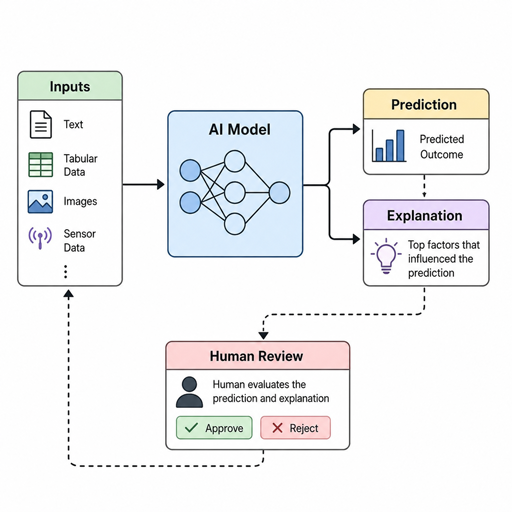
Explainable AI is the practice of making artificial intelligence systems understandable to the people who build, use, manage, or are affected by them. Instead of treating a model as a sealed black box, explainable AI shows which factors influenced an output, how confident the system appears to be, and where human review may be needed. The goal is not to make every algorithm simple; it is to make AI insights clear enough for responsible decisions.
In practical terms, explainable AI helps teams connect technical performance with human trust. It supports model explainability, ai transparency, compliance conversations, user adoption, and better governance across the AI lifecycle.
What is explainable AI?
Explainable AI, often shortened to XAI, is a set of methods, design practices, and communication techniques that help humans understand how an AI system reaches a result. When people search for Explainable AI XAI or xai explainable ai, they are usually looking for the same core idea: AI should provide useful reasons, not just outputs.
A traditional AI model may return a score, prediction, recommendation, classification, or generated response without clearly showing why. Explainable AI adds context around that output. For example, a credit risk model might not simply label an applicant as higher risk; it may show that income stability, debt-to-income ratio, and recent payment history had the strongest influence. A medical imaging model might highlight the region of an image that contributed most to its classification, while still leaving the final judgment to a qualified clinician.
Good explanations are audience-aware. A data scientist may need feature importance, confidence intervals, error analysis, and model behavior across subgroups. A business leader may need to know whether the system is reliable enough for a workflow. A customer may need a plain-language reason for a decision and a path to challenge or correct it. Explainable AI is strongest when it turns complex model behavior into insight each audience can actually use.
Defining characteristics of explainable AI
A system does not become explainable just because it has a dashboard or a technical report. Useful XAI typically includes several characteristics:
- Clarity: The explanation is understandable to its intended audience, whether technical or nontechnical.
- Traceability: Teams can connect an output to relevant inputs, model logic, assumptions, or evidence.
- Relevance: The explanation focuses on factors that genuinely influenced the result, not decorative details.
- Consistency: Similar decisions can be explained in a similar way, making patterns easier to audit.
- Actionability: Users can see what the explanation means and, when appropriate, what can be changed.
- Limits: The explanation acknowledges uncertainty, data gaps, or cases where the model may be less reliable.
These characteristics matter because explanations can be misleading if they are too vague, too technical, or too detached from the real decision being made. The best explainable AI practices do not overwhelm people with every internal detail. They reveal the right level of detail for the risk, audience, and use case.
Why ai transparency matters
AI transparency matters because people need a reasonable basis for trusting systems that influence decisions. When an AI tool recommends a product, flags a transaction, ranks a candidate, routes a support ticket, or summarizes a legal document, its output can affect time, money, opportunity, safety, and reputation. If no one can explain why the system acted as it did, it becomes difficult to detect mistakes, bias, misuse, or drift.
Transparency also improves collaboration between technical and business teams. Data scientists may understand model architecture, but product managers, compliance teams, frontline employees, executives, and customers need a different kind of understanding. Explainable AI gives these groups a shared language for discussing whether a model is working as intended.
For organizations, ai transparency is not only an ethical ideal. It is also a practical operating discipline. Transparent systems are easier to monitor, debug, document, improve, and defend. When a model behaves unexpectedly, explainability can help identify whether the issue came from training data, changing user behavior, weak features, poor thresholds, or inappropriate deployment.
This is especially important because high-performing models are not automatically trustworthy. A model can achieve strong average accuracy while still failing for certain groups, rare cases, new conditions, or unusual inputs. Explainable AI helps teams move beyond “the model performs well overall” toward a more useful question: “Can we understand when, why, and for whom this model works?”
How does explainable AI work?
Explainable AI works by revealing patterns in how a model uses data to produce an output. Some approaches use models that are naturally easier to interpret, while others add explanation methods around complex models after they make predictions. In both cases, the purpose is to turn raw model behavior into understandable ai insights.
There is no single XAI technique that fits every situation. A simple decision tree may be explainable because people can follow its branches. A large neural network may need separate tools that estimate which inputs mattered most, test how outputs change when inputs change, or summarize patterns across many predictions. The right approach depends on the model type, the decision risk, the available data, and the audience.
Interpretable models
Some models are easier to explain by design. Linear models, rule-based systems, scorecards, small decision trees, and carefully constrained models can often show a direct relationship between inputs and outputs. For example, a scorecard may assign visible weights to factors, making it easier to see why one case received a higher score than another.
Interpretable models can be valuable in high-stakes or regulated environments because their logic is easier to document and review. They may also be easier for operational teams to adopt because the decision path is visible. However, interpretability can come with trade-offs. In some cases, a simpler model may not capture complex patterns as well as a more advanced model, so teams must balance understandability with performance.
Post-hoc explanations
Post-hoc explanations are created after a model has made a prediction. They are often used for complex systems where the internal logic is too large or nonlinear for people to inspect directly. These methods may estimate which features most influenced a particular result, show how sensitive the result is to changes in inputs, or provide similar past examples for comparison.
Post-hoc techniques can make complex models more usable, but they require care. An explanation may approximate model behavior rather than reveal the complete internal process. That does not make it useless, but it does mean teams should validate explanations, communicate uncertainty, and avoid presenting simplified explanations as perfect truth.
Global and local explanations
Explainable AI often distinguishes between global and local explanations. A global explanation describes how a model tends to behave overall. It may show the most influential features across the full dataset or reveal broad patterns in how predictions change. A local explanation focuses on one specific output, such as why a particular transaction was flagged or why one applicant received a certain score.
Both views are useful. Global explanations help teams understand the model as a system. Local explanations help people inspect individual decisions. A trustworthy ai program usually needs both because an overall pattern does not always explain a single case, and a single case does not always represent the whole model.
Human-centered explanation design
Explainable AI is not only a technical problem. It is also a communication problem. An explanation that is mathematically accurate but unreadable to its audience will not create meaningful trust. Likewise, a friendly explanation that hides important caveats can create false confidence.
Human-centered XAI starts by asking who needs the explanation and what they need to do with it. A support agent may need a short reason code and recommended next step. An auditor may need documentation, test results, and evidence of controls. A customer may need clear language about the main factors behind a decision. Designing for the user prevents explainability from becoming a technical artifact that no one uses.
Model explainability in the AI lifecycle
Model explainability is most effective when it is built into the AI lifecycle from the beginning. If teams wait until after deployment, they may discover that the model, data pipeline, documentation, or interface cannot support meaningful explanations. Treating XAI as an early design requirement helps prevent expensive rework and weak governance.
During problem definition, teams should clarify what decision the AI system will support, who will use it, and what level of explanation is necessary. A low-risk recommendation tool may need lightweight transparency, while a model affecting access to services may require deeper documentation, stronger review, and clearer user-facing explanations.
During data preparation, explainability depends on understanding where data came from, what it represents, and what limitations it carries. A model trained on incomplete, biased, outdated, or poorly labeled data may still produce confident outputs. Explainable AI cannot fix bad data by itself, but it can help expose suspicious patterns and make data limitations visible.
During training and evaluation, teams can compare model performance with interpretability needs. They can test whether important features make sense, whether outputs change unexpectedly, and whether the model behaves differently across relevant groups. This is where ai insights become more than performance metrics; they become evidence for responsible deployment.
During deployment, explanations should be available in the places where decisions happen. If an employee sees a risk score, they should also see enough context to interpret it. If a user is affected by an automated recommendation or decision, the organization should consider what explanation is appropriate, useful, and fair.
During monitoring, explainability helps teams identify model drift, data drift, changing relationships, and emerging failure modes. A model that made sense at launch may become less reliable as market conditions, user behavior, fraud tactics, language patterns, or operational processes change. Ongoing explanation and review keep AI systems from becoming invisible infrastructure that no one questions.
Core benefits of explainable AI
Explainable AI creates value because it makes AI systems easier to understand, challenge, improve, and trust. The exact benefits vary by industry and use case, but several patterns appear across many organizations.
- Better decision support: Explanations help users understand how much weight to give an AI output. Instead of accepting a prediction blindly, they can combine it with professional judgment and context.
- Faster troubleshooting: When a model fails, explainability can point teams toward the likely cause, such as a problematic feature, a data quality issue, or a shift in input patterns.
- Stronger governance: Clear explanations make it easier to document model behavior, review decisions, and show that appropriate controls exist.
- Improved user trust: People are more likely to use AI tools when they understand what the system is doing and where its limits are.
- Fairness review: Explanations can help teams investigate whether a model relies on questionable proxies or produces concerning patterns for certain groups.
- Operational adoption: Employees can incorporate AI into workflows more confidently when outputs come with context, not just scores or labels.
- Better product experiences: User-facing explanations can reduce confusion and help people understand recommendations, rankings, or automated actions.
These benefits depend on quality. A weak explanation can be worse than no explanation if it creates the appearance of accountability without meaningful understanding. For example, saying “the model made this decision based on your profile” is usually too vague to be useful. A better explanation identifies the most relevant factors, clarifies uncertainty, and avoids implying that the AI is always correct.
When does model explainability matter most?
Model explainability matters most when AI outputs influence important decisions, affect people directly, or operate in complex environments where mistakes are costly. The higher the potential impact, the stronger the need for ai transparency, documentation, review, and human oversight.
In low-risk contexts, such as suggesting playlist songs or organizing personal notes, a simple explanation may be enough. In higher-risk contexts, such as lending, healthcare, hiring, insurance, education, cybersecurity, public services, or legal support, explanations become more important. People affected by the output may need to understand what happened, employees may need to override or escalate decisions, and organizations may need to show that the system is controlled responsibly.
Explainability is also important when models are used at scale. A small error pattern can become a large operational problem if repeated thousands or millions of times. Without explanations, teams may not notice that a model is relying on the wrong signals or treating edge cases poorly.
Practical examples and use cases
Explainable AI can appear in many forms depending on the workflow. Common examples include:
- Credit and lending: Showing which financial factors most influenced a risk score or eligibility result.
- Healthcare support: Highlighting image regions, symptoms, or record patterns that contributed to a model’s suggestion, while preserving clinician judgment.
- Fraud detection: Identifying transaction behaviors that triggered a suspicious activity flag.
- Customer service: Explaining why a ticket was routed to a certain team or prioritized as urgent.
- Human resources: Auditing whether screening tools are relying on appropriate job-related criteria.
- Manufacturing: Showing which sensor readings contributed to a predicted equipment failure.
- Cybersecurity: Explaining why network activity was flagged as unusual or risky.
- Marketing personalization: Clarifying why a customer segment received a recommendation or message.
In each case, the explanation should match the decision. A technician may need root-cause clues. A customer may need a plain-language reason. An executive may need trend-level assurance that the system is performing responsibly.
Explainable AI and trustworthy ai
Trustworthy ai is broader than explainable AI. It includes reliability, safety, privacy, fairness, security, accountability, and appropriate human control. Explainability supports those goals, but it does not replace them.
A model can be explainable and still be inaccurate. It can be transparent and still use poor data. It can generate clear reasons and still be deployed in a process where no one has authority to challenge it. For that reason, explainable AI should be treated as one part of a larger responsible AI program.
That said, explainability often acts as the bridge between technical controls and human accountability. It helps people see whether a model’s behavior aligns with organizational values, user expectations, and operational requirements. Without explanations, conversations about trust can become abstract. With explanations, teams can inspect concrete evidence: what the model used, how it behaved, where it struggled, and what should happen next.
Trustworthy ai also requires humility. AI systems are built from historical data, design choices, assumptions, and optimization goals. They do not understand context the way humans do. Explainable AI makes those limitations easier to see, which helps organizations avoid overreliance and design better human review processes.
Common misconceptions about explainable AI
Explainable AI is sometimes misunderstood. These misconceptions can lead teams to overpromise what XAI can do or underuse it where it would help.
- Misconception: Explainability means revealing all source code. In reality, explainability focuses on making model behavior understandable. Source code may be part of technical review, but most users need decision logic, influential factors, limits, and context.
- Misconception: A simple model is always better. Simpler models are often easier to interpret, but they are not automatically more accurate, fair, or appropriate. The best choice depends on the use case and risk.
- Misconception: Post-hoc explanations are perfect. Many post-hoc methods approximate how a model behaved. They can be useful, but they should be tested and communicated carefully.
- Misconception: Explainable AI eliminates bias. XAI can help detect and investigate bias, but it does not remove biased data, flawed labels, or unfair processes by itself.
- Misconception: More detail always means better explanation. Too much technical detail can confuse users. A good explanation gives the right information for the person and task.
- Misconception: Explainability is only for data scientists. Business teams, auditors, legal teams, product owners, frontline employees, and end users may all need different explanation layers.
Understanding these limits keeps explainable ai practical. The aim is not to make every system perfectly transparent in every possible way. The aim is to make AI understandable enough for responsible use.
The risks of black-box AI
A black-box AI system is one whose internal reasoning is difficult or impossible for users to understand. Some black-box systems are technically complex, while others are simply poorly documented or poorly communicated. The problem is not complexity alone. The problem is using complexity as an excuse for decisions no one can inspect.
Black-box AI can create several risks. Teams may accept outputs without knowing whether they are reliable. Users may be unable to correct errors or challenge decisions. Leaders may deploy models without understanding operational consequences. Compliance and risk teams may struggle to document why a system was approved. Developers may find it harder to debug failures because they lack visibility into what the model learned.
There is also a trust risk. If people affected by an AI system receive unexplained decisions, they may see the process as arbitrary or unfair. Even when the model is accurate, lack of explanation can damage confidence. Explainable AI helps reduce that gap by making the system’s reasoning more visible and reviewable.
However, not every AI system needs the same depth of explanation. A model that sorts internal documents may not require the same level of review as a model that affects someone’s access to financial services. The key is proportionality: match the explanation standard to the stakes of the decision.
A practical framework for applying XAI
Organizations can make explainable AI more manageable by approaching it as a structured practice rather than a one-time feature. The following framework can help teams decide what kind of explanation they need and how to apply it.
- Define the decision context. Identify what the AI system does, who uses it, who is affected, and what could go wrong.
- Classify the level of risk. Consider whether the model affects rights, access, safety, finances, reputation, or sensitive personal outcomes.
- Choose the explanation audience. Decide whether the explanation is for developers, business users, auditors, customers, or another group.
- Select explanation methods. Use interpretable models, feature analysis, example-based explanations, sensitivity testing, documentation, or user-facing reason codes as appropriate.
- Validate the explanations. Check whether the explanations accurately reflect model behavior and are understandable to the intended audience.
- Design human review. Clarify when people can override, escalate, correct, or investigate an AI output.
- Monitor after deployment. Review whether explanations remain accurate as data, behavior, and operating conditions change.
This framework keeps explainability tied to real decisions. It also helps prevent a common failure: creating technical explanation artifacts that look impressive but do not help anyone make a better choice.
Good explanations are layered
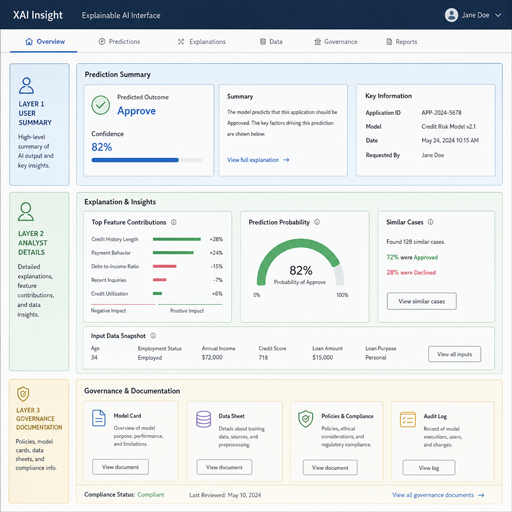
One of the most effective ways to design explainable AI is to use layers. Different people need different levels of detail, and a single explanation rarely satisfies everyone. A layered approach provides a simple explanation first, then allows deeper inspection when needed.
For example, a user-facing interface might show the top three reasons behind a recommendation in plain language. An internal operations view might include feature values, confidence indicators, and recommended review actions. A governance report might include model documentation, training data summaries, validation results, limitations, and monitoring procedures.
Layered explanations also reduce cognitive overload. Most users do not want a mathematical breakdown every time an AI tool acts. But when a decision is unusual, disputed, high impact, or uncertain, deeper detail should be available. This is how explainable AI balances usability with accountability.
A layered design may include:
- Plain-language summaries for end users and nontechnical stakeholders.
- Reason codes that identify the main factors behind an output.
- Confidence or uncertainty indicators that show when caution is needed.
- Technical diagnostics for data scientists and machine learning engineers.
- Governance documentation for risk, compliance, audit, or leadership review.
- Feedback mechanisms so users can report errors, add context, or request review.
This layered approach is especially useful in organizations where AI tools move across teams. It gives each group enough information to act without forcing everyone to become a machine learning expert.
The role of ai insights in better decisions
AI insights are only valuable when they improve understanding or action. A prediction by itself may be useful, but an explained prediction can be more powerful because it shows the factors behind the outcome. This helps people decide whether to accept the output, investigate further, or use it as one signal among many.
Consider a churn prediction model. A simple output might say that a customer has a high likelihood of leaving. An explainable output might show that recent support delays, reduced product usage, and a lower engagement score contributed most to the prediction. That explanation turns a risk score into an action plan: improve service response, re-engage the customer, or offer targeted help.
The same principle applies across domains. In maintenance, an explanation can point technicians toward the sensor reading most associated with equipment failure. In cybersecurity, it can help analysts prioritize suspicious events. In content moderation, it can help reviewers understand why material was flagged. Explainability makes ai insights more usable because it connects prediction with cause, context, or next step.
Still, teams should be careful not to confuse correlation with guaranteed cause. Many AI models identify patterns, not true causal relationships. A responsible explanation should avoid saying “this caused that” unless the model and evidence support a causal claim. In many cases, “this factor contributed to the model’s prediction” is more accurate.
Building a culture of explainability
Technology alone cannot create explainable AI. Organizations also need habits, roles, and expectations that make explanation part of normal AI work. If teams reward only speed and accuracy, explainability may be treated as an afterthought. If they value responsible adoption, explanations become part of product quality.
A culture of explainability starts with asking better questions. What data is the model using? What assumptions are built into the design? Who could be harmed by errors? What explanation would a user reasonably expect? How will the organization respond when the model is wrong? These questions help teams design AI systems that are easier to inspect before problems appear.
Documentation is also important. Teams should record why a model was built, how it was evaluated, what data was used, what limitations are known, and what monitoring is in place. Documentation does not need to be performative or bloated. It should be clear enough that future teams can understand what was done and why.
Cross-functional review strengthens the process. Data scientists, engineers, product managers, domain experts, legal or compliance professionals, and user experience designers often see different risks. Bringing them together can improve both the model and its explanations. Explainable AI works best when responsibility is shared, not isolated inside one technical team.
A checklist for evaluating explainable AI
Before deploying or relying on an AI system, teams can use a simple checklist to assess whether explainability is strong enough for the use case.
- Purpose: Is the model’s role in the decision clearly defined?
- Audience: Do the right people receive explanations they can understand?
- Inputs: Are the main data sources and important features documented?
- Output: Is the result accompanied by useful context, such as reasons, confidence, or limits?
- Accuracy: Has the explanation method been tested against actual model behavior?
- Fairness: Can teams examine performance and explanations across relevant groups?
- Oversight: Is there a clear process for human review, escalation, or override?
- Feedback: Can users report errors, provide missing context, or challenge outcomes when appropriate?
- Monitoring: Are explanations reviewed as data and model behavior change over time?
- Accountability: Is ownership clear for maintaining, updating, and retiring the system?
This checklist is not a substitute for technical validation, legal review, or domain expertise. It is a practical starting point for making explainability visible in everyday AI decisions.
Explainability is becoming a baseline expectation
As AI becomes more common in business workflows, users are less willing to accept unexplained automation. People want to know why a system recommended, ranked, rejected, flagged, or generated something. Organizations also need clearer internal visibility because AI is moving from experiments into operational processes.
This shift does not mean every system must expose every detail to every user. Some information may be proprietary, security-sensitive, or too technical to be useful. But the direction is clear: responsible AI requires meaningful explanations appropriate to the decision and audience.
For teams building or adopting AI, the practical lesson is simple. Do not treat explainability as a feature added at the end. Build it into problem definition, model selection, interface design, governance, and monitoring. The earlier explainability is considered, the easier it is to create systems people can understand and use responsibly.
Bringing explainable AI into everyday practice
Explainable AI is important because it turns AI from a mysterious output generator into a system that can be questioned, improved, and governed. It helps people understand how models behave, where their limits are, and when human judgment should take the lead. That understanding is essential for ai transparency, model explainability, and trustworthy ai.
The best approach is practical rather than performative. Choose explanation methods that fit the model, risk, and audience. Provide enough detail to support action, but not so much that users are buried in complexity. Validate explanations instead of assuming they are accurate. Keep monitoring the system after launch.
In the end, explainable ai is not about making AI less advanced. It is about making advanced systems more usable, accountable, and aligned with human decisions. When organizations can explain their AI, they are better prepared to trust it, improve it, and use it responsibly.
