
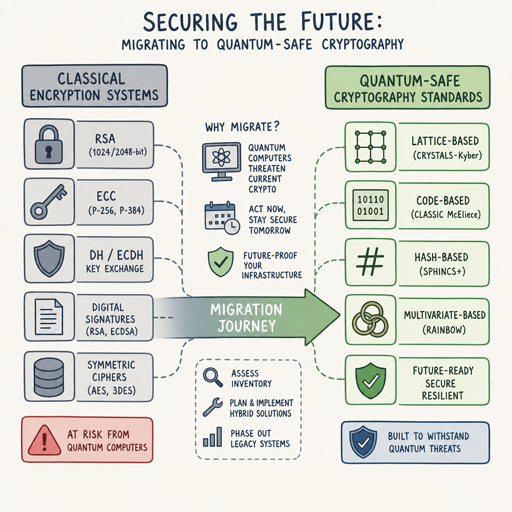
Quantum-safe cryptography has moved from a future-facing research topic into an implementation priority for security leaders, software teams, infrastructure owners, and compliance stakeholders. The standardization wave matters because it gives organizations a clearer path for replacing vulnerable public-key cryptography with quantum-resistant algorithms that can protect sensitive data over the long term. This article explains what changed, why post-quantum security planning should begin before a cryptographically relevant quantum computer exists, and how teams can start building practical quantum security solutions without overreacting or buying hype.
Why is quantum-safe cryptography becoming urgent now?
Quantum-safe cryptography is becoming urgent because the standards landscape has matured enough for organizations to begin serious migration planning, while the data at risk may need to remain confidential for years. NIST released its first three finalized post-quantum cryptography standards in August 2024: FIPS 203 for ML-KEM, FIPS 204 for ML-DSA, and FIPS 205 for SLH-DSA, describing them as ready for use. NIST later selected HQC for standardization as an additional post-quantum encryption algorithm, reinforcing that the transition is an ongoing program rather than a single release event.
The risk is not only “a quantum computer might break encryption someday.” The practical concern is that attackers can capture encrypted traffic or stored data now and attempt to decrypt it later if quantum capabilities mature. This “harvest now, decrypt later” model changes the timeline for industries that hold long-lived information: healthcare records, government files, intellectual property, legal documents, financial data, customer identities, and machine-to-machine credentials.
That is why post-quantum security is less about panic and more about disciplined modernization. Most enterprises have years of embedded cryptography spread across applications, devices, APIs, certificates, VPNs, cloud services, identity systems, firmware signing, and vendor products. Replacing that foundation safely takes inventory, testing, procurement changes, and crypto-agility—not a last-minute patch.
The standardization wave has given teams a clearer target
For years, organizations knew quantum risk was coming but lacked final standards to build against. That uncertainty encouraged pilots and proofs of concept, but it also made production decisions harder. The publication of NIST’s FIPS 203, 204, and 205 changed the conversation from “which algorithms might win?” to “where do these standards fit in our architecture?”
At a high level, the current standards address two major needs:
- Key establishment and encryption: FIPS 203 specifies ML-KEM, a module-lattice-based key-encapsulation mechanism intended for establishing shared secrets in protocols and systems. NIST lists ML-KEM-512, ML-KEM-768, and ML-KEM-1024 as parameter sets with increasing security strength and decreasing performance.
- Digital signatures: FIPS 204 specifies ML-DSA for generating and verifying digital signatures, while FIPS 205 specifies SLH-DSA, a stateless hash-based digital signature algorithm. NIST described FIPS 204 as the primary standard for protecting digital signatures and FIPS 205 as another digital signature option based on SPHINCS+.
- Future diversity: NIST selected HQC in March 2025 for future standardization as another encryption algorithm, adding diversity beyond the initial foundation.
This clarity is important because cryptography is deeply interconnected. A payment system may depend on TLS, certificate authorities, hardware security modules, code-signing workflows, mobile apps, cloud key management, third-party APIs, and older systems that no one wants to touch. Standards give vendors and internal engineering teams a shared destination.
Still, “standardized” does not mean “automatically deployed everywhere.” Libraries, protocols, certificates, hardware modules, managed services, procurement rules, and audit practices all need to catch up. The standardization wave opens the door; migration work still has to walk through it.
Quantum-safe, post-quantum, and quantum cryptography are not the same thing
The terminology can be confusing because related phrases are often used interchangeably. In everyday business discussions, quantum-safe cryptography, quantum safe cryptography, post-quantum cryptography, and quantum-resistant algorithms usually refer to cryptographic methods designed to resist attacks from both classical and future quantum computers. These methods generally run on conventional computers and networks.
Quantum cryptography, by contrast, often refers to approaches that use quantum physics directly, such as quantum key distribution. That distinction matters for buyers and architects. Post-quantum cryptography is typically a software-and-standards migration problem across existing digital infrastructure, while quantum cryptography may require specialized hardware, links, and operational models.
NSA’s public post-quantum cybersecurity resources state that it views quantum-resistant, or post-quantum, cryptography as more cost-effective and easier to maintain than quantum key distribution for many needs. That does not make every product labeled “post-quantum” automatically appropriate, but it does explain why the standards conversation is centered on algorithms that can integrate into normal IT, cloud, application, and network environments.
A simple way to frame the difference is this:
|
Term |
Practical meaning |
Typical planning question |
|---|---|---|
|
Quantum-safe cryptography |
Broad label for protections intended to remain secure against quantum-enabled attacks |
Which systems need stronger cryptographic protection over the next decade? |
|
Post-quantum cryptography |
Standardized or candidate algorithms designed to run on classical systems |
Which algorithms, libraries, and protocols should we adopt? |
|
Quantum-resistant algorithms |
Algorithms believed to resist known quantum attacks |
Where do ML-KEM, ML-DSA, SLH-DSA, or future standards fit? |
|
Quantum cryptography |
Techniques that may use quantum properties directly |
Is specialized infrastructure justified for this use case? |
For most organizations, the immediate work is post-quantum security migration: discovering vulnerable cryptography, prioritizing high-value systems, testing standards-based replacements, and building the ability to swap algorithms again as guidance evolves.
The business risk is hidden in ordinary systems
Quantum risk can sound abstract until teams map it to ordinary business processes. The vulnerable areas are not limited to research labs or national security systems. They include the authentication, encryption, and signing mechanisms that support digital trust every day.
Consider a few common examples:
- Customer-facing web applications rely on TLS and certificates to protect sessions and prove server identity.
- APIs and service meshes use keys and certificates for machine-to-machine trust.
- Software updates depend on digital signatures so devices and applications can verify that code has not been tampered with.
- VPNs and remote access tools protect employee and partner connectivity.
- Databases and backups may contain encrypted records with long confidentiality lifetimes.
- IoT, industrial, and medical devices may have cryptography embedded in firmware that is difficult to upgrade.
- Identity systems depend on signatures, tokens, certificates, and key-management processes.
The issue is not that every one of these systems must change tomorrow. It is that many organizations do not know where cryptography is used, which algorithms are in place, who owns those systems, which vendors control the roadmap, or how quickly replacements can be tested. A hidden dependency can become the slowest part of a quantum-safe migration.
That is why cryptographic inventory is the starting point. CISA, NSA, and NIST have encouraged organizations to build a quantum-readiness roadmap, including early planning for migration to post-quantum cryptographic standards. Their joint guidance emphasizes that migration takes time and that organizations need visibility into systems using vulnerable cryptography.
What should a quantum-safe migration roadmap include?
A quantum-safe migration roadmap should include inventory, risk prioritization, vendor coordination, testing, phased deployment, monitoring, and governance. The goal is not to replace every cryptographic component at once; it is to create a controlled path from today’s vulnerable public-key systems toward standards-based quantum security solutions.
A practical roadmap often starts with these steps:
- Create a cryptographic inventory. Identify where public-key cryptography is used across applications, infrastructure, endpoints, cloud services, data stores, certificates, code signing, and vendor-managed platforms.
- Classify data by shelf life. Prioritize systems that protect information needing confidentiality for many years. Data with a long useful life is more exposed to harvest-now-decrypt-later risk.
- Map algorithms to business processes. Tie RSA, elliptic-curve, Diffie-Hellman, and certificate dependencies to actual applications, owners, data flows, and recovery requirements.
- Engage vendors early. Ask software, hardware, cloud, security, and SaaS providers for their post-quantum cryptography roadmaps, supported standards, testing timelines, and upgrade constraints.
- Test hybrid and standards-based approaches. Many transitions will combine classical and post-quantum mechanisms during the migration period to reduce operational risk.
- Build crypto-agility. Design systems so algorithms, key sizes, certificate profiles, and libraries can be changed without major application rewrites.
- Update procurement and architecture standards. Require new systems to document cryptographic dependencies and support migration to quantum-resistant algorithms where appropriate.
- Monitor standards and validation requirements. NIST and other authorities continue to publish guidance, and regulated organizations may need to align with evolving validation programs.
This roadmap turns a large, intimidating problem into a portfolio of manageable workstreams. Security leaders can begin with the systems that carry the greatest confidentiality, safety, compliance, or business-continuity impact.
Crypto-agility is the real operating model
The standardization wave is not the end of cryptographic change. It is the beginning of a new operating model where organizations assume algorithms, libraries, and protocols will evolve. Crypto-agility is the ability to identify, replace, test, and govern cryptography without heroic emergency projects.
In practice, crypto-agility has several layers. At the architecture level, teams avoid hard-coding algorithms into applications. At the operational level, they keep accurate inventories and ownership records. At the governance level, they create approval paths for algorithm changes, vendor exceptions, and migration deadlines. At the testing level, they evaluate performance, interoperability, certificate size, handshake behavior, signing speed, and failure modes before production rollout.
This matters because quantum-resistant algorithms do not always behave exactly like the systems they replace. Keys, signatures, ciphertexts, computational costs, and bandwidth needs can differ. A change that is simple in a lab may affect latency-sensitive APIs, constrained devices, legacy middleware, certificate chains, or monitoring tools.
Crypto-agility also protects against overcommitment. If new guidance emerges, if an implementation flaw appears, or if a better standard becomes available, agile systems can move faster. NIST’s own process shows that post-quantum security will continue to develop: after the first three standards, NIST kept evaluating additional algorithms and selected HQC for standardization.
Vendor claims need careful translation
As standards mature, more vendors will market quantum security solutions. That is useful, but buyers need to separate standards-based readiness from broad claims. A phrase like “quantum-safe” can cover serious post-quantum cryptography engineering, early-stage product features, consulting services, lab demonstrations, or ambiguous marketing.
When evaluating a provider, ask concrete questions:
- Which NIST standards or candidate algorithms are supported today?
- Are implementations production-ready, experimental, or limited to pilots?
- How are keys generated, stored, rotated, and retired?
- Does the product support hybrid migration with existing cryptography?
- What changes are required for certificates, APIs, agents, endpoints, or hardware?
- How will the vendor handle future standards, validation, and interoperability updates?
- What evidence is available from testing in environments similar to yours?
This is also where large consulting and technology firms enter the conversation. Accenture, for example, describes quantum security services around strategy, discovery, agility, and testing quantum-secure products and architectures. Its public materials also discuss helping organizations transition to post-quantum cryptography and build crypto-agility, which is why searches such as “accenture quantum safe encryption or post-quantum cryptography” often appear when enterprises compare advisory and implementation options.
The point is not that every organization needs the same partner. The point is that vendor selection should be tied to your inventory, risk profile, regulatory exposure, architecture, and ability to operate the solution after the pilot ends.
A practical checklist for security and technology leaders
A strong first phase does not require perfect knowledge of the future. It requires enough structure to stop quantum-safe cryptography from becoming a vague, unfunded concern. Use this checklist to turn awareness into action:
- Name an owner. Assign responsibility to a security architecture, cryptography, risk, or platform engineering leader.
- Define scope. Start with public-key cryptography in internet-facing systems, identity, code signing, sensitive data stores, and long-lived records.
- Build the inventory. Capture algorithms, key lengths, certificates, protocols, libraries, products, vendors, system owners, and data classifications.
- Rank migration urgency. Prioritize by data shelf life, exposure, business criticality, upgrade complexity, and regulatory impact.
- Ask vendors for roadmaps. Require specific dates, supported standards, dependencies, and customer testing options rather than generic “quantum-ready” language.
- Run controlled pilots. Test ML-KEM and post-quantum signature use cases in non-production or isolated environments before broad rollout.
- Measure operational impact. Review latency, message size, device constraints, certificate handling, monitoring, logging, and rollback procedures.
- Update policies. Add post-quantum security and crypto-agility requirements to architecture reviews, procurement, software development, and third-party risk.
- Plan for phased deployment. Sequence changes so high-value and easier-to-upgrade systems move first, while complex legacy platforms get dedicated remediation plans.
- Keep watching standards. Track NIST, CISA, NSA, protocol bodies, cloud providers, and major software libraries for implementation guidance.
A checklist like this helps executives understand that the work is not purely theoretical. It also helps technical teams avoid the opposite failure: jumping directly into algorithm swaps without knowing where cryptography lives or which business processes depend on it.
The standardization wave changes the security conversation
The most important shift is psychological as much as technical. Quantum-safe cryptography used to feel like a distant research issue. Now it looks like a familiar enterprise security program: asset discovery, risk management, architecture standards, vendor management, phased migration, testing, and governance.
NIST’s post-quantum cryptography project states that its principal PQC standards specify key establishment and digital signature schemes, and that ML-KEM, ML-DSA, and SLH-DSA are expected to provide the foundation for most post-quantum cryptography deployments. NIST also notes a transition timeline in which quantum-vulnerable algorithms are to be deprecated and ultimately removed from its standards by 2035, with higher-risk systems moving earlier.
That does not mean every business should treat 2035 as the starting line. Organizations with long-lived sensitive data, slow hardware refresh cycles, embedded devices, regulated infrastructure, or complex vendor ecosystems need more runway. Migration programs that begin with inventory and crypto-agility today will be better positioned when customers, regulators, insurers, procurement teams, and partners start asking harder questions.
The takeaway
The quantum-safe cryptography standardization wave gives organizations something they have lacked for years: a practical direction. Post-quantum security is no longer only about predicting when a powerful quantum computer will arrive. It is about preparing the systems, contracts, architectures, and operating models that will allow quantum-resistant algorithms to be adopted safely.
The best next step is simple but meaningful: find your cryptography. Once you know where it lives, what it protects, who owns it, and how hard it is to change, quantum safe cryptography becomes a manageable modernization program rather than an abstract future threat.