
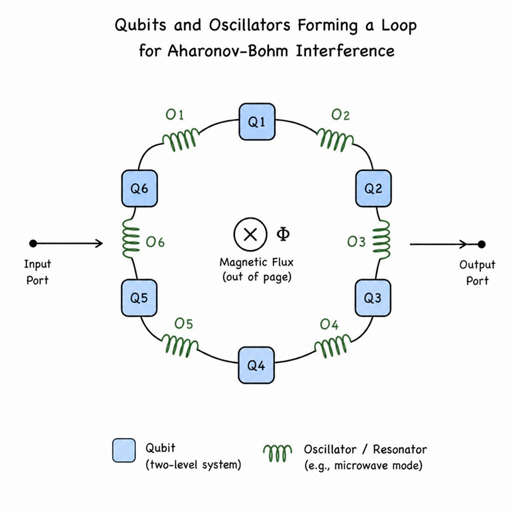
A hybrid quantum computer has been used to observe the Aharonov–Bohm effect inside a lattice gauge theory simulation, moving a foundational quantum phenomenon into a more programmable setting. The work matters because it shows how qubits and quantum oscillators can share the job of representing matter and fields, a pattern that could influence quantum computing integration across physics, chemistry, materials research, and eventually applied workflows. Reported by the University of Oxford and published in Nature Physics, the experiment is a research milestone rather than a commercial breakthrough, but it points clearly toward the hybrid quantum computing future.
What did the hybrid quantum computer observe?
The computer observed Aharonov–Bohm interference in a simulated Z₂ lattice gauge theory: a quantum particle’s motion changed because of an effective magnetic flux, even though the particle did not pass through a magnetic field in the classical sense. In the experiment, matter tunneling around a loop was allowed when the effective flux was zero, but inhibited when the flux corresponded to π, showing destructive interference in the simulated gauge setting.
That is the central point: the researchers did not simply recreate an old textbook effect with new hardware. They placed it inside a dynamical simulation where matter and gauge fields were both active parts of the quantum system. This makes the result important for quantum simulation, because lattice gauge theories are used to model interactions between matter and fields in areas such as condensed matter and high-energy physics.
The Aharonov–Bohm effect in plain language
The Aharonov–Bohm effect is a quantum interference effect showing that potentials can influence a particle’s phase, even in a region where the classical magnetic field is absent. In everyday terms, a particle can “feel” the existence of a magnetic flux through the phase of its wavefunction, and that phase can show up as a measurable change in interference. The effect was predicted by Yakir Aharonov and David Bohm in 1959 and later confirmed experimentally with electrons.
A useful analogy is a pair of runners taking two different routes around a closed-off area. In classical thinking, if neither runner enters the blocked region, what is inside should not matter. In quantum mechanics, the phase accumulated along the two paths can differ because of what is enclosed by the loop, and when the two paths recombine, the result can be constructive or destructive interference.
In the Oxford experiment, the “closed-off area” was not a physical solenoid on a lab bench. It was encoded in a programmable quantum simulation of a gauge theory. That shift is what makes the setting new: the effect appeared in a system designed to emulate the rules of a lattice gauge model, rather than in a conventional electron-interference experiment.
How hybrid quantum classical computing made the experiment possible
Hybrid quantum classical computing usually means combining quantum processors with classical processors, but in this experiment “hybrid” also has a hardware-physics meaning. The trapped-ion system used two different quantum degrees of freedom: qubits encoded in internal ion states and quantum oscillators encoded in the ions’ motion. The qubits represented gauge fields, while the oscillators represented matter.
This division of labor is important. Many quantum computers translate everything into qubits, but bosonic fields and vibrational modes can be expensive to represent that way. By allowing oscillators to carry part of the simulation directly, a hybrid qubit–oscillator architecture can represent certain physical models more naturally.
The experiment also used a digital–analogue approach. Digital operations helped prepare states and read out observables, while analogue evolution simulated real-time dynamics. That is a practical example of quantum computing integration: different control methods, physical encodings, and measurement strategies are combined into one workflow instead of forcing every task into a single rigid model.
The experiment as a step-by-step concept
The details are technical, but the logic is easier to follow when broken into stages:
- Build a minimal lattice element. The team used a trapped-ion system to form a small loop, with two oscillators representing matter sites and two qubits representing the gauge links between them.
- Encode effective magnetic flux. The gauge-field qubits were prepared in entangled states corresponding to different flux conditions through the loop.
- Let the matter evolve. The simulated matter particle was allowed to tunnel around the loop through the available paths.
- Compare flux settings. With zero effective flux, tunneling continued; with π flux, destructive interference suppressed tunneling.
- Read the result as gauge-theory physics. The frozen or unfrozen dynamics demonstrated Aharonov–Bohm behavior inside the simulated lattice gauge theory.
This sequence shows why the result is more than a device benchmark. The system was used as an experimental model of a theory that becomes difficult to study as it grows, which is one of the clearest near-term use cases for quantum simulation.
Why does this matter for the quantum computing future?
It matters because many hard scientific problems are not just “large calculations”; they involve quantum systems whose state spaces grow too quickly for ordinary classical simulation. Quantum computers may be useful first as controllable physics laboratories, where researchers build a quantum system that follows the same rules as the target system and then observe its behavior.
That idea reaches beyond foundational physics. Chemistry, materials science, and particle physics all include systems where interactions, correlations, and real-time dynamics can become difficult for classical computers. The Oxford result does not prove a near-term commercial advantage, but it strengthens the case that hybrid quantum computing can be engineered around the structure of the problem rather than around qubits alone.
It also fits a broader pattern in quantum computing advancements: the field is moving from isolated demonstrations toward integrated architectures. NVIDIA’s CUDA-Q, for example, is designed to let developers work across CPU, GPU, and QPU resources in a single hybrid programming model, supporting simulation and hybrid quantum-classical workflows.
Hybrid quantum computing is becoming an integration problem
The phrase “hybrid quantum computing” can mean several related things, and the distinction matters for readers tracking the field.
|
Hybrid layer |
What is combined |
Why it matters |
|---|---|---|
|
Hardware physics |
Qubits plus oscillators, phonons, photons, or other modes |
Represents certain quantum systems more naturally |
|
Algorithm design |
Quantum circuits plus classical optimization |
Fits today’s noisy and limited quantum processors |
|
Computing infrastructure |
QPUs plus CPUs, GPUs, and HPC systems |
Lets quantum devices act as accelerators inside larger workflows |
|
Application pipelines |
Simulation, AI, data handling, and quantum subroutines |
Connects research devices to practical scientific tasks |
The Oxford trapped-ion experiment sits mainly in the first two layers. Platforms such as CUDA-Q sit mainly in the third layer, supporting the software and infrastructure needed for broader hybrid workflows. Searches for “nvda hybrid quantum computing” often point to this infrastructure story: quantum processors are unlikely to replace classical supercomputers; they are more likely to become specialized accelerators connected to classical and AI systems.
What this suggests for drug discovery and chemistry
The experiment itself is about lattice gauge theory, not drug discovery. Still, it helps explain why researchers talk about a hybrid quantum computing pipeline for real world drug discovery. A realistic pipeline would not send every task to a quantum processor. It would combine classical molecular modeling, AI-based candidate generation, GPU-accelerated simulation, experimental data, and carefully selected quantum subroutines for problems where quantum structure is central.
In that context, hybrid quantum classical computing is attractive because chemistry is already quantum at its foundation, but practical drug discovery also requires enormous classical workflows. A future pipeline might use classical systems to prepare molecular candidates, GPUs to accelerate simulations and machine learning, and QPUs to explore electronic-structure or dynamics problems that become difficult for classical approximations.
The key lesson from the Aharonov–Bohm simulation is architectural: use the right computational representation for the right part of the problem. If oscillators are a better match for field-like behavior, use oscillators. If GPUs are best for large-scale classical optimization, use GPUs. If qubits can represent a hard quantum subproblem more directly, integrate them carefully instead of treating them as a standalone miracle machine.
Practical takeaways for researchers and technology leaders
For teams watching quantum computing advancements, this result offers a grounded way to think about progress:
- Do not judge quantum systems only by qubit count. Encoding, controllability, connectivity, and the match between hardware and problem structure can be just as important.
- Expect hybrid workflows, not pure quantum replacement. The likely path is coordinated use of QPUs, CPUs, GPUs, software compilers, error mitigation, and domain-specific models.
- Separate research milestones from commercial readiness. A foundational physics demonstration can be important without immediately changing enterprise computing.
- Track quantum simulation closely. Simulating quantum matter, fields, and dynamics remains one of the strongest conceptual arguments for useful quantum computing.
- Build integration skills early. The organizations best prepared for quantum utility may be those already learning how to connect quantum tools with HPC, AI, and scientific data pipelines.
The bottom line
This hybrid quantum computer demonstration shows the Aharonov–Bohm effect in a programmable gauge-theory setting, using qubits and oscillators as complementary parts of the same quantum simulator. Its importance lies less in immediate application and more in the method: quantum systems can be engineered to study other quantum systems in ways that classical machines struggle to reproduce.
For the future of quantum computing, that is a meaningful signal. Progress will likely come from integration: hybrid hardware, hybrid algorithms, hybrid infrastructure, and hybrid scientific workflows. The path from a two-ion lattice loop to real-world chemistry or drug discovery is long, but experiments like this clarify what that path may look like.
