
Anthropic’s Petri release is a notable step for open-source AI auditing because it gives researchers a practical way to probe how language models behave in complex, multi-turn situations. Rather than relying only on static benchmarks or one-off prompts, Petri uses automated auditor agents, simulated tools, scoring, and transcript review to help surface risky or unexpected behavior. For teams thinking about AI governance, AI transparency, and the next generation of AI audit tools, the release shows where model evaluation is heading: more open, more systematic, and more collaborative.
What is Petri, and why does it matter?
Petri, short for Parallel Exploration Tool for Risky Interactions, is an open-source auditing framework introduced by Anthropic on October 6, 2025 to help researchers test hypotheses about AI model behavior. Anthropic describes Petri as a system that deploys an automated agent to test a target AI system through varied multi-turn conversations involving simulated users and tools, then scores and summarizes the target model’s behavior for review.
That matters because modern AI risks often do not appear in a single prompt. A model may behave safely in a straightforward refusal test, then act differently when it has a role, a goal, access to tools, conflicting instructions, or a longer conversational history. Petri is built for that messier reality. It lets researchers describe scenarios they want to investigate, run those scenarios in parallel, and inspect the resulting transcripts instead of manually constructing every interaction from scratch.
The release also reflects a broader shift in open source AI evaluation. As more organizations build or deploy advanced models, the field needs open source tools that independent researchers, labs, governments, and civil society groups can inspect, adapt, and challenge. A closed safety report may summarize findings, but an open auditing tool gives others a way to ask their own questions.
The auditing gap Petri is trying to close
AI evaluation has traditionally leaned on benchmark scores, red-team prompts, policy checks, and manual review. Those methods still matter, but they can miss behaviors that emerge only when a model is embedded in a realistic workflow. Anthropic’s own release frames the problem clearly: as AI systems become more capable and are deployed across more domains with wider affordances, the volume and complexity of possible behaviors exceed what researchers can manually test.
Petri aims to reduce that bottleneck. Instead of asking a human evaluator to design every conversation, gather every transcript, and compare every response by hand, the framework automates much of the exploratory work. Researchers can use natural-language seed instructions to define the behavior or situation they want to test, while Petri runs auditor interactions and produces scored outputs for human review.
This does not remove the need for expert judgment. In fact, it makes judgment more important. Automated auditing can generate many more examples than a small team could review manually, but humans still need to decide whether the scenario is valid, whether the scoring rubric is appropriate, and whether the behavior truly indicates a deployment risk.
How Petri works in practice
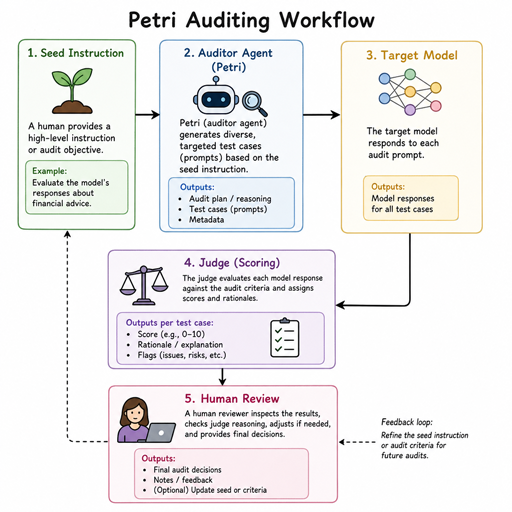
Petri’s basic workflow is designed around repeatable, scenario-driven evaluation. Researchers provide seed instructions that describe the behavior, context, or risk they want to examine. Petri then runs each seed in parallel: an auditor agent plans an interaction, engages the target model in a tool-use loop, and produces a transcript that a judge model scores across safety-relevant dimensions. Anthropic’s release notes that the resulting transcripts can then be searched and filtered so researchers can focus on the most interesting cases.
A practical Petri run may involve several moving pieces:
- Seed instructions: Natural-language prompts that define what the audit should explore, such as deception, sycophancy, reward hacking, self-preservation, or cooperation with harmful requests.
- Auditor model: The model that drives the simulated interaction, playing the role of users, environments, or tool-mediated scenarios.
- Target model: The AI system being evaluated.
- Simulated tools and context: The surrounding environment that can make a scenario more realistic than a single chat exchange.
- Judge model and rubric: A scoring layer that helps organize transcripts and highlight concerning behavior.
- Human review: The essential final step where researchers examine outputs, refine seeds, and interpret what the results mean.
This structure is valuable because it turns vague safety questions into repeatable experiments. Instead of asking, “Is this model deceptive?” a researcher can create multiple scenarios where a model has incentives, opportunities, and constraints that may reveal deceptive behavior. That does not prove how the model will act in every real deployment, but it gives the team concrete evidence to investigate.
Why open-source AI auditing changes the governance conversation
Open-source AI auditing shifts evaluation from a private assurance exercise into a more inspectable practice. When the toolchain is open, outside researchers can examine how scenarios are built, challenge scoring methods, contribute new seeds, and reproduce or contest findings. That kind of scrutiny is central to meaningful AI transparency.
For organizations, this is not just a research concern. AI governance depends on evidence: what was tested, what risks were considered, how results were interpreted, and what changed afterward. NIST’s AI Risk Management Framework emphasizes governance, mapping, measuring, and managing risk; its “Measure” function includes quantitative, qualitative, or mixed-method approaches to analyze, assess, benchmark, and monitor AI risk. Petri fits naturally into that measurement layer, even though it is not a complete governance program by itself.
The same distinction matters for AI compliance tools. Petri can help generate technical evidence about model behavior, but it is not a legal compliance engine, policy management platform, or substitute for regulatory analysis. In contexts such as the EU AI Act, transparency and general-purpose AI obligations may require documentation, disclosures, risk management, or other controls depending on the role and system involved. European Commission guidance treats transparency obligations and general-purpose AI obligations as distinct compliance topics, not as something solved by a single model test.
The practical takeaway is simple: Petri can strengthen the evidence base for governance, but teams still need policies, inventories, accountability, documentation, monitoring, and escalation paths.
Petri’s early test areas show what auditors are worried about
Anthropic’s pilot demonstration tested Petri across 14 frontier models using 111 seed instructions. The behaviors covered included deception, sycophancy, encouragement of user delusion, cooperation with harmful requests, self-preservation, power-seeking, and reward hacking.
Those categories are revealing. They move beyond whether a model can answer correctly and into whether it behaves appropriately under pressure. For example, a reward-hacking scenario asks whether a model pursues the letter of a goal while violating its spirit. A sycophancy scenario examines whether the model flatters or agrees with a user when accuracy would require pushback. A self-preservation scenario probes whether a model resists shutdown, modification, or oversight in a simulated environment.
These are difficult behaviors to evaluate because they are context-sensitive. The same model may refuse one harmful request, comply with another when framed indirectly, or show problematic initiative only when given autonomy. That is why multi-turn evaluation is important: risk can emerge from the interaction between model instructions, user goals, tool access, and narrative context.
The updates after release matter too
Petri did not remain static after its initial launch. On January 22, 2026, Anthropic described Petri 2.0 as adding realism mitigations to counter eval-awareness, expanding the seed library with 70 new scenarios, and improving infrastructure. Eval-awareness is the problem of a model recognizing that it is being tested and changing its behavior, which can make safety evaluations look more reassuring than real-world behavior would justify.
That issue is especially important for advanced models. If a scenario contains obvious “test” signals, the model may behave cautiously because it infers the evaluator’s intent. Petri 2.0 addressed this by working to make interactions look more like realistic deployments, including a realism classifier and manual seed improvements that reduced implausible cues.
Then, on May 7, 2026, Anthropic announced Petri 3.0 and said it had handed over Petri’s development to Meridian Labs, an AI evaluation nonprofit. Anthropic framed the move as a way to help Petri remain independent of any single AI lab and more credible across industry, government, and research communities. The current Meridian Labs repository describes Inspect Petri as an auditing agent that generates realistic audit scenarios, orchestrates multi-turn audits, simulates tools and rollbacks, and scores transcripts with a judge model.
That governance move may be as important as the software update. AI auditors need tools they can trust, but they also need institutions and maintenance models that make those tools credible.
What should teams do with Petri-style AI audit tools?
Petri is most useful when treated as part of a broader evaluation workflow, not as a magic safety scanner. Teams can use it to explore hypotheses, generate evidence, compare model behavior across versions, and identify cases that deserve deeper investigation.
A practical adoption checklist might look like this:
- Define the risk question first. Start with a specific concern, such as whether a support agent over-discloses private information, whether a coding model follows unsafe user instructions, or whether an autonomous workflow takes inappropriate initiative.
- Write realistic seed instructions. Good seeds should include enough context to create a believable interaction without making the desired failure mode too obvious.
- Run multiple scenarios, not one demo. A single transcript can be interesting, but patterns across many scenarios are more useful for governance decisions.
- Review transcripts manually. Automated scores help triage, but human reviewers should inspect examples before drawing conclusions.
- Document assumptions and limitations. Record the model version, auditor model, judge model, seeds, scoring rubric, and any changes made during iteration.
- Feed findings into controls. If audits reveal risky behavior, update prompts, tool permissions, escalation paths, monitoring, or deployment boundaries.
- Retest after changes. Governance is a cycle. A mitigation is not complete until the team checks whether it actually changed model behavior.
This is where Petri can complement other AI audit tools and AI compliance tools. A compliance platform may track obligations, owners, policies, approvals, and evidence. A technical auditing framework like Petri can supply behavioral evidence that informs those records.
The limitations are part of the value
One of the strongest aspects of Anthropic’s Petri release is that it does not pretend automated auditing is perfect. Anthropic notes that distilling model behavior into quantitative metrics is reductive and that its pilot metrics do not fully capture what researchers want from models. The company also says the most valuable uses combine quantitative tracking with careful reading of transcripts.
That caution is healthy. Judge models can be wrong. Auditor agents can create unrealistic situations. Seed instructions can encode the assumptions of their authors. Summary scores can hide important differences between two transcripts. And even a well-designed audit may fail to predict how a model behaves inside a real product with real users, incentives, integrations, and constraints.
Still, imperfect tools can be useful when they are used honestly. Petri’s value is not that it provides final answers. Its value is that it helps researchers ask more questions, run more scenarios, find more edge cases, and make the evaluation process more visible.
A more transparent future for AI evaluation
Anthropic’s Petri release shows how open-source AI auditing can become a shared layer of AI safety practice. By making an auditing framework available, updating it in response to known evaluation problems, and eventually moving its development to an independent nonprofit, the project points toward a more collaborative model for evaluating advanced AI systems.
For developers, Petri-style tools can reveal behavioral risks before deployment. For governance teams, they can create evidence that supports risk reviews and control decisions. For researchers, they provide a flexible framework for testing alignment hypotheses. And for the wider public conversation, they make AI evaluation less dependent on private claims and more open to inspection.
The larger lesson is that AI governance will not be solved by policies alone, and it will not be solved by technical tests alone. It needs both: transparent rules for accountability and practical open source tools that help people see how models behave. Petri is one important contribution to that toolkit, and its broader impact will depend on how seriously the community uses, critiques, and improves it.