
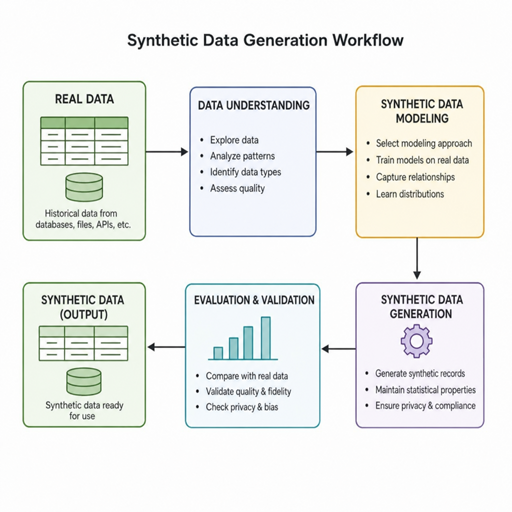
Synthetic data is artificially created information that mirrors the patterns, structure, and relationships found in real-world datasets. It helps teams train, test, validate, and improve systems when real data is limited, sensitive, expensive, biased, or difficult to collect. Used well, synthetic data generation can make machine learning data more available, safer to use, and better suited to the specific scenarios a model needs to understand.
What is synthetic data, and why does it matter?
Synthetic data is data generated by algorithms, simulations, statistical models, or AI systems rather than captured directly from real events, customers, devices, or transactions. It matters because modern analytics and machine learning often need more data, more variety, and more control than real datasets can provide on their own.
In simple terms, synthetic data is not “fake” in the sense of being useless. It is artificial data designed to behave like useful data. A synthetic customer record, image, transaction, sensor reading, medical-style entry, or conversation sample can preserve important relationships without exposing the original individual, device, or event that inspired it.
This makes synthetic data especially valuable in situations where teams face practical limits. Real data may be locked behind privacy rules, too small to support reliable modeling, missing rare examples, or expensive to label. Synthetic Data Generation gives teams another way to create fit-for-purpose datasets while reducing dependence on raw production data.
The core idea behind synthetic data generation
Synthetic data generation is the process of creating new data points that resemble a target dataset or desired scenario. Depending on the use case, this may involve rule-based generation, simulations, statistical sampling, generative AI, or domain-specific data synthesis.
A rule-based approach might create artificial data using known formats and constraints, such as generating transaction records with valid dates, product categories, and order amounts. A simulation-based approach might model real-world systems, such as traffic flows, factory sensors, or weather-influenced demand. A machine learning approach may learn patterns from existing data and produce new examples with similar characteristics.
The goal is not always to copy real data as closely as possible. In many cases, the goal is to create data that is useful for a specific task. That task may be model training, quality assurance, privacy-preserving analysis, software testing, or exploring edge cases that rarely appear in production.
Common forms of synthetic data
Synthetic data can appear in many formats, including:
- Tabular data: Artificial rows and columns for analytics, testing, finance, healthcare-style records, customer profiles, or operational systems.
- Image data: Generated or modified images used for computer vision models, inspection systems, medical imaging research, or autonomous systems.
- Text data: Artificial documents, messages, prompts, support tickets, product descriptions, or conversational examples.
- Time-series data: Simulated sensor readings, market-like sequences, demand curves, equipment signals, or activity logs.
- Audio and speech data: Generated voice samples, acoustic environments, commands, or training phrases.
- Graph data: Artificial networks representing relationships among people, devices, entities, transactions, or locations.
Each format has different risks and quality requirements. For example, synthetic text may need linguistic diversity and factual control, while synthetic time-series data must preserve sequence behavior and realistic changes over time.
Key benefits of synthetic data
Synthetic data is useful because it gives teams more control over the data they use. Instead of waiting for the perfect dataset to appear, teams can generate examples that fill gaps, protect sensitive information, and support more reliable development workflows.
Better access to machine learning data
Machine learning models often need large, varied, and representative datasets. In practice, real machine learning data can be scarce, restricted, messy, or incomplete. Synthetic data can help expand the available training material without requiring teams to collect every example from the real world.
This is especially helpful when a model must handle rare events. A fraud detection system, for example, may see far fewer suspicious transactions than normal ones. A quality inspection model may have many images of acceptable products but few examples of defects. Synthetic data can add targeted examples so the model has more opportunities to learn what unusual cases look like.
That does not mean synthetic data automatically replaces real data. The strongest results often come from combining real and synthetic datasets thoughtfully. Real data anchors the model in actual behavior, while artificial data broadens the range of situations the model can learn from.
Stronger data augmentation
Data augmentation is the practice of expanding or modifying data to improve model learning. Synthetic data can support data augmentation by creating new variations that preserve useful meaning while changing details such as lighting, wording, background, sequence patterns, or class balance.
For image models, data augmentation might include synthetic changes in angle, brightness, object placement, or environment. For text models, it might involve generating paraphrases, alternate customer questions, or different tones. For tabular data, it may involve creating new records that follow realistic distributions while filling underrepresented categories.
The advantage is practical: data augmentation helps reduce overfitting. A model that only sees narrow examples may memorize surface patterns instead of learning durable signals. By training on a wider range of synthetic variations, the model can become more resilient when it encounters new real-world inputs.
Privacy-aware development
Real datasets may contain personal, confidential, or regulated information. Even when teams have permission to use the data, sharing it across departments, vendors, development environments, or research workflows can create risk. Synthetic data offers a way to reduce exposure by generating artificial records that preserve useful patterns without directly revealing original individuals.
This can be helpful for software testing, analytics prototyping, training demonstrations, and collaboration. A team may need realistic-looking data to test an application, but it does not necessarily need real customer names, account numbers, or behavior histories. Data synthesis can produce safer substitutes for many of these workflows.
Privacy still requires care. Poorly generated synthetic data may leak too much about the source data if it memorizes rare records or reproduces sensitive combinations. Teams should validate privacy risk, apply governance, and avoid treating synthetic data as automatically anonymous.
More control over edge cases
Real-world data is often uneven. Common situations appear frequently, while critical edge cases may be rare. Unfortunately, many systems fail in edge cases: unusual customer behavior, unexpected sensor readings, uncommon language, low-light images, rare defects, or abnormal transaction patterns.
Synthetic data generation tools can help teams design these scenarios on purpose. Instead of hoping the dataset contains enough unusual examples, teams can specify the conditions they want to test. This is valuable for model robustness, software testing, safety evaluation, and operational planning.
For example, a logistics team could simulate demand spikes, delayed shipments, or incomplete location data. A computer vision team could create images under different lighting or weather conditions. A chatbot team could generate variations of confusing, multilingual, or incomplete user requests.
Faster experimentation
Data collection, cleaning, labeling, and approval can slow down development. Synthetic data can shorten early experimentation by giving teams realistic material before the final production dataset is available. This is useful when building prototypes, testing pipelines, comparing model approaches, or training teams.
Speed does not remove the need for validation. Synthetic datasets should be tested against real-world goals before they influence major decisions. Still, in early-stage work, artificial data can help teams move from theory to working systems more quickly.
Where synthetic data creates the most value
Synthetic data is most valuable when it solves a clear data problem. It should not be used simply because it is novel. It works best when the team understands what real data cannot provide and can define what synthetic data must contribute.
AI and machine learning model training
In machine learning, synthetic data can help with class imbalance, limited labels, rare scenarios, and model generalization. It can also support pretraining or fine-tuning when real examples are hard to obtain. The key is to align the generated data with the model’s intended task.
A model trained on poorly matched artificial data may learn patterns that do not transfer to production. For this reason, teams should compare model performance with and without synthetic data. If the synthetic examples improve validation on real-world test sets, they are likely adding value. If performance drops, the synthetic data may be introducing noise or unrealistic signals.
Software testing and quality assurance
Developers often need realistic data to test applications, integrations, and user flows. Production data may be unavailable or unsafe to use in test environments. Synthetic data can provide structured, repeatable, and privacy-conscious test records.
This is especially useful for testing boundary conditions. Teams can generate accounts with missing fields, unusual order sizes, duplicate entries, long names, international formats, or expired statuses. These examples help reveal bugs before users encounter them.
Analytics and business intelligence
Synthetic data can support dashboard prototyping, metric testing, and analytics workflow design. Analysts can build reports using artificial data that resembles expected business structures before live data pipelines are ready. This helps stakeholders review logic, layouts, and assumptions earlier in the process.
However, synthetic analytics should be clearly labeled. Artificial numbers should not be confused with real business performance. The value lies in testing the system, not reporting actual outcomes.
Training, education, and demos
Teams often need safe datasets for workshops, onboarding, sales demos, and internal education. Real data may be too sensitive, too messy, or too difficult to explain. Synthetic data can be shaped to demonstrate a concept clearly while avoiding privacy concerns.
For example, a training dataset can include obvious examples of missing values, duplicate records, outliers, or segmentation patterns. This gives learners a practical experience without exposing real customers or operations.
How does synthetic data compare with real data?
Synthetic data complements real data; it does not automatically replace it. Real data reflects actual behavior, operational complexity, and unexpected patterns, while synthetic data offers control, scale, privacy support, and scenario design.
The best choice depends on the problem. If a team needs to measure actual revenue, diagnose real customer behavior, or audit historical decisions, real data is essential. If the team needs to test a workflow, increase variation, protect sensitive fields, or create rare training examples, synthetic data may be the better tool.
|
Factor |
Real data |
Synthetic data |
|---|---|---|
|
Source |
Collected from actual events, users, systems, or environments |
Generated through rules, simulations, models, or data synthesis methods |
|
Strength |
Captures real-world complexity and true historical behavior |
Offers control, scalability, and safer sharing in many workflows |
|
Limitation |
May be sensitive, scarce, biased, expensive, or incomplete |
May be unrealistic, biased, or misleading if poorly generated |
|
Best use |
Measurement, auditing, validation, and production-grounded analysis |
Testing, augmentation, privacy-aware development, and scenario creation |
|
Governance need |
Access controls, consent, security, compliance |
Quality checks, privacy testing, labeling, and source documentation |
A practical approach is to treat real data as the reference point and synthetic data as a strategic extension. Synthetic data should be judged by whether it improves the task at hand, not by whether it looks impressive in isolation.
Choosing synthetic data generation tools
Synthetic data generation tools vary widely. Some focus on tabular enterprise data, while others specialize in images, text, simulations, privacy preservation, or AI model training. The right choice depends on the format, risk level, quality requirements, and technical workflow.
What should you look for in synthetic data generation tools?
The best synthetic data generation tools fit your use case, integrate with your workflow, and provide ways to evaluate quality and privacy. A tool should make it easier to generate useful data, but it should also help you understand whether that data is realistic, safe, and appropriate.
When evaluating options, consider:
- Data type support: Make sure the tool handles your required format, such as tabular, text, image, audio, time-series, or graph data.
- Control and customization: Look for ways to define distributions, constraints, rare cases, labels, formats, and business rules.
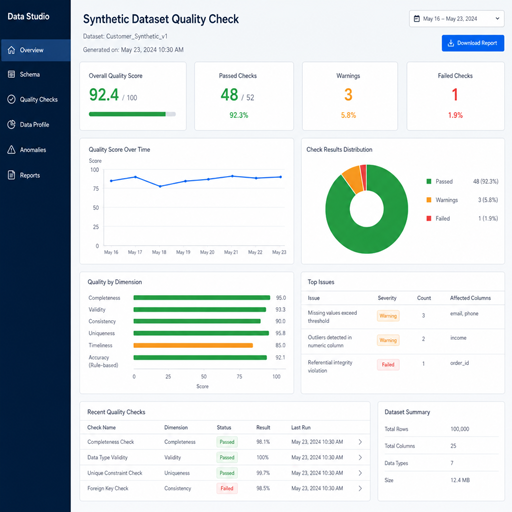
- Quality evaluation: Strong tools help compare synthetic and real data patterns, detect unrealistic outputs, and validate usefulness.
- Privacy safeguards: For sensitive use cases, assess whether the tool supports privacy testing, masking, differential privacy techniques, or leakage checks.
- Workflow integration: Consider compatibility with data warehouses, notebooks, model training pipelines, APIs, and testing environments.
- Documentation and governance: Teams need clear records of how data was generated, what source data was used, and what limitations apply.
- Human review: Even advanced tools benefit from expert review, especially in regulated, high-stakes, or customer-facing contexts.
A good tool should not be judged only by how much data it can produce. Volume is useful only when the generated data helps the system perform better, test more thoroughly, or reduce risk.
Best practices for using synthetic data
Synthetic data works best when it is designed, validated, and governed like any other important data asset. Teams should define the purpose before generation, measure quality after generation, and monitor how the data affects downstream outcomes.
Start with a clear objective
Before creating artificial data, define the problem. Are you trying to balance a training dataset, test a software workflow, protect privacy, simulate rare events, or teach a concept? Each goal requires different generation methods and validation checks.
A dataset built for software testing may need unusual input combinations. A dataset built for machine learning may need realistic feature relationships and labels. A dataset built for privacy-aware sharing may need stronger safeguards against re-identification.
Validate against real-world requirements
Synthetic data should be evaluated in context. For machine learning, that may mean testing model performance on a real holdout dataset. For software testing, it may mean confirming that generated records trigger the right application behavior. For analytics prototypes, it may mean checking whether the data supports realistic dashboard logic.
Useful validation questions include:
- Does the synthetic data preserve the relationships that matter for the task?
- Does it introduce unrealistic shortcuts that a model might exploit?
- Are rare cases represented clearly and intentionally?
- Are sensitive details removed or sufficiently transformed?
- Is the dataset labeled so users know it is synthetic?
- Does performance improve when synthetic data is added?
Document assumptions and limits
Synthetic data should come with context. Teams should document how it was created, what it is meant for, what source data or rules informed it, and where it should not be used. This prevents confusion later when someone sees realistic-looking data and assumes it reflects actual events.
Documentation is also important for trust. A stakeholder does not need every technical detail, but they do need to know whether the data is suitable for the decision being made. Clear labeling reduces misuse.
Common risks and limitations
Synthetic data can be powerful, but it is not risk-free. The biggest problems usually come from overconfidence: assuming generated data is private, realistic, unbiased, or useful without testing it.
A synthetic dataset may reinforce biases from the source data. It may smooth away rare but important patterns. It may create examples that appear plausible but violate real-world constraints. In machine learning, it may cause a model to perform well in development and poorly in production if the generated examples do not match actual conditions.
Privacy is another concern. If a data synthesis process overfits to the original dataset, some synthetic records may resemble real individuals too closely. This is why privacy evaluation matters, particularly when source data contains personal or confidential information.
Teams should also avoid using synthetic data to answer questions it cannot support. Artificial data can help test a dashboard, but it cannot prove real business performance. It can help train a model, but it cannot guarantee production accuracy. It can reduce exposure to sensitive records, but it does not remove the need for governance.
A practical synthetic data implementation checklist
Use this checklist before bringing synthetic data into a project:
- Define the use case: Training, testing, augmentation, privacy, simulation, education, or prototyping.
- Identify the data gap: Scarcity, imbalance, sensitivity, cost, missing labels, rare events, or limited access.
- Choose the generation method: Rules, simulation, statistical modeling, generative AI, or a specialized tool.
- Set quality criteria: Realism, diversity, constraint accuracy, label quality, and downstream usefulness.
- Test privacy risk: Check whether synthetic outputs reveal or closely reproduce sensitive source records.
- Compare outcomes: Measure performance or workflow quality with and without synthetic data.
- Label clearly: Make sure users know the dataset is artificial data and understand its intended purpose.
- Document limitations: Record assumptions, generation methods, source dependencies, and prohibited uses.
- Review regularly: Reassess quality when real-world data, model goals, or business conditions change.
The future value of synthetic data
Synthetic data is becoming an important part of modern data strategy because it helps teams work around persistent data constraints. As organizations build more AI systems, test more digital products, and handle more sensitive information, they need ways to create useful data without relying solely on raw real-world records.
The strongest synthetic data programs will not focus on generation alone. They will focus on quality, governance, validation, and measurable usefulness. Teams that combine real data, synthetic data, and careful evaluation can build systems that are easier to test, safer to share, and better prepared for uncommon scenarios.
In the end, synthetic data is valuable because it gives teams more options. It can expand machine learning data, strengthen data augmentation, support privacy-aware workflows, and make development more flexible. When generated with purpose and validated with care, synthetic data becomes more than artificial information; it becomes a practical tool for building better data-driven systems.
