
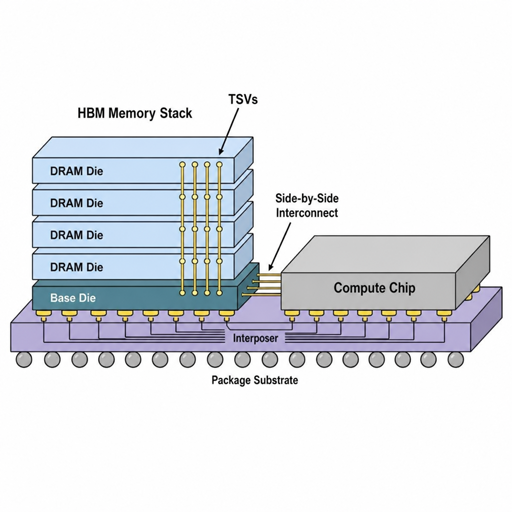
High-Bandwidth Memory HBM is a specialized form of stacked DRAM designed to move large volumes of data between memory and processors far faster than many conventional memory arrangements. Its main value is simple: when a processor is powerful enough to calculate faster than data can arrive, HBM helps remove that bottleneck. That is why high bandwidth memory HBM has become central to AI accelerators, high-performance computing, advanced networking, analytics, and other memory-bound workloads.
What makes High-Bandwidth Memory HBM different?
High-Bandwidth Memory HBM differs from conventional memory because it stacks DRAM dies vertically and places them very close to the compute device, typically in the same advanced package or on a shared interposer. Instead of relying mainly on very high clock speeds across narrower interfaces, HBM uses a very wide, highly parallel interface to move more data per clock at lower energy per bit. AMD describes HBM as 3D IC memory that provides higher bandwidth relative to DDR4/DDR5-style discrete memory solutions, while its Versal HBM devices integrate HBM2e beside compute fabric to reduce bottlenecks for memory-bound applications.
This architectural shift matters because many modern processors are no longer limited only by arithmetic performance. GPUs, FPGAs, AI accelerators, and custom ASICs may have thousands of execution units waiting for model weights, vectors, graph data, simulation states, or packet streams. If memory bandwidth is too low, those execution units stall, wasting silicon, power, and time.
The core advantage is memory bandwidth
Memory bandwidth is the amount of data a system can move between memory and compute resources over time. HBM’s headline advantage is that it greatly increases this data movement capacity in a compact package. Micron’s public HBM portfolio, for example, lists HBM3E at more than 1.2 TB/s of bandwidth per stack and HBM4 at more than 2.8 TB/s per stack, illustrating how newer HBM generations target AI and HPC workloads that need terabytes of data movement per second.
That bandwidth improves practical performance when workloads repeatedly stream large datasets. In AI inference, the processor may need to read model weights and key-value cache data again and again. In scientific simulation, memory must feed grids, particles, matrices, and intermediate states. In network processing, packets and lookup tables must move quickly with low delay. In each case, high-speed memory is useful not because it sounds faster on a spec sheet, but because it keeps compute engines busy.
Why bandwidth can matter more than raw capacity
Capacity tells you how much data fits in memory. Bandwidth tells you how quickly that data can be used. A workload with a massive model or dataset needs enough capacity, but once it fits, the next question is often how fast the system can read and update it.
This is why HBM is often paired with accelerators rather than used as ordinary system memory. It is typically more expensive and more complex to package than commodity DRAM, so it is reserved for places where bandwidth has a direct effect on utilization, latency, or throughput. The best fit is not “every computer”; it is the part of the system where slow data movement would waste expensive compute.
Performance gains show up in memory-bound workloads
HBM delivers its strongest benefits when an application is memory-bound, meaning performance is constrained by data movement rather than by compute instructions alone. AMD’s technical documentation describes the HBM interface as a highly parallel DRAM interface intended for compute-intensive, memory-bound applications, and its Versal HBM materials cite use cases such as machine learning, database acceleration, advanced network testing, and next-generation firewalls.
Common examples include:
- AI training and inference: HBM can feed tensor cores and other matrix engines with model parameters, activations, and cache data.
- High-performance computing: Simulations, weather models, molecular dynamics, and numerical solvers often move large arrays constantly.
- Data analytics and databases: Scans, joins, graph operations, and vector search can benefit when data access is the limiting factor.
- Networking and security: Packet inspection, encryption, routing, and firewall workloads can require fast memory access with predictable throughput.
- Media and visualization: Rendering, transcoding, and image pipelines may benefit when frames or intermediate buffers are large.
The practical advantage is not just higher peak speed. Better memory bandwidth can improve accelerator utilization, reduce time spent waiting on data, and allow designers to build more balanced systems.
HBM improves energy efficiency and package density
Another major advantage of hbm high bandwidth memory is efficiency. Because HBM places memory physically close to the processor and uses a wide interface, each bit can travel a shorter distance than it would across many board-level traces. Shorter data paths can reduce the energy required for data movement, which matters in servers where memory traffic is constant.
AMD states that its Versal HBM series with integrated HBM2e delivers up to 819 GB/s of memory bandwidth and, in its cited comparison, up to 6x more bandwidth at 65% lower power per bit than a Versal Premium configuration using LPDDR4 components. The exact result depends on the device and comparison, but the broader design point is clear: integrating stacked memory close to compute can improve bandwidth, area, latency, and power behavior for suitable workloads.
Density is also important. HBM stacks memory vertically, so designers can place significant capacity near the processor without spreading many memory packages around the board. That helps in accelerators, compact modules, and systems where board space, signal integrity, and power delivery are all constraints.
Why is HBM so important for AI?
HBM is important for AI because modern models need both enormous compute and constant access to memory. Training moves model weights, gradients, activations, and optimizer data; inference repeatedly reads weights and may also maintain large context caches. As models handle longer context windows, multimodal inputs, and more concurrent users, memory bandwidth and memory capacity become central to response time and throughput.
Micron describes HBM as a foundation for AI and high-performance computing, and its HBM materials connect higher bandwidth and capacity with large language model training and inference. In a 2026 white paper on agentic AI data centers, Micron argues that future systems will require greater HBM bandwidth and capacity to support richer context, higher concurrency, and key-value cache demands.
This is also where the phrase “hbm high bandwidth memory ai demand shortage root cause” appears in search behavior: buyers and researchers are trying to understand why AI infrastructure has created pressure on memory supply. The root cause is not only that AI uses more chips. It is that AI accelerators require specialized memory, advanced packaging, high-yield stacking, and tight coordination between memory suppliers, accelerator vendors, and packaging capacity.
The HBM shortage reflects structural supply constraints
The current HBM shortage is tied to rapid AI data center expansion, long manufacturing lead times, and the fact that HBM production depends on specialized stacking, testing, and packaging capacity. CSIS describes the AI data center buildout as driving an unprecedented surge in demand for HBM, while S&P Global notes that AI accelerators combine processors and high bandwidth memory and that demand across those components has outpaced capacity additions.
This matters for procurement strategy. HBM is not a drop-in commodity that can be instantly expanded when demand rises. Suppliers must allocate wafers, packaging resources, engineering support, and qualified production lines. Deloitte has also linked 2026 memory tightness to AI demand for memory chips including HBM, high-capacity DRAM, and enterprise SSDs, showing that the pressure can spill beyond one product category.
For organizations planning AI clusters or accelerator-based systems, the implication is straightforward: memory solutions should be evaluated early, not after the processor choice is finalized. Availability, capacity per accelerator, bandwidth per stack, and software memory behavior can all affect project timelines.
HBM is not the best answer for every system
HBM is powerful, but it is not automatically the right choice for every computing environment. Conventional DDR memory remains practical for general-purpose servers, desktops, and many enterprise applications because it offers broad availability, flexible capacity expansion, and mature cost structures. GDDR can be attractive for graphics and some accelerator designs where high bandwidth is needed but packaging choices differ.
A useful comparison looks like this:
|
Memory type |
Typical strength |
Best-fit use |
|---|---|---|
|
HBM |
Very high bandwidth close to compute |
AI accelerators, HPC, FPGAs, custom ASICs |
|
DDR |
Scalable general-purpose capacity |
CPUs, servers, enterprise systems |
|
GDDR |
High bandwidth for graphics-style designs |
GPUs, visualization, gaming, some accelerators |
|
On-chip SRAM/cache |
Extremely low latency, limited capacity |
Hot data, buffering, processor-local reuse |
HBM makes the most sense when the value of extra performance, efficiency, or density justifies the added design and supply-chain complexity. If an application spends most of its time waiting on storage, networking, or single-threaded CPU work, HBM may not solve the main bottleneck.
How to evaluate HBM for a computing workload
Choosing high bandwidth memory HBM should start with workload behavior, not marketing language. The goal is to understand whether the application is truly constrained by memory movement and whether the software can use the available bandwidth.
Use this checklist:
- Measure memory stalls. Profile whether compute units are waiting for data rather than performing useful work.
- Estimate working-set size. Confirm whether the active model, dataset, or cache fits in available HBM capacity.
- Check access patterns. Streaming and parallel access patterns usually benefit more than random, poorly localized access.
- Model concurrency. AI inference may need enough HBM capacity for multiple users, sessions, or agents at once.
- Review packaging and platform constraints. HBM affects accelerator selection, board design, thermals, and supplier qualification.
- Plan supply early. In tight markets, allocation and lead times can be as important as technical specifications.
- Optimize software. Kernel fusion, batching, quantization, caching, and data layout can determine whether bandwidth is actually used.
A balanced system treats HBM as one layer in a broader memory hierarchy. Fast local HBM, larger system DRAM, high-throughput SSDs, and efficient interconnects all have roles. The best designs move the right data to the right memory tier at the right time.
The main advantages in perspective
The advantages of High-Bandwidth Memory HBM come down to throughput, efficiency, density, and balance. It helps processors spend more time computing and less time waiting. It can reduce energy per bit for bandwidth-heavy data movement. It allows large amounts of high-speed memory to sit close to accelerators in compact packages.
Those strengths explain why HBM has become a strategic technology for AI and high-performance computing. They also explain why demand can create shortages: the same specialized characteristics that make HBM valuable also make it harder to scale quickly. For organizations building modern compute infrastructure, the lesson is to treat memory bandwidth as a first-order design decision, not a secondary specification checked after choosing the processor.
