
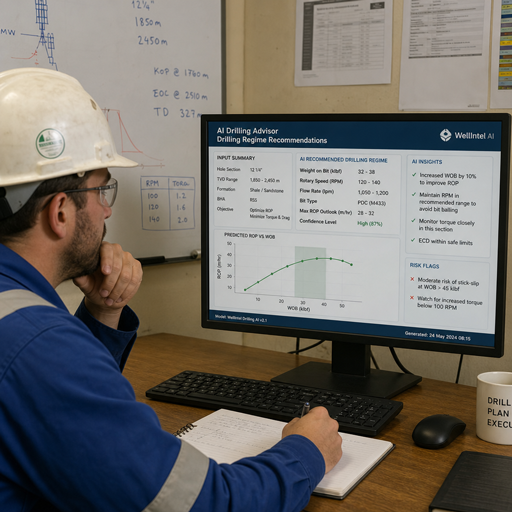
AI is changing how drilling teams interpret downhole behavior, identify efficient operating windows, and make faster decisions at the rig. Instead of relying only on static plans or delayed post-run analysis, AI drilling optimization can help crews recognize drilling regimes that support higher rate of penetration, fewer dysfunctions, and more consistent execution. In the right conditions, this approach may point to a projected potential increase in drilling speed of up to 68%, though results depend on formation, equipment, data quality, and operational discipline.
How can AI identify better drilling regimes?
AI can identify better drilling regimes by learning the relationship between surface parameters, downhole responses, formation behavior, and drilling performance. A drilling regime is the operating state created by choices such as weight on bit, rotary speed, flow rate, torque, differential pressure, and toolface control. When machine learning drilling models analyze these variables together, they can detect patterns that are difficult for humans to see in real time, especially when conditions shift quickly.
Traditional optimization often looks at one parameter at a time. AI driven drilling optimization is different because it studies combinations of inputs and outcomes. For example, a model may find that increasing rotary speed only improves drilling speed within a narrow torque range, or that more weight on bit begins to reduce efficiency once vibration appears. That insight helps teams move away from guesswork and toward operating envelopes that are both productive and stable.
The practical value is not that AI “drills the well” by itself. The value is that it gives engineers and rig crews a clearer view of what is happening, which parameters are likely helping, and which settings may be creating hidden inefficiency.
The real problem is not always lack of power
When drilling speed drops, the first instinct is often to add energy: more weight, more RPM, more flow, or more aggressive tool settings. Sometimes that works. Other times, it drives the system into a less efficient regime where energy is lost to vibration, stick-slip, bit wear, poor cuttings transport, or unstable directional control.
This is where ai for drilling optimization becomes especially useful. The model can compare thousands of parameter combinations against performance outcomes and flag regimes where added energy no longer produces added progress. In many wells, the fastest regime is not the most forceful one. It is the regime where the bit, bottomhole assembly, hydraulics, and formation response are working together with fewer losses.
That distinction matters because drilling performance is rarely limited by a single factor. A crew may have enough horsepower, good tools, and an experienced driller, yet still lose time because the operation spends too long outside the most efficient window. Smart drilling solutions aim to reduce that gap between available capability and actual performance.
What data does AI need to optimize drilling?
AI needs reliable, time-aligned drilling data that reflects both operating inputs and drilling outcomes. The most useful datasets often include weight on bit, RPM, torque, standpipe pressure, flow rate, rate of penetration, hookload, mud properties, depth, lithology indicators, vibration measurements, bit information, and bottomhole assembly details. The more complete and consistent the data, the better the model can distinguish real patterns from noise.
Data quality is often the difference between a useful recommendation and a misleading one. If sensor readings are inconsistent, depth tracking is inaccurate, or important context is missing, the model may identify correlations that do not hold up in the field. For that reason, successful ai drilling optimization starts with disciplined data handling, not just a sophisticated algorithm.
A practical data foundation usually includes:
- Clean surface data: consistent sampling, corrected sensor errors, and reliable depth matching.
- Downhole context: vibration, shock, toolface, and directional data where available.
- Operational labels: connection times, sliding intervals, reaming, circulation, trips, and non-drilling periods separated from true drilling activity.
- Formation context: lithology changes, expected pressure windows, abrasive zones, and intervals known for dysfunction.
- Performance outcomes: rate of penetration, mechanical specific energy, bit dull condition, tool reliability, and hole quality indicators.
With those elements in place, drilling optimization tools can do more than display trends. They can learn which operating choices have historically produced efficient drilling in similar conditions and which choices have led to wasted energy or avoidable slowdowns.
From historical learning to real-time guidance
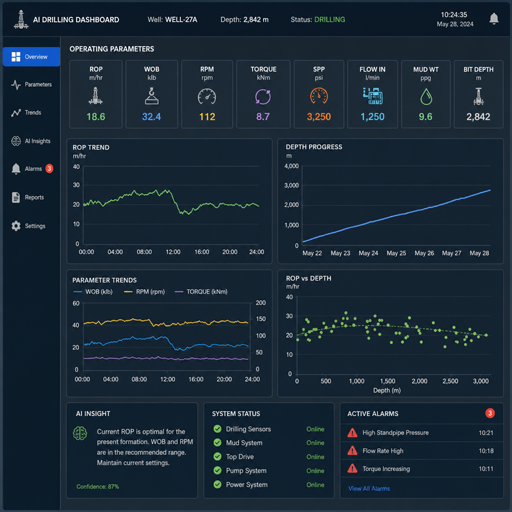
AI drilling optimization software in oil gas industry operations typically works across two time horizons: planning and execution. Before drilling, models can analyze offset wells to identify patterns by formation, section, bit type, and bottomhole assembly. During drilling, the system can compare real-time behavior against learned performance envelopes and recommend parameter adjustments.
In planning mode, engineers may use AI to define expected drilling regimes for each interval. That can support better bit selection, motor or rotary steerable planning, hydraulic design, and performance targets. In execution mode, the model helps answer a more immediate question: are we currently drilling in the regime that gives us the best balance of speed, stability, and tool health?
The feedback loop can be powerful. Each well adds new data, and each section can refine the understanding of what works in a specific field or formation. Over time, this creates a more practical knowledge base than a static drilling program because it reflects real operating behavior, not only planned assumptions.
What does a projected 68% speed increase really mean?
A projected potential increase in drilling speed of up to 68% should be read as an opportunity indicator, not a guaranteed result on every well. It suggests that, under analyzed conditions, AI identified regimes where rate of penetration could be significantly higher than baseline performance. The actual gain will depend on whether the recommended regime is operationally safe, compatible with equipment limits, and repeatable in the target formation.
This distinction is important. A model may show that a certain parameter combination produced faster drilling in a specific interval, but engineers still need to check constraints such as torque limits, vibration risk, hole cleaning, wellbore stability, directional objectives, and bit life. Responsible ai driven drilling optimization balances speed with reliability.
A useful way to interpret the projection is through three questions:
- Where was the improvement identified? A gain in one formation or hole section may not apply everywhere.
- What was the baseline? A large percentage gain may reflect a shift from a highly inefficient regime to a normal efficient one.
- What trade-offs were considered? Faster drilling is valuable only if it does not create extra trips, poor hole quality, or premature tool failure.
When teams treat AI recommendations as decision support rather than automatic instructions, they are more likely to capture the upside without ignoring operational risk.
Where drilling optimization tools create value
Modern drilling optimization tools are most useful when they help people act sooner. A driller may already know that vibration is hurting performance, but AI can help identify the parameter combination that triggered the dysfunction and suggest a more stable window. An engineer may suspect that a section is underperforming, but AI can quantify whether the current regime is below offset potential.
Common areas of value include:
- Rate of penetration improvement: identifying parameter windows that support faster drilling without unnecessary dysfunction.
- Mechanical specific energy reduction: spotting when the system is using too much energy for too little rock removal.
- Vibration and stick-slip mitigation: detecting operating states that increase shock, whirl, or torsional instability.
- Bit and tool preservation: avoiding regimes that may accelerate wear or damage.
- Consistency between crews: making best practices visible so performance depends less on individual interpretation.
- Post-well learning: turning completed well data into better planning assumptions for the next program.
The biggest benefit is often consistency. A single high-performing stand is useful, but repeatable high performance across a lateral or multi-well campaign is where optimization becomes meaningful.
Human expertise remains central
AI does not replace the judgment of drillers, directional drillers, drilling engineers, or company representatives. It gives them another layer of pattern recognition. People still understand operational context that models may miss, such as rig limitations, changing mud properties, surface equipment behavior, safety constraints, and the practical realities of making changes during active drilling.
The best results usually come from a collaborative workflow. The software highlights a potential regime. The engineer checks whether the recommendation makes sense against the drilling plan and constraints. The driller applies the adjustment carefully, watches the response, and confirms whether the well behaves as expected.
This is also why explainability matters. If a system simply says “increase RPM” without showing the supporting trend, crews may not trust it. Better smart drilling solutions show why a recommendation is being made, what data supports it, and what risks should be monitored after the change.
A practical workflow for AI drilling optimization
Organizations do not need to transform everything at once. A focused workflow can make ai drilling optimization easier to adopt and easier to measure.
- Define the performance objective. Decide whether the priority is drilling speed, vibration reduction, bit life, consistency, or a balanced target.
- Select the interval. Start with a section where performance variation is meaningful and enough offset data exists.
- Prepare the data. Clean and align drilling data so the model learns from true drilling conditions rather than mixed operational states.
- Build or configure the model. Use historical patterns to identify efficient and inefficient regimes.
- Validate with domain experts. Check whether recommendations are operationally realistic before using them in the field.
- Deploy as decision support. Present recommendations clearly and pair them with limits, alerts, and context.
- Review after the run. Compare recommended regimes, actual parameter changes, and final outcomes to improve the next well.
This workflow keeps the technology grounded. The goal is not to chase a number on a dashboard. The goal is to create a repeatable process for finding and staying in better drilling regimes.
The future is adaptive, not automatic
The next stage of AI drilling optimization is likely to be more adaptive. Instead of using only static offset analysis, systems will increasingly update recommendations as the well progresses. As new data comes in, the model can adjust its understanding of the formation, the bit response, and the safe operating window.
That future depends on trust. Teams will need transparent models, clear workflows, strong data governance, and a culture that treats AI as a partner in engineering judgment. The companies that benefit most will not be the ones that simply buy software. They will be the ones that connect data, people, and operating discipline into one optimization loop.
AI can help identify drilling regimes with meaningful potential to improve speed, including projections as high as 68% in the right context. But the larger opportunity is broader than one number. By combining machine learning drilling insights with field expertise, operators can make faster, better-informed decisions and build more consistent drilling performance from well to well.
