
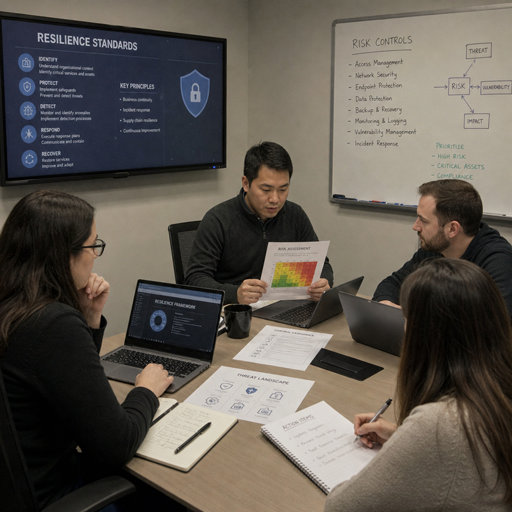
Cyber resilience is the ability to prepare for, withstand, respond to, and recover from cyber disruption without losing sight of business priorities. Effective standards help make that resilience repeatable by turning good intentions into clear controls, documented responsibilities, measurable practices, and continuous improvement. For organizations of any size, the right mix of Cyber Resilience Standards, security compliance practices, and risk-based decision-making can reduce confusion when threats change or incidents occur.
What do Cyber Resilience Standards actually help organizations do?
Cyber Resilience Standards help organizations build a structured, consistent approach to protecting information, managing cyber risk, and maintaining operations during disruption. They do not eliminate every threat, but they create a common language for governance, controls, incident response, recovery planning, and accountability. When applied well, they move cybersecurity from a reactive technical function into a business-wide resilience strategy.
At a practical level, standards answer questions that every organization eventually faces: Who owns security decisions? Which assets are most important? What controls are required? How often should risks be reviewed? What happens when a system is compromised? Without standards, teams may rely on scattered tools, personal judgment, or informal habits. That can work for a while, but it becomes fragile as the organization grows, adopts new technology, or faces more complex threats.
Cybersecurity standards also help leaders make better trade-offs. Not every system carries the same level of risk, and not every control deserves the same investment. A standards-based approach gives teams a way to prioritize effort based on business impact, regulatory obligations, threat exposure, and recovery needs.
Standards turn resilience into an operating model
Resilience is often discussed as a goal, but standards make it operational. They define the policies, processes, controls, and evidence needed to show that security is not being handled randomly. This matters because cyber resilience depends on repeated behavior over time, not a single project or one-time technology purchase.
Strong information security standards typically support several core activities:
- Governance: Clarifying who is responsible for security decisions, approvals, oversight, and escalation.
- Asset management: Identifying systems, data, users, applications, vendors, and infrastructure that need protection.
- Risk management: Evaluating threats, vulnerabilities, likelihood, impact, and treatment options.
- Control implementation: Applying safeguards such as access management, monitoring, encryption, backups, and secure configuration.
- Incident response: Preparing teams to detect, contain, investigate, communicate, and recover from events.
- Business continuity: Connecting security planning with operational recovery and service availability.
- Continuous improvement: Reviewing performance, testing assumptions, and adapting controls as conditions change.
The value is not only in having written documents. The real benefit comes when standards shape everyday decisions. For example, a change management process can prevent risky system updates. A vendor assessment process can reduce exposure from third-party relationships. A backup and recovery standard can make restoration more predictable after ransomware, accidental deletion, or system failure.
The relationship between compliance and resilience
Security compliance and cyber resilience are related, but they are not the same thing. Compliance focuses on meeting defined obligations, such as internal policies, customer requirements, contractual commitments, or regulatory expectations. Resilience focuses on the organization’s ability to keep functioning and recover when things go wrong.
The strongest programs connect the two. Compliance provides structure, evidence, and accountability. Resilience adds context, judgment, and operational readiness. An organization can be compliant on paper and still struggle during a real incident if teams have not tested their plans, understood dependencies, or prepared decision-makers.
A useful way to think about it is this: compliance asks, “Have we met the requirement?” Resilience asks, “Will this actually work when we are under pressure?” Both questions matter. Standards help organizations answer them together instead of treating audits, risk reviews, and incident planning as separate exercises.
Why are risk management standards central to cyber resilience?
Risk management standards are central because cyber resilience depends on understanding what could disrupt the organization, how serious the disruption could be, and which actions should reduce or manage that risk. Without a risk-based approach, security investments can become uneven, with too much attention on visible tools and too little on critical processes, people, and recovery capabilities.
A cyber risk assessment is one of the most important building blocks. It helps identify what needs protection, what threats are relevant, where weaknesses exist, and what the business impact could be if a control fails. The result should not be a static report that sits untouched. It should inform priorities, budgets, response planning, vendor decisions, and executive conversations.
Risk management also helps organizations accept that perfect protection is impossible. The goal is not to remove all risk. The goal is to understand risk clearly, reduce it where practical, transfer it where appropriate, accept it where justified, and prepare for the risks that remain.
A practical cyber risk assessment flow
A useful assessment does not need to be unnecessarily complex, but it should be disciplined. Organizations can start with a repeatable process like this:
- Define the scope. Decide whether the assessment covers the whole organization, a business unit, a system, a vendor, or a specific process.
- Identify critical assets. List key data, applications, infrastructure, services, and operational dependencies.
- Map threats and vulnerabilities. Consider external attackers, insider misuse, misconfiguration, software flaws, supplier issues, and operational errors.
- Estimate likelihood and impact. Evaluate how probable each scenario is and what it could mean for operations, finances, customers, legal obligations, and reputation.
- Review existing controls. Document what is already in place and whether those controls are designed and operating effectively.
- Prioritize treatment. Choose whether to reduce, transfer, avoid, or accept the risk, with clear ownership and timelines.
- Track improvement. Reassess regularly and update the risk picture when technology, threats, business processes, or regulations change.
This flow supports resilience because it connects security work to business reality. It also helps leaders see why some controls deserve urgent attention while others can be scheduled over time.
Core standards areas that strengthen resilience
Cyber Resilience Standards may vary by industry, size, and regulatory environment, but most effective programs cover a similar set of areas. These areas work together. A strong access control policy helps prevent unauthorized activity, but incident response and recovery planning are still needed in case prevention fails.
Identity and access control
Access is one of the most important control areas because user accounts are often the path into critical systems. Standards should define how accounts are created, reviewed, changed, and removed. They should also address privileged access, shared accounts, remote access, authentication requirements, and approval workflows.
Good access control supports resilience by limiting the damage that can occur if credentials are stolen or misused. It also improves accountability because actions can be tied to approved users and roles.
Data protection and classification
Not all data requires the same level of protection. A classification standard helps teams understand which information is public, internal, confidential, sensitive, or regulated. Once data is classified, the organization can apply appropriate handling rules for storage, transmission, retention, encryption, and disposal.
This prevents teams from overprotecting low-risk data while underprotecting information that could create serious harm if exposed. It also supports security compliance by making data handling more consistent and easier to demonstrate.
Secure configuration and change management
Many incidents begin with preventable weaknesses, such as exposed services, default settings, unnecessary permissions, or unreviewed changes. Configuration standards define secure baselines for systems, cloud environments, endpoints, applications, and network devices. Change management standards ensure that updates are reviewed, tested, approved, and documented.
Together, these practices reduce avoidable disruption. They also make recovery easier because teams have a clearer understanding of how systems are supposed to be built and maintained.
Monitoring and detection
Resilience requires visibility. Monitoring standards define what should be logged, where logs should be stored, who reviews alerts, and how suspicious activity is escalated. Detection capabilities should cover critical systems, user activity, network behavior, cloud services, and administrative actions where appropriate.
The goal is not to generate endless alerts. The goal is to identify meaningful signals early enough to contain problems before they spread.
Incident response and recovery
Incident response standards guide the organization through stressful events. They should define roles, communication paths, severity levels, escalation points, evidence handling, and decision-making authority. Recovery standards should address backups, restoration priorities, recovery time expectations, manual workarounds, and validation after systems come back online.
This is where resilience becomes highly practical. Teams should know who to call, what to do first, how to communicate, and how to restore essential services in the right order.
Effective resilience strategies are practical, tested, and owned
Resilience strategies work best when they are realistic enough to be followed. A policy that no one understands or a response plan that has never been tested will not provide much help during an incident. Standards should be written clearly, assigned to owners, reviewed on a schedule, and supported with training.
One practical strategy is to align security controls with business impact. Critical services should receive more attention than low-impact systems. For example, a customer-facing platform, payment process, operational database, or identity system may need stronger monitoring, tighter access, more frequent backups, and more detailed recovery procedures.
Another strategy is to build resilience into normal operations instead of treating it as an emergency-only concern. Secure onboarding, vendor reviews, patch routines, tabletop exercises, backup testing, and access reviews all reduce the chance that a crisis becomes chaotic.
How can organizations apply standards without creating unnecessary complexity?
Organizations can apply standards effectively by starting with the risks that matter most, choosing controls that fit their environment, and building evidence through normal work instead of creating paperwork for its own sake. The goal is to create a security compliance and resilience program that people can actually use, not a heavy process that slows every decision.
A simple maturity path can help:
- Start with essentials. Identify critical assets, assign security ownership, document key policies, and address obvious high-risk gaps.
- Standardize repeatable processes. Create consistent workflows for access requests, vendor reviews, risk acceptance, incident escalation, and change approvals.
- Automate where useful. Use tools to support logging, patch tracking, identity management, configuration checks, and evidence collection.
- Test the program. Run tabletop exercises, restore backups, review incident response steps, and validate whether controls work as expected.
- Improve based on results. Use lessons from audits, assessments, incidents, near misses, and business changes to refine standards.
This approach keeps the program manageable. It also helps teams avoid the common mistake of trying to implement everything at once. Progress should be deliberate, visible, and tied to meaningful risk reduction.
Common mistakes that weaken standards-based resilience
Even well-intended programs can lose effectiveness if standards are treated as static documents. Cyber risk changes as organizations adopt new systems, work with new suppliers, move workloads, collect more data, or face new attack methods. Standards need periodic review and practical ownership.
Common mistakes include:
- Writing policies that do not match reality. If the documented process is not how work actually happens, teams will ignore it or create workarounds.
- Focusing only on audit evidence. Evidence matters, but it should reflect real control performance, not just checklist completion.
- Neglecting recovery. Prevention is important, but resilience also depends on backup integrity, restoration plans, communication, and business continuity.
- Treating risk assessment as a one-time task. A cyber risk assessment should be refreshed when systems, threats, vendors, or business priorities change.
- Leaving ownership unclear. Standards without accountable owners tend to decay over time.
- Overcomplicating requirements. Excessive complexity can reduce adoption, especially when teams are already under operational pressure.
Avoiding these mistakes requires honest review. If a standard is too vague, too complex, or disconnected from real operations, it should be improved rather than simply reapproved.
Measuring whether standards are working
Standards are only valuable if they lead to better decisions and stronger outcomes. Measurement helps organizations understand whether controls are operating, risks are decreasing, and resilience capabilities are improving. The right measures will vary, but they should be understandable to both technical teams and business leaders.
Useful indicators may include:
- Percentage of critical assets with assigned owners
- Number of overdue high-risk remediation actions
- Frequency and results of access reviews
- Time required to detect and escalate serious incidents
- Backup test success rates and restoration issues
- Completion of security awareness or role-based training
- Number of critical vendors reviewed against security requirements
- Open exceptions to information security standards and their approval status
Metrics should encourage improvement, not just reporting. If a measure does not help leaders make decisions, it may not be worth tracking. Strong resilience reporting explains what changed, why it matters, and what action is needed next.
Building a culture that supports cyber resilience
Technology and documentation matter, but culture determines whether standards are followed when no one is watching. People need to understand why controls exist and how their actions affect the organization’s ability to withstand disruption. This is especially important for employees who handle sensitive data, approve access, manage vendors, or operate critical systems.
A resilient culture does not expect every employee to become a cybersecurity expert. Instead, it makes secure behavior easier and more natural. Clear procedures, usable tools, timely training, and supportive reporting channels all help. When employees feel comfortable raising concerns early, the organization has a better chance of addressing issues before they become serious incidents.
Leaders also play a visible role. When executives treat cybersecurity standards as business enablers rather than administrative obstacles, teams are more likely to take them seriously. Leadership support also helps resolve conflicts between speed, cost, convenience, and risk.
Standards provide structure, but improvement creates resilience
Cybersecurity standards, risk management standards, and security compliance requirements give organizations the foundation for a more disciplined security program. They clarify expectations, reduce inconsistency, and create a shared model for protecting information and maintaining operations. But the real value comes from using those standards to guide decisions, test readiness, and improve over time.
Cyber resilience is not a final destination. It is an ongoing practice shaped by risk assessments, lessons learned, business priorities, and changing threats. Organizations that treat standards as living tools can build resilience strategies that are practical, measurable, and aligned with the way the business actually works.
The takeaway is simple: effective standards do more than satisfy requirements. They help organizations prepare before disruption, respond with confidence during incidents, and recover with greater control afterward.
