
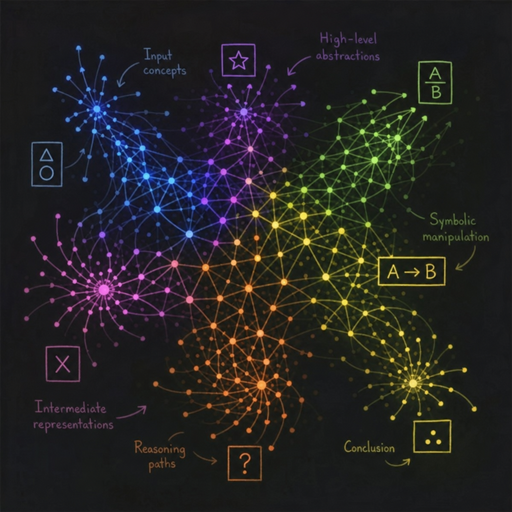
AI chatbots can appear to reason like people when they solve a math problem, explain a legal clause, debug code, or untangle a messy conversation. A Yale-led study offers a clearer way to think about that ability: today’s neural networks may use internal patterns that behave like symbolic structures, even though the systems are built from numeric vectors rather than human-style symbols. For anyone evaluating intelligent chatbots, the takeaway is practical: better reasoning is not just about smoother answers, but about understanding how models organize information, where they fail, and how their behavior can be tested.
How do AI chatbots reason like humans?
AI chatbots reason like humans in the limited sense that they can manipulate relationships among words, numbers, roles, and concepts in ways that resemble symbolic thinking. Humans often reason with symbols: a word in a sentence, a number in a fraction, or a variable in a formula has a role within a larger structure. Modern large language models do not store those elements as neat human-readable symbols; they process information through vectors, which are long lists of numbers. The Yale-led research suggests that those vector representations can implicitly realize symbolic structure, helping explain why models can perform tasks in language, arithmetic, logic, and code that seem to require structured reasoning.
That distinction matters because it avoids two common mistakes. The first is assuming an AI chatbot “thinks” exactly like a person because it produces fluent explanations. The second is assuming it merely guesses the next word with no internal organization at all. The more useful view is in between: AI reasoning models may develop internal structures that are powerful enough to support reasoning-like behavior, while still differing from human cognition in important ways.
This is why AI chatbots reasoning has become such an important topic for product leaders, researchers, educators, and everyday users. As chatbots move from novelty tools into customer support, analytics, operations, writing, coding, and decision support, people need better ways to evaluate chatbot intelligence beyond whether an answer sounds confident.
The study connects vectors with symbolic structure
The study, titled “The Emergent Symbolic Structure of Artificial Neural Networks,” was submitted to arXiv on August 30, 2026, by R. Thomas McCoy, Paul Soulos, Tal Linzen, and Paul Smolensky. Its central question is simple to state but hard to answer: if intelligence has traditionally been modeled through structured symbols, how can neural networks built from continuous vectors perform so well on symbolic tasks? The authors propose that neural networks may internally approximate symbolic structure despite not being explicitly designed as symbolic systems.
In the Yale summary, the researchers explain the issue using the contrast between human symbolic thinking and machine vector processing. A person can look at a sentence such as “cats chase dogs” and identify cats as the subject, chase as the verb, and dogs as the object. A neural network does not need to label those roles in the same explicit way, but the research suggests that its internal vectors can still encode role-like relationships.
The researchers tested whether a model’s internal representations could be closely approximated using tensor product representations, a mathematical framework for representing “fillers” and “roles.” In a sentence, the filler might be a word, while the role might be subject, verb, or object. In a fraction, the filler might be a number, while the role might be numerator or denominator. The study found that these role-filler approximations could replace major parts of the representation-generating process while leaving model behavior largely unchanged across several domains.
That does not mean a chatbot has human understanding, personal intent, or conscious reasoning. It does mean the old divide between “symbolic AI” and “neural AI” may be less clean than it appears. Modern neural networks may be learning patterns that act symbolically at a higher level, even when the lower-level machinery remains numeric and difficult to interpret.

Why this changes the conversation about chatbot intelligence
For years, conversations about chatbot intelligence have swung between hype and dismissal. One side treats advanced chatbots as if they understand the world the way people do. The other side describes them as autocomplete systems that only mimic reasoning. The new research points toward a more useful and more demanding question: what kinds of structure do these systems actually learn, and how can that structure be inspected?
This shift matters because many AI failures are not obvious at the surface level. A chatbot may explain a chain of reasoning clearly while relying on a fragile shortcut. It may solve one version of a problem and fail when the wording changes. It may produce a correct answer for the wrong reason, or a wrong answer with a convincing explanation. If researchers can identify internal representations that correspond to roles, relationships, and symbolic structure, developers may gain better tools for diagnosing why models behave as they do.
The Yale report notes that the researchers were able to modify model behavior through targeted interventions on internal vector representations. For example, they could shift an adjective’s role in a sentence so that the model behaved as if the adjective modified a different noun. That kind of intervention suggests the model’s behavior depends on identifiable structure inside its representation, not only on surface-level word patterns.
For businesses, this is not just an academic detail. If an organization uses intelligent chatbots to summarize customer complaints, route support tickets, analyze contracts, or generate code, it needs more than polished prose. It needs systems whose reasoning can be evaluated, stress-tested, and constrained.
The difference between sounding rational and reasoning reliably
A chatbot can sound rational without reasoning reliably. Fluent language is persuasive, and modern chatbots are especially good at producing organized explanations. But the appearance of logic is not the same as dependable logic.
This is where AI conversation analysis becomes valuable. Instead of judging only the final answer, teams can analyze the full interaction: the user’s prompt, the model’s assumptions, the intermediate steps it describes, the sources it uses, the uncertainty it expresses, and whether it changes its answer when challenged. A model that handles ambiguity responsibly is often more useful than one that confidently fills every gap.
Practical AI conversation analysis may include:
- Prompt sensitivity checks: Does the answer change dramatically when the same request is phrased differently?
- Role and entity tracking: Does the chatbot keep track of who did what, when, and why across a long conversation?
- Contradiction detection: Does the model notice when a user provides conflicting information?
- Evidence handling: Does it separate facts, assumptions, and recommendations?
- Uncertainty behavior: Does it say “I don’t know” or ask for clarification when needed?
- Escalation judgment: Does it know when a human reviewer should take over?
These checks are especially important because human-like output can cause users to overtrust a model. A chatbot that explains itself in a warm, confident tone may feel more capable than it is. Strong evaluation practices help bring attention back to actual performance rather than conversational charm.
What the research means for enterprise AI adoption
Enterprise teams often search for the best enterprise AI chatbots with advanced reasoning 2025 because they want tools that can handle complex workflows, not just casual Q&A. The study does not rank enterprise products, and it should not be read as a buying guide. However, it does offer a better lens for evaluating enterprise AI: look for systems that can preserve structure, follow roles, reason across steps, and remain controllable under pressure.
In practical terms, advanced reasoning in an enterprise chatbot usually shows up in the way the system handles constraints. Can it follow a company policy while answering a customer? Can it compare two documents without mixing up which clause belongs to which file? Can it maintain separate assumptions for separate scenarios? Can it explain what information it used and what it did not know?
A reasoning-capable enterprise chatbot should support more than natural conversation. It should fit into a governed process where outputs can be monitored, reviewed, and improved. That includes clear logging, permission controls, knowledge-source management, audit trails, and human handoff paths. The better the chatbot becomes at handling complex tasks, the more important these safeguards become.
A useful enterprise evaluation checklist includes:
- Reasoning consistency: Test the same problem in multiple formats and compare whether the model reaches equivalent conclusions.
- Context discipline: Check whether the chatbot can use supplied business context without inventing missing details.
- Data boundaries: Confirm that the system respects access controls and does not expose sensitive information.
- Explainability support: Look for ways to inspect sources, reasoning traces, confidence signals, or decision paths.
- Human review design: Define which tasks require approval before the chatbot’s output affects customers, employees, or operations.
- Failure recovery: Test what happens when the model is uncertain, receives incomplete input, or encounters conflicting instructions.
The most useful enterprise AI chatbot is not always the one that gives the longest answer or the most human-sounding reply. It is the one that performs reliably inside the actual business environment where it will be used.
Free chatbots and the rise of accessible reasoning tools
Search interest in the best free AI chatbots with advanced reasoning 2026 reflects a real change in user expectations. People now expect free or low-cost chatbots to help with planning, writing, studying, coding, summarizing, and problem solving. Many of these tools can feel surprisingly intelligent, especially when they handle multi-step prompts or explain a topic in plain language.
Still, free access does not remove the need for careful judgment. A free chatbot may be useful for brainstorming, drafting, learning, and exploring options, but users should be cautious with sensitive, high-stakes, or highly specialized decisions. The question is not only whether the tool can produce a good answer once. The better question is whether it can produce dependable answers across varied tasks, changing inputs, and real-world constraints.
For individual users, the safest approach is to treat advanced chatbots as reasoning assistants rather than final authorities. Ask them to show assumptions. Request alternative explanations. Compare answers against trusted sources when accuracy matters. If the topic involves health, law, finance, security, or employment decisions, use chatbot output as a starting point for discussion with qualified humans rather than as a substitute.
AI reasoning models still need guardrails
The Yale-led study helps explain how neural networks may represent structure internally, but it also reinforces why guardrails matter. If researchers still do not fully understand how these systems encode and use information, then deployment should be measured and test-driven. Yale’s coverage quotes researchers emphasizing that incomplete understanding can lead to surprising or unsafe behavior and that the work only begins to address how neural networks encode information.
This is especially important for AI reasoning models used in operational settings. A model that can reason through a complex request may also reason through a poorly designed instruction in an unexpected way. It may over-prioritize a user’s phrasing, misread a policy, or apply a pattern from one domain to another where it does not belong. Advanced capability and advanced risk often grow together.
Good guardrails are not just content filters. They include product design, workflow design, and organizational habits. Teams should define what the chatbot is allowed to do, what it should refuse, when it should ask clarifying questions, and when it should route the conversation to a person. They should also test for edge cases before launch and keep testing after launch because user behavior changes once a tool becomes part of daily work.
A balanced guardrail strategy may include:
- Clear task boundaries so the chatbot knows whether it is drafting, advising, classifying, or deciding.
- Approved knowledge sources so answers are grounded in current, relevant material.
- Confidence and uncertainty cues so users understand when the model may be operating with limited information.
- Human-in-the-loop review for consequential actions.
- Conversation monitoring to identify recurring failure patterns.
- Update cycles to refine prompts, policies, retrieval sources, and escalation rules.
The goal is not to make chatbots timid. The goal is to make them useful in ways that match the level of trust the organization can responsibly support.
Better prompts reveal better reasoning behavior
Users cannot control a model’s internal representations directly, but they can create conditions that reveal stronger or weaker reasoning behavior. A vague prompt often invites a generic answer. A structured prompt gives the chatbot roles, constraints, context, and success criteria, making it easier to evaluate whether the response is actually useful.
For example, instead of asking, “What should we do about customer churn?” a business user might ask the chatbot to analyze churn using specific customer segments, time periods, possible causes, and recommended next steps. The second prompt gives the model a structure to work within. It also makes mistakes easier to spot because the answer can be checked against the requested categories.
Useful prompting habits include:
- Define the role: Tell the chatbot whether it should act as an editor, analyst, tutor, support assistant, or strategic planner.
- Provide context: Include the audience, goal, constraints, and any known facts.
- Ask for assumptions: Have the model separate what it knows from what it is inferring.
- Request a format: Tables, checklists, summaries, and step-by-step outputs make reasoning easier to inspect.
- Challenge the answer: Ask what could be wrong, what information is missing, or how the recommendation would change under another scenario.
- Use verification prompts: Ask the chatbot to identify claims that should be fact-checked before use.
These habits are useful whether someone is using a free chatbot, a workplace assistant, or a specialized enterprise platform. They turn the interaction from a one-shot answer into a reasoning process that can be reviewed.
The human comparison should stay precise
It is tempting to say that chatbots now reason like humans. The more precise statement is that some neural networks can develop internal structures that support behavior similar to symbolic reasoning, a long-standing feature of human cognition. That is impressive, but it is not the same as human understanding, lived experience, common sense, or accountability.
Humans reason with goals, memories, emotions, social context, and embodied experience. Chatbots reason through learned statistical and structural patterns in data. Those patterns can be powerful, and the study suggests they may be more structurally organized than they first appear. But the system does not become a person because its answers resemble human reasoning.
This precision matters for trust. If people underestimate chatbots, they may miss useful opportunities to improve productivity and access to knowledge. If they overestimate chatbots, they may hand off decisions that require judgment, empathy, responsibility, or verified expertise. A mature view recognizes both the genuine capability and the real limits.
The next stage is interpretability, not just bigger models
For much of the AI boom, progress has been associated with scale: larger models, more data, more compute, longer context windows, and broader capabilities. Those factors still matter, but the study points toward another frontier: interpretability. If researchers and developers can better understand how neural networks organize roles, symbols, and relationships, they may be able to build systems that are not only stronger but also more controllable.
Interpretability could improve how teams debug chatbot failures. It could help identify when a model has confused two entities, reversed a relationship, or applied a rule in the wrong context. It could also support more targeted interventions, allowing developers to adjust behavior without relying only on broad retraining or surface-level prompt changes.
For users, the long-term benefit would be more dependable intelligent chatbots. A chatbot that can explain its answer is helpful. A chatbot whose internal behavior can be inspected, tested, and corrected is more valuable. The industry needs both conversational fluency and engineering discipline.
Key takeaways for teams using intelligent chatbots
The research does not settle every question about machine reasoning, but it gives teams a better framework for thinking about AI adoption. Instead of asking whether a chatbot is “smart” in a vague sense, ask what kind of structure it can handle and how that structure is tested.
Key takeaways include:
- AI chatbots reasoning is not magic. Neural networks may encode role-like symbolic structures inside numeric vector representations.
- Human-like output is not proof of human-like thought. A chatbot can be useful without thinking, understanding, or intending in the human sense.
- Evaluation should focus on structure. Test whether the model tracks roles, entities, constraints, and relationships across varied prompts.
- Conversation analysis matters. Review not only the final answer but the interaction pattern, assumptions, uncertainty, and failure modes.
- Enterprise use requires governance. The more consequential the workflow, the more important human review, auditability, and data controls become.
- Free tools still need verification. Accessible reasoning features are valuable, but users should fact-check important outputs.
The most important lesson is that reasoning quality should be observed, tested, and managed. A chatbot that sounds intelligent may still fail in subtle ways. A chatbot that is evaluated carefully can become a meaningful assistant while staying within responsible limits.
Conclusion: clearer science can lead to safer AI use
The Yale-led neural network study adds an important piece to the puzzle of how AI chatbots perform reasoning-like tasks. By showing that vector-based neural networks can implicitly approximate symbolic structures, the research helps explain why modern chatbots can handle language, logic, arithmetic, and code so effectively. It also reminds us that understanding these systems remains a work in progress.
For businesses and users, the practical message is straightforward. Use AI chatbots where they help, test them where they matter, and avoid confusing fluent conversation with guaranteed correctness. The future of chatbot intelligence will not be defined only by more human-sounding answers. It will be defined by models that can reason more reliably, reveal more about how they work, and fit safely into the human decisions around them.
