
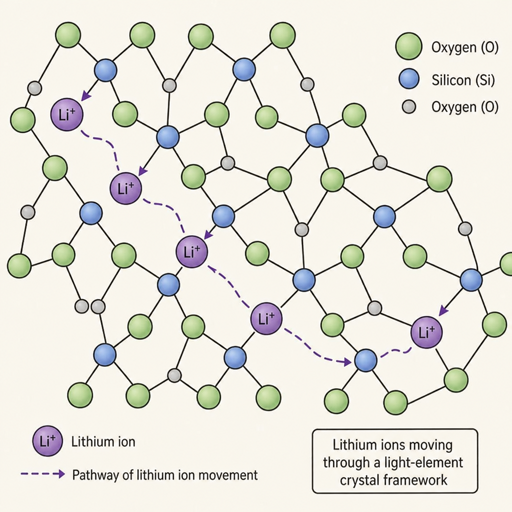
All-solid-state batteries are moving from distant promise to serious engineering target, and a newly reported light-element crystal framework shows why materials research matters so much. The framework, RbLi(Li₃SiO₄)₂, points toward solid electrolytes that could be lighter, safer, and better suited to fast lithium-ion movement than some heavier oxide options. It is not a finished battery product, but it gives researchers a clearer path for improving solid-state technology where it matters most: safety, weight, and real battery performance.
What makes this new crystal framework important?
The breakthrough is important because it tackles one of the quiet constraints in all-solid-state batteries: the solid electrolyte can add too much weight if it relies on heavy elements. A joint team led by Nichia Corporation and the University of Electro-Communications reported that RbLi(Li₃SiO₄)₂ uses a lightweight UCr₄C₄-type crystal framework with a low theoretical density of 2.74 g/cm³, compared with 5.12 g/cm³ for a commonly studied oxide electrolyte example that contains lanthanum and zirconium.
That matters because EVs, portable devices, and grid energy storage solutions all benefit when more of the battery’s mass contributes to useful stored energy. A safer chemistry is valuable, but if the cell becomes too heavy, the practical gains shrink. This new solid battery technology suggests that researchers can look beyond familiar heavy oxide frameworks and still find structures that allow lithium ions to move quickly.
The safety promise of all-solid-state batteries
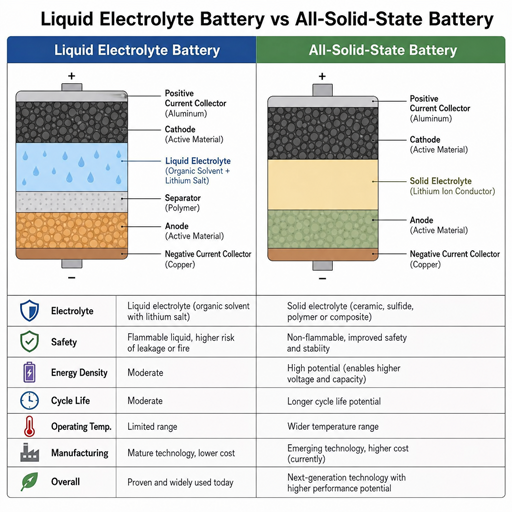
Conventional lithium-ion batteries usually rely on liquid electrolytes that shuttle ions between the electrodes. Solid-state batteries replace that liquid or gel with a solid electrolyte, which can reduce leakage concerns and support safer battery designs when properly engineered. The U.S. Department of Energy describes next-generation batteries, including solid-state designs, as technologies being developed for benefits such as improved performance and safety.
The appeal is especially strong for lithium-metal batteries. Lithium metal can offer high energy potential, but it also brings challenges around stability, unwanted reactions, and dendrite growth. A solid electrolyte is often discussed as a way to help control those risks, although researchers still need to prove safety at the full-cell, pack, manufacturing, and abuse-testing levels.
That is why “safer” should not be read as “automatically risk-free.” All-solid-state batteries still require careful interface design, pressure management, defect control, thermal testing, and scalable production quality. The new framework is exciting because it improves the materials toolbox, not because it removes every engineering problem overnight.
How lithium ions move through the new material
The reported material is built around one-dimensional lithium channels, but simulations showed that those channels can interconnect into a three-dimensional lithium transport network. That is a meaningful detail because a strictly one-dimensional pathway can be vulnerable: if defects block a route, ion movement can slow sharply. A connected 3D network gives ions more ways to move around local obstacles.
The research team used experimental synthesis along with computational methods, including preferred potential molecular dynamics and density functional theory calculations, to understand the conduction mechanism. Their analysis found an ultra-low lithium-ion migration barrier of 0.30 eV through interstitial sites, close to the 0.26 eV value cited for garnet-type Li₇La₃Zr₂O₁₂, a well-known benchmark solid electrolyte.
In plain English, the crystal structure appears to make it relatively easy for lithium ions to hop from place to place once the right mobile defects are present. That is central to battery performance because a solid electrolyte must conduct ions efficiently while also remaining chemically and mechanically stable inside the cell.
Key technical takeaways
- Lower material weight: The framework’s low theoretical density could help improve gravimetric energy density if it can be integrated into practical cells.
- Fast ion pathway: A low migration barrier suggests lithium ions can move efficiently through the structure.
- Network resilience: Interconnected channels may reduce the impact of localized defects that would otherwise create bottlenecks.
- Clear optimization route: The limiting issue is not only ion movement but also forming enough lithium defects to unlock that movement.
- Early-stage relevance: The material is a promising electrolyte framework, not a ready-to-install EV battery.
Why defect formation is the next hurdle
The same study that highlighted fast migration also identified a major limitation: in stoichiometric samples, forming lithium defects requires significantly more energy than moving lithium ions once those defects exist. The reported defect formation energy is 1.26 eV, compared with the 0.30 eV migration barrier.
This distinction is crucial. A material can have excellent pathways, but if too few ions are able to enter the “traffic lanes,” measured conductivity may still disappoint. The research team’s proposed direction is lithium-rich composition design, which could increase the number of mobile lithium carriers and better reveal the framework’s full conduction potential.
For readers following solid-state technology, this is a familiar pattern. Many promising electrolyte materials look strong in one property and weak in another. The job is not just to find a fast conductor; it is to balance conductivity, density, chemical stability, mechanical strength, electrode compatibility, manufacturability, and cost.
Where this fits in the race toward better EV batteries
Search interest around toyota all solid state ev batteries shows how closely the public connects solid-state progress with electric vehicles. Toyota has publicly discussed all-solid-state batteries as part of its next-generation BEV battery roadmap, with development tied to Toyota Industries and a focus on faster charging and improved cruising range targets.
That does not mean every new solid electrolyte discovery will appear in a Toyota vehicle, or in any vehicle, soon. Automakers need cell formats, supply chains, validation cycles, pack designs, crash safety systems, and long-term durability data before a chemistry becomes commercial. Still, material advances like this one are part of the upstream research that may eventually influence future electric mobility.
For EVs, the dream is simple to describe and hard to deliver: more range, shorter charging stops, less fire risk, longer service life, and lower total system weight. All-solid-state batteries are attractive because they could help address several of those goals at once. But the path from laboratory electrolyte to reliable automotive battery is long, and each new material must survive that full journey.
The practical checklist for judging solid-state battery claims
Not every battery headline deserves the same level of excitement. Some announcements describe a complete prototype cell, while others report a new electrolyte material, interface treatment, manufacturing method, or simulation result. This light-element crystal framework belongs in the materials-breakthrough category.
When evaluating solid-state batteries or solid battery technology news, use this checklist:
- What exactly was demonstrated? A powder, electrolyte pellet, coin cell, pouch cell, automotive-format cell, or full pack are very different milestones.
- Was performance measured in a real cell? Ionic conductivity is important, but full battery performance depends on electrodes, interfaces, pressure, temperature, and cycling.
- Does the chemistry reduce weight or only improve safety? Energy density gains require attention to every gram in the system.
- Can the material be manufactured consistently? A good lab result must become repeatable, scalable, and economical.
- How does it behave over time? Long cycle life, calendar aging, and tolerance to real operating conditions are essential.
- What problem remains unsolved? In this case, lithium defect formation and lithium-rich composition design are central next steps.
This approach keeps the conversation grounded. It also helps separate meaningful progress from vague claims that treat solid-state technology as a single magic upgrade.
Better energy storage depends on better materials
Energy storage solutions are no longer judged only by how much electricity they can hold. They are judged by safety, cost, lifecycle impact, supply chain resilience, charge speed, temperature tolerance, and performance under stress. Solid-state batteries sit at the center of that conversation because they promise a different internal architecture, not just a small tweak to today’s lithium-ion cells.
The new RbLi(Li₃SiO₄)₂ framework adds an important idea: lighter solid electrolytes may be just as important as highly conductive ones. If researchers can combine low density with strong ionic conduction and stable interfaces, all-solid-state batteries could become more compelling for EVs, aviation-adjacent applications, consumer electronics, and stationary storage where safety and space matter.
The broader lesson is that battery performance is built from materials upward. A faster ion pathway, a lighter framework, or a more stable interface can change what engineers are able to design later. Progress often looks incremental in the lab, but those increments are how new battery platforms become possible.
A promising step, not the finish line
The light-element UCr₄C₄-type framework does not instantly solve commercialization for all-solid-state batteries. It does, however, offer a credible new direction for designing lighter oxide-based solid electrolytes with fast lithium-ion conduction. The clearest next step is improving composition so the material has enough mobile lithium defects to make full use of its low migration barrier.
For anyone tracking solid-state batteries, the takeaway is optimistic but measured. The future of safer, lighter, faster-charging batteries will not depend on one discovery alone. It will come from connecting discoveries like this one with manufacturable cells, durable interfaces, and real-world validation.
