
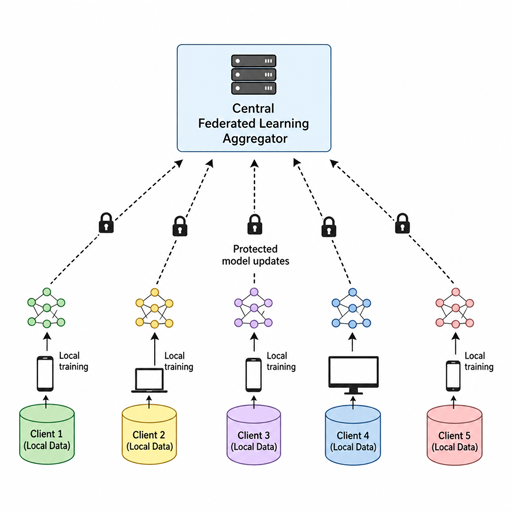
Federated learning allows organizations to train AI models across distributed data sources without moving the raw data into one central repository. That makes it valuable for privacy-conscious environments, but it does not make the system secure by default. Strong Federated Learning Security requires protection across the full lifecycle: participant onboarding, local training, model update sharing, aggregation, monitoring, and governance.
This guide provides an overview of implementing security and privacy in federated learning, with practical controls for reducing data leakage, model manipulation, and operational risk. It is written for teams designing, evaluating, or improving secure federated learning systems in business, research, healthcare, finance, mobile, edge, and cross-organization AI settings.
What makes federated learning security different?
Federated learning security is different because the training process is distributed across many devices, organizations, or environments that may not be equally trusted. Instead of protecting one centralized dataset and one controlled training pipeline, teams must protect communication channels, local compute environments, model updates, aggregation logic, participant behavior, and the final model at the same time.
In traditional machine learning, the largest security concern often begins with the central data store. In federated learning, raw data usually remains with each participant, which can improve privacy posture, but the system still exchanges information through model parameters, gradients, metadata, logs, and orchestration messages. Those artifacts can reveal sensitive patterns if they are not protected.
This is why federated learning privacy and cyber security must be designed together. A system can keep raw data local and still leak information through poorly protected updates. It can use encryption and still be vulnerable to poisoned model contributions. It can require authenticated participants and still fail if endpoint devices are compromised.
A secure AI training strategy for federated learning must therefore answer several questions at once:
- Who is allowed to participate? Identity, enrollment, and trust boundaries matter.
- What can each participant see? Access controls and protocol design limit exposure.
- How are updates protected in transit and at rest? Encryption and secure channels reduce interception risk.
- How does the aggregator detect harmful updates? Robust aggregation and anomaly detection help limit poisoning.
- What privacy guarantees are applied? Differential privacy, secure aggregation, and minimization reduce leakage.
- How is the system monitored over time? Federated environments change, and so do risks.
The key mindset shift is simple: federated learning reduces one class of risk, but it introduces a broader security surface. The goal is not merely to decentralize data. The goal is to create a trustworthy distributed training process.
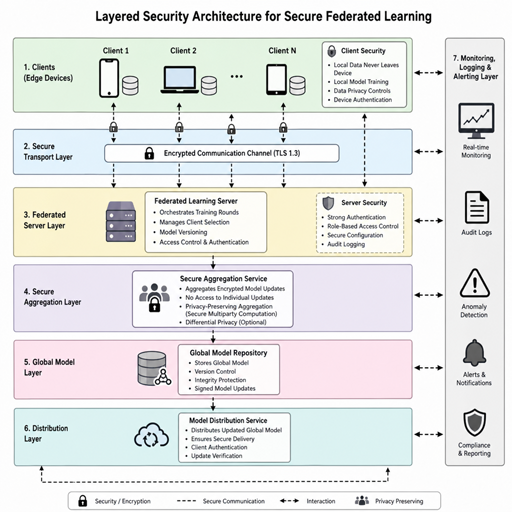
The security and privacy goals of federated learning
Secure federated learning should protect data confidentiality, model integrity, participant availability, and the privacy of individuals or organizations represented in local datasets. These goals overlap, but they are not identical, and treating them separately helps teams choose the right controls.
Confidentiality protects sensitive information
Confidentiality means that raw data, training signals, model updates, and system metadata are not exposed to unauthorized parties. Federated learning supports confidentiality by keeping raw data local, but additional controls are needed to protect what still moves through the system.
For example, gradients or model updates can sometimes reveal information about local training examples. Logs can expose participant identifiers. Timing patterns can reveal operational details. A confidentiality strategy should therefore protect not only the obvious data assets but also the indirect signals created during training.
Common confidentiality controls include transport encryption, secure aggregation, trusted execution environments where appropriate, strict logging policies, secrets management, and least-privilege access to orchestration systems.
Integrity keeps the model trustworthy
Integrity means the training process produces a model that reflects legitimate learning rather than manipulation. In a federated setting, each participant contributes updates, and a compromised or malicious participant may try to distort the global model.
Attacks can be broad, such as making the model perform worse overall, or targeted, such as creating a hidden behavior that appears only for specific inputs. Integrity controls should focus on validating participants, detecting abnormal updates, using robust aggregation methods, and maintaining audit trails that make suspicious behavior easier to investigate.
A model that is private but easily poisoned is not secure. Federated learning cyber security must include defenses that protect learning quality and model behavior, not just data movement.
Availability keeps training and inference reliable
Availability means the federated learning system remains usable despite unreliable participants, network issues, denial-of-service attempts, or operational failures. Because federated learning often depends on many distributed clients, availability must be designed into the protocol.
Some clients may drop out mid-round. Some may have limited compute or unstable connectivity. Attackers may attempt to flood the system or disrupt coordination. Resilient scheduling, participant sampling, rate limits, fallback procedures, and monitoring can help maintain progress without over-trusting any single client.
Privacy limits what can be inferred
Privacy is broader than confidentiality. Even if no raw record is exposed, a system may still allow someone to infer that a person, transaction, device, or organization was part of the training data. Federated learning privacy aims to reduce these inference risks.
Privacy controls include data minimization, differential privacy, secure aggregation, participant anonymity where appropriate, careful model release processes, and restrictions on diagnostic outputs. Privacy should be evaluated from the perspective of the individuals or entities represented in the data, not only from the perspective of the system operator.
Common threats in federated learning systems
Federated systems face many of the same risks as other AI platforms, but the distributed design changes how those risks appear. A practical threat model should account for hostile participants, compromised clients, curious servers, external attackers, accidental leakage, and model misuse.
Data inference attacks
Data inference attacks attempt to learn sensitive information from model updates, gradients, outputs, or final model behavior. In some cases, attackers may try to reconstruct aspects of training data. In others, they may test whether a specific record or individual was likely included in training.
These risks are especially important when local datasets are small, rare, or highly sensitive. A hospital, bank, law firm, manufacturer, or mobile app provider may have data that is valuable precisely because it is not broadly available. If model updates are not protected, federated learning may give a false sense of safety.
Defenses include secure aggregation, differential privacy, update clipping, limiting the granularity of shared information, reducing unnecessary metadata, and controlling access to intermediate artifacts.
Model poisoning and backdoor attacks
Model poisoning occurs when a participant submits harmful updates to degrade or manipulate the global model. Backdoor attacks are more targeted: the model behaves normally in most cases but produces attacker-desired behavior when a trigger pattern appears.
These attacks are challenging because federated learning systems are designed to accept learning signals from participants. A malicious update may look mathematically plausible, especially if the attacker understands the training objective. Robust aggregation, anomaly scoring, update validation, reputation mechanisms, and post-training evaluation can help reduce this risk.
Teams should avoid assuming that every enrolled client is honest. In cross-device settings, devices can be compromised. In cross-organization settings, incentives may not be perfectly aligned. In research collaborations, mistakes or misconfigurations may have effects similar to malicious activity.
Sybil and participant manipulation attacks
A Sybil attack occurs when an attacker creates or controls many fake participants to gain influence over training. If the system gives equal weight to each participant, fake identities can distort the model, bypass reputation systems, or overwhelm monitoring.
Participant authentication, enrollment controls, device attestation, organization-level verification, rate limits, and contribution weighting can reduce exposure. The right approach depends on the deployment model. A federated system among known institutions can use stronger identity governance than a large cross-device system with millions of consumer endpoints.
Communication and orchestration attacks
The communication layer carries training instructions, model versions, updates, credentials, and operational metadata. Attackers may try to intercept, replay, alter, delay, or redirect messages. Poor orchestration security can also expose secrets, misconfigure training rounds, or allow unauthorized model access.
Secure channels, mutual authentication, message signing, replay protection, version controls, and hardened APIs are baseline requirements. The orchestration service should be treated as a critical security component, not just a scheduler.
Endpoint compromise
Federated learning depends on local training environments, which may include mobile devices, browsers, edge gateways, partner servers, or internal systems. If an endpoint is compromised, attackers may access local data, manipulate updates, steal credentials, or observe training behavior.
Endpoint security is therefore part of federated learning security. Controls can include application sandboxing, device health checks, secure key storage, patch management, runtime integrity checks, and limits on what any one client can contribute.
The building blocks of secure federated learning
A strong architecture combines several layers of defense rather than relying on one technique. No single control can solve every federated learning privacy and security problem, so teams should combine cryptographic, statistical, operational, and governance safeguards.
|
Security layer |
What it protects |
Practical purpose |
|---|---|---|
|
Identity and access management |
Participants, operators, services |
Ensures only approved entities join training or manage the system |
|
Secure communication |
Updates, instructions, metadata |
Reduces interception, tampering, and replay risk |
|
Secure aggregation |
Individual participant updates |
Helps prevent the server from seeing each client’s raw update |
|
Differential privacy |
Sensitive patterns in training data |
Limits what can be inferred from contributions or model behavior |
|
Robust aggregation |
Global model integrity |
Reduces the influence of abnormal or malicious updates |
|
Monitoring and audit logs |
Training behavior and operations |
Supports detection, investigation, and governance |
|
Model evaluation |
Final and intermediate models |
Checks for degradation, bias, backdoors, and unexpected behavior |
Identity, enrollment, and trust boundaries
Security begins before the first training round. Teams need a clear process for deciding who can participate, how they are authenticated, and what level of trust they receive.
In a cross-silo environment, where participants are known organizations, enrollment can include contracts, technical onboarding, credential management, and agreed operating procedures. In a cross-device environment, where participants may be phones, laptops, vehicles, or sensors, enrollment may depend more heavily on app identity, device health signals, rate limits, and automated eligibility checks.
Trust boundaries should be explicit. The server may not be trusted with raw updates. Clients may not be trusted to follow protocol. Administrators may need limited access to sensitive logs. Once these assumptions are documented, controls can be mapped to real risks instead of vague concerns.
Encryption and secure transport
Encrypted transport protects data as it moves between participants and coordinating services. Mutual authentication helps ensure that clients communicate with the correct server and that the server accepts updates only from legitimate clients.
Encryption should be paired with good key management. Keys should be rotated when appropriate, stored securely, and separated by role or environment. Development, staging, and production systems should not share secrets. Administrative access to keys should be tightly controlled and logged.
Transport security is necessary, but it is not sufficient. If the server can decrypt and inspect every individual update, privacy risks may remain. That is where secure aggregation can add another layer.
Secure aggregation
Secure aggregation allows a server to compute an aggregate result from client updates without directly viewing each individual update. In practical terms, the aggregator learns the combined update needed for model training, while individual contributions are hidden.
This is useful when the server is honest-but-curious, when participants do not want their individual updates exposed, or when organizational policy requires minimizing access to sensitive signals. Secure aggregation can also reduce the damage caused by excessive logging or insider misuse because individual updates are less visible.
However, secure aggregation is not a complete defense. It may make some anomaly detection harder because the server sees less detail. Teams may need privacy-preserving validation methods, client-side checks, or carefully designed aggregate-level monitoring.
Differential privacy
Differential privacy adds controlled noise or other limits so that the presence or absence of a single record has less influence on what others can learn. In federated learning, it can be applied locally by clients, centrally after aggregation, or through hybrid approaches.
The benefit is stronger privacy against inference attacks. The tradeoff is that privacy protections can affect model utility if they are too aggressive or poorly tuned. Teams need to define privacy goals, evaluate model performance, and document the assumptions behind privacy parameters.
Differential privacy should not be used as a decorative label. It requires careful implementation, testing, and governance. If the privacy budget is not tracked, if repeated training rounds are ignored, or if outputs are released without control, the intended privacy protection may weaken.
Robust aggregation and anomaly detection
Robust aggregation methods reduce the impact of outlier updates or malicious contributions. Depending on the design, they may limit extreme values, compare update similarity, reduce the weight of suspicious clients, or use aggregation rules that are less sensitive to manipulation.
Anomaly detection can support this by identifying unusual update sizes, directions, timing, loss patterns, or participation behavior. These signals should be interpreted carefully. A legitimate participant with unusual data may look different from others, and automatically excluding such clients can harm fairness or model quality.
The goal is not to remove every unusual contribution. The goal is to distinguish useful diversity from harmful manipulation and to create a review process for ambiguous cases.
How do you design a secure federated learning workflow?
A secure federated learning workflow is designed by mapping the training lifecycle, identifying what can go wrong at each step, and applying layered controls that match the risk. The workflow should make security part of routine model development rather than an afterthought added just before deployment.
A practical workflow includes the following steps:
- Define the collaboration model. Decide whether the system is cross-device, cross-silo, internal, external, or hybrid. The answer affects identity, availability, consent, and governance requirements.
- Classify the data and participants. Understand whether local datasets contain personal, regulated, proprietary, operational, or safety-sensitive information. Identify whether participants are known institutions, employees, customers, devices, or third-party systems.
- Create a threat model. Consider data inference, poisoning, backdoors, Sybil behavior, communication attacks, endpoint compromise, insider misuse, and model extraction. Document assumptions instead of relying on informal confidence.
- Choose privacy controls. Decide where secure aggregation, differential privacy, minimization, retention limits, and output restrictions are needed. Balance privacy goals with expected model utility.
- Choose integrity controls. Select robust aggregation, update validation, contribution limits, anomaly detection, and model evaluation methods. Include defenses against targeted manipulation, not only broad performance degradation.
- Harden the infrastructure. Secure APIs, orchestration services, credentials, logging pipelines, training containers, and deployment environments. Treat the federated coordinator as high-value infrastructure.
- Test before production. Simulate unreliable clients, malicious updates, inference attempts, network failures, and rollback scenarios. Include security tests alongside model quality tests.
- Monitor and improve. Track training behavior, participant health, model drift, privacy budget consumption, unusual update patterns, and operational incidents. Revise controls as the system evolves.
This workflow is not a one-time checklist. Federated learning systems change as new participants join, models are updated, data distributions shift, and attackers learn. Security should be reviewed at each major model or protocol change.
Implementation patterns for stronger protection
Different federated learning systems need different safeguards, but several patterns are broadly useful. The best approach is usually a combination of technical controls and clear operating rules.
Use least privilege everywhere
Participants should receive only the model version, instructions, and credentials they need for a specific training task. Operators should have role-based access to dashboards, logs, keys, and configuration settings. Services should have narrow permissions rather than broad administrative access.
Least privilege limits blast radius. If a credential leaks or a device is compromised, the attacker should not gain broad control over the entire learning process. This principle is familiar in cyber security, but it is especially important in federated learning because the system naturally spans many environments.
Minimize shared information
Secure AI training benefits from data minimization at every layer. Do not share raw data when updates are enough. Do not share individual updates when aggregates are enough. Do not keep detailed logs longer than necessary. Do not expose training diagnostics to more people or systems than required.
Minimization also applies to metadata. Participant IDs, timestamps, locations, device characteristics, and training frequency may create privacy concerns even when model updates are protected. A privacy review should include these surrounding signals.
Separate training, evaluation, and deployment controls
The system that trains the model should not automatically be allowed to deploy it. Separating training orchestration from model approval helps prevent a poisoned or poorly performing model from moving directly into production.
Evaluation should include accuracy, robustness, privacy risk, safety behavior, and domain-specific quality checks. If the model affects important decisions, human review or staged rollout may be appropriate. Versioning and rollback are essential so teams can respond if a deployed model behaves unexpectedly.
Protect logs and observability data
Monitoring is necessary, but observability can become a source of leakage. Logs may include client identifiers, error messages, model metadata, update sizes, or configuration details. Debugging tools may capture more information than teams realize.
Logging policies should specify what is collected, who can access it, how long it is retained, and how sensitive fields are redacted or aggregated. Security teams should review observability pipelines as part of the federated learning architecture, not as a separate operational detail.
Plan for client dropout and unreliable networks
Federated learning often operates in environments where clients appear and disappear. A system that fails when a few clients drop out may encourage unsafe shortcuts, such as weakening authentication or accepting incomplete validation.
Resilient designs anticipate dropout. They use participant sampling, timeout rules, secure recovery protocols, and aggregation thresholds. These choices affect both availability and privacy, so they should be documented and tested.
Privacy-preserving techniques and their tradeoffs
Privacy techniques can be powerful, but each one introduces design choices. Teams should understand the practical implications before adopting them.
Secure aggregation versus visibility
Secure aggregation hides individual updates from the server, which supports privacy. The tradeoff is reduced visibility into each participant’s contribution. That can complicate debugging, anomaly detection, and quality analysis.
A balanced design may combine secure aggregation with client-side validation, aggregate-level monitoring, trusted sampling, or privacy-preserving metrics. The system should not require unrestricted access to individual updates simply to operate safely.
Differential privacy versus utility
Differential privacy can reduce inference risk, but the added noise or constraints may affect model performance. The impact depends on the task, data distribution, privacy settings, number of training rounds, and model design.
Teams should test privacy configurations using realistic data and success criteria. A privacy setting that works in a lab may not fit production conditions. Documentation should explain the selected approach in language that security, legal, compliance, and product stakeholders can understand.
Local privacy versus central privacy
Local privacy techniques protect data before updates leave the client. This can provide strong protection against an untrusted server, but it may reduce model utility. Central privacy techniques apply protections after aggregation, which may preserve more utility but requires more trust in the aggregation process.
Neither approach is automatically better. The right choice depends on who is trusted, what data is involved, what regulations or policies apply, and how much performance loss the use case can tolerate.
Governance, compliance, and accountability
Technical controls are not enough if no one owns the system’s risk. Governance defines responsibilities, acceptable use, review processes, and escalation paths.
For secure federated learning, governance should cover:
- Participant eligibility: who can join, how they are verified, and when they are removed.
- Data boundaries: what data can be used locally and what information may leave the environment.
- Model approval: who reviews models before deployment and what evidence is required.
- Privacy review: how inference risks, privacy budgets, metadata, and outputs are assessed.
- Incident response: what happens if poisoning, leakage, compromise, or misuse is suspected.
- Auditability: what records are kept to support investigation without creating unnecessary privacy risk.
- Change management: how protocol, model, and infrastructure updates are tested and approved.
This is where a survey on security and privacy of federated learning becomes more than an academic exercise. The recurring lesson across the field is that privacy, robustness, and operational security interact. Governance helps teams manage those interactions deliberately.
A practical checklist for federated learning cyber security
Use this checklist when planning a new system or reviewing an existing one. It is not a replacement for a full security assessment, but it can reveal gaps quickly.
- Threat model completed: The team has documented likely attackers, assets, trust assumptions, and abuse cases.
- Participants verified: Enrollment, authentication, and removal processes are defined.
- Communication secured: Transport encryption, mutual authentication, replay protection, and message integrity are in place.
- Updates protected: Secure aggregation or another suitable method limits exposure of individual contributions.
- Privacy controls selected: Differential privacy, minimization, retention limits, and output controls are evaluated.
- Poisoning defenses included: Robust aggregation, anomaly detection, update limits, and evaluation tests are implemented.
- Endpoints considered: Local training environments are hardened according to their risk level.
- Logs reviewed: Observability data is minimized, protected, and retained only as needed.
- Model release controlled: Evaluation, approval, versioning, and rollback processes exist.
- Monitoring active: Training rounds, participant behavior, model quality, privacy indicators, and incidents are tracked.
- Governance assigned: Owners are responsible for security, privacy, compliance, and operational response.
If several items are missing, the system may still be a federated learning system, but it should not be described as secure federated learning without qualification.
Mistakes that weaken federated learning privacy
Many privacy failures come from overconfidence. Teams may assume that because raw data stays local, the entire system is private. That assumption can hide practical leakage paths.
One common mistake is ignoring model updates. Gradients and parameters are not raw records, but they can still carry information. Another mistake is keeping too much metadata in logs, dashboards, and analytics tools. A third is releasing models or diagnostic outputs without testing whether they enable inference attacks.
Teams also weaken privacy when they treat privacy controls as interchangeable. Encryption, secure aggregation, and differential privacy solve different problems. Encryption protects data in transit or at rest. Secure aggregation hides individual updates during aggregation. Differential privacy limits what can be inferred from participation or records. Strong federated learning privacy often requires more than one of these controls.
Finally, privacy can degrade over time. Repeated training rounds, new participants, new outputs, and model updates may change the risk picture. Ongoing review matters as much as initial design.
Building a mature federated learning security program
Maturity comes from making security repeatable. Instead of designing controls separately for every model, organizations should create reusable patterns, approved architectures, testing procedures, and review gates.
A mature program usually includes a reference architecture for federated learning, standard participant onboarding procedures, approved cryptographic and privacy techniques, model validation requirements, incident response playbooks, and documentation templates. This makes teams faster because they do not have to reinvent every decision. It also makes risk easier to compare across projects.
Education is part of maturity as well. Data scientists, security engineers, privacy teams, infrastructure teams, and business owners need a shared vocabulary. When everyone understands the difference between data localization, secure aggregation, differential privacy, and robust aggregation, the organization can make better decisions.
The final goal is not perfection. Federated learning systems operate in complex environments, and risk cannot be eliminated entirely. The goal is a defensible, monitored, well-governed approach to secure AI training that preserves the value of distributed data while reducing preventable exposure.
Key takeaways
Federated learning can improve privacy by keeping raw data closer to its source, but it does not automatically guarantee security. The system still needs protection against inference, poisoning, Sybil behavior, endpoint compromise, orchestration abuse, and operational leakage.
The strongest approach layers controls across identity, encryption, secure aggregation, differential privacy, robust aggregation, endpoint hardening, monitoring, and governance. These controls should be selected based on a clear threat model rather than added as isolated features.
For teams seeking an overview of implementing security and privacy in federated learning, the most important principle is to treat the entire training lifecycle as the security boundary. Protect the clients, the coordinator, the communications, the updates, the model, and the decisions that move the model into production. That is how federated learning becomes not just distributed, but trustworthy.
