
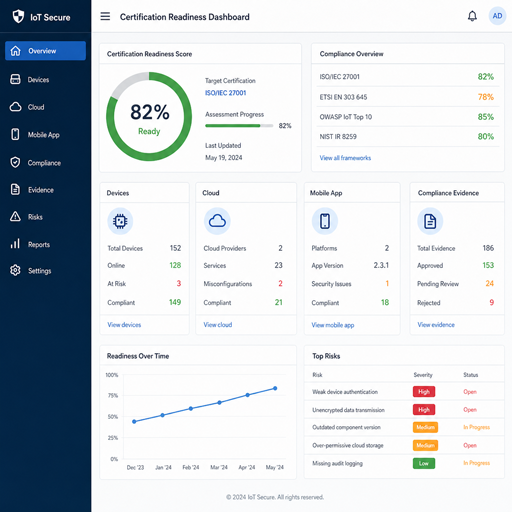
IoT security certification is easier to pursue when your product team can see exactly how standards, evidence, engineering work, and risk decisions connect. This product page presents a practical certification-readiness package for manufacturers, product owners, security teams, and compliance leaders who need to align connected products with recognized IoT security standards without slowing delivery. You get a structured way to assess IoT device security, prepare documentation, prioritize remediation, and move toward certification or labeling with less ambiguity.
What does this IoT Security Certification package include?
The package is built to help teams understand where their connected product stands against relevant iot security standards and what must happen next. It does not promise certification by itself, because certification outcomes depend on the product, target market, lab or assessor requirements, implementation evidence, and the selected scheme. Instead, it gives your team a clear, evidence-driven path from uncertainty to a practical readiness plan.
This is useful when a device is already in development, preparing for launch, entering a new market, or being reviewed after customer security questions. The package focuses on the product as a whole: the device, firmware, companion apps, cloud services, update mechanisms, documentation, and support processes that affect real-world security.
Core deliverables include:
- Standards alignment review that maps your product against applicable security expectations such as device identity, secure configuration, software updates, vulnerability handling, data protection, and lifecycle support.
- IoT device security certification readiness assessment that identifies missing evidence, unclear controls, and gaps that may affect an audit, label application, procurement review, or customer security questionnaire.
- Risk-based remediation plan that separates urgent security issues from lower-priority improvements, helping engineering and leadership make realistic decisions.
- Evidence checklist for documentation, test results, design records, policies, update procedures, and support commitments.
- Executive-ready summary that explains readiness, risks, dependencies, and recommended next steps without forcing non-technical stakeholders to interpret raw control language.
- Practical guidance on iot security best practices so teams understand not only what a requirement says, but how it may show up in product design and post-market operations.
Built for connected-product teams that need clarity before assessment
Many IoT teams know they need stronger security, but they are not always sure which benchmark applies or how to prove that security is actually present. A smart lock, industrial sensor, medical-adjacent wearable, home gateway, camera, appliance, or building device can involve different architectures and risks. Even within one product line, the device may depend on firmware, mobile apps, APIs, cloud infrastructure, third-party components, user accounts, and long-term update commitments.
The package helps convert that complexity into a practical work plan. Instead of treating IoT Security Certification as a final checkbox, it treats certification readiness as an engineering, documentation, and iot risk management process. That matters because many security gaps are not simply missing controls; they are missing decisions, missing ownership, or missing proof that a control works as intended.
Use this package when your team needs to:
- Prepare a product for a certification, label, customer review, or market-entry requirement.
- Understand how current product design compares with established IoT security best practices.
- Identify whether security claims can be supported with documentation and test evidence.
- Prioritize remediation before engaging an external lab or certification body.
- Create a shared language between engineering, product, compliance, legal, procurement, and leadership.
- Reduce avoidable rework caused by late discovery of security or evidence gaps.
Standards alignment without guesswork
IoT security standards are not all identical, but many share common themes: unique device identity, secure authentication, update capability, vulnerability reporting, data protection, secure default configuration, and clear support periods. NIST IR 8425 documents a consumer IoT product profile based on NIST’s IoT core baseline and describes cybersecurity capabilities commonly needed for consumer IoT products. (csrc.nist.gov) ETSI EN 303 645 is an outcome-focused consumer IoT cybersecurity standard, with ETSI describing the 2024 version as a document of high-level security provisions for consumer IoT devices. (etsi.org) The FCC’s IoT Labeling Program uses a U.S. government certification mark, the Cyber Trust Mark, with a QR code leading consumers to product-specific registry information. (docs.fcc.gov)
This package helps your team understand how those kinds of expectations translate into product work. For example, “secure updates” may require more than an over-the-air update feature. It can involve update authenticity, integrity checks, rollback considerations, user communication, dependency tracking, release process controls, and evidence that the mechanism was tested.
Typical alignment areas include:
- Device identity and access control Review how the device identifies itself, how users or services authenticate, and whether default credentials or weak enrollment flows create avoidable exposure.
- Software and firmware update readiness Examine whether updates can be delivered securely, verified before installation, documented, and supported over the product’s expected life.
- Secure configuration and hardening Identify unnecessary exposed services, insecure defaults, overly permissive debug access, and configuration decisions that may weaken deployed devices.
- Data protection and privacy-supporting controls Consider what data is collected, where it travels, how it is protected, and whether users or administrators receive clear information about security-relevant settings.
- Vulnerability disclosure and response Assess whether your team can receive reports, triage issues, communicate fixes, and maintain a documented process after launch.
- Product lifecycle and support commitments Clarify how long the product will receive security updates, what happens at end of support, and how that information is communicated.
A practical path from product review to readiness plan
The package is designed to work with real product constraints. Some teams are pre-release and can still influence architecture. Others have shipping devices, legacy components, supplier dependencies, or market deadlines. The review process adapts to the stage of the product while keeping the focus on evidence and risk.
A typical engagement starts with product scoping. Your team identifies the device model, software components, companion services, intended markets, users, connectivity methods, update approach, and known constraints. From there, the product is reviewed against relevant iot security standards and practical certification expectations. The output is not just a list of problems; it is a prioritized plan that explains what to fix, what to document, and what decisions require leadership approval.
Readiness workflow:
- Scope the product and certification goal Define the product boundary, target market, device type, intended claim, and any known certification or labeling objective.
- Collect security and lifecycle evidence Gather architecture diagrams, threat models if available, update procedures, access-control details, SBOM or component records if maintained, vulnerability response procedures, test records, and user-facing security documentation.
- Map controls to product reality Translate standards language into concrete product questions: how credentials are handled, how updates are validated, how data is protected, and how support is maintained.
- Identify readiness gaps Separate missing implementation, missing documentation, insufficient test evidence, unclear ownership, and risks that may require business decisions.
- Prioritize remediation Rank actions by impact, certification relevance, engineering effort, user risk, and dependency on suppliers or platform teams.
- Prepare next-step documentation Build a clear checklist and summary that can support internal planning, external assessment preparation, procurement conversations, or customer security reviews.
Designed for better iot risk management
Good iot risk management is not about treating every issue as equally urgent. It is about understanding how a weakness could affect users, operations, data, brand trust, and market access. A device with limited data, no actuator, and short support life may create a different risk profile from a camera, access-control device, industrial gateway, or health-related sensor. The package helps teams evaluate those differences without losing sight of baseline security expectations.
This approach is especially helpful when engineering teams need to justify remediation priorities. A finding such as “incomplete vulnerability disclosure process” may seem administrative, but it can affect how quickly the company responds when researchers or customers report issues. A finding such as “unclear security update support period” may affect customer trust and market acceptance, even if the device is technically capable of receiving updates.
The readiness plan turns these findings into practical action. It can help product leadership decide whether to delay a release, narrow a claim, update documentation, add a control, engage a lab, or accept and track a residual risk. The result is a security conversation that is clearer, more accountable, and easier to connect to commercial goals.
Security features are translated into buyer and user benefits
Technical controls matter, but they only create value when they reduce real exposure and support trust. This package helps your team explain product security in a way that is accurate, supportable, and useful to customers. Instead of broad claims such as “secure by design,” the output encourages evidence-based language: what is protected, how updates are handled, what users can configure, and how vulnerabilities are managed.
Feature-to-benefit examples:
|
Security area |
What the review looks for |
Practical benefit |
|---|---|---|
|
Unique credentials or secure enrollment |
Avoidance of shared default passwords and weak onboarding flows |
Reduces common unauthorized-access risks |
|
Secure update mechanism |
Signed or validated updates, controlled release process, update records |
Helps keep devices maintainable after deployment |
|
Vulnerability response process |
Public or customer-facing reporting path, triage ownership, remediation workflow |
Makes post-market security issues easier to manage |
|
Data protection controls |
Data minimization, protected transmission, appropriate storage practices |
Supports user trust and procurement review |
|
Support lifecycle documentation |
Defined security update period and end-of-support communication |
Sets clearer expectations for customers and partners |
These examples are not a substitute for formal assessment, but they show how the package connects engineering work with commercial confidence. When your sales, support, and product teams can explain security accurately, customers are less likely to receive vague answers or unsupported promises.
Product specifications
This package is a professional readiness and advisory product for organizations developing, manufacturing, distributing, or reviewing connected devices. It is suitable for teams that need a structured understanding of iot device security before entering a formal certification, labeling, procurement, or customer assurance process.
Product format: IoT security certification readiness service Primary audience: IoT manufacturers, product teams, security leaders, compliance managers, solution providers, and connected-device startups Product focus: IoT device security, certification readiness, standards mapping, evidence preparation, and iot risk management Typical inputs: Product architecture, device and firmware details, cloud and app overview, update process, security documentation, support lifecycle details, known risks, and target market information Typical outputs: Gap assessment, standards mapping, prioritized remediation plan, evidence checklist, and stakeholder summary Pricing: Available by consultation or quote, because scope depends on product complexity, target standards, number of device variants, documentation maturity, and depth of review required Best fit: Teams preparing for IoT Security Certification, security labeling, enterprise customer review, investor due diligence, or pre-launch security readiness Not a replacement for: A formal certification body, accredited test lab, legal advice, penetration test, or guarantee of certification outcome
A clearer route to the best iot security certification for your market
The best iot security certification is not always the most recognizable name in isolation. It is the one that fits your product category, customer expectations, sales region, risk profile, and operational ability to maintain security after launch. A consumer smart-home product, an enterprise sensor platform, and an industrial gateway may need different evidence, different messaging, and different readiness priorities.
This package helps you make that decision with fewer assumptions. If your team is unsure whether to pursue a label, prepare for an enterprise assessment, align with a baseline standard, or strengthen internal controls first, the readiness output gives you a practical basis for that discussion. It can also help you avoid spending time on a certification path before the product has the documentation or implementation maturity to support it.
Move from uncertainty to a certification-ready plan
If your connected product is approaching launch, entering a new market, or facing more security questions from customers, now is the right time to organize the evidence. IoT device security is easier to improve before an assessor, buyer, or regulator forces the issue. A structured readiness review gives your team a clear view of what is strong, what is missing, and what should happen next.
Request a consultation to scope your IoT Security Certification readiness package. Bring your product overview, target market, known security concerns, and any certification or customer requirements already on your radar. From there, the next step is a focused review that turns iot security standards into an actionable plan your technical and business teams can use.
