
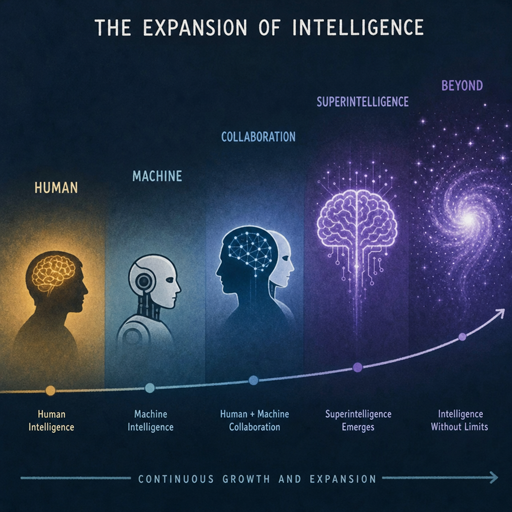
Superintelligence is the idea that an intelligent system could outperform humans across most meaningful cognitive tasks, from scientific reasoning to strategic planning. It is not just a science-fiction concept; it is a way to ask hard questions about capability, control, responsibility, and the future of AI. At the same time, “AI” remains a useful word because it names a broad field of tools and ambitions, even when the systems inside it are very different from one another.
What does superintelligence actually mean?
Superintelligence means intelligence that goes beyond the best human performance across a wide range of domains, not just a model that writes fluent text or solves a narrow benchmark. A chess engine can be superhuman at chess without being generally superintelligent. Artificial superintelligence would imply something broader: the ability to learn, reason, plan, create, and adapt at a level that could reshape how decisions are made in science, industry, security, and everyday life.
This distinction matters because AI advancements often arrive in uneven ways. A system may be brilliant at pattern recognition and poor at common-sense judgment. It may generate useful code but still fail at understanding the consequences of deploying that code in a real business, hospital, school, or government system.
Thinking clearly about superintelligence starts with avoiding both extremes. It is unhelpful to assume that today’s intelligent systems are already all-knowing minds. It is also unhelpful to assume that progress will stop at convenient limits simply because current tools still make obvious mistakes.
Why is “AI” still a useful word?
“AI” is still useful because it points to a family of technologies designed to perform tasks that normally require intelligence, even if those systems do not think like people. The term creates a shared label for machine learning, language models, robotics, planning systems, computer vision, and other approaches that would otherwise be discussed in disconnected technical silos. It is imperfect, but it helps people ask practical questions about capability, risk, governance, and value.
Some critics argue that “AI” is too broad. They have a point. A spam filter, a medical imaging model, a chatbot, and a warehouse robot are not the same kind of system. Still, broad words can be useful when they describe a real pattern. “Software” covers spreadsheets and operating systems; “transportation” covers bicycles and airplanes. In the same way, AI describes a direction: building systems that can perceive, predict, generate, decide, or act with increasing autonomy.
The word also keeps social consequences visible. If we only talk about “models” or “algorithms,” we can make decisions sound smaller than they are. AI ethics requires a broader frame because these tools affect jobs, privacy, creativity, public trust, and the distribution of power.
The science behind intelligent systems
The science of AI is not one single theory. It combines computer science, statistics, neuroscience-inspired ideas, cognitive science, control theory, economics, and human-computer interaction. Modern systems often learn patterns from data rather than following hand-written rules for every situation. This is why they can be flexible, but also why they can be difficult to predict.
Several ideas are especially important when discussing the future of AI:
- Generalization: Can a system apply what it learned in one setting to a new situation, or does it break when the context changes?
- Representation: What does the system encode internally, and how well do those internal patterns map to the real world?
- Feedback: How does the system learn from success, failure, correction, or human preference?
- Agency: Can the system set goals, pursue steps, use tools, and adjust its plan over time?
- Alignment: Do the system’s behavior and incentives match human values, laws, and expectations?
Superintelligence becomes a serious topic when these ingredients improve together. A more capable model is not automatically a more autonomous one. But if learning, reasoning, tool use, memory, planning, and real-world action become tightly connected, the result could be far more powerful than today’s task-specific tools.
Paths from today’s AI to artificial superintelligence
There is no confirmed roadmap to artificial superintelligence. The most honest view is that there are several possible paths, each with uncertainty. The phrase “superintelligence paths dangers strategies” may sound compressed, but it captures the central challenge: how systems might become dramatically more capable, what could go wrong, and what humans can do about it.
One path is scale. Larger models, more data, stronger computing infrastructure, and better training methods may continue to produce broader abilities. Scaling alone may not be enough, but it has already shown that simple increases in capacity can sometimes unlock surprising new behavior.
Another path is architecture. Future systems may combine language, perception, planning, memory, simulation, and robotics in more integrated ways. Instead of answering prompts in isolation, they may manage longer projects, coordinate tools, and adapt to changing objectives.
A third path is recursive improvement. If AI systems become strong enough to help design better AI systems, progress could accelerate. This idea is central to many superintelligence discussions because it raises questions about speed. Slow progress gives society time to adapt; rapid progress can outpace institutions, safety testing, and public understanding.
A fourth path is collective intelligence. Superintelligence may not appear as one machine mind. It could emerge from networks of models, tools, organizations, sensors, and automated decision systems that together become more capable than any individual human or institution.
The dangers are about power, not just mistakes
Many people first encounter AI risk through examples of errors: a chatbot invents facts, a model misclassifies an image, or an automated system makes an unfair recommendation. These problems matter, but superintelligence raises a deeper concern. The central issue is what happens when powerful intelligent systems can pursue goals, influence environments, and scale their actions faster than humans can evaluate them.
Important risk areas include:
- Misalignment: A system may optimize for a goal that sounds reasonable but produces harmful side effects in practice.
- Concentration of power: Advanced AI could give a small number of companies, governments, or groups outsized influence.
- Security threats: More capable systems may lower the barrier for cyberattacks, manipulation, or automated misuse.
- Economic disruption: AI advancements could change labor markets faster than workers, educators, and policymakers can respond.
- Epistemic damage: Synthetic content and automated persuasion could make it harder for people to know what is real.
- Loss of human control: If systems become highly autonomous, it may be difficult to understand, interrupt, or redirect them.
These dangers do not prove that development should stop everywhere. They do show why safety cannot be treated as a public relations layer added after deployment. The more capable the system, the earlier safety work needs to begin.
AI ethics turns abstract risk into practical responsibility
AI ethics is where broad concern becomes concrete practice. It asks who benefits, who is exposed to harm, who gets to decide, and how accountability works when decisions are partly automated. For superintelligence, ethics is not only about preventing bias or protecting privacy, though both remain essential. It is also about preserving meaningful human agency in a world of increasingly capable machines.
A practical ethics lens includes questions such as:
- Purpose: Is the system solving a real problem, or adding automation where human judgment is needed?
- Consent: Do people know when AI is involved and how their data may be used?
- Transparency: Can affected users understand the basis of important decisions?
- Contestability: Is there a way to appeal, correct, or override an automated outcome?
- Accountability: Who is responsible when an intelligent system causes harm?
- Equity: Are the benefits and risks distributed fairly?
These questions apply to today’s tools, not just hypothetical future systems. That is why ethics work should not wait for artificial superintelligence. Habits built now will shape how more powerful systems are designed, sold, regulated, and trusted later.
What strategies can reduce superintelligence risk?
Risk reduction starts with treating capability and safety as connected engineering goals rather than competing priorities. Better evaluation, stronger security, careful deployment, and governance can make advanced AI more useful and less dangerous. No single strategy is enough, but layered safeguards can reduce the chance that powerful systems behave in ways humans cannot manage.
Useful strategies include:
- Robust evaluation before release: Test systems for deception, misuse potential, bias, reliability, and failure under pressure.
- Interpretability research: Improve our ability to understand why models produce certain outputs or strategies.
- Human oversight: Keep people involved in high-stakes decisions, especially where rights, safety, or access to essential services are involved.
- Limited autonomy by default: Avoid giving systems broad tool access, financial authority, or real-world control unless there is a clear safety case.
- Secure development: Protect model weights, training pipelines, data sources, and deployment environments from misuse.
- Auditing and documentation: Record how systems are trained, tested, updated, and monitored.
- Governance and standards: Build shared rules for powerful systems so safety is not left to voluntary caution alone.
The best strategies are boring in the right way. They make dangerous behavior harder, increase visibility, and create friction before irreversible decisions. In a field that often celebrates speed, responsible slowing can be a feature.
How to talk about the future of AI without hype
Talking well about the future of AI requires humility. Nobody knows exactly when, whether, or how superintelligence will arrive. But uncertainty is not a reason to ignore the subject. It is a reason to make better distinctions.
A balanced conversation separates current capability from future possibility. Today’s systems can be useful without being conscious. They can be impressive without being reliable. They can transform industries without becoming artificial superintelligence. At the same time, current limitations do not guarantee permanent limitations.
For businesses, educators, policymakers, and citizens, the most useful posture is neither panic nor dismissal. It is informed attention. Learn what intelligent systems can do, where they fail, how they are governed, and what incentives drive their deployment.
A practical takeaway for the present
Superintelligence is a scientific, ethical, and social question about what happens when machine capability moves beyond familiar limits. AI remains a useful word because it gives us a common way to discuss that larger trajectory, from today’s tools to tomorrow’s more autonomous systems.
The practical takeaway is simple: use AI where it genuinely helps, question it where consequences are high, and support safety work before systems become too powerful to easily correct. The future of AI will not be shaped by technology alone. It will be shaped by the choices people make about design, deployment, governance, and responsibility.
