
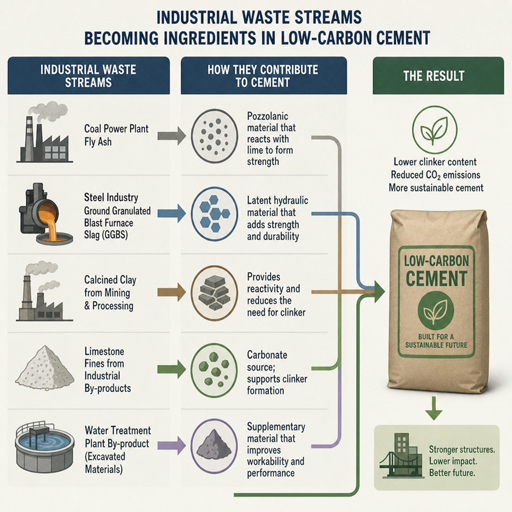
Cement is essential to modern construction, but its production carries a heavy emissions burden. A growing body of research suggests that industrial waste in low-carbon cement can help reduce reliance on virgin limestone and high-clinker formulas while giving hard-to-recycle by-products a more useful second life. The latest studies do not make ordinary cement magically “carbon neutral,” but they do point to a practical route for cement sustainability: use the chemistry already present in waste streams more intelligently.
Can industrial waste really help make lower-carbon cement?
Yes, industrial waste can help make lower-carbon cement when the waste stream has the right mineral composition, is processed safely, and performs reliably in the final binder. A 2026 study on multi-source industrial solid wastes used calcium carbide slag, coal gasification slag, steel slag, and silica fume to produce low-carbon cement clinker under controlled calcination conditions, showing how several by-products can work together rather than being treated as isolated substitutes.
The idea is powerful because cement emissions come from more than kiln fuel. Portland cement depends on clinker, the reactive material made by heating limestone and other raw materials at very high temperatures. The U.S. EPA describes Portland cement manufacturing as an energy-intensive process involving the grinding and heating of raw materials such as limestone, clay, sand, and iron ore; substantial CO₂ is released both from fuel combustion and from calcining limestone.
That is where industrial waste becomes more than a disposal problem. Some by-products already contain useful calcium, silica, alumina, or iron. If those components can partially replace virgin raw materials, reduce the clinker factor, or contribute to alternative binder chemistry, they can support carbon footprint reduction while preserving the performance that builders expect from cement-based materials.
Why cement is so difficult to decarbonize
Cement is hard to clean up because its emissions are built into the chemistry of production. Electrifying a kiln or switching to cleaner fuels can help, but it does not fully eliminate the CO₂ released when limestone is converted into clinker. The International Energy Agency notes that cutting cement emissions is difficult because the sector relies on carbon-containing raw materials and high-temperature heat, and that deeper reductions require measures such as alternative raw materials and carbon capture.
This is why low-emission cement cannot depend on one solution. Energy efficiency, alternative fuels, clinker substitution, better concrete design, recycled materials, and carbon capture all have roles to play. Industrial by-products are especially interesting because they may address two problems at once: reducing the carbon intensity of cement and diverting usable mineral material from disposal.
In practical terms, the most important target is often the clinker-to-cement ratio. Less clinker generally means lower process emissions, provided the replacement materials are available, suitable, and tested for the intended application. That makes sustainable cement a materials science challenge as much as a climate challenge.
The waste materials gaining attention
Not every waste stream belongs in cement. The useful ones tend to be mineral-rich, consistent enough to control, and compatible with cement hydration or clinker formation. Researchers and producers are exploring a wide range of materials, but several categories appear repeatedly in low-carbon cement research.
Common candidates include:
- Steel slag: A by-product of steelmaking that can contain calcium, iron, and silicate phases useful in cement-related systems.
- Coal fly ash and gasification slag: Aluminosilicate-rich materials that may contribute to blended cement or alternative binders, depending on chemistry and quality.
- Ground granulated blast furnace slag: A long-used supplementary cementitious material from iron production that can reduce clinker demand in suitable mixes.
- Silica fume: A fine silicon-rich by-product that can improve density and performance in some cementitious systems.
- Calcium carbide slag: A calcium-rich residue that may serve as an alternative calcium source in certain low-carbon clinker or binder formulations.
- Construction and demolition fines: Recycled mineral powders that may function as fillers or, with the right treatment, more reactive ingredients.
The IEA’s low-carbon cement roadmap identifies industrial by-products such as ground granulated blast furnace slag and fly ash as clinker substitutes, alongside other options such as limestone, gypsum, natural volcanic materials, and calcined clay.
What did the new study add to the conversation?
The important shift is from single-waste substitution to multi-waste design. Instead of asking whether one by-product can replace a fixed percentage of cement, researchers are studying how several wastes can be combined to supply the calcium, silica, alumina, and iron needed for clinker formation or cementitious performance. The 2026 study on multi-source solid wastes examined phase evolution, hydration kinetics, and performance development, which are the kinds of details that matter if low-emission cement is going to move beyond laboratory curiosity.
This matters because waste streams are uneven. One material may be rich in calcium but short on reactive silica. Another may offer silica or alumina but require an activator or blending partner. A multi-waste approach can potentially balance these weaknesses, allowing the final cementitious material to behave more like a designed product than a compromise.
For green construction, that distinction is crucial. Contractors, engineers, and specifiers do not simply need “greener” materials; they need materials with predictable setting, strength development, durability, workability, and compliance with relevant standards. A promising low-carbon binder must earn trust through repeatable performance.
From waste disposal to circular construction
Using industrial waste in low-carbon cement supports a circular construction model. Instead of extracting every ingredient from virgin sources, the cement supply chain can recover value from materials already generated by steel plants, energy facilities, chemical production, or demolition activity. That does not eliminate the need for careful environmental controls, but it changes how waste is viewed.
The circular benefit is especially strong when the waste material is local. Transport can erode climate benefits if heavy mineral materials are moved long distances. Regional availability also affects whether a cement producer can rely on consistent supply at commercial scale. A good laboratory result is encouraging, but a good supply chain is what makes sustainable cement usable in real projects.
For project teams, the practical takeaway is to look beyond a single label. “Green cement” may refer to a blended cement, a low-clinker binder, an alkali-activated material, a carbon-cured product, or a cement paired with carbon capture. The environmental value depends on the full mix design, sourcing, transport, manufacturing energy, and verified performance.
Benefits for carbon footprint reduction
The strongest climate case for industrial waste-based cement comes from avoided clinker and avoided virgin raw material extraction. If a by-product can replace part of the clinker or serve as an alternative raw feedstock, it may lower the emissions associated with both process chemistry and energy demand. The IEA describes reducing the clinker-to-cement ratio as one of the key strategies for cement sector decarbonization, along with efficiency, lower-carbon fuels, and innovative technologies.
Potential benefits include:
- Lower clinker demand: Replacing a portion of clinker with suitable supplementary cementitious materials can reduce the most carbon-intensive part of cement.
- Better material efficiency: Waste-derived ingredients may supply minerals that would otherwise require quarrying and processing.
- Reduced landfill pressure: Beneficial use can divert mineral by-products from disposal, where regulations and material quality allow.
- Improved performance in some mixes: Certain by-products can refine pore structure, improve later-age strength, or enhance durability when used correctly.
- More resilient material supply: Diverse cement ingredients can reduce dependence on a narrow set of virgin raw materials.
These benefits are not automatic. They depend on testing, quality control, emissions accounting, and the specific application. A sidewalk, bridge deck, foundation, precast panel, and marine structure may each place different demands on cement and concrete.
The limits of carbon-neutral cement claims
Carbon-neutral cement is an ambitious goal, but waste-based formulations alone should not be treated as a guaranteed path to neutrality. Lower-carbon cement can cut emissions, but true neutrality usually requires a broader package: reduced clinker, cleaner energy, efficient production, careful mix design, verified carbon accounting, and sometimes carbon capture or durable carbon storage.
This distinction matters for buyers and builders. A cement may be “low-emission” compared with a conventional baseline without being net-zero. Environmental Product Declarations, project specifications, and third-party testing can help separate meaningful carbon footprint reduction from vague sustainability language.
A useful rule is simple: ask what is being reduced, compared with what baseline, and over which boundary. Is the claim based on cement production only, concrete mix design, transport, installation, or full life cycle? Better answers lead to better procurement decisions.
What builders and specifiers should watch
Low-carbon cement is moving quickly, but construction is rightly conservative. Materials must perform for decades, often under moisture, freeze-thaw cycles, chemical exposure, heat, loading, and other stresses. Industrial waste-derived binders need evidence that they are safe, durable, and consistent.
Before specifying a sustainable cement product, teams should check:
- Applicable standards: Confirm whether the cement or concrete mix meets the codes and specifications required for the project.
- Performance data: Review compressive strength, setting time, durability, shrinkage, and workability results for the intended use.
- Material consistency: Ask how the supplier manages variation in waste chemistry and particle size.
- Environmental documentation: Look for transparent carbon data, ideally through an Environmental Product Declaration or comparable disclosure.
- Local availability: Favor materials with reliable regional supply to avoid schedule risk and unnecessary transport emissions.
- Health and safety controls: Ensure potentially problematic constituents are tested and managed under relevant regulations.
This checklist does not slow innovation; it makes innovation buildable. The best low-emission cement products will be those that combine credible climate benefits with ordinary construction confidence.
A realistic path for green construction
The future of cement sustainability will likely be a portfolio, not a single breakthrough. Industrial waste in low-carbon cement is one important piece because it uses existing mineral streams more efficiently. Carbon capture, electrified heat, calcined clay, smarter concrete mixes, recycled aggregates, and performance-based specifications can add further gains.
For architects and developers, the near-term opportunity is to ask for lower-carbon options early in design. For engineers, it is to specify performance rather than defaulting to familiar high-clinker mixes where alternatives would work. For producers, it is to invest in quality control and transparent data so that new binders can be trusted at scale.
The new research is a reminder that waste is often a misplaced resource. When its chemistry is understood and its risks are managed, industrial by-products can help create low-emission cement that supports green construction without abandoning the strength, durability, and familiarity that make cement so widely used.
The takeaway
Industrial waste will not solve cement emissions by itself, and not every waste stream should become a building material. But the research direction is clear: carefully designed waste-based binders can reduce clinker dependence, improve resource efficiency, and support more sustainable cement production. For a sector as carbon-intensive and essential as cement, that makes industrial waste a serious ingredient in the next generation of low-carbon construction.
