

Fusion researchers have proposed a smarter route toward ignition: heat the plasma first, then increase its density, rather than trying to force density upward from the start. The idea comes from new theoretical work at Princeton Plasma Physics Laboratory (PPPL), and it matters because ignition is the point where a plasma can keep itself hot through its own fusion reactions. This is not a working power plant yet, but it is a potentially important shift in how scientists think about the path to practical fusion energy. If you landed here while searching for a “fusion energy drink,” this article is about nuclear fusion—the physics of powering the Sun, not a beverage.
What shortcut did scientists find?
Scientists at PPPL mapped what they describe as a less demanding route to a self-sustaining fusion plasma: raise the plasma temperature first, then add density once the fuel is already hot. In their framework, this route can move through a region called the Cordey saddle, a comparatively accessible point on the boundary between plasma that still needs outside heating and plasma that can sustain its own fusion burn. The work is theoretical, not yet an experimental demonstration, but it gives future fusion technology teams a clearer way to think about how to approach ignition efficiently.
The simplest way to picture it is a mountain pass. Many fusion strategies try to climb the steep face by increasing plasma density and then pouring in heat. The PPPL result suggests there may be a more efficient route around the highest part of the mountain: get the plasma hot first, then increase density after the system is in a better physical state to make use of that added fuel.
That distinction may sound subtle, but in plasma physics subtle ordering can matter. A fusion plasma is not a normal gas sitting calmly in a container. It is a superhot, electrically charged state of matter that must be heated, shaped, stabilized, and confined long enough for nuclei to collide and fuse. Changing the order of operations may change how much external heating is needed and how close a machine can come to ignition before losses and impurities pull it back down.
Why ignition is the central fusion milestone
Ignition is the moment fusion research has been chasing for decades because it marks a transition from “we are heating the plasma” to “the plasma is helping heat itself.” In a deuterium-tritium fusion reaction, the fusion products include helium nuclei and energetic neutrons. In magnetic confinement devices such as tokamaks, the charged helium nuclei can stay in the plasma and contribute heat, while the neutrons carry energy outward that a future power plant would capture as heat for electricity production.
Laboratory fusion requires three broad conditions: very high temperature, enough particle density, and enough confinement time. ITER summarizes the challenge as getting fuel hot enough for energetic collisions, dense enough for collisions to occur often, and confined long enough that the reaction can build rather than immediately fade.
That is why the phrase “shortcut” should not be read as “easy.” Fusion energy remains one of the hardest engineering and scientific projects ever attempted. The shortcut is not a loophole in physics; it is a potentially better path through the same physics.
The Lawson criterion set the finish line
For more than 70 years, researchers have used the Lawson criterion to judge whether a fusion plasma can become self-sustaining. In broad terms, it describes whether the combination of temperature, density, and confinement is good enough for fusion heating to overcome energy losses. PPPL’s new work builds on that older ignition framework by asking a different question: not just where the finish line is, but how to reach it with less wasted effort.
This is a practical change in perspective. A finish line is useful, but it does not tell you whether to sprint straight uphill, follow a switchback trail, or avoid a dangerous ridge. Fusion researchers need all three kinds of knowledge: the target conditions, the route to those conditions, and the engineering choices that keep the route realistic.
Q helps compare different routes
The PPPL team compared possible paths using Q, the ratio of fusion power produced to external heating power supplied. A Q of 5 means the fusion reactions are producing five times as much power as the heating system is delivering to the plasma. In the idealized clean-fuel case described by the researchers, the Cordey saddle appears around Q = 5, though real plasmas can require more because impurities, radiation losses, and magnetic-field effects complicate the picture.
This matters because energy gain can be confusing in public discussions. A plasma can reach a meaningful scientific gain without the entire facility producing net electricity. The 2022 National Ignition Facility experiment, for example, produced more fusion energy from the target than the laser energy delivered to it, but many technologies would still be needed to turn that kind of result into an affordable power system.
Why is nuclear fusion so hard?
Nuclear fusion is hard because positively charged atomic nuclei naturally repel one another, so they must be brought into extreme conditions before they collide and fuse often enough to release useful energy. On Earth, scientists must create those conditions inside machines, while also preventing the hot plasma from touching and damaging surrounding materials. Fusion is attractive because the fuel reactions can release enormous energy without the carbon emissions of fossil fuel combustion, but the path from a successful physics experiment to a reliable clean energy plant is long.
The underlying fuel reaction is conceptually simple. Light atomic nuclei combine to form heavier nuclei, releasing energy in the process. The Sun does this naturally because its enormous gravity creates the pressure and temperature needed for fusion. A power plant on Earth cannot rely on stellar gravity, so it must use magnetic fields, lasers, pulsed power, or other confinement strategies to create a controlled environment where fusion can happen.
For magnetic fusion, the central challenge is control. The plasma must be hot, but the machine around it must survive. It must be dense enough for reactions, but not so unstable that it tears itself apart. It must be confined long enough, but the confinement system cannot consume so much power that the reactor becomes pointless.
The main barriers still facing fusion
A promising route to ignition does not remove the remaining engineering problems. It simply helps researchers think more clearly about one of the most important physics hurdles. Major challenges include:
- Plasma stability: The plasma must avoid disruptions, turbulence, and instabilities that can cool the fuel or stress the device.
- Heat exhaust: A future reactor must safely handle intense heat and particles leaving the plasma, especially near components such as divertors. ITER identifies heat exhaust management as a significant engineering challenge for future tokamak systems.
- Materials durability: Reactor walls and internal components must tolerate high-energy particles, heat loads, radiation, and repeated operation.
- Tritium supply and breeding: Deuterium-tritium fusion depends on tritium, which is scarce and must be bred and managed carefully in a practical reactor. ITER lists the tritium fuel cycle as a key challenge for future D-T fusion power.
- Whole-plant efficiency: A commercial plant must produce more usable electricity than it consumes across magnets, heating systems, pumps, cryogenics, control systems, and maintenance.
- Cost and reliability: The machine cannot merely work once. It must operate often, safely, maintainably, and economically.
That is why measured language is important. The PPPL framework may be a meaningful step, but it is not a headline-ready promise that fusion power will arrive immediately. It is a better map, not the completed journey.
The “heat first, then add fuel” idea in plain English
The new route can be understood as an accessibility problem. Imagine trying to start a campfire with damp wood. One strategy is to pile on more wood immediately and hope a small flame becomes large enough. Another is to build a small, hot core first, then add more fuel once the fire can use it. Fusion plasma is not a campfire, but the analogy captures the logic: adding more fuel too early can increase the burden on the heating system instead of helping the burn.
In a plasma, density is not automatically good. More particles can mean more possible fusion collisions, but they can also mean more radiation losses and more complexity. Heating first may place the plasma closer to a state where added density contributes to fusion power rather than simply making the system harder to heat.
The PPPL result describes a pathway through the Cordey saddle. A saddle, in this context, is like a lower pass between higher peaks. Rather than aiming directly at the most difficult route to ignition, the theory suggests future machines could navigate through a more accessible boundary between externally heated and self-sustaining plasma states.
Why the order of operations matters
Fusion is often summarized as temperature, density, and confinement, but those variables are not independent knobs. Turning one knob can affect the others. Raise density, and you may increase collision opportunities, but you may also change how the plasma radiates energy. Increase magnetic field strength, and you may improve confinement, but the machine becomes more demanding. Add impurities from wall materials, and the plasma may lose energy through radiation.
That is why an ignition route matters. A reactor design needs more than a target number on paper. It needs a sequence of operations that can be executed by real magnets, heating systems, fuel injection systems, diagnostics, and control software.
The “heat first” concept gives researchers a route to test in simulations and, eventually, experiments. PPPL notes that the current work is theoretical because no experiment today reaches the temperatures where the relevant Cordey pass sits. The next step is not to build a power plant around the idea tomorrow; it is to run digital experiments, refine the model, and look for machine designs that could test the approach.
The shortcut depends on real-world plasma conditions
A clean theoretical plasma is easier to model than a reactor plasma. In an ideal world, the fuel contains only what scientists want, the magnetic fields behave exactly as planned, and the walls never add impurities. In a real device, tiny amounts of unwanted material can enter the plasma, and those impurities can radiate energy away.
PPPL’s summary specifically notes that contaminants and extremely strong magnetic fields can shift the Cordey saddle, increasing the Q value needed to reach it. That is a crucial caveat. The shortcut does not erase the impact of tungsten, plasma-facing materials, radiation losses, or high-field design choices. It creates a framework for studying how those realities change the route to ignition.
This is also where the language of “may have found” is doing important work. Science advances through models, predictions, experiments, failures, revisions, and repeated validation. A theoretical shortcut becomes a practical shortcut only when it survives that process.
A useful way to read fusion breakthroughs
Fusion news can be exciting, but it can also be easy to overread. When you see a headline about a breakthrough, ask what kind of breakthrough it is:
- Physics breakthrough: Does it prove a new plasma behavior, ignition condition, or confinement regime?
- Engineering breakthrough: Does it make magnets, materials, lasers, fuel systems, or maintenance more practical?
- Operational breakthrough: Does it show repeatable, controllable performance over meaningful time periods?
- Economic breakthrough: Does it reduce cost, complexity, or plant size enough to change deployment prospects?
- Grid breakthrough: Does it actually deliver electricity reliably to the grid?
The PPPL shortcut is best understood as a physics and modeling advance. It may influence engineering decisions, especially for tokamaks and stellarators, but it has not yet demonstrated grid power.
What this could mean for tokamaks and stellarators
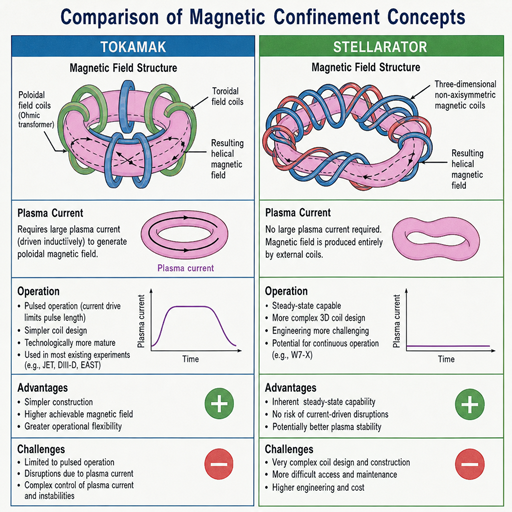
The findings could influence two major magnetic fusion concepts: tokamaks and stellarators. Tokamaks use a doughnut-shaped chamber and strong magnetic fields to confine plasma, while stellarators use more geometrically complex magnetic fields to achieve stable confinement. ScienceDaily’s summary of the PPPL work notes that the findings could affect how researchers think about both types of devices.
For tokamaks, the route to ignition is often tied to strong plasma current, external heating, fueling, and active stability control. A better map of ignition accessibility could help researchers decide how to ramp up a plasma, when to inject fuel, and how to avoid operating points that demand too much external power.
For stellarators, the implications may be different. Stellarators are designed to maintain confinement with externally shaped magnetic fields rather than relying as heavily on plasma current. If the ignition path can be optimized through a heat-first strategy, stellarator designers may use that insight alongside their own strengths in steady-state operation and stability.
The key point is not that one design “wins.” Fusion technology is still broad enough that multiple approaches are worth investigating. Tokamaks, stellarators, inertial fusion systems, magnetized target concepts, and other designs are all trying to solve overlapping but distinct problems.
Fusion progress is coming from several directions at once
The PPPL shortcut is part of a wider pattern: fusion research is advancing because multiple enabling technologies are improving at the same time. Better theory helps scientists map the route. Better simulations let them test more ideas before building hardware. Better magnets can confine plasma more strongly. Better diagnostics reveal what the plasma is doing. Better control systems may respond faster than human operators can.
High-temperature superconducting magnets are one example. MIT reported that a large-scale high-temperature superconducting magnet achieved a 20-tesla magnetic field in a 2021 test, and later analysis described the design and performance in peer-reviewed papers. Stronger magnets can help compact fusion designs by improving confinement, though they also introduce engineering demands around stress, cooling, protection, and reliability.
The National Ignition Facility provides another example from a different branch of fusion research. In December 2022, NIF achieved scientific energy breakeven in an inertial confinement fusion experiment, delivering 2.05 megajoules of laser energy to a target and producing 3.15 megajoules of fusion energy output. That was a historic physics milestone, even though it was not the same as producing net electricity for the grid.
These examples matter because fusion is not waiting on one miracle. It is more like an ecosystem of hard problems gradually becoming less impossible.
The role of simulation and plasma physics
Plasma physics is central because fusion machines are too expensive and complex to improve by trial and error alone. Researchers need models that can predict how a plasma will behave before they build or operate a device. The PPPL framework is exactly that kind of work: it improves the conceptual map so future experiments can be better targeted.
Simulation also helps connect physics to engineering. A route that looks elegant in equations may fail when impurities, wall interactions, heating efficiency, magnetic geometry, or control limits are added. Good modeling exposes those conflicts earlier.
In commercial terms, that can save time. If a design team can rule out inefficient pathways before building hardware, it can focus resources on more promising operating scenarios. That does not guarantee success, but it improves the odds of learning quickly.
Could this change clean energy?
This shortcut could matter for clean energy if it helps future fusion devices reach ignition with less external heating and more realistic operating conditions. Fusion would complement, not replace, renewable energy sources such as solar, wind, geothermal, and hydropower. The appeal is that a successful fusion plant could provide firm, low-carbon power without depending on weather, but practical deployment still depends on solving materials, fuel-cycle, reliability, regulatory, and cost challenges.
It is useful to think of fusion as a potential future clean energy pillar rather than an immediate substitute for today’s renewables. Solar and wind are already being deployed at scale. Fusion is still being developed. The correct comparison is not “fusion versus renewable energy” as if only one can exist; the deeper question is what mix of clean power sources can reliably serve a modern grid.
If fusion becomes commercially viable, it could help with several grid needs. It could provide steady power during long periods of low wind or limited sunlight. It could support industrial loads that need high reliability. It could reduce pressure on storage and transmission systems in some regions. But those benefits remain conditional on building plants that work outside the laboratory.
Fusion’s practical promise
The reason scientists keep pursuing fusion is not hype alone. The potential advantages are unusually attractive:
- Low operational carbon emissions: Fusion reactions themselves do not burn fossil fuels.
- High energy density: Fusion reactions release far more energy per unit of fuel than chemical combustion; ITER states that controlled fusion releases nearly four million times more energy than chemical reactions such as burning coal, oil, or gas.
- Firm power potential: A fusion plant could, in principle, produce electricity on demand rather than only when the sun shines or the wind blows.
- Different risk profile from fission: Fusion does not rely on a chain reaction in the same way nuclear fission plants do, though it still requires serious radiation management, materials handling, and regulatory oversight.
- Long-term fuel possibilities: Deuterium is abundant in water, while tritium can potentially be bred in reactor blankets, though the tritium cycle remains a major engineering challenge.
The promise is real, but so is the gap. The world does not need fusion optimism that ignores engineering. It needs fusion progress that survives engineering.
What has to happen next
The PPPL shortcut now needs to move from theoretical mapping toward testing. That does not necessarily mean one dramatic experiment. More likely, progress will come through a sequence of modeling, simulation, machine design, diagnostic improvement, and experimental campaigns.
A credible next phase would include checking how the heat-first path behaves under less ideal assumptions. Researchers need to know what happens when impurities enter the plasma, when heating is imperfect, when control systems have limits, and when the machine must run for longer periods. The more realistic the model becomes, the more useful the shortcut will be.
A realistic development path
For the shortcut to become practically meaningful, researchers and engineers would need to work through steps such as:
- Refine the theory. Test the framework against more detailed plasma models and a wider range of machine assumptions.
- Run digital experiments. Use simulations to identify operating paths that could pass through the Cordey saddle under realistic constraints.
- Study impurities and radiation losses. Determine how materials such as tungsten shift the ignition route and how much extra performance is needed.
- Match the route to machine designs. Evaluate whether tokamaks, stellarators, or other devices can actually execute the heat-first sequence.
- Design experimental campaigns. Use existing or future machines to test pieces of the strategy, even before full ignition is possible.
- Integrate plant-level engineering. Connect plasma performance to magnets, fueling, heat exhaust, tritium breeding, maintenance, and electricity generation.
- Repeat and validate. Confirm that results are reproducible, controllable, and useful beyond a narrow set of conditions.
This is how fusion advances: not as a single leap, but as a chain of hard-won improvements.
The shortcut is a map, not a power plant
The most balanced interpretation is that scientists may have found a better map to ignition. That is genuinely important. Maps change strategy. They help teams avoid dead ends, compare routes, and spend resources more intelligently.
But a map is not the same as a road, and a road is not the same as a functioning electrical grid. Fusion energy still needs durable materials, reliable confinement, efficient heating, tritium self-sufficiency, maintainable machines, and economics that can compete in the real world.
The encouraging part is that fusion progress is becoming more integrated. The field is no longer only asking whether fusion is physically possible. It is asking how to make the route more efficient, how to build smaller or better machines, how to control plasma in real time, and how to connect the science to energy systems.
Key takeaways
- PPPL researchers proposed a theoretical heat-first, density-second route that may reach fusion ignition more efficiently than some traditional paths.
- The route passes through a region called the Cordey saddle, a lower boundary between externally heated plasma and self-sustaining burning plasma.
- The work builds on the Lawson criterion by focusing not only on the ignition conditions, but also on how to access them.
- The result is not yet an experimental power breakthrough; PPPL states that the work is theoretical and needs further digital and experimental study.
- Fusion could become a major clean energy technology, but it still faces major challenges in plasma control, materials, heat exhaust, tritium breeding, and economics.
- The best way to read this news is with cautious optimism: it may be a better path up the mountain, but the climb is still difficult.
The bottom line
The proposed shortcut to fusion energy is exciting because it changes the question from “What conditions define ignition?” to “What is the smartest route to get there?” That shift matters. If the heat-first approach holds up under more realistic modeling and future experiments, it could guide the design and operation of next-generation fusion machines.
Still, the story is not that fusion has suddenly been solved. The story is that plasma physics may have revealed a more efficient path through one of fusion’s hardest landscapes. For a field where every improvement must fight extreme temperatures, unstable plasmas, demanding materials, and unforgiving economics, a better map is a breakthrough worth taking seriously.
