
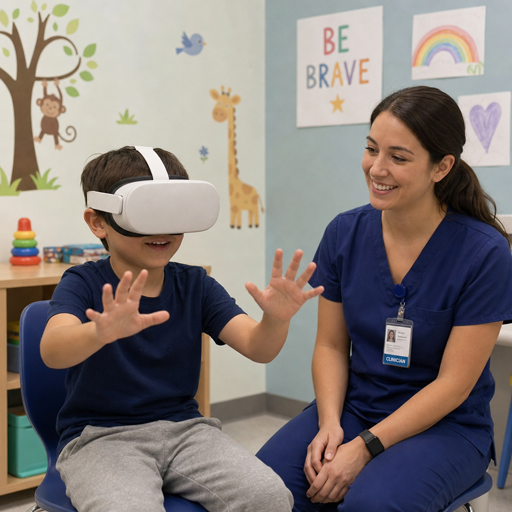
Pediatric virtual reality therapy is moving from “interesting technology” to a practical support tool for children facing pain, anxiety, rehabilitation, or repeated medical procedures. When it is integrated thoughtfully, VR can help children focus on an immersive, age-appropriate experience while clinicians continue to provide standard care, safety monitoring, and human reassurance. The goal is not to replace therapy, medication, preparation, or clinical judgment; it is to add a flexible layer of engagement that can make care feel less frightening and more manageable.
For hospitals, clinics, therapists, and pediatric care teams, the real question is no longer whether vr for kids is exciting. It is how to introduce it responsibly, measure whether it helps, and make sure the child’s comfort remains more important than the device.
How does pediatric VR therapy work?
Pediatric VR therapy works by placing a child inside a computer-generated environment that captures attention, encourages interaction, and can reduce awareness of distressing surroundings. In medical settings, VR is often used as a distraction during procedures such as needle-related care, dressing changes, dental treatment, imaging preparation, or other moments when pain and anxiety may increase. In therapeutic settings, it may also support relaxation, exposure-based exercises, movement practice, or coping-skill rehearsal when guided by trained professionals.
The basic mechanism is simple: attention is limited. When a child is deeply engaged in a calming underwater world, a game-like breathing exercise, or a virtual adventure, less attention may be available for the sensation, sound, or anticipation of a procedure. Systematic reviews have found that VR can reduce pain and anxiety for pediatric patients during a range of medical procedures, though the strength of evidence varies by procedure, study design, and outcome measure. (pmc.ncbi.nlm.nih.gov)
That distinction matters. VR is not magic, and it is not a universal fit for every child. The best programs treat virtual reality children’s care as a clinical workflow, not a novelty. They define when VR is appropriate, who introduces it, how the headset is cleaned, what content is used, how discomfort is handled, and how outcomes are recorded.
The evidence base is promising but still developing
Interest in pediatric virtual reality therapy has been building for decades. One often-cited early example is the virtual reality therapy pediatric patients 2004 feasibility study published as A Pilot and Feasibility Study of Virtual Reality as a Distraction for Children With Cancer. That study examined VR distraction during port access procedures for pediatric cancer patients, comparing VR with non-VR distraction and no distraction. (pubmed.ncbi.nlm.nih.gov)
Since then, the literature has expanded across pediatric pain, anxiety, needle procedures, burn care, dental care, oncology-related procedures, perioperative preparation, and rehabilitation. A 2019 systematic review and meta-analysis reported that VR was used mainly as distraction during venous access, dental, burn, and oncological care, with findings supporting reduced pain and anxiety in pediatric medical procedures. (pmc.ncbi.nlm.nih.gov) An updated review later concluded that VR can be a useful tool for reducing pain and anxiety in pediatric patients compared with usual care, while also noting the need for careful study design and pediatric-specific evaluation. (pmc.ncbi.nlm.nih.gov)
More recent reviews continue to add nuance. For example, an umbrella review focused on needle-related procedures found directionally consistent benefits for self-reported pain, fear, and anxiety, but also pointed to limitations such as overlapping primary studies and variable review quality. (pmc.ncbi.nlm.nih.gov) In plain language, the signal is encouraging, especially for selected short procedures, but teams should avoid overstating certainty. Pediatric VR should be implemented as an evidence-informed adjunct with ongoing evaluation, not as a guaranteed outcome.
Where VR fits in pediatric care
The strongest use cases tend to share a few characteristics: the child can safely wear a headset, the experience is short enough to remain comfortable, the clinical team can still access the body part being treated, and the VR content matches the child’s developmental level. Integration is usually easier when VR is attached to a specific moment in care rather than offered vaguely as a “technology option.”
Common pediatric use cases include:
- Needle-related procedures: Blood draws, IV starts, injections, port access, and similar procedures are natural candidates because they are brief, anxiety-provoking, and often repeated.
- Dressing changes and wound care: VR may help shift attention during uncomfortable care, especially when paired with appropriate analgesia and trauma-informed communication.
- Dental visits: Immersive distraction may support cooperation during selected procedures, provided the headset does not interfere with access, positioning, or safety.
- Preoperative preparation: VR can help some children rehearse an unfamiliar environment or practice relaxation before surgery.
- Imaging preparation: For children who need to stay still, VR-based education or simulation may help them understand what to expect before an MRI or similar scan.
- Rehabilitation and movement practice: Game-like environments can make repetition feel more engaging, though therapeutic goals should always guide the activity.
- Relaxation and coping skills: Calming scenes, guided breathing, or interactive mindfulness exercises may support emotional regulation when supervised appropriately.
The value of VR is often greatest when it turns a passive, scary moment into an active experience. A child is not merely being told to “hold still” or “think about something else.” They are exploring, choosing, breathing, reaching, looking, listening, and participating.
What makes VR different from ordinary distraction?
VR differs from ordinary distraction because it can surround the child’s visual and auditory attention more fully than a toy, tablet, book, or conversation. A video on a screen competes with the room; immersive VR can temporarily make the room feel less dominant. That sense of presence is part of why clinicians and researchers are interested in virtual reality children’s interventions for procedural distress.
Still, ordinary distraction remains valuable. Bubbles, music, storytelling, caregiver coaching, topical anesthetics, child life support, and clear explanations can all be effective parts of pediatric care. VR should not push these tools aside. In many cases, the best approach is layered: prepare the child, involve the caregiver, manage pain medically when indicated, use developmentally appropriate language, and add VR when it fits the clinical moment.
A helpful way to think about pediatric virtual reality therapy is not “VR versus everything else.” It is “VR as one option in a comfort toolkit.” Some children will love it. Some will prefer to watch what is happening. Some may feel uneasy with a headset covering their eyes. Respecting those differences is central to ethical integration.
A practical integration plan for clinics and care teams
Successful VR adoption depends less on the headset itself and more on the system around it. A clinic can buy impressive equipment and still fail if no one knows where it is stored, how to clean it, when to offer it, or what to do when a child says they feel dizzy. A simple implementation plan keeps the technology useful rather than chaotic.
1. Define the clinical purpose first
Before choosing hardware or content, identify the problem VR is meant to solve. Is the goal to reduce needle anxiety? Improve cooperation during dressing changes? Support relaxation during infusion visits? Help children rehearse coping skills? A clear purpose prevents the program from becoming an unfocused gadget project.
Strong goals are specific and observable. For example, a pediatric clinic might aim to offer VR distraction to eligible children during routine blood draws. A therapy practice might use VR only for structured relaxation exercises after screening for sensory sensitivity. A rehabilitation team might use interactive movement-based VR when it supports an existing treatment plan.
2. Select appropriate patients and moments
Not every child or procedure is a good fit. Children vary in age, temperament, sensory tolerance, medical complexity, vision needs, developmental level, trauma history, and ability to follow instructions. Some may need a gradual introduction. Others may prefer non-headset distraction.
A basic screening process should consider:
- Whether the child can understand and agree to try VR in an age-appropriate way.
- Whether the headset fits comfortably and safely.
- Whether the procedure allows the child to look away from the clinical field.
- Whether the child has a history of motion sickness, dizziness, seizures, severe nausea, or sensory distress that requires extra caution.
- Whether the caregiver and clinician can still communicate with the child.
- Whether the child can remove the headset or signal discomfort quickly.
Screening does not need to be complicated, but it must be consistent. The safest programs make opting out easy and normal.
3. Build consent and assent into the workflow
Children should not feel tricked into using VR. They need a simple explanation: what the headset does, what they will see, how long it may last, and how they can stop. Caregivers should also understand that VR is supportive, not a replacement for necessary pain control or clinical care.
A child-friendly introduction might sound like this: “This headset can take you into a game or calm place while we do the quick poke. You are still in the room with us. If you want to stop, raise your hand or say ‘stop,’ and we will help you take it off.”
That kind of language gives the child control. It also reduces the risk that VR becomes another thing happening to them rather than something they choose to use.
4. Choose content with care
Content selection is one of the most overlooked parts of pediatric VR integration. The best experience is not always the most exciting one. For medical procedures, overly intense games, fast motion, jump scares, competitive pressure, or visually busy scenes can increase arousal rather than calm it.
Look for content that is:
- Age-appropriate and easy to understand.
- Short enough for the procedure.
- Calm or gently engaging rather than overwhelming.
- Simple to launch without complicated menus.
- Free of frightening imagery, aggressive themes, or unexpected sensory intensity.
- Compatible with seated or reclined positioning when needed.
- Designed so the child does not need large movements that could interfere with care.
For younger children, guided exploration or simple interactive worlds may work better than complex tasks. For adolescents, autonomy matters; giving them a choice between a few approved experiences can increase buy-in.
5. Train staff for both technology and communication
Staff training should cover more than “turn it on.” The team needs to know how to introduce VR, fit the headset, monitor the child, troubleshoot common problems, clean the equipment, document use, and stop the session quickly. They also need to know when not to use it.
A short staff checklist can help:
- Confirm eligibility and caregiver awareness.
- Explain the experience to the child in plain language.
- Check headset fit and comfort.
- Start the content before the most stressful part of the procedure when possible.
- Keep verbal contact with the child.
- Watch for signs of discomfort, nausea, panic, or overheating.
- End the session gently and reorient the child to the room.
- Clean and store the device according to policy.
- Record whether VR was used and how the child responded.
When staff feel confident, VR becomes smoother for the child. When staff feel rushed or uncertain, the headset can add stress.
Safety, comfort, and equity must guide adoption
Good pediatric VR programs are cautious without being fearful. They acknowledge that children are not small adults. Headset fit, interpupillary distance, hygiene, content intensity, communication, and emotional readiness all matter. Emerging research has also raised pediatric-specific considerations around headset compatibility and fit, reinforcing the need to treat equipment setup as part of the clinical method rather than an afterthought. (arxiv.org)
Comfort should be monitored continuously. A child who becomes quiet is not always calm; they may be overwhelmed. A child who laughs may still need pain control. A child who initially agrees may change their mind halfway through. The team should treat “stop” as an immediate instruction, not a negotiation.
Equity is another important piece. If VR is available only to certain families, certain appointment times, or children who appear “easy,” the program may unintentionally widen gaps. Clinics should think through language access, disability accommodations, sensory needs, cleaning turnaround, and staff availability. If the program is being evaluated, data should be reviewed to see who is offered VR and who actually uses it.
Privacy and data practices also deserve attention. Some VR platforms collect usage data or require accounts. Pediatric care teams should understand what information is captured, where it goes, and whether the platform fits organizational privacy expectations. When in doubt, choose simpler setups with minimal data exposure.
Measuring whether the program helps
A VR program should be evaluated in ways that are realistic for the setting. The goal is not to turn every clinic into a research lab, but teams should be able to answer basic questions: Is VR being used? With whom? During which procedures? Does it appear to help? Are there problems? Do staff find it feasible?
Useful measures may include:
- Child-reported pain or anxiety: Simple age-appropriate scales before and after the procedure can provide meaningful feedback.
- Caregiver observations: Parents and caregivers can often comment on whether the child seemed more relaxed or more willing to return.
- Staff feedback: Clinicians can report whether VR made care easier, harder, or neutral.
- Procedure flow: Teams can note whether setup time is reasonable and whether the device interferes with clinical tasks.
- Completion and tolerance: Track whether sessions are completed, stopped early, or declined.
- Adverse effects: Record nausea, dizziness, fear, headache, equipment problems, or emotional distress.
- Repeat-use patterns: Children who return for repeated procedures may show whether VR remains helpful after novelty fades.
The most useful evaluation is honest. If VR helps during blood draws but not during longer appointments, that is valuable information. If one headset model is hard to clean quickly, workflow can change. If adolescents prefer one type of content while younger children prefer another, the library can be adjusted.
Common integration mistakes to avoid
Pediatric VR can fail for preventable reasons. Many of these mistakes come from treating VR as entertainment rather than a care intervention.
Avoid these pitfalls:
- Introducing VR too late. If the headset appears only after the child is already highly distressed, it may be harder for them to engage. Whenever possible, introduce it calmly before the peak stress moment.
- Using content that is too intense. Fast motion, loud sounds, or competitive games can backfire, especially for anxious or sensory-sensitive children.
- Assuming every child wants immersion. Some children feel safer watching the clinician. Others want a caregiver’s hand, a countdown, or full information about each step.
- Forgetting clinical communication. A headset should not isolate the child from the team. Staff should continue explaining, checking in, and offering control cues.
- Skipping cleaning protocols. Shared devices need clear infection prevention procedures, especially in pediatric and immunocompromised settings.
- Overpromising results. Families should hear that VR may help with distraction and coping, not that it will eliminate pain or fear.
- Failing to document outcomes. Without tracking, teams cannot improve the program or justify continued use.
Avoiding these mistakes keeps the focus where it belongs: on the child’s experience, safety, and dignity.
What should families know before trying VR for kids?
Families should know that VR for kids in healthcare is usually used as an add-on comfort strategy, not a stand-alone medical treatment. It may help a child feel more engaged, distracted, or calm during selected procedures, but it should be paired with appropriate clinical care, preparation, and pain management when needed. Parents and caregivers should feel comfortable asking what content will be used, how the device is cleaned, whether the child can stop at any time, and what alternatives are available.
A family can also help the care team personalize the experience. For example, a caregiver might mention that the child dislikes loud sounds, loves ocean scenes, becomes nauseated in cars, or feels anxious when they cannot see the room. These details can shape whether VR is offered and which experience is selected.
After the session, families can debrief gently. Instead of asking, “Did it hurt?” try asking, “What helped you get through that?” or “Would you want to use the headset again next time?” This shifts the conversation toward coping, confidence, and choice.
The future of pediatric virtual reality therapy is practical, not flashy
The next stage of pediatric virtual reality therapy will likely be less about novelty and more about thoughtful integration. As hardware becomes more accessible and content libraries improve, the differentiator will be clinical quality: screening, staff training, child-centered design, measurement, privacy, and equitable access.
Research will continue to refine which children benefit most, which procedures are best suited to VR, how long sessions should last, and how immersive content compares with other distraction and coping tools. Reviews already suggest promise for pediatric pain and anxiety, while also reminding clinicians to pay attention to study quality and real-world feasibility. (pmc.ncbi.nlm.nih.gov)
The most effective programs will not present VR as a futuristic replacement for compassionate care. They will use it to support the same goals pediatric teams have always had: helping children feel safer, giving them developmentally appropriate control, reducing distress where possible, and making necessary care easier to tolerate.
Key takeaways for responsible integration
Pediatric VR is most useful when it is treated as a structured clinical support rather than a gadget. A strong program starts small, learns from real use, and keeps the child’s experience at the center.
Remember these essentials:
- Match VR to a clear clinical purpose.
- Screen children for comfort, fit, communication, and safety.
- Use age-appropriate content that supports calm engagement.
- Preserve caregiver involvement and clinician communication.
- Pair VR with standard care, not instead of it.
- Train staff on setup, monitoring, cleaning, and documentation.
- Measure outcomes honestly and adjust the program over time.
Pediatric virtual reality therapy has real potential because it meets children in a language they often understand: play, imagination, movement, and choice. When integrated with care, humility, and evidence-informed practice, it can become more than a headset. It can be one more way to help children face difficult moments with support and confidence.