
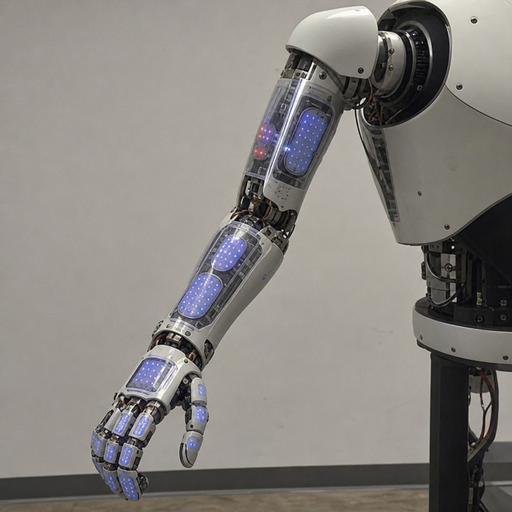
Sensor-covered humanoid robot skins are changing how machines understand and respond to the physical world. Instead of relying only on cameras, microphones, or a few isolated touch points, these systems spread robot sensors across arms, hands, torsos, legs, and sometimes the face to create a more complete sense of contact, pressure, temperature, and movement. For ai robots designed to work near people, that extra layer of awareness can make interaction more natural, safer, and more adaptable.
As advanced robotics moves from controlled labs into homes, hospitals, warehouses, schools, and public spaces, the outer surface of a robot becomes more than a shell. It becomes a communication layer, a safety feature, and a design challenge all at once.
What are sensor-covered humanoid robots?
Sensor-covered humanoid robots are human-shaped machines fitted with distributed sensors across their exterior surfaces, allowing them to detect touch, force, proximity, motion, and other environmental signals. In simple terms, the robot’s “skin” helps it feel what is happening around its body, not just see it from a camera mounted in its head.
This matters because humanoid robots are built to operate in spaces made for people. They may need to pick up fragile objects, move through crowded rooms, assist someone with limited mobility, or react when a person accidentally bumps into them. A robot with limited sensing may continue its motion unless its main vision system detects a problem. A robot with a sensor-covered surface can potentially register contact immediately and adjust its behavior.
The word “skin” can be a little misleading. These systems are not always soft, lifelike, or human in appearance. In many cases, the skin is a layered technical surface that combines flexible materials, wiring, embedded electronics, and protective coverings. Some designs prioritize realistic touch, while others focus on durability, modular repair, or industrial performance.
The role of robot sensors in physical intelligence
Robot sensors are the bridge between mechanical motion and intelligent behavior. Cameras help a robot recognize objects and navigate a room, but touch and force sensors help it understand what happens when it actually interacts with the world. That difference is crucial, because real environments are full of soft materials, uneven surfaces, moving people, and objects that do not behave exactly as expected.
A humanoid robot might visually identify a cup, but it still needs to know how firmly to grip it. It may see a chair, but it needs to notice when its leg brushes against that chair while turning. It may plan a smooth arm movement, but it needs to stop or soften the motion if a person’s hand enters the path.
Sensor technology adds this missing feedback loop. Instead of executing a movement blindly after a command is given, the robot can monitor what its body experiences during the action. That is one reason sensor-covered humanoid robots are so important to the future of practical ai robots: they support real-time correction, not just pre-planned movement.
Common sensing functions may include:
- Pressure detection: Helps a robot understand how hard it is touching or gripping something.
- Tactile sensing: Gives feedback about contact location, texture, or surface variation.
- Proximity sensing: Allows a robot to detect nearby objects or people before direct contact.
- Temperature sensing: Can help identify heat sources or avoid unsafe contact.
- Force and torque sensing: Measures physical loads through joints, limbs, or contact points.
- Motion and strain sensing: Tracks bending, stretching, deformation, or posture changes in flexible surfaces.
Each sensor type contributes a different piece of awareness. The challenge is not just collecting the data, but combining it into decisions the robot can act on quickly and reliably.
Why does robotic skin matter for human interaction?
Robotic skin matters because human environments are physical, unpredictable, and full of subtle contact. A robot that can feel pressure, detect touch, and respond to unexpected contact is better suited for close-range interaction than one that relies only on vision or fixed programming.
People communicate through touch more often than they realize. A hand on the shoulder can signal attention. A light push can mean “move this way.” A blocked motion can indicate discomfort or danger. For humanoid robots to work comfortably around people, especially in caregiving, education, reception, or collaborative work, they need ways to interpret these physical cues without overreacting or ignoring them.
A sensor-covered surface can also help prevent awkward or unsafe behavior. If a robot reaches for an object and touches a person’s sleeve instead, tactile feedback can trigger a pause. If it is carrying something and detects uneven pressure, it can adjust its grip. If it collides lightly with furniture, it can modify its path before the situation becomes more serious.
This is where robot design becomes deeply connected to trust. People are more likely to feel comfortable around humanoid robots when those robots move with awareness and restraint. A machine that stops when touched, yields space, and handles objects gently feels less mechanical and more socially acceptable, even if it does not look perfectly human.
How sensor-covered surfaces are designed
The outer layer of a humanoid robot has to do several jobs at once. It must protect internal parts, preserve the robot’s range of motion, support sensing accuracy, and fit the intended appearance of the machine. Those requirements can pull designers in different directions.
A soft surface may make the robot feel more approachable and improve contact sensing, but it may wear down faster in demanding settings. A harder shell may be easier to clean and protect, but it can limit tactile sensitivity. A highly detailed sensor network can provide rich data, but it can also increase complexity, cost, and maintenance demands.
Layered materials and flexible electronics
Many sensor-covered skins use layered construction. The outer layer may be a flexible protective material. Beneath that, sensing elements detect pressure, stretch, or electrical changes caused by touch. Deeper layers may include wiring, signal processing hardware, and structural components that connect the skin to the robot’s frame.
Flexible electronics are especially important because humanoid robots bend at shoulders, elbows, wrists, hips, knees, and fingers. If the sensing layer cracks, stretches unpredictably, or loses calibration during motion, the robot’s awareness becomes less reliable. Good design must account for repeated movement, compression, cleaning, and accidental impact.
Sensor placement and density
Not every area of a robot needs the same level of sensitivity. Hands and fingers may require fine tactile sensing because they handle objects and interact directly with people. Arms, shoulders, and torso panels may need broader pressure and collision detection. Feet and legs may focus on balance, contact with the floor, and safe walking.
This creates a practical design question: where does high-resolution sensing deliver the most value? Covering every surface with dense sensors may sound ideal, but it can create data overload and maintenance challenges. A thoughtful robot design places the right sensors in the right locations based on the robot’s tasks.
Comfort, appearance, and usability
A humanoid robot’s surface is also part of its user experience. In a factory, a clearly mechanical look may be acceptable or even preferred. In a clinic or home, softer contours, warmer materials, and less intimidating shapes may matter more. The same sensor technology can feel very different depending on how it is packaged.
Designers must also think about cleaning, repair, and replacement. A skin that looks impressive but is difficult to maintain may not be practical. Modular panels, accessible connectors, and durable materials can make sensor-covered humanoid robots easier to service over time.
Benefits of sensor-covered humanoid robots
The biggest benefit of distributed sensing is not that a robot gains one new ability. It is that many everyday actions become more controlled, responsive, and context-aware. In advanced robotics, small improvements in feedback can have large effects on how useful a robot feels in the real world.
Key benefits include:
- Safer movement near people: Contact sensors can help a robot slow, stop, or redirect when it touches a person or object unexpectedly.
- More delicate object handling: Tactile and pressure feedback can support better grip control when objects are fragile, soft, slippery, or irregular.
- Improved balance and posture: Sensors in feet, legs, and body panels can contribute to awareness of weight distribution and contact points.
- More natural interaction: A robot that responds to a tap, hand placement, or physical guidance can feel easier to work with.
- Better task adaptation: Real-time feedback helps robots adjust when conditions differ from the original plan.
- Reduced reliance on vision alone: Tactile sensing can still provide useful information when cameras are blocked, lighting is poor, or objects are partially hidden.
These benefits are especially relevant when humanoid robots are expected to share space rather than operate behind barriers. The closer robots get to people, the more important body-wide awareness becomes.
Where this technology could be useful
Sensor-covered humanoid robots have potential across many environments, but the strongest use cases are places where physical interaction is frequent, variable, and sensitive. The goal is not to make every robot humanlike for its own sake. The goal is to help machines work more effectively in human-centered spaces.
Healthcare and assisted living
In care environments, robots may need to deliver items, provide reminders, guide movement, or support routine tasks. A sensor-covered exterior could help a robot detect when someone touches it for balance, when an arm movement is blocked, or when it has made contact with bedding, furniture, or medical equipment.
This does not replace human care, and it should not be treated as a shortcut around empathy or professional judgment. But better sensing can make assistive ai robots more cautious and responsive in settings where physical safety and emotional comfort are both important.
Warehouses and industrial spaces
In warehouses, humanoid robots may work around shelves, carts, packages, and employees. Full-body sensing can help with collision awareness and object handling, especially in spaces that change throughout the day. A robot that detects side contact or pressure on its arm can react faster than one waiting for a camera to interpret the scene.
Industrial settings may prioritize ruggedness over lifelike appearance. In these cases, robotic skin may look more like durable sensor armor than soft human skin. The design focus is reliable feedback under repeated use.
Homes, hospitality, and public spaces
In homes and service environments, robots may need to move among people who are not trained to interact with machines. Touch-responsive surfaces can make basic interaction more intuitive. A person might tap a robot to get its attention, guide it gently out of the way, or expect it to pause when bumped.
For these settings, appearance and behavior are closely linked. The robot should not only sense contact but respond in a way that feels calm and predictable. That response is part of the overall experience, not just a technical function.
The main challenges still facing robotic skin
Despite the promise, sensor-covered humanoid robots are difficult to build well. The outer surface is exposed to the messiness of real life: dust, moisture, impact, wear, repeated bending, cleaning products, and unpredictable human behavior. A system that works in a controlled demonstration may need significant refinement before it becomes dependable in daily operation.
Important challenges include:
- Durability: Sensors must keep working after repeated motion, pressure, and accidental bumps.
- Calibration: The robot needs consistent readings over time, even as materials stretch or age.
- Data processing: A body-wide sensor network can produce large amounts of information that must be interpreted quickly.
- Power and wiring: Sensors need energy and communication pathways without making the robot bulky or fragile.
- Repairability: Damaged skin sections should be practical to replace without rebuilding the entire robot.
- Privacy and trust: As robots collect more environmental data, designers must consider what is captured, stored, and shared.
- Cost: More sensing can increase complexity, so designers must balance capability with practical deployment.
These are not small obstacles. They shape whether sensor technology becomes a useful feature or an expensive burden. The most successful designs will likely be those that match the sensing system to the robot’s real tasks rather than adding sensors everywhere simply because it is possible.
What should designers prioritize?
Designers should prioritize reliable sensing, safe behavior, and practical maintenance over novelty. A sensor-covered surface is valuable only if it helps the robot make better decisions in real situations, not if it merely looks futuristic.
A practical design process starts with use cases. What will the robot touch? Who will touch the robot? How often will the skin be cleaned, repaired, or replaced? What kinds of contact should trigger a stop, a soft response, or no response at all? These questions keep the technology grounded in human needs.
For teams working on advanced robotics, a useful checklist may include:
- Define the robot’s main physical interactions before choosing sensor types.
- Put higher sensing density where touch accuracy matters most, such as hands or forearms.
- Use durable materials in high-wear zones, even if they are less visually impressive.
- Design for repair from the beginning with modular panels or replaceable sections.
- Test reactions to accidental contact, not only planned touch gestures.
- Make robot responses visible and understandable, such as slowing, pausing, or changing posture.
- Avoid collecting unnecessary data if the same task can be completed with simpler sensing.
Good robotic skin is not just an engineering layer. It is part of the robot’s behavior, safety model, and relationship with users.
The future of touch-aware ai robots
The next generation of ai robots will likely depend on better physical awareness as much as better software. Language, vision, and planning are powerful, but they do not solve the basic problem of moving safely through a world filled with people and objects. Touch-aware robot design gives machines another channel for understanding that world.
As sensor technology improves, humanoid robots may become better at tasks that require gentle handling, close collaboration, and responsive movement. Their surfaces may become more flexible, easier to repair, and more capable of interpreting different kinds of contact. The most meaningful progress will not be robots that simply imitate human skin, but robots that use sensing to behave more safely and helpfully.
Sensor-covered humanoid robots represent a shift in how we think about machine intelligence. Intelligence is not only in the processor, the camera, or the software model. It is also in the body: in the way a robot feels pressure, notices contact, adjusts its grip, and respects the space around it.
Final takeaway
Sensor-covered humanoid robot skins bring together robotics, materials science, artificial intelligence, and human-centered design. They give humanoid robots a richer understanding of physical interaction, making them better suited for environments where people and machines work side by side.
The technology still faces real challenges, from durability and cost to privacy and maintenance. But its direction is clear: if robots are going to share our spaces, they need more than vision and movement. They need the ability to sense contact, respond thoughtfully, and make physical interaction feel safer, smoother, and more natural.