
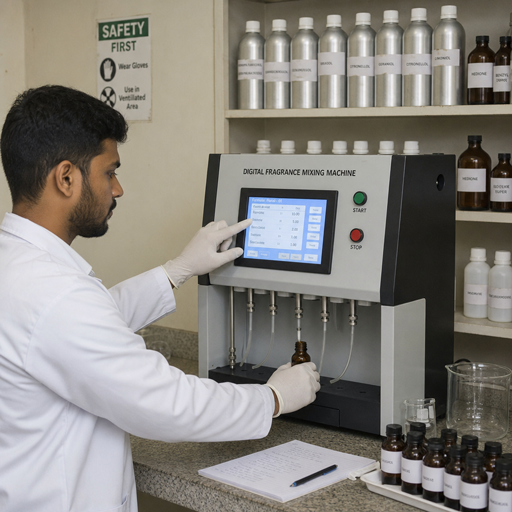
Fragrance creation is moving toward a more flexible, data-aware, and repeatable model. Precision custom fragrance mixing machines help brands, labs, retailers, and scent-focused businesses blend aromatic components with greater control, making it easier to develop custom scent solutions without relying only on manual measurement. For companies that want personalization, consistency, and faster sampling, this technology can become a practical bridge between creative perfumery and operational efficiency.
What makes precision custom fragrance mixing machines useful?
Precision custom fragrance mixing machines are useful because they bring structure to a process that has traditionally depended on careful hand-weighing, manual documentation, and repeated trial adjustments. A machine cannot replace the creative judgment of a perfumer, but it can help execute formulas accurately, reduce avoidable handling errors, and make small-batch experimentation more manageable. The result is a workflow where creative decisions remain human, while repetitive measuring and dispensing tasks become more consistent.
At a practical level, these systems are designed to measure and dispense fragrance ingredients according to a defined formula. Depending on the setup, they may support different ingredient reservoirs, adjustable dosing, digital formula storage, and repeatable batch preparation. That matters because fragrance work often involves very small amounts of concentrated materials, where a slight variation can change the character of the finished scent.
For growing businesses, the value is not only technical. Precision mixing can also support a better customer experience. A boutique, private label brand, hotel, spa, cosmetics company, or home fragrance studio can offer more personalized options while maintaining a controlled process behind the scenes.
The shift from standard scents to custom scent solutions
Consumers and businesses increasingly expect scent to feel intentional rather than generic. A signature fragrance can shape how a space, product, or brand is remembered. That is why custom scent solutions are used across categories such as personal fragrance, skincare, candles, diffusers, hospitality, retail environments, and corporate gifting.
Traditional fragrance development can still be the right path for complex launches, especially when a brand needs deep creative direction, regulatory review, stability testing, and large-scale manufacturing support. However, not every project starts at that level. Many businesses first need to test ideas, create variations, personalize a base concept, or produce limited batches.
Precision equipment can help in those early and mid-stage workflows by making customization more practical. Instead of treating every variation as a fully manual project, teams can work from structured formulas and adjust specific elements. For example, a brand might create a core floral scent and then offer lighter, warmer, fresher, or more woody versions based on customer preferences.
This does not mean every fragrance should be endlessly customized. Too many choices can confuse customers and complicate production. The strongest programs usually combine creative boundaries with personalization: a clear scent family, a small number of adjustable notes, and a reliable mixing process.
How the mixing process supports consistency
A good fragrance experience depends on repeatability. If a customer loves a scent today, they expect the next bottle, candle, or diffuser refill to smell familiar. Precision custom fragrance mixing machines help support that expectation by following defined measurements rather than relying entirely on manual recreation.
Consistency begins with a formula. Each component has a role, whether it adds brightness, depth, softness, freshness, sweetness, diffusion, or lasting character. When those components are measured consistently, the final scent is more likely to stay aligned with the intended profile.
A more controlled mixing workflow can support:
- Formula accuracy: Digital or programmed measurements help reduce variation between samples and batches.
- Faster iteration: Teams can adjust one part of a formula and compare versions without rebuilding everything from memory.
- Cleaner documentation: Saved formulas and batch records make it easier to revisit successful blends.
- Reduced waste: More accurate dispensing can limit overuse of costly materials during testing.
- Scalable learning: New team members can follow an established process instead of relying only on informal notes.
Even with precision tools, quality control still matters. Ingredients need to be stored properly, equipment must be cleaned according to the material being used, and formulas should be reviewed for safety and suitability. Machines improve process control, but they work best inside a disciplined fragrance development system.
Where these machines fit in the fragrance workflow
Precision fragrance mixing is not one single use case. Different businesses use equipment in different parts of the scent journey, from rapid prototyping to retail personalization. Understanding the workflow helps clarify whether the technology is a convenience, a growth tool, or a core part of the business model.
Product development and sampling
During development, teams often need to compare multiple versions of a fragrance. One version may emphasize citrus top notes, another may deepen the amber base, and another may soften the overall sweetness. Precision mixing can make those comparisons easier by producing measured variations from a controlled starting point.
This is especially helpful when teams are working with perfumers, evaluators, marketers, or clients who need to smell differences clearly. Instead of wondering whether a sample changed because of the formula or because of an inconsistent measurement, the team can focus on the creative result.
Retail and on-demand personalization
In a retail setting, custom scent solutions can become part of the customer experience. A shopper might choose a fragrance family, select preferred accents, and leave with a personalized scent blended on site. The machine supports the experience by making the process feel smooth, repeatable, and less dependent on improvisation.
For this model to work well, the menu should be simple. Customers do not need access to every raw material. They need guided choices that feel personal without becoming overwhelming.
Small-batch production
Some businesses use precision custom fragrance mixing machines for limited runs, seasonal scents, event gifts, or test-market products. In these situations, flexibility matters. The business may not need a large manufacturing batch yet, but it still needs reliable output that can be labeled, evaluated, and repeated if demand grows.
Small-batch production also gives brands room to learn. They can observe which scent profiles customers prefer before committing to larger inventory decisions.
What should businesses consider before investing?
Businesses should consider their formula complexity, production volume, ingredient handling needs, staff workflow, and customer experience goals before investing in fragrance mixing equipment. The best machine is not simply the most advanced option; it is the one that fits the way the business develops, sells, and repeats fragrance products. A thoughtful buying process can prevent underused equipment, operational bottlenecks, or a personalization model that is too complicated to maintain.
Before choosing a system, it helps to ask practical questions:
- What will the machine actually produce? Clarify whether it will be used for perfume samples, home fragrance oils, cosmetic fragrance bases, room scents, or another application. Different products may require different handling and compliance considerations.
- How many ingredients need to be available? A broad palette can support creativity, but it can also increase cleaning, storage, and training demands. Many businesses do better with a focused ingredient set.
- Will customers interact with the process? If the machine is part of a public-facing experience, design, speed, noise, cleanliness, and ease of explanation all matter.
- How will formulas be stored and protected? Formula management is valuable for repeat orders, internal training, and brand consistency. Businesses should think about who can create, edit, and access formulas.
- What safety practices are needed? Fragrance materials can be concentrated and must be handled responsibly. Staff should understand labeling, storage, cleaning, spill response, and any applicable product requirements.
The decision should connect back to business strategy. A machine can enable personalization, but the offer still needs clear positioning, appealing scent design, and a process customers can understand.
Benefits beyond accurate dispensing
Accuracy is the most obvious benefit, but it is not the only one. When used well, precision fragrance equipment can improve the entire rhythm of product creation. Teams spend less time repeating basic measurements and more time evaluating scent quality, customer feedback, and market fit.
For creative teams, this can reduce friction. A perfumer or product developer can test a structured set of ideas more efficiently. For operations teams, it can create clearer procedures and more predictable output. For customers, it can make personalization feel polished rather than improvised.
There is also a branding advantage. A guided custom scent experience can feel premium because the customer sees that their preferences are being translated into a real formula. The machine becomes part of the story, but it should not overshadow the fragrance itself. The emotional value still comes from the finished scent and the meaning attached to it.
Common mistakes to avoid
Precision tools work best when they are paired with clear thinking. A business can have sophisticated equipment and still create a confusing or inconsistent fragrance program if the surrounding process is weak.
Avoid these common mistakes:
- Offering too many choices: A long list of notes can make customers uncertain. Curated options usually feel more confident.
- Skipping formula discipline: If staff make undocumented changes, repeatability disappears.
- Ignoring ingredient behavior: Some materials are stronger, heavier, more persistent, or more sensitive than others. Precision dosing helps, but evaluation is still essential.
- Treating the machine as the brand: Technology can support the experience, but the scent concept, packaging, service, and story also matter.
- Undertraining staff: Operators should understand both the equipment and the basics of fragrance handling.
A better approach is to build a simple, repeatable system. Start with a defined scent library, create a limited set of customization paths, document every formula, and evaluate results before expanding the offer.
Practical ways to use fragrance personalization
Custom scent solutions can be applied in many settings, but the most successful uses tend to have a clear purpose. Personalization should solve a real customer or brand need, not exist only because the technology is available.
A few practical applications include:
- Signature scent programs for hotels, spas, boutiques, or offices that want a memorable atmosphere.
- Personal fragrance bars where customers create a scent from guided families such as fresh, floral, woody, or warm.
- Limited-edition product drops for candles, diffusers, body care, or gifting.
- Event activations where attendees receive a customized fragrance as a keepsake.
- Product development labs that need efficient sampling and formula comparison.
- Private label testing for brands exploring new scent directions before larger production.
In each case, the technology supports a larger goal: making fragrance more relevant, memorable, and repeatable.
The future of fragrance is both creative and controlled
Precision custom fragrance mixing machines show how the fragrance industry can combine artistry with better process control. They make it easier to explore variations, offer personalization, and repeat successful blends without removing the need for human taste, evaluation, and brand judgment.
For businesses exploring custom scent solutions, the most important step is to define the experience first. Know who the scent is for, how much choice they should have, and what level of consistency the business needs. With the right process around it, precision mixing technology can help turn fragrance from a fixed product into a flexible, personal, and scalable experience.