
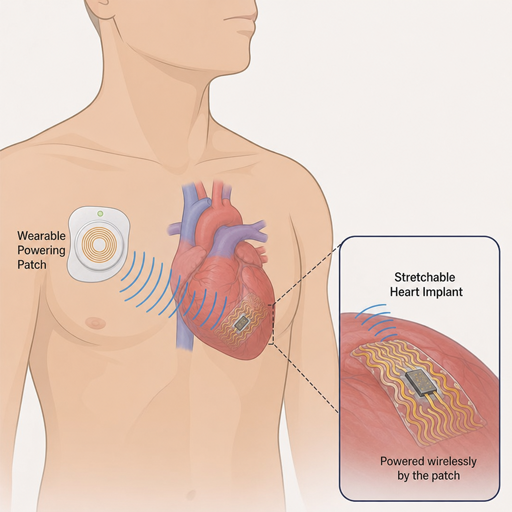
Soft, wireless medical implants are moving closer to a practical future: devices that can bend, stretch, and stay powered while the body moves. A recently reported wearable-to-implant power system from researchers at the Institute for Basic Science, Seoul National University, and collaborators is designed to keep energy flowing to stretchable implantable devices even when alignment and shape change. The work points toward a future where medical device power can be less dependent on bulky batteries, rigid hardware, or wires that limit how implants fit living tissue.
Why is wireless power for medical implants so difficult?
Wireless power for medical implants is difficult because the human body is not a fixed charging dock. Tissue moves, organs shift, muscles contract, and soft electronics may stretch or bend after implantation. Traditional wireless charging technology often works best when a transmitter and receiver stay close, aligned, and stable; inside the body, that neat geometry can quickly fall apart.
That challenge becomes even more important as implantable devices become softer. Soft bioelectronics can conform to tissue, which may reduce mechanical mismatch and help the device maintain contact with the body. But the same flexibility that makes an implant more tissue-friendly can also change the receiver’s shape, orientation, and coupling with the external power source.
In simple terms, the problem is not only getting power through the skin. It is getting enough usable energy to the right place while the patient breathes, moves, heals, and lives normally.
The new system pairs a wearable transmitter with a stretchable receiver
The reported system uses two main parts: a wearable transmitter outside the body and a stretchable receiver integrated into the implant. Energy travels wirelessly between them, without a physical lead passing through the skin. The receiver uses liquid metal to maintain conductivity during deformation, while the transmitter adapts as the coupling between the two parts changes.
This matters because stretch and misalignment often happen at the same time. A patient’s movement could shift the external device, while the implant itself bends or elongates with tissue. A system built only for one “perfect” position may lose efficiency or stop working reliably under those conditions.
The researchers applied a principle known as parity-time symmetry to help stabilize energy transfer. In this context, the transmitter uses amplification and feedback to adjust its operating frequency as the relationship between transmitter and receiver changes. That makes the power link more tolerant of real-world variation rather than dependent on a rigid setup.
How could stretch-tolerant wireless charging technology change implant design?
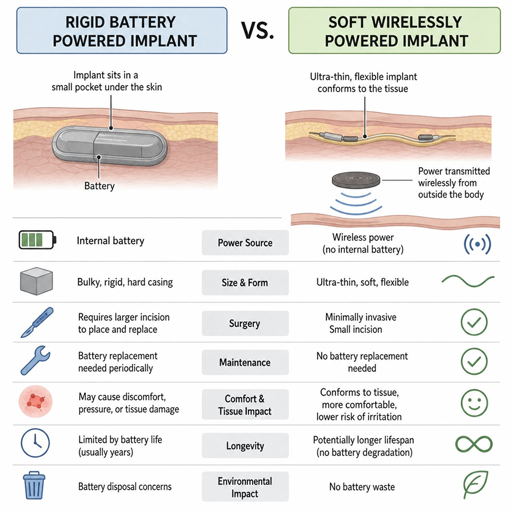
Stretch-tolerant wireless charging technology could let engineers design implants around the body’s movement instead of forcing the body to accommodate rigid hardware. If wireless medical implants can receive power reliably while deforming, they may become thinner, softer, and better suited for organs or tissues that constantly move. That shift could be especially important for cardiac, neurological, sensing, and drug-delivery devices.
The research team initially used the system to develop a wirelessly powered cardiac pacemaker. In animal experiments with pigs, the implant reportedly controlled heartbeats and maintained pacing despite deformation and alignment changes; the work remains preclinical and would require further testing, including human clinical trials, before any clinical use.
The broader idea is a wireless power interface for rechargeable battery operated medical implants or battery-light devices that need ongoing energy without frequent surgery. Instead of designing every implant around a large internal power source, developers could explore smaller implanted electronics paired with an external wearable power patch. That could help separate the therapeutic function of the implant from the bulk and lifespan limits of the battery.
What makes this different from earlier wireless medical implant research?
This development focuses on powering soft implants under stretching and misalignment, while earlier approaches have often focused on depth, miniaturization, communication, or battery-free operation. For example, MIT researchers have explored wireless systems that power and communicate with devices deep inside the body using radio-frequency waves, and MIT Media Lab researchers more recently reported a tiny injectable magnetoelectric antenna for deep-tissue implants.
That context is useful because searches such as “mit creates wireless power system for medical implants” often point to a larger trend rather than one single invention. MIT’s work has shown how wireless power might support tiny implants, smart pills, neuromodulation, or deep-tissue devices. The newer stretch-tolerant system addresses a related but distinct issue: keeping power stable when the implant is soft, moving, and deforming.
Together, these research directions show why medical device power is becoming a central design question. The future of implantable devices is not only about better sensors or smarter stimulation. It is also about how those devices receive energy safely, comfortably, and consistently.
Practical benefits researchers are trying to unlock
Wireless power for medical implants is not just a convenience feature. It could influence device size, patient comfort, surgical burden, and the kinds of therapies engineers can realistically build. The promise is strongest when power delivery becomes reliable enough to support daily movement and long-term use.
Potential benefits include:
- Smaller implanted hardware: Reducing dependence on large batteries may allow some implants to become thinner or less invasive.
- Better mechanical fit: Soft receivers can move with tissue instead of resisting it, which may be valuable for organs that stretch or contract.
- External serviceability: A wearable transmitter can be adjusted, replaced, or upgraded more easily than an implanted battery.
- Support for closed-loop therapy: Future systems could combine wireless power with sensing and communication so an implant can monitor signals and respond with therapy.
- More flexible placement options: If power transfer tolerates misalignment, clinicians and engineers may have more freedom in where and how devices are positioned.
The most exciting use cases are likely to involve implants that need regular or continuous power but also need to remain soft. A rigid device may be acceptable in some areas of the body, but the heart, gut, muscles, and nerves present more dynamic environments.
The safety and clinical hurdles are still significant
Promising laboratory and animal results do not automatically translate into approved implantable devices. Wireless medical implants must meet demanding expectations for biocompatibility, power control, heating, durability, infection risk, and long-term reliability. Any system that transfers energy through tissue also has to be evaluated carefully for safety under realistic conditions.
The newly reported stretchable system still needs more assessment before health care use. The Tech Xplore report notes that additional testing, including human clinical trials, would be needed before the technology could be used in clinical settings.
There are also practical design questions. How comfortably can a patient wear the transmitter? How precisely must it be placed? What happens during sleep, exercise, bathing, or device displacement? How does the implant perform after months or years of mechanical stress? These are not objections to the technology; they are the questions that determine whether an elegant engineering system becomes a dependable medical product.
What to watch next in medical device power
The field is moving toward implants that are not only wireless, but also adaptive. Instead of relying on one fixed power condition, future systems may adjust to tissue motion, device position, and changing therapeutic needs. That is where stretch-tolerant designs, injectable antennas, RF-powered microdevices, and magnetoelectric approaches may each play a role.
Key developments to watch include:
- Integrated sensing and therapy: Researchers are exploring implants that can record physiological signals and deliver stimulation or treatment in response.
- Power plus data links: A power system becomes more useful when the implant can also send information back to an external wearable.
- Miniaturized receivers: Smaller receivers could open the door to less invasive devices, but miniaturization must be balanced with energy needs.
- Real-world alignment tolerance: Systems must work outside ideal lab positions, especially for active patients.
- Long-term materials performance: Stretchable conductors, encapsulation layers, and electrodes must survive repeated motion inside the body.
For clinicians, engineers, and medical technology companies, the lesson is clear: power architecture should be considered early in implant design. The battery, receiver, transmitter, and data pathway are not separate accessories. They shape the entire therapeutic experience.
A step toward softer, more capable implantable devices
This new stretch-tolerant approach does not mean every implant will soon be battery-free or wirelessly powered. It does suggest that wireless power for medical implants is becoming more realistic for soft, moving systems that older charging designs were not built to support. By pairing a wearable transmitter with a deformable receiver, researchers are addressing one of the most practical barriers to next-generation implantable devices.
The direction is important: medical implants are becoming more like living systems in how they fit, flex, sense, and respond. To make that possible, wireless charging technology must become just as adaptable. If future testing supports safety and reliability, stretchable wireless power could help turn flexible electronics into practical long-term medical tools.
