
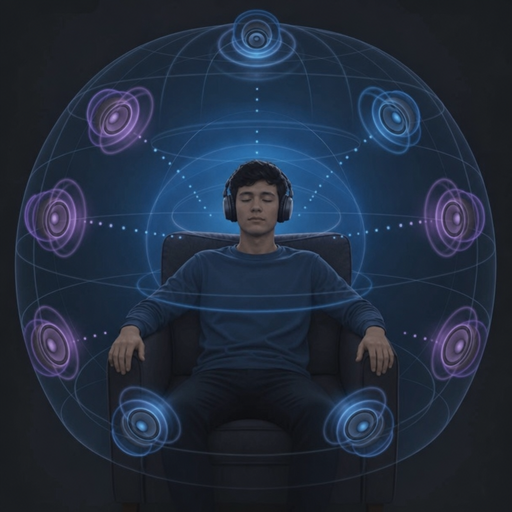
Zero-latency spatial audio brings immersive sound into moments where timing matters: gaming, live performance, virtual production, collaboration, training, and interactive media. It combines the depth of spatial audio with the immediacy people expect from real-world listening, so sound feels positioned, responsive, and believable instead of delayed or disconnected. For creators, developers, and listeners, the goal is simple: a richer sound experience without the lag that breaks presence.
What is zero-latency spatial audio?
Zero-latency spatial audio is audio technology designed to make directional, three-dimensional sound respond so quickly that the listener does not perceive a delay. In practice, “zero-latency” is an ideal rather than a magic number; every digital system has some processing time. The point is to keep that delay low enough that movement, interaction, and sound remain tightly aligned.
Traditional stereo places sound between left and right channels. Surround sound expands that field with speakers around the listener. 3d audio goes further by creating the impression that sounds can come from above, below, behind, nearby, or far away, often using headphones, speaker arrays, or object-based mixing. When spatial audio becomes low-latency, the listener can turn, move, react, or perform without feeling that the sound is catching up.
That responsiveness is what makes the technology so compelling. A footstep behind you in a game, a singer monitoring their own voice, or a trainee responding to a simulated emergency all depend on timing as much as direction. If the spatial effect is beautiful but late, the illusion collapses.
Latency is the hidden barrier to immersion
Immersive sound is not only about detail, volume, or dramatic effects. It is about trust. The brain constantly compares what it sees, feels, and hears; when those signals line up, the environment feels natural. When sound arrives late, even by a noticeable fraction, the listener may not describe the problem technically, but they will feel that something is off.
This matters most in interactive settings. A film viewer can accept carefully mixed spatial effects because the sound is locked to a fixed timeline. A gamer, musician, VR user, or remote collaborator creates the timeline in real time. Every head turn, button press, spoken word, or instrument note changes what the system must deliver next.
Latency also affects performance. Musicians may struggle to stay in time if monitoring is delayed. Competitive players may react slower if directional cues do not match the action. In training simulations, a delayed sound cue can weaken realism and reduce confidence. Zero-latency spatial audio addresses these issues by treating speed as part of the creative experience, not merely a technical specification.
How does spatial audio create a more realistic sound experience?
Spatial audio creates a more realistic sound experience by simulating how people hear sound in physical space. It accounts for direction, distance, reflection, movement, and sometimes the shape of the listener’s head and ears. Instead of sending the same flat mix to everyone, it can place audio objects in a virtual environment and update their position as the listener or scene changes.
Several ideas work together to create this effect:
- Direction: Sounds are positioned around the listener, not just balanced left or right.
- Distance: Volume, tone, and reflections help suggest whether something is near, far, open, or enclosed.
- Elevation: 3d audio can make sound feel as if it is coming from above or below, which stereo cannot convincingly do on its own.
- Motion: Moving sounds can travel through the space smoothly, helping users track action with their ears.
- Environment: Reverb and early reflections can make a room, street, arena, cave, or virtual world feel more believable.
The best spatial mixes do not call attention to themselves constantly. They guide the listener. A subtle sound behind the shoulder can build tension, a voice placed slightly ahead can feel intimate, and an overhead effect can make a digital scene feel taller and more open.
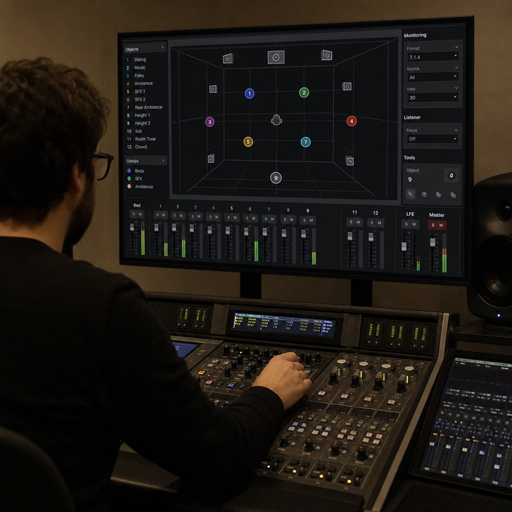
The difference between surround sound, spatial audio, and 3d audio
Surround sound, spatial audio, and 3d audio are related, but they are not identical. Surround sound usually refers to a channel-based setup, such as speakers placed in front, beside, and behind the listener. It can be powerful and cinematic, especially in controlled environments, but it often depends on a fixed listening position and predefined speaker layout.
Spatial audio is a broader concept. It focuses on placing sound in space, whether through speakers, headphones, or virtual rendering. It can be channel-based, object-based, binaural, or adaptive. Instead of asking only, “Which speaker should play this?” spatial audio asks, “Where should this sound appear to be?”
3d audio is often used to describe sound with height and depth, not just horizontal placement. It helps create a sphere of sound around the listener. In many contexts, people use “spatial audio” and “3d audio” interchangeably, but 3d audio usually emphasizes full three-dimensional positioning.
A useful way to think about the distinction:
|
Term |
Main idea |
Common use case |
Key limitation |
|---|---|---|---|
|
Stereo |
Left-right sound image |
Music, podcasts, basic media |
Limited sense of space |
|
Surround sound |
Multiple speaker channels around the listener |
Home theater, cinema, games |
Often tied to fixed layouts |
|
Spatial audio |
Sound positioned in a perceived space |
Headphones, XR, interactive media |
Quality depends on rendering and tracking |
|
3d audio |
Sound with width, depth, and height |
VR, simulation, advanced games |
Can feel unnatural if latency or mix is poor |
Zero-latency spatial audio matters across all of these because timing affects every format. Even the most advanced sound field loses impact if it does not respond naturally.
Why zero-latency matters in real-world use
The value of zero-latency spatial audio becomes clearest when sound is connected to action. If you are passively listening to a pre-rendered track, a small amount of processing delay may not matter much. If you are moving through a virtual space, performing live, or responding to another person, delay becomes part of the experience.
Gaming and esports
In games, sound is often information. A reload click, a vehicle approaching from the left, or a footstep above the player can influence a decision before anything appears on screen. Spatial audio helps players locate those cues, while low latency helps them trust the timing.
For casual players, this can make worlds feel more alive. For competitive players, it can support faster orientation and cleaner reactions. The benefit is not only dramatic immersion; it is the practical ability to understand where events are happening without looking directly at them.
Virtual reality and mixed reality
VR and mixed reality depend on presence. When a user turns their head, the sound field should update instantly enough to feel anchored in the virtual or blended environment. If the visual scene moves but the audio lags, the brain notices the mismatch.
Low-latency 3d audio helps virtual objects feel stable. A hovering drone should remain in the correct spot as the user turns. A voice in a training scenario should stay attached to the person speaking. These details make digital environments feel less like a screen and more like a place.
Music creation and live performance
Performers are especially sensitive to timing. A singer hearing their voice late in the monitor may pull back, rush, or lose confidence. A guitarist using spatial effects in a live rig needs those effects to feel connected to the instrument, not pasted on afterward.
Zero-latency spatial audio can support more expressive monitoring and performance design. Instead of a flat cue mix, musicians may hear bandmates, click tracks, or effects placed in a more intuitive sound field. That can reduce clutter and help each performer focus.
Remote collaboration and communication
Video calls and virtual meetings often flatten voices into the same narrow space. Spatial audio can separate speakers by position, making conversations easier to follow. When latency is kept low, it also helps preserve natural turn-taking.
This is especially useful when many people are speaking, brainstorming, reviewing designs, or working in shared virtual rooms. A more realistic sound experience can reduce fatigue because listeners do not have to work as hard to identify who is speaking.
The building blocks of low-latency immersive sound
Zero-latency spatial audio is not achieved by one feature alone. It depends on the full signal chain, from capture and processing to playback and tracking. A system is only as responsive as its slowest meaningful stage.
Key building blocks include:
- Efficient audio processing Spatial rendering, effects, and mixing must happen quickly. Heavy processing can add delay, especially if the system is trying to simulate complex environments in real time.
- Fast head or position tracking In headphone-based spatial audio, the system may need to know where the listener is looking. If tracking updates slowly, the sound field can drift or feel detached.
- Optimized hardware paths Interfaces, chips, drivers, and wireless links all contribute to latency. Professional systems often prioritize stable, predictable performance over unnecessary processing layers.
- Smart buffering choices Buffers help prevent glitches, but larger buffers can increase delay. Low-latency systems balance reliability with responsiveness.
- Playback designed for the format Headphones, earbuds, speaker arrays, and soundbars reproduce spatial cues differently. The playback device must support the intended sound experience convincingly.
- Content mixed with space in mind Technology cannot rescue a confusing mix. Sounds need clear placement, appropriate movement, and enough contrast for the listener to understand the space.
When these parts work together, the result feels effortless. The listener does not think about rendering, buffers, or object metadata. They simply hear a world that reacts as expected.
Practical tips for creating better spatial audio content
Creators do not need to make every sound fly around the listener. In fact, overusing spatial movement can become distracting. The strongest immersive sound design usually begins with intention: what should the listener notice, feel, or understand?
Use this checklist when planning spatial audio content:
- Define the listener’s perspective. Decide whether the audience is an observer, a participant, a performer, or a character inside the scene.
- Anchor important sounds. Voices, alerts, and key interactions should be easy to locate and should not move without purpose.
- Leave room in the mix. Spatial separation works best when sounds are not fighting for the same frequency and position.
- Use height sparingly. Overhead sound can be powerful, but constant vertical motion may feel artificial.
- Test on real playback devices. A mix that works on studio monitors may translate differently to earbuds, headphones, or consumer speakers.
- Check latency in context. Do not evaluate delay only as a number; test whether actions, visuals, and sounds feel connected.
- Avoid novelty effects. Movement should serve the story, task, or interaction rather than simply proving the system can move sound.
For interactive projects, it is also wise to prototype early. Spatial decisions can affect interface design, player behavior, scene layout, and performance requirements. Waiting until the final mix may reveal problems that are harder to fix.
Common mistakes that weaken the effect
Spatial audio can be impressive, but poor execution makes it tiring or confusing. One common mistake is treating immersive sound as a layer added at the end. If the project was designed around flat audio, spatial cues may feel decorative rather than useful.
Another mistake is ignoring the center of attention. When too many elements compete from all directions, the listener may feel surrounded but not guided. Immersion should not mean chaos. The mix still needs hierarchy, contrast, and restraint.
Latency is also easy to underestimate. A demo may sound impressive when the listener sits still, but problems appear once head tracking, live input, or real-time interaction begins. The more interactive the experience, the more important it is to test motion, timing, and responsiveness together.
Finally, creators sometimes assume that more technology automatically creates a better result. Advanced audio technology helps, but the emotional impact still comes from thoughtful choices. The best spatial audio supports the moment so naturally that the listener forgets the system is there.
Where zero-latency spatial audio is headed
The future of zero-latency spatial audio is likely to be shaped by more personal, adaptive, and interactive listening. As devices become faster and rendering becomes more efficient, spatial sound can become less of a premium effect and more of a normal part of digital media.
Personalization will play a major role. People hear spatial cues differently, so systems that adapt to the listener may create more convincing results. At the same time, creators will need workflows that make immersive sound easier to design, preview, and deliver across many devices.
The biggest shift may be cultural rather than technical. Audiences are becoming more comfortable with sound that moves, responds, and surrounds them. As expectations rise, flat or delayed audio may feel increasingly out of place in interactive media. Zero-latency spatial audio points toward experiences where sound is not background decoration, but a responsive part of the environment.
A better sound experience starts with timing
Immersive sound depends on more than spaciousness. It depends on timing, clarity, and the listener’s ability to believe what they hear. Zero-latency spatial audio brings those pieces together by making surround sound, 3d audio, and spatial rendering feel immediate enough for real interaction.
For creators, the practical takeaway is to design for responsiveness from the beginning. Choose tools and workflows that protect timing, test on the devices your audience will use, and give every sound a reason to exist in space. When immersive audio reacts naturally, the technology disappears—and the experience takes over.
