
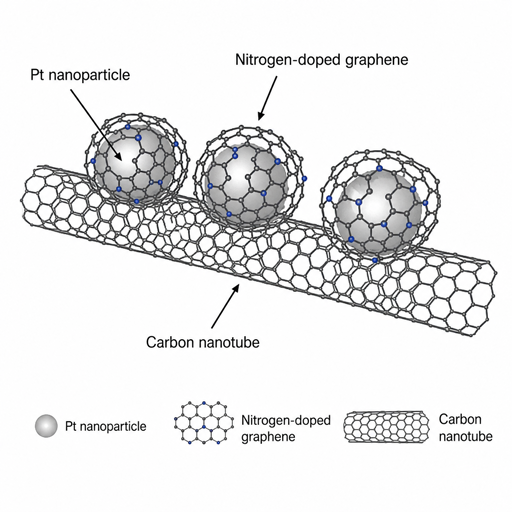
Platinum in fuel cells is powerful, expensive, and vulnerable to wear, which is why catalyst durability matters so much for the future of hydrogen fuel cells. A recent Nagoya University study points to a promising materials design: wrapping platinum nanoparticles in nitrogen-doped graphene and supporting them on single-walled carbon nanotubes. In practical terms, platinum fuel cells nitrogen-enhanced graphene research is about helping the same precious metal work longer, resist degradation, and support cleaner energy solutions with less waste.
Why does platinum matter so much in hydrogen fuel cells?
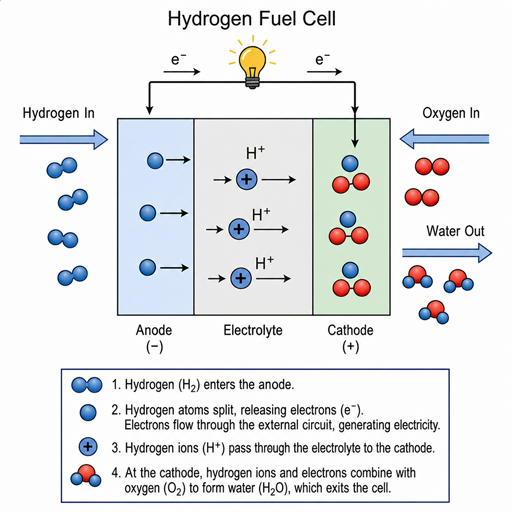
Platinum matters because it helps the fuel cell reactions happen fast enough to produce useful power. In a hydrogen fuel cell, hydrogen is split into protons and electrons at one electrode; the electrons travel through an external circuit, while the protons pass through a membrane and later combine with oxygen and electrons to form water. The U.S. Department of Energy describes platinum as the catalyst that enables hydrogen splitting at the anode and oxygen reduction at the cathode in PEM fuel cells.
That is the strength of platinum and hydrogen fuel cells, but it is also a bottleneck. Platinum is a scarce precious metal, so using it inefficiently raises cost and complicates scaling. The deeper challenge is that fuel cells do not simply need platinum to perform well on day one; they need it to survive years of starts, stops, load changes, humidity shifts, and voltage cycling.
The durability problem behind clean hydrogen power
Hydrogen fuel cells are often discussed as clean energy solutions because, when hydrogen is converted to electricity in the cell, the direct byproduct is water rather than carbon dioxide. DOE notes that hydrogen can support transportation, stationary power, data centers, backup power, buses, and heavy-duty trucks, depending on how the broader system is designed and how the hydrogen is produced.
Inside the cell, however, the catalyst layer operates in a harsh electrochemical environment. Platinum nanoparticles can migrate, merge into larger particles, or lose active surface area. Carbon supports can corrode under repeated high-voltage conditions, especially during start-stop operation. When that happens, fuel cell efficiency drops because less catalyst surface is available to drive the oxygen reduction reaction.
The practical issue is simple: better performance is not enough if the catalyst degrades too quickly. For commercial vehicles, stationary systems, and other demanding uses, durability can be just as important as peak output.
How the nitrogen-enhanced graphene wrapper works
The Nagoya University team developed a catalyst called Pt@N-FLG/SWCNT, short for nitrogen-doped few-layer graphene-shell-encapsulated platinum electrocatalysts supported by single-walled carbon nanotubes. The design places platinum nanoparticles inside a thin nitrogen-containing graphene shell and anchors the wrapped particles on nanotube supports.
Graphene acts like a protective layer around the platinum, helping reduce direct exposure to conditions that drive particle movement and clumping. Nitrogen doping is the key twist. Rather than simply blocking access to the platinum, nitrogen atoms in the graphene shell interact with platinum and change how oxygen-containing molecules behave at the catalyst surface. The ACS Catalysis paper reports that Pt–N interactions reduced platinum’s 5d hole population and oxidation state, modulating the d-band center in a way connected to improved oxygen reduction activity.
In plain English, the wrapper is not just armor. It is a tuned interface. The catalyst still needs to let the reaction proceed, while protecting the metal from the kinds of structural changes that shorten catalyst life. That balance is what makes platinum fuel cells nitrogen-enhanced graphene research especially interesting.
What the new catalyst achieved in testing
The reported numbers are notable because they combine activity and durability. In laboratory measurements, Pt@N-FLG/SWCNT showed an electrochemical surface area of 96.3 square meters per gram, compared with 60.6 square meters per gram for a commercial catalyst cited by Nagoya University. In the ACS Catalysis abstract, the material also showed mass activity of 369 mA per milligram at 0.9 V versus reversible hydrogen electrode, exceeding commercial Pt/C in the reported rotating disk electrode test.
Durability was the headline. After 30,000 accelerated durability test cycles, the catalyst retained 96.9% of its electrochemical surface area and recorded a voltage loss of 22.8 mV at 0.8 A/cm². In a separate high-voltage triangular-wave cycling test designed to stress the carbon support, Nagoya University reported no voltage loss at 1.5 A after 5,000 cycles.
A useful way to read the results:
- More exposed active surface: Smaller, stable platinum structures provide more usable catalytic area per gram.
- Less clumping: Imaging suggested the nanotube support restricted platinum movement and helped prevent the large agglomerates often associated with aged catalysts.
- Stronger support durability: Single-walled carbon nanotubes contributed chemical stability under aggressive testing.
- Better path to lower platinum demand: If more platinum remains active for longer, future systems may be able to reduce precious-metal loading without sacrificing lifespan.
Why this matters for fuel cell efficiency and cost
Fuel cell efficiency depends on many factors: membrane design, gas flow, water management, heat control, stack engineering, and the catalyst layer. The catalyst does not determine everything, but it strongly affects how easily the oxygen reduction reaction proceeds at the cathode. Since oxygen reduction is relatively slow, improving the catalyst can reduce losses that limit usable voltage and power.
The cost angle is equally important. Platinum in hydrogen fuel cells is valuable because it performs reactions that cheaper materials often struggle to match under real operating conditions. But if a system needs too much platinum, or if the platinum loses surface area too quickly, the economics become harder. More durable fuel cells platinum catalyst designs can help by making each gram of platinum work harder over a longer service life.
This is why researchers often target two goals at once: higher activity and longer durability. Activity helps reduce the amount of platinum needed to achieve a given output. Durability helps keep that performance from fading. The Nagoya team’s work is promising because the nitrogen-doped graphene shell supports both ideas in one structure.
The role of carbon nanotubes in the design
The graphene wrapper gets most of the attention, but the single-walled carbon nanotube support is also important. Conventional carbon supports can corrode during high-voltage events, and support corrosion can destabilize platinum nanoparticles. If the support weakens, even a good catalyst can lose contact, movement control, and usable surface area.
Nagoya University reported that the team used corrosion-resistant single-walled carbon nanotubes supplied by Meijo Nano Carbon Co., Ltd. The researchers also found that the graphene-encapsulated platinum attached well without linkers, a discovery described as accidental by lead investigator Miftakhul Huda.
That detail matters because catalyst manufacturing is often as much about practical integration as it is about chemistry. A material can be impressive in principle, but if it requires fragile processing or complicated connectors, scale-up becomes harder. Direct attachment does not guarantee commercialization, but it gives researchers a cleaner platform to refine.
Where this could fit among clean energy solutions
Hydrogen fuel cells are not a universal replacement for batteries, combustion engines, or grid-connected electrification. Their strongest potential tends to appear where long runtime, fast refueling, high utilization, or heavy payload requirements make batteries more challenging. DOE has identified hydrogen and fuel cells as relevant for applications such as heavy-duty trucks, buses, data centers, energy storage, and backup power.
For those use cases, catalyst life is not a minor technical footnote. A fleet vehicle or stationary system has to justify its total cost over time. If the stack degrades quickly, maintenance and replacement can outweigh operational benefits. If the catalyst lasts longer, the system has a better chance of becoming practical.
This is also where clean hydrogen production matters. A fuel cell can produce only water at the point of use, but the climate value depends on the upstream hydrogen pathway. Catalyst improvements do not solve hydrogen production, storage, or infrastructure challenges. They do, however, improve one of the core technologies that would use clean hydrogen once it is available.
What still needs to happen next
The research is encouraging, but it is not the same as a finished commercial product. The study demonstrates strong laboratory performance and durability under accelerated testing. The next questions involve manufacturability, repeatability, integration into full-scale stacks, performance under varied operating conditions, and cost at volume.
Key areas to watch include:
- Lower platinum loading: The Nagoya team has stated an interest in increasing performance while decreasing the amount of platinum needed for scale-up.
- Real-world drive-cycle testing: Heavy-duty use involves changing loads, temperatures, humidity, and shutdown events.
- Stack-level validation: A catalyst layer that performs well in controlled tests must also work reliably inside complete systems.
- Production simplicity: Materials that require fewer complex processing steps have a better chance of moving beyond the lab.
- Lifecycle impact: Better catalyst durability should be evaluated alongside hydrogen sourcing, recycling, and overall system efficiency.
A small wrapper with large implications
Platinum remains central to many hydrogen fuel cells because it is exceptionally effective at driving key electrochemical reactions. The problem is not that platinum fails to work; it is that it must work longer, with less material, under tougher conditions. Nitrogen-doped graphene encapsulation offers a smart route: protect the nanoparticle, tune its chemistry, and stabilize it on a more durable carbon support.
The broader takeaway is that fuel cell efficiency will not come from one breakthrough alone. It will come from many improvements across catalysts, membranes, stacks, hydrogen supply, and system design. Still, platinum fuel cells nitrogen-enhanced graphene research shows how nanoscale engineering can address a very practical challenge: making clean energy solutions last long enough to matter.
