
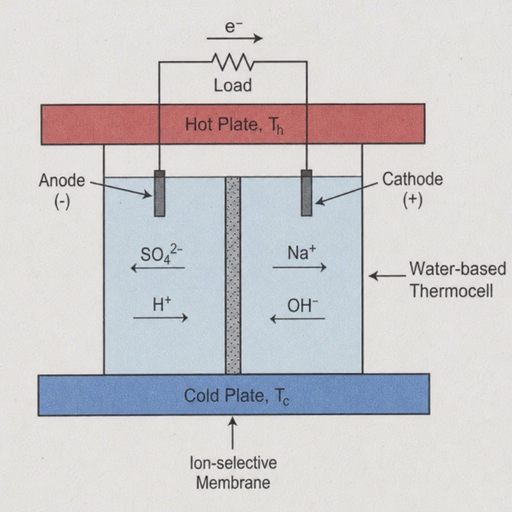
Water-based cells waste heat electricity research is moving from promising lab concept toward more realistic performance testing. A new method from researchers at National Taiwan University measures electrical output and heat flow at the same time, giving scientists a clearer view of how well thermogalvanic cells actually convert heat to power. That matters because low-temperature waste heat is everywhere, but turning it into sustainable electricity depends on understanding both the electricity produced and the heat lost along the way.
How do water-based cells turn waste heat into electricity?
Water-based cells, often called thermogalvanic cells or thermocells, convert a temperature difference into electrical energy through electrochemical reactions. In a simple setup, two electrodes sit in a water-based electrolyte, with one side kept warmer than the other. The temperature difference creates a voltage, and when the cell is connected to a circuit, current can flow.
This approach is attractive because it does not rely on spinning turbines or large mechanical systems. Traditional heat-to-power generation often uses heat to produce steam, then uses that steam to turn a turbine. That can work very well at high temperatures, but it is less suited to the smaller temperature differences found around factory surfaces, building walls, data centers, electronics, vehicles, and sun-warmed materials.
Thermocells offer a quieter, simpler route for thermal energy conversion. Because some designs use water-based energy systems and comparatively abundant materials, they could become useful in places where conventional power generation is too complex, too expensive, or too inefficient for low-grade heat.
The hidden challenge is heat moving the wrong way
The basic idea sounds straightforward: place a cell between a hot side and a cold side, then harvest the voltage created by that difference. In practice, the same water that makes the cell appealing also creates a major performance problem. Water transfers heat readily, and when the liquid circulates, it can carry heat directly from the hot side to the cold side without producing useful electricity.
That unwanted heat transfer weakens the very temperature gradient the device needs. Efficiency is not just about how much electricity a cell produces; it is the relationship between electrical power output and the heat passing through the system. If heat rushes through the liquid without being converted, the cell may look active but still be inefficient.
This is why waste heat recovery is difficult at low temperatures. The available energy is spread out, the temperature differences may be modest, and losses can quickly overwhelm the useful output. A device that performs well under simplified calculations may underperform when heat movement inside the full operating cell is measured directly.
Why did the new measurement method matter?
The new method matters because it measures real electrical power and total heat flux while the cell is operating, rather than relying only on estimates borrowed from solid-state thermoelectric models. Those older approaches often assume heat travels through a stationary material. In a water-based thermocell, however, liquid motion can add convective heat transfer that the model may miss.
That distinction is more than a technical detail. If researchers underestimate the heat flowing through the cell, they can overestimate efficiency. The National Taiwan University team found that in some cases conventional calculations were close, but in others they produced apparent efficiencies almost 30 times too high.
For electricity generation research, this changes how progress should be judged. A design change that appears to improve a cell under a simplified calculation may not improve real-world performance. The new approach gives researchers a practical way to test whether a water-based energy device is genuinely getting better or merely looking better on paper.
What the method revealed about better cell design
One of the most interesting findings was that cell orientation can strongly affect performance. The researchers reported that tilting the cell to an optimum incline angle of 60° helped suppress large-scale circulation that carried too much heat from the hot side to the cold side. At the same time, it preserved enough movement to transport the chemical species needed for continuous electricity generation.
That is an important insight because it does not depend on inventing an entirely new electrolyte, adding a complex membrane, or redesigning the device from scratch. Sometimes, better waste heat recovery starts with understanding how heat and liquid motion behave inside the device. Orientation, spacing, geometry, and flow can be just as important as the materials themselves.
The study also showed that increasing the distance between electrodes could look beneficial using conventional calculations, while direct measurements showed the opposite trend. This is a useful warning for the field: design rules based on incomplete efficiency estimates can send researchers in the wrong direction.
Key design lessons from the research
- Measure both outputs and losses. Electrical power alone does not show whether a thermocell is efficient. Total heat flow must also be measured.
- Account for convection. In water-based cells, moving liquid can transfer heat in ways that stationary-material models do not capture.
- Test the full operating device. Practical performance depends on the assembled cell, not only the active electrolyte.
- Treat geometry as a performance variable. Electrode distance, cell angle, and internal circulation can affect thermal energy conversion.
- Avoid headline efficiency claims without context. The test method, temperature difference, device boundary, and heat-flow assumptions all matter.
Waste heat is abundant, but not automatically useful
Waste heat is released by industrial processes, buildings, data centers, electronics, transportation systems, and even everyday sun-warmed surfaces. The opportunity is large because so much heat escapes into the environment without doing useful work. Yet low-temperature heat is harder to harvest than high-temperature heat because the temperature gradients are often small and inconsistent.
That is where thermocells could fit. They are not a replacement for large power plants, solar farms, or grid-scale storage. Instead, their promise is in distributed, low-maintenance electricity generation from heat sources that are currently ignored. A panel, wall, pipe, enclosure, or device surface with a stable temperature difference could become a small energy-harvesting site.
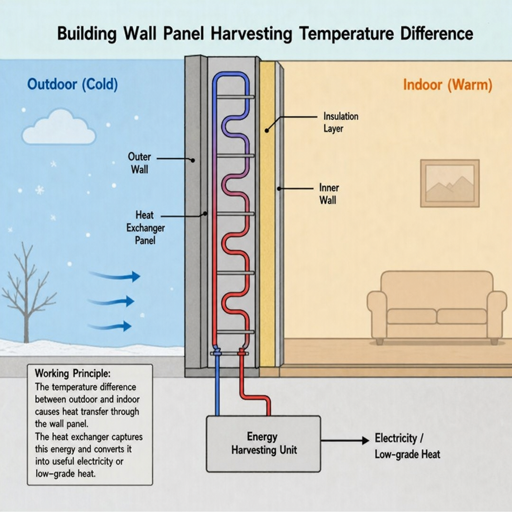
The practical use cases will likely depend on modest power needs. The Tech Xplore report notes that the research team is extending the approach to devices placed between hot and cold air, such as across a wall panel or door, with the goal of generating enough electricity for small electronic devices.
Where heat-to-power cells could make sense
Water-based cells waste heat electricity systems are most compelling where the heat source is steady, nearby, and otherwise unused. They may be especially useful when replacing batteries is inconvenient or when sensors need small amounts of local power.
Potential applications include:
- Building surfaces Walls, windows, roofs, or doors can experience temperature differences between indoor and outdoor air. Integrated thermocell modules might harvest some of that difference for low-power monitoring devices.
- Industrial equipment Pipes, tanks, warm panels, and process equipment often release low-grade heat. Small heat-to-power modules could support local sensors that monitor temperature, vibration, flow, or safety conditions.
- Data centers and electronics Servers and electronic devices produce heat that must be removed. While most of that heat will still need thermal management, energy harvesting could support auxiliary sensing or monitoring.
- Remote sensing systems In locations where wiring or battery replacement is difficult, even small amounts of sustainable electricity can be useful if the device is designed for low power consumption.
- Sun-warmed infrastructure Outdoor surfaces often heat up during the day and cool at night. With the right temperature gradient and device design, some of that thermal energy could be converted into electricity.
What should readers take away from the breakthrough?
The main takeaway is that better measurement can be as important as better materials. The new method does not mean water-based thermocells are suddenly ready to power homes or replace major electricity generation systems. It means researchers now have a clearer way to separate real performance gains from misleading efficiency estimates.
That clarity matters for sustainable electricity. If a technology is going to move from laboratory cells to useful products, designers need to know where energy is going, why performance drops, and which changes actually improve conversion. Directly measuring total heat flux and real electrical output gives the field a stronger foundation for making those decisions.
For businesses, engineers, and energy watchers, the research is also a reminder to read efficiency claims carefully. A high number without test conditions, heat-flow boundaries, or operating details may not say much. The most useful claims explain what was measured, how the device was configured, and whether the results reflect the full system.
A clearer path for water-based energy research
The future of water-based thermocells will depend on practical engineering: controlling heat losses, improving durability, maintaining chemical stability, and integrating devices into real environments. The new method helps by showing which design choices improve operational efficiency rather than apparent efficiency.
That is a necessary step for any serious waste heat recovery technology. Low-grade heat is widely available, but useful electricity generation requires more than a temperature difference. It requires a device that can preserve that difference, move charge efficiently, and minimize heat that bypasses the conversion process.
Water-based cells may ultimately serve as one piece of a broader thermal energy conversion toolkit. Their simplicity, lack of moving mechanical parts, and compatibility with low-temperature heat make them worth watching. With more accurate measurement, researchers can refine the technology in a way that is grounded in real performance, not optimistic assumptions.
The promise is not that every warm surface becomes a power plant. The promise is more practical: small, efficient, sustainable electricity from heat that would otherwise be wasted. And with better testing methods, the path from scientific possibility to useful deployment becomes much easier to see.
