
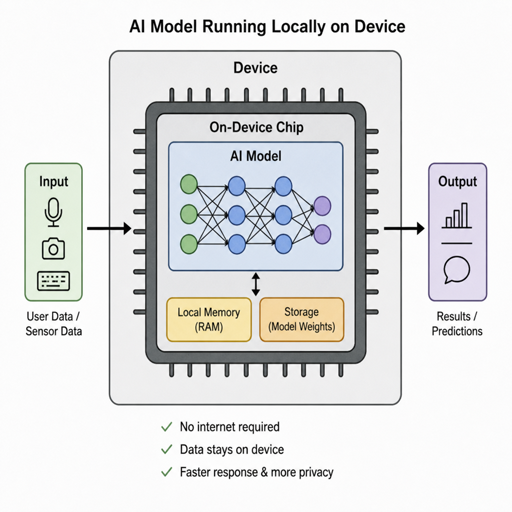
On-device neural engines are specialized computing components that help devices run artificial intelligence tasks locally instead of sending every request to the cloud. They make on-device AI faster, more private, and more responsive by bringing real-time AI processing closer to the sensor, user, machine, or environment where data is created. For product teams, engineers, and technology leaders, understanding how these engines work is becoming essential as edge computing and local AI solutions move from niche features to everyday expectations.
What are on-device neural engines?
On-device neural engines are hardware blocks designed to accelerate machine learning workloads directly inside a device, such as a phone, camera, vehicle, wearable, robot, appliance, industrial controller, or medical instrument. Instead of relying only on a general-purpose CPU or a remote server, the device uses dedicated machine learning hardware to process models locally with lower latency and often lower power consumption.
A neural engine is not the same thing as a full AI application. It is the hardware layer that helps AI models run efficiently. The model may detect objects, recognize speech, classify sensor patterns, estimate depth, enhance images, predict equipment behavior, or personalize user experiences. The neural engine handles many of the math-heavy operations behind those tasks, especially the repeated matrix and vector calculations common in modern neural networks.
This matters because many AI experiences are only useful when they happen instantly. A security camera cannot wait several seconds to identify motion. A vehicle safety system cannot depend on a slow network call. A hearing aid or wearable health device must react continuously and discreetly. On-device neural engines make those experiences more practical by giving embedded AI systems local intelligence.
The shift from cloud-first AI to local intelligence
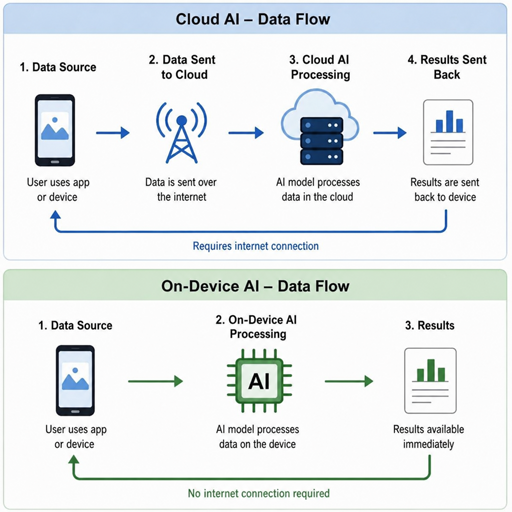
For years, many AI applications depended heavily on cloud infrastructure. A device collected data, sent it to a remote server, waited for inference, and then received a result. That model still works well for large-scale training, deep analytics, content generation, and tasks that require massive compute capacity. But it is not ideal for every use case.
On-device AI changes the architecture. Data can be processed where it is generated, and only the most useful results, summaries, or exceptions need to be sent elsewhere. This is one reason edge computing has become so important: it reduces dependence on constant connectivity and allows systems to keep working in more environments.
The move toward local AI solutions is also driven by user expectations. People increasingly expect their devices to respond immediately, preserve privacy, and function even when the network is unreliable. Businesses want smarter equipment without pushing every data point through expensive cloud pipelines. Developers want to design applications that feel seamless instead of delayed.
Cloud AI and on-device AI are not enemies. In many strong architectures, they complement each other. The cloud can train, update, coordinate, and analyze at scale, while the device handles immediate inference and context-aware decisions. The result is a more balanced system that uses the right computing resource for the right job.
Why real-time AI processing matters
Real-time AI processing is valuable because the usefulness of an AI decision often depends on timing. If an application produces the correct answer too late, the answer may no longer matter. Local inference can reduce the delay caused by network transmission, server queues, and round-trip communication.
Consider a few practical examples:
- Smart cameras: A camera can detect people, packages, vehicles, or unusual motion locally before deciding whether to record, alert, or upload.
- Industrial monitoring: A machine can identify vibration or temperature patterns that suggest a fault before the condition becomes costly.
- Voice interfaces: A device can recognize wake words, filter background noise, or process simple commands without sending every audio clip to a server.
- Automotive systems: Sensors can support driver assistance features that require fast reaction times.
- Healthcare and wellness devices: Wearables can interpret signals continuously while preserving battery life and reducing data exposure.
Latency is only one part of the story. Real-time AI processing also supports reliability. If a device has to wait for cloud access, its intelligence depends on bandwidth, network coverage, and server availability. When AI runs locally, the device can keep performing key functions in remote facilities, moving vehicles, crowded networks, or offline conditions.
The core building blocks of machine learning hardware
Machine learning hardware is designed around the kinds of operations AI models perform most often. Traditional CPUs are flexible and good at handling many different types of instructions. Neural engines, neural processing units, digital signal processors, GPUs, and other accelerators are usually optimized for parallel math, repeated calculations, and efficient data movement.
A typical on-device AI stack may include several layers:
|
Layer |
Role in on-device AI |
Practical impact |
|---|---|---|
|
Sensors |
Capture audio, images, motion, temperature, pressure, or other signals |
Determines the quality and type of input data |
|
Preprocessing |
Cleans, compresses, normalizes, or transforms raw data |
Helps the model work faster and more accurately |
|
Neural engine or accelerator |
Runs model inference efficiently |
Enables fast local predictions with less strain on the CPU |
|
Memory |
Stores model weights, temporary data, and runtime context |
Affects model size, speed, and power use |
|
Software runtime |
Connects the model to the hardware |
Helps developers deploy and optimize models |
|
Application logic |
Decides what to do with the model output |
Turns prediction into a user-facing feature or automated action |
The best results come when these layers are designed together. A powerful accelerator may still perform poorly if the model is too large, memory access is inefficient, or the software runtime is not optimized. Likewise, a compact model can feel surprisingly capable when it is matched with the right hardware and product design.
This is why successful embedded AI systems are not built by simply dropping a model onto a device. They require trade-offs between accuracy, latency, power, cost, heat, memory, privacy, and update strategy.
How do on-device neural engines improve privacy?
On-device neural engines can improve privacy by reducing the amount of raw personal or operational data that needs to leave the device. When inference happens locally, sensitive inputs such as voice, images, location patterns, biometric signals, or industrial data may be processed into useful outputs without being continuously transmitted to external servers.
This does not automatically make a product private. Privacy still depends on the full system design, including what data is collected, how it is stored, how long it is retained, whether users have control, and how updates are handled. However, local processing gives designers a powerful privacy-friendly option: process more data near the source and share less by default.
For example, a smart home device might detect a wake word locally, then activate cloud-based services only after the user requests something more complex. A factory sensor might analyze machine conditions locally and send only an alert or trend summary instead of constant raw telemetry. A camera might blur, classify, or filter content on-device before anything is saved or transmitted.
This privacy advantage is especially relevant in products that operate in personal spaces, regulated environments, or sensitive business settings. When combined with clear user controls and responsible data practices, on-device AI can help create experiences that feel intelligent without feeling invasive.
The performance benefits go beyond speed
Speed is the easiest benefit to understand, but it is not the only reason on-device neural engines matter. Local acceleration can also support energy efficiency, scalability, resilience, and cost control. These benefits are often connected.
A device that processes AI locally may avoid sending large amounts of data over a network. That can reduce bandwidth use and cloud compute costs. It may also conserve energy, especially when the neural engine is optimized for the specific workload. In battery-powered products, those savings can affect whether an AI feature is practical at all.
Local AI also scales differently from cloud-only systems. If every device sends every inference request to a server, growth can increase backend load dramatically. If each device handles routine inference on its own, the cloud can focus on updates, aggregated insights, exception handling, and heavier analysis.
Key performance-related advantages include:
- Lower latency: Decisions happen closer to the input source.
- Reduced bandwidth demand: Devices can transmit results instead of constant raw data.
- Better offline behavior: Core features can keep working without uninterrupted connectivity.
- Lower recurring infrastructure pressure: Routine inference may not need constant server-side compute.
- Improved responsiveness: User interactions feel more immediate and natural.
- Power-aware operation: Specialized hardware can run certain models more efficiently than general-purpose processors.
These advantages are not guaranteed in every design. A poorly optimized model can still drain a battery or create heat. A local AI feature can still feel slow if memory movement is inefficient. But when hardware, software, and model design are aligned, on-device neural engines can make AI feel built into the product rather than bolted onto it.
Common use cases for embedded AI systems
Embedded AI systems are showing up anywhere a device needs to sense, interpret, and respond. Some use cases are visible to end users, while others operate quietly inside machines, infrastructure, and business equipment.
In consumer electronics, on-device neural engines support camera enhancements, voice features, translation, handwriting recognition, accessibility tools, personalization, and health-related insights. The user may not think about the hardware behind these features; they simply notice that the device responds quickly and adapts to their context.
In industrial and commercial settings, embedded AI systems can inspect products, monitor equipment, manage energy use, support worker safety, and detect anomalies. These environments often benefit from local processing because they may generate large volumes of sensor data that would be inefficient to transmit continuously. Local inference allows the system to flag important events while ignoring normal noise.
In transportation, local AI can help interpret camera, radar, lidar, audio, and motion data. In agriculture, edge devices can monitor crops, soil, irrigation, pests, or equipment. In retail and logistics, smart scanners, cameras, and handheld devices can support inventory, checkout, routing, and quality control.
The unifying theme is context. On-device AI is most valuable when the device has immediate access to real-world signals and can turn those signals into timely action.
Design trade-offs teams need to understand
Building with on-device neural engines requires choices. More accuracy may require a larger model. A larger model may require more memory, more power, or a more capable accelerator. A cheaper chip may limit model complexity. A privacy-first design may reduce cloud visibility. A fully offline product may need a more careful update process.
Teams should think about these trade-offs early, not after the product architecture is locked. The right question is not simply, “Can this model run on the device?” It is, “Can this model run on the device within the limits of the user experience, battery, heat, cost, reliability, and maintenance plan?”
A practical evaluation checklist includes:
- Latency target: How fast does the system need to respond for the feature to feel useful or safe?
- Power budget: Will the AI workload run continuously, occasionally, or only after a trigger?
- Model size: Can the model fit within available memory and storage constraints?
- Input quality: Are the sensors accurate and consistent enough for reliable inference?
- Connectivity assumptions: What must work when the device is offline or on a weak network?
- Privacy requirements: What data can be processed locally, stored, transmitted, or discarded?
- Update strategy: How will models, thresholds, and software improve after deployment?
- Fallback behavior: What happens when confidence is low or conditions are unfamiliar?
These questions help prevent a common mistake: treating AI as a feature that can be added late. In reality, effective local AI solutions require product, hardware, software, data, and user experience decisions to work together.
What makes a good local AI solution?
A good local AI solution solves a clear problem on the device, within real operating constraints, without making the product harder to use or maintain. It is not defined by having the largest model or the most impressive technical demo; it is defined by whether local intelligence improves the experience in a measurable, practical way for the user or operator.
Strong solutions often start with a narrow, valuable task. For example, instead of trying to understand every possible scene, a device might only need to detect whether a specific condition is present. Instead of sending every sensor reading to the cloud, it may only need to identify exceptions. Focus makes optimization easier and improves reliability.
A good local AI solution also has a clear confidence strategy. AI models produce predictions, not certainty. Product teams need to decide what the system should do when confidence is high, moderate, or low. In some cases, the device can act automatically. In others, it should ask for user confirmation, save an event for review, or escalate to a cloud service.
The best implementations feel quiet and useful. They reduce friction, shorten response time, protect sensitive data, or make a device more capable in places where cloud access is limited. They also give users appropriate transparency, especially when AI affects safety, privacy, or important decisions.
Model optimization is where theory becomes product reality
Many AI models are developed in environments with more compute power than a small device can provide. To run effectively on-device, models often need to be optimized. This may involve reducing model size, simplifying architecture, compressing weights, quantizing numerical precision, pruning unnecessary parameters, or using a model designed specifically for edge computing.
Optimization is not just about making a model smaller. It is about preserving enough accuracy while meeting real product constraints. A tiny model that is fast but unreliable may not be useful. A highly accurate model that overheats the device or drains the battery may also fail in practice.
Common optimization approaches include:
- Quantization: Using lower-precision numbers to reduce memory use and speed up calculation.
- Pruning: Removing parts of a model that contribute little to output quality.
- Distillation: Training a smaller model to mimic a larger model’s behavior.
- Efficient architectures: Choosing model designs built for mobile, embedded, or edge environments.
- Input reduction: Processing only relevant frames, regions, signals, or time windows.
- Trigger-based inference: Running heavier AI only after a lightweight detector identifies a likely event.
The most effective approach depends on the product. A smart speaker, inspection camera, wearable, drone, and industrial sensor may all use on-device neural engines, but their constraints differ. The optimization process should reflect the environment where the device will actually operate.
Edge computing creates a larger system around the device
Edge computing is often described as moving computation closer to where data is created. On-device neural engines are one piece of that broader idea. They allow individual devices to make fast local decisions, while nearby gateways, local servers, or cloud platforms may handle coordination and larger workloads.
This layered approach can be powerful. A camera may detect events locally, an edge gateway may combine information from multiple cameras, and the cloud may analyze long-term trends. A manufacturing line may use machine-level AI for immediate control and plant-level analytics for performance improvement. A fleet of devices may run local inference while receiving periodic model updates from a central system.
Thinking in layers prevents overloading any single part of the architecture. The device does not need to do everything. The cloud does not need to do everything. Each layer should handle the work it is best suited for.
For teams planning an AI-enabled product, this means architecture matters as much as model selection. The right balance between device, edge, and cloud can improve performance, cost, privacy, and reliability at the same time.
Where do cloud AI and on-device AI work best together?
Cloud AI and on-device AI work best together when local systems handle time-sensitive inference and cloud systems handle scale, learning, coordination, and complex analysis. This hybrid approach lets products respond quickly in the moment while still improving over time through broader data, model updates, and centralized management.
A simple pattern is local detection plus cloud enrichment. A device identifies that something important happened, then sends a compact event to a cloud service for deeper interpretation or long-term storage. Another pattern is local personalization plus cloud-based updates, where the device adapts to a user or environment while the cloud distributes improved models.
Hybrid designs can also improve resilience. If the network is available, the system can use cloud resources for richer features. If connectivity drops, core local functions still work. This is often more user-friendly than a design that fails completely when the network is weak.
The key is to avoid unnecessary data movement. Teams should ask what truly needs to leave the device, what can be summarized, and what can be discarded after local processing. That discipline can make AI systems faster, leaner, and more respectful of user expectations.
Practical steps for teams exploring on-device AI
Teams do not need to begin with the most complex AI vision. A practical path starts with a focused use case, clear constraints, and a small prototype that proves whether local processing adds value. From there, the work can expand into optimization, testing, deployment, and maintenance.
A useful development path looks like this:
- Define the decision the device must make. Be specific about the input, output, and action.
- Set success constraints. Include latency, power, memory, accuracy, privacy, cost, and offline needs.
- Choose the right hardware class. Match the workload to available machine learning hardware rather than assuming one chip fits all cases.
- Prototype with representative data. Use data from real environments, not only clean lab samples.
- Optimize the model for the device. Test speed, memory, heat, and battery behavior together.
- Design for uncertainty. Decide how the product handles low confidence, edge cases, and sensor noise.
- Plan updates from the beginning. AI systems need a safe way to improve after deployment.
- Test the full experience. Evaluate whether the feature feels useful, trustworthy, and understandable.
This process keeps the team focused on product value rather than AI novelty. It also helps reveal whether a task should run fully on-device, partly at the edge, or mostly in the cloud.
The future is more personal, responsive, and distributed
On-device neural engines are helping AI become less like a remote service and more like a built-in capability. As hardware improves and models become more efficient, more devices will be able to interpret context, react quickly, and support users without constant cloud dependence.
This does not mean every device will become autonomous or every workload will move local. Large-scale AI systems will still rely on data centers for training, coordination, and heavyweight computation. But the balance is shifting. More intelligence will live inside the products people carry, wear, install, drive, and depend on.
For businesses, this shift opens opportunities to design faster, more resilient, more privacy-aware products. For developers, it creates new constraints and new creative possibilities. For users, it can mean technology that feels more immediate and less intrusive.
The important takeaway is simple: on-device AI is not just a hardware trend. It is a product design shift. When on-device neural engines, edge computing, optimized models, and thoughtful software come together, AI can move closer to the real world—and become more useful because of it.
